 Eurasia Press & News
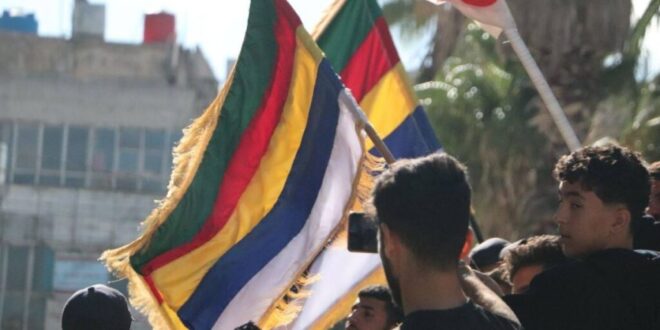
The city of Suwayda (in southern Syria) is witnessing security tensions following an arrest campaign that has targeted figures opposing the spiritual leader of the Druze community, Sheikh Hikmat al-Hijri.
Enab Baladi’s correspondent reported that National Guard forces, which are backed by Sheikh al-Hijri, carried out arrests in the province starting on Friday evening, 28 November. Those detained include the two Druze sheikhs Raed al-Metni and Marwan Rizk, as well as Asim Abu Fakhr, Ghandi Abu Fakhr, and another man from the al-Safadi family.
Videos circulated on social media, shared by activists, show scenes of torture and humiliation of Sheikh al-Metni, including shaving his moustache and verbally abusing him.
The local network “Suwayda 24” reported today that the National Guard deployed checkpoints at main entrances and roads in parallel with the arrest campaign.
Suwayda 24 confirmed that the total number of detainees stands at five people, naming Raed al-Metni and Asim Abu Fakhr among them, while not identifying the other detainees.
The network said it contacted relatives of one of the detainees, who said they were surprised by the news and were making phone calls to find out the reasons, noting that the motives behind the arrests remain unknown so far.
The National Guard has not issued any clarification regarding the reasons or motives for the arrests.
By contrast, accounts supportive of the National Guard claimed that the arrests were prompted by an alleged coup attempt the detainees were planning against Sheikh al-Hijri.
Maher Sharaf al-Din, a media figure close to al-Hijri, said that those detained had been planning to carry out security operations in Suwayda, citing what he described as “exclusive sources” without naming them.
According to Sharaf al-Din, these operations included assassinations of certain leading figures, car bomb attacks, and the planting of explosive devices in public and crowded places.
After the Suwayda events
The National Guard is an armed formation announced on 23 August with the blessing of Sheikh al-Hijri, bringing together several factions operating in Suwayda.
The formation came after more than a month of tensions in the province between local factions in Suwayda on one side and government forces and Bedouin tribes on the other.
The Suwayda events began on 12 July, when mutual kidnappings broke out between residents of the al-Maqous neighborhood in Suwayda city, which has a majority Bedouin population, and several members of the Druze community. The situation escalated the following day into armed clashes.
The Syrian government intervened on 14 July to end the conflict, but its intervention was accompanied by violations against Druze civilians, prompting local factions to respond, including factions that had previously coordinated with the Ministries of Defense and Interior.
On 16 July, government forces withdrew from Suwayda after being targeted by Israeli airstrikes. Their withdrawal was followed by violations and acts of revenge against Bedouin residents of the province, which in turn prompted the dispatch of military convoys in the form of “tribal mobilizations” in their support.
Subsequently, the Syrian government and Israel reached a US mediated agreement providing for a halt to military operations.
Ongoing clashes
Despite the truce, limited clashes have continued between the two sides, coupled with mutual accusations of violating the ceasefire.
On 25 November, local factions in Suwayda targeted an Internal Security checkpoint belonging to the Syrian Interior Ministry in the western countryside of the province.
The factions attacked the Bard checkpoint in Bard village (in the western countryside of Suwayda), which is the first village in Suwayda province, east of the city of Bosra in Daraa province.
The attack on the checkpoint left one Internal Security member dead and two others wounded, according to Enab Baladi’s correspondent, who noted that the checkpoint had been considered a humanitarian crossing point and was not involved in military operations.
For its part, the National Guard issued a statement saying that what it called “gangs affiliated with the Damascus government,” stationed in the villages of Rima Hazem and al-Mansoura (in the Suwayda countryside), carried out a new breach of the truce on Tuesday evening.
According to the statement, the attack involved five drones, in addition to heavy and medium machine guns, targeting the western sector around the villages of Salim and Atil (in the Suwayda countryside) and the international highway, including the homes of “peaceful civilians.”
The Guard said the attack resulted in the death of one civilian and several injuries, adding that its forces “responded to the situation immediately.”