 Eurasia Press & News
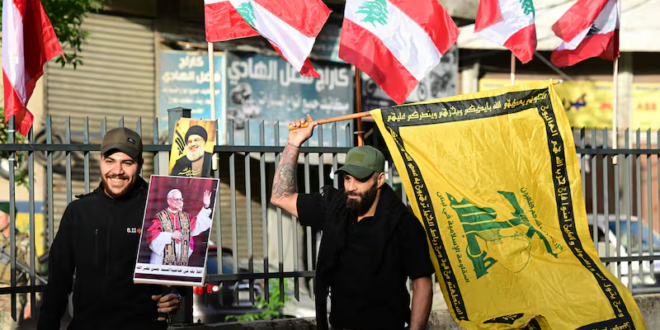
Chaos erupted among government agencies in Iraq on Thursday after Lebanon’s Hezbollah and Yemen’s Houthis appeared briefly on a list of terrorist groups facing sanctions, before it was quickly retracted.
A terrorist listing would be a surprise move against Iranian allies with connections in Iraq. The Official Gazette published on the Justice Ministry website, dated November 17, listed the two groups among organisations accused of terrorism and financing extremism.
It said the decision was based on a confidential report submitted by the Anti-Money Laundering and Counter-Terrorism Financing Office at the Central Bank of Iraq. The Gazette publishes government decisions and new legislation.
Iraq was “freezing the movable and immovable assets and economic resources” belonging to the listed individuals and organisations, it added. Hezbollah and the Houthis had “taken part in a terrorist attack”, it said, without giving details.
After news of the listing spread, the central bank said it “did not approve the freezing of those entities’ funds, which was apparently published in error”. It asked the government to remove the two lists in which Hezbollah and the Houthis are mentioned.
A letter from the acting deputy governor of the Central Bank, Ammar Khalaf, asked the Committee for the Freezing of Terrorists’ Funds to delete the clause containing the names. The letter was given to The National.
“We are calling for a statement to clarify this stance, to rectify the clause and to publish the corrected stance in the Gazette,” it said.
Later on Thursday, the Gazette was removed from the Justice Ministry website.
Heightened tension
The developments are likely to increase tension between Iraqi Prime Minister Mohammed Shia Al Sudani, who is seeking a second term in office after elections in November, and the Tehran-allied militias and political parties accusing him of leaning too much towards Washington.
There was speculation that Thursday’s chaos might have been linked to the delicate coalition talks. Hezbollah and the Houthis are allied to Iran and to Tehran-backed Shiite political parties and armed factions in Iraq.
The US has been working to cut off funding to Hezbollah and the Houthis, imposing sanctions on those accused of making financial transactions on their behalf.
Mr Al Sudani ordered an inquiry into the matter on Thursday. “The investigation will hold those responsible for the error contained in the decision of the Committee for Freezing Terrorist Funds,” his office said.
He said Iraq has approved freezing the funds only of organisations tied to ISIS and Al Qaeda. “Our government will not compromise its stance when it comes to Lebanon and the Palestinians,” he said.
‘Scapegoat’
One of the several security and civilian officials affiliated to different government ministries and departments who is a member of the committees concerned defended the procedure.
“Our procedure is 100 per cent sound and based on the Anti-Money Laundering and Counter-Terrorism Financing Law,” the official told The National.
“We deal with all requests that come from local security or judicial authorities and the foreign parties like the UN Security Council, and take our decision unanimously.
“The decisions are not taken by one employee or department but there are representatives of several ministries and offices and the decisions and lists go to these different departments to have their stamps and signatures.”
Al Ahad TV, linked to a powerful armed faction called Asaib Ahl Al Haq, revealed the names and some photos of senior security officers and government officials on the committees involved. Such a move is regarded by the official as a threat, forcing him to flee his house.
“It is obvious that the government is under immense pressure from these groups and we are afraid that we will be the scapegoat,” he said.
‘Stab in the back’
The PM’s statement failed to placate Tehran-allied political parties and armed groups, with some taking to the streets in Baghdad and other provinces to protest against the listing.
Some paraded in cars and waved Hezbollah’s yellow flag, and honked their horns while upbeat songs praising the militias blared loudly from the vehicles.
“If loving these people is terrorism, then I am the first terrorist,” read a banner with pictures of late Hezbollah leader Hassan Nasrallah and Houthi chief Abdul Malik Al Houthi, which was held by a protester in Baghdad’s Tahrir Square.
“It’s a stab in the back,” a senior paramilitary leader connected to an influential faction told The National. “We expect anything from Al Sudani to make America happy, as he thinks that they can pave the way for him to win a second term.”
Immediately after spreading the news, Hezbollah had sought clarification from the Iraqi government through “private channels”, he added.
“We don’t see it as a mistake,” he said. “The government thought it would go unnoticed but later when it saw the mounting public pressure it backed down.”
Walking a tightrope
After the 2003 US-led invasion that toppled Saddam Hussein, Hezbollah has strengthened ties with Iran-backed political parties and militias in Iraq. It gained enough influence to have a say in forming successive governments, and both Hezbollah and the Houthis have representatives in Iraq.
Since taking office in late 2022, Mr Al Sudani has walked a tightrope under US pressure to rein in and disarm Iranian proxies in Iraq.
In August, the government withdrew a contentious draft law regulating the country’s Shiite-dominated paramilitaries, known as the Popular Mobilisation Forces, under pressure from the US and other powers.
The bill proposed restructuring and widening the powers of the PMF. The US said the law could have undermined Iraq’s sovereignty and entrenched Iranian influence in the political and security realm.
Thursday’s developments come as Mr Al Sudani faces widespread anger from Iran-backed militias and their supporters after US President Donald Trump announced the Iraqi Prime Minister had nominated him for the Nobel Peace Prize.
During his first term in office in January 2020, Mr Trump ordered the drone strike that killed Iranian Quds Force commander Qassem Suleimani and PMF de facto leader Abu Mahdi Al Muhandis, along with several comrades in Baghdad.
It is believed that the apparent listing had angered Iran-linked Iraqi political factions who pressured the government to retract its move, an Iraqi politician told The National.
“Everything in Iraq has a political motive behind it, even though the decision has been issued and printed by the official Gazette means it is an official government stance,” he said. It comes at a delicate time when the country is undergoing a complex government formation process.
Most likely the chaos was triggered by “individuals associated with the Co-ordination Framework who have close ties with Hezbollah, the Houthis and Iran”, the politician said.
“It also signals that Iraq is siding with Israel. We can say this is a form of a political conflict especially as the government is being formed.”
The Co-ordination Framework is an alliance of the main Shiite parties that are ruling Iraq and have won a considerable amount of seats in Parliament during last month’s elections.
“This represents an unprecedented development in Iraq’s political landscape and can be interpreted as part of Baghdad’s broader effort to improve relations with the US and alleviate mounting pressure,” prominent activist Ali Al Mikdam said.
However, the practical implementation of this decision appears limited, suggesting that it may remain largely a formal measure rather than a fully actionable policy, Mr Al Mikdam said.
But the move could lead to consequences as Hezbollah maintains structural and political ties with powerful Iraqi militias, he added.
“Designating Hezbollah as a terrorist organisation carries substantial risks and could trigger internal tensions with the potential to escalate into more serious confrontations,” he said.