 Eurasia Press & News
The Syrian-Iraqi border is witnessing a new phase characterized by strategic competition and ideological disparity, and its importance goes beyond being just a bilateral border to turn into a geopolitical hotbed of tension that is likely to influence the future regional landscape. Despite the current relative calm, this stability remains circumstantial, while the potential for tension or escalation—according to internal developments in the two countries or regional and international transformations—remains evidently high.
The Syrian-Iraqi border has entered a new phase in its modern history, as the transformations in the Syrian scene, following the change of the former regime and the rise of the Headquarters for the Liberation of Al-Sham to the forefront of power, led to a new border reality in which multi-directional and contradictory forces meet ideologies. This shift is different from what the border has known for decades, when it was relatively stable under two Baathist regimes until 2003, before gradually moving into the Iranian sphere of influence after the outbreak of the Syrian crisis in 2011. Although these borders, to date, retain a degree of calm and fragile stability, the features of the tension inherent in them raise indications of the possibility of escalation at any moment, making it a sensitive test point for the coming geopolitical landscape in the Middle East.
Critical Borders and Fragility Roots
The fragility and instability of the borders are due to the conflicts formed during the new millennium, but they are in fact rooted and rooted during the Baath regime of the two countries, in which government institutions contributed in the framework of their attempts to circumvent the sanctions imposed on them, especially after the 1990s and early century, when the economic crisis in Iraq intensified, and its international isolation increased, prompting the Iraqi and Syrian regimes to tolerate smuggling networks, which were widely practiced, and in certain cases the state was sponsoring illegal commercial activity, especially in trade, which includes livestock, oil, electronics, tobacco and fuel.
This role of border under the auspices of the state has been a decisive factor in its future instability, and even in the development and adaptation of these networks, as Baathist governments have provided the necessary and well-established infrastructure for smuggling, cross-border relations, and logistics for ongoing illegal activity. This structure was later used after the 2003 U.S. war on Iraq to facilitate the passage of fighters and elements of terrorist organizations from Syria to Iraq, which spread significantly in areas of the Baghdad and Anbar belts, and was quickly employed and used for its purposes in smuggling weapons and elements, and this continued when ISIS crossed the border and linked territory from Syria and Iraq within the so-called “caliphate.”
After the outbreak of the Syrian crisis and the tightening of sanctions on the regime, the latter benefited from the fragility of the Syrian-Iraqi border and employed it primarily to ensure the economic survival of the regime, similar to smuggling during the 1990s and before, with a major difference; the dependence of smuggling during this stage on narcotics and Captagon pills, Syria has become a regional center for drugs, as production processes and smuggling methods have developed, to reach the value of this industry about one billion dollars, and provide a basic financial resource, enabling the pro-regime to bypass sanctions, finance militias, and maintain their grip on power.
In doing so, that history formed the basis for the flourishing roles of organizations and non-state actors, but the Syrian crisis in 2011, and then the intervention of Iran and its proxies in 2012, has exacerbated the fragility of the border, and the actors are no longer active on both sides, but also control the vital nodes and strategic areas.
Vital nodes and strategic areas
With the outbreak of the Syrian crisis in 2011, and the intervention of Iran and its proxies directly and intensively, the scene of the Iraqi-Syrian border has shifted, and its functions have also shifted, with Iran’s increasing influence in the Syrian arena, and its use of Syrian geography as a major axis in the military and logistical supply operations to Hezbollah in Lebanon. Tehran has intensified the operations of passing and smuggling weapons through Iraq to Syria to Lebanon, which applies to its proxies, who began with the outbreak of the Syrian crisis by practicing roles and activities across the border, with the intervention of Hezbollah and Iraqi armed factions in the fighting in Syria.
With this intensity, cross-border activity has taken on a geopolitical strategic dimension, no longer limited to arms or elements smuggling, but has been seen as a key area of Iran’s strategic land corridor, which has provided a reliable supply line for Iranian military and financial assets throughout Iraq, Syria and even Lebanon, and directly supported proxies such as Hezbollah.
This corridor witnessed several transformations, as it represented three tracks at the beginning, a road linking northern Iraq to northern Syria through the Rabia crossing between the provinces of Nineveh and Hasaka, before the United States cut it off by deploying its forces in the areas of eastern Syria, and a second road from southern Iraq to southern Syria through the Al-Tanf crossing, and the United States also cut it with the establishment of the “Al-Tanf garrison” in 2014, to settle on the middle corridor, through the Al-Qaim/Al-Bukamal crossing, located on the main highway linking Damascus and Baghdad.
Iran-backed Iraqi factions have played a pivotal role in securing the corridor, bolstering their presence significantly in northwestern Iraq and pushing their units toward key locations such as Tal Afar Airport, a strategic city on the road from Mosul to Sinjar. The supply route was passing through the south of Mount Sinjar to Syria, towards the cities of Deir ez-Zor and Mayadeen.
The state of the border after regime change
The change of the Syrian regime has led to a period of uncertainty, as Iraqi security concerns have increased from the resulting vacuum in eastern Syria, and from the cost of unilaterally protecting the border, especially since those fears were accompanied by the rise of HTS to power, and the activity of its former leader in Iraq within the ranks of Al-Qaeda and ISIS, which recalled the events of 2014, when ISIS took control of large areas of the two countries until 2018.
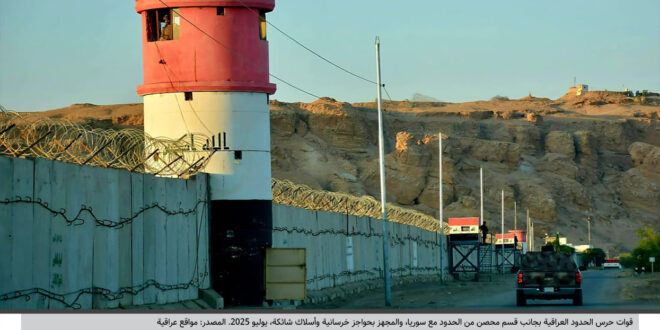
This change was therefore a source of concern for Iraqi leaders, and specifically for Shiite political forces, which prompted Baghdad to focus on the internal security dimensions in its response to the change in Syria. In late November 2024, the government intensified the deployment of the Iraqi army along the border, and accelerated the construction of the concrete wall along the 400-kilometer border, which was completed in June 2025. In its approach to the Interim Authority in Damascus, Baghdad was quick to adopt a proactive security approach, which was reflected in the visits of high-level Iraqi security delegations to Damascus, which began with the visit of the head of the Iraqi intelligence service, Hamid al-Shatri, and his meeting with Ahmed Shari on December 26, 2024, and then his second visit on April 25, 2025, and focused on the files of border security and counter-terrorism.
After the closure of the Al-Qaim/Albukamal border crossing in late December 2024, it reopened in mid-June 2025, and the immediate objectives were humanitarian: to facilitate the return of Iraqis stranded in Syria and Syrian refugees to Iraq, and then economically, to the vital role of the border in the commercial movement needed by the local markets in the two countries, and the opening of the border has been delayed since Baghdad announced its intention to achieve this in January 2025, to ensure that the transitional Syrian government can effectively manage this crossing.
Dynamics of control and strategies of actors
The Syrian-Iraqi border is currently divided into separate sectors of control, shared by five parties with conflicting objectives and multiple agendas, and these official parties are the Syrian Interim Government and the Iraqi Government, along with two sub-state actors: the Iraqi armed factions and the Syrian Democratic Forces, in addition to an active US military presence.
On the official side, the Syrian Interim Government faces the complex task of consolidating its internal legitimacy and central authority, and the borders are directly linked to its authority and control over resources, including customs and tax resources, which requires the transformation of border crossings into engines of economic growth, in addition to showing sovereignty over the entire Syrian geography. Moreover, the border is linked to the government’s ability to prove its regional efficiency, in terms of controlling it and limiting cross-border drug and arms smuggling. Syrian security forces and the army have carried out campaigns against drug trafficking, raiding production facilities and confiscating large quantities of them. However, the interim government faces complex challenges, with effective government control over the entire Iraqi border remaining limited. While it controls the central Qaim/Albukamal region, the northeast is completely out of the control of the interim government, and smuggling networks rooted for decades limit the possibility of achieving total security over the areas they control from the border.
On the other hand, Iraq focuses on the security dimension of combating ISIS, despite the defeat of the organization, its threat is still present, especially after it regained part of its activity in Syria with regime change, exploiting the security vacuum and its previous relations with elements and leaders of Hay’at Tahrir al-Sham. On the other hand, Baghdad is trying to balance between security concerns and American pressure not to pass the Popular Mobilization Forces Law and impose sanctions on factions belonging to the crowd and demand the dissolution of the factions forming it, and where these pressures come at a time when the crowd is spreading in locations of the border, Baghdad fears the repercussions of any US decisions or measures on border security.
Moreover, many Iraqi armed factions are active in positions from the border, and reports indicate that they are still trying to use illegal corridors with the aim of smuggling weapons and elements into Syria for Iran. According to press reports, citing Syrian officials, Damascus has deployed about 3,000 troops along the border to deter infiltration attempts from Iraq, especially in the wake of Israeli military operations against Iranian capabilities in June 2025. Such publication is an Iraqi interest, to maintain channels of communication that contribute to avoiding any escalation or suspicious movements from both sides of the border.
On the other hand, the Syrian Democratic Forces (SDF) control the far north of the border from the Syrian side, and run the Simalka/Fishakhabur crossing in the north-eastern province of Rojava, and is managed by the Kurdistan Regional Government from the Iraqi side. On March 10, 2025, it reached a preliminary agreement, with US support, with the Syrian Interim Government, providing for the integration of civilian and military institutions, including border crossings and oil fields. However, the SDF has so far maintained control of the crossing, which is the only way for autonomous areas with the outside.
The future of the Semalka crossing management is linked to the path of negotiations between the interim government and the SDF, whose collapse would keep the northern part of the Syrian-Iraqi border permanently separate from government control, which means preserving its functions as a humanitarian and economic crossing, which is a major supply route for the resources and goods needed by the Autonomous Administration in its areas of control.
The geopolitical landscape on both sides of the border
The Iraqi and Syrian sides have shown the ability to manage the border effectively, with Baghdad’s pragmatic policy focused on overcoming its fears and doubts about the roots and background of the Syrian Interim Government, and focusing on the security aspects, especially in preventing ISIS from exploiting the vacuum on the Syrian side, by strengthening its activity on the border and in the adjacent areas, as well as in preventing Iranian-backed armed factions from maintaining their activity on both sides of the border, similar to the situation that existed before regime change.
However, the current emerging situation on the border can be one of the most significant future geopolitical tensions in the region. The deployment of the Syrian army, whose main nucleus is formed by HTS, on the border, in exchange for the spread of the popular crowd on the other side, albeit in a limited way as the Iraqi army strengthens its deployment, means that security and stability on the border remains subject to the fundamental ideological disparity between the two parties, and the tension and escalation with any possible change or influence.
On the one hand, Jabhat al-Nusra, which later became HTS, was founded with the main objective of fighting against the former Syrian army and its Iranian backers and proxies, and it is doubtful that their access to power will lead to a change in their references, extremist ideas and the reasons for their formation, so that the government seeks to show an unprecedented regional and international openness, especially towards Israel, with which it is likely to sign a security agreement soon, as well as towards Russia, which participated mainly through air strikes in the former regime’s campaign against the armed opposition, including Hay’at Tahrir al-Sham, where Syrian President Ahmed al-Sharaa visited and met with Russian President Vladimir Putin on October 15, 2025. However, the interim government still takes an opposition position from Iran and its proxies, as their original enemy, and holds them responsible for what it describes as the internal rebellion in the Sahel, especially the role of Hezbollah in the events of March 6-10, 2025.
On the other hand, the popular crowd was formed in the wake of the rise of ISIS and its control over a large geography of Iraq, and its formation came under a legal fatwa issued by the religious authority Ali al-Sistani on June 13, 2014. Where the new authority in Syria is linked to the contexts that required the fatwa, especially the same Sharia, which was previously detained in four Iraqi prisons, including Abu Ghraib and the US “Buka camp” in Iraq, as a member of al-Qaeda, before moving to Syria to establish a branch of the organization there by order of “Abu Bakr al-Baghdadi.” This background, which was announced to be separated from it, remains present in the Iraqi mentality, and where the popular crowd adhered to the government’s decision not to interfere in the clashes that preceded regime change in Syria, but Iraq, according to the head of the crowd, Faleh al-Fayyad, cannot “turn a blind eye when Syria is controlled by terrorist groups.”
Thus, the Iraqi-Syrian border is likely to be dragged into long-term tensions, which may escalate into a state of conflict with the local conditions of the two countries or regional countries, especially since, in the short and medium term, they represent the most likely ground for indirect confrontation between Iran and the United States and its partners, driven by Iran’s need to create a turmoil that restores its influence that it lost after the war in the Gaza Strip, as well as in light of the tightening of the United States measures aimed at containing Iran’s proxies in the region, especially in Iraq.
Finally, it can be said that the Syrian-Iraqi border has entered a new phase characterized by strategic competition and ideological contradiction, and it exceeds its importance as a bilateral border, insofar as it is considered a new geopolitical hotbed in the future regional scene, maintaining its current calm and stability is a local issue, and its susceptibility to tension and perhaps escalation, according to local changes in the two countries or regional and international transformations, is a highly incoming issue.