 Eurasia Press & News
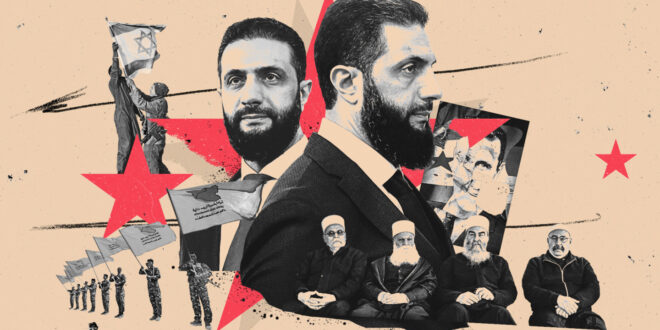
If the new government can deliver justice, contain sectarian tensions, and foster equitable rebuilding, Syria will begin charting a path towards a better future
Damascus, Syria – On the night of the 8th of December 2024, Assad fled his presidential palace aboard a Russian military helicopter. In just 11 days, the house of cards he had fought for more than a decade to protect had come crumbling down.
Damascus’ streets soon flooded with crowds revelling with glee. At the same time, desperate groups of Syrians also thronged the country’s many prisons and mortuaries. Syria, a year ago, was a country in simultaneous euphoria and shock. These families were searching for their loved ones who ‘disappeared behind the sun’ of Assad’s gulag archipelago.
Medeha has been looking for her 23-year-old son, Mohammed, since the day of the liberation after she found a photo of him in the Caesar Families Association database of murdered prisoners.
She, like many others, desperately scoured prison branches and mortuaries for evidence of what happened to Mohammed. She never found out the truth. A year on, almost all the families are still searching.
In May, President Ahmed Al-Sharaa formed the National Commission for the Missing, tasked with bringing to light the fates of hundreds of thousands of missing people, but a year on from the fall, the commission is yet to identify any missing individuals, according to Zeina Shahla, the spokeswoman for the commission.
“The commission is currently focused on setting up the ground for the work in the years to come,” she explained to The New Arab, with the first priority being the creation of a national database for the missing.
An issue as vast as Syria’s missing people certainly can’t be solved in a year, but for the families, progress is about more than just bringing them closure. It is a question of justice.
“We want justice,” demands Medeha. “Many of us know who was responsible for our loved ones’ disappearances. Many [of the perpetrators] still walk free.”
Genuine justice for the crimes of the regime still appears distant. Al-Sharaa also formed a Commission for Transitional Justice in May. However, the new government has been criticised for opaque ‘settlement deals’ the government has been making with several Assad-era cronies that have allowed many to walk free in return for surrendering large portions of their ill-gotten gains.
Despite this, there are some signs that Assad’s period of impunity may be coming to an end. In November, Syria held its first public trials for 14 individuals accused of complicity in a wave of violence that erupted on Syria’s coast in March.
Half of those on trial were individuals linked to insurgent groups that launched a coordinated uprising against the government. The other half were members of the government’s security services who had been sent to put down the uprising and subsequently took part in the massacre of 1,400 mostly Alawite civilians.
Syria has witnessed widespread sectarian violence over the last year, with the government’s frequent complicity “eroding public trust in a war-weary society”, argues Nanar Hawach, a Senior Analyst at the International Crisis Group.
Following the coastal massacres in March, a suicide bombing targeted a Christian congregation during prayers in Mar Elias church in the Damascus neighbourhood of Dweila in June, killing 25. The government would attribute the attack to the Islamic State (IS), despite another Sunni Islamist group, Saraya Ansar Al-Sunna, claiming responsibility.
Sectarian violence also erupted in the southern region of Suweida in July, between the Bedouin and the Druze. A government intervention brought another wave of bloodshed targeting the Druze, which itself triggered an Israeli intervention ostensibly to “protect” the Druze. The government was forced to withdraw under withering Israeli airstrikes, with Israel prohibiting any further deployment of military forces in the region.
Since July, Suweida has become increasingly dominated by the faction of Sheikh Hikmat Al-Hijri, who, in the last week, arrested a number of rival Druze figures. Al-Hijri has repeatedly rejected any notion of government control, instead calling for an Israeli intervention to “stop the genocide”.
Israel has sought to exploit the collapse of Assad’s regime to expand its occupation of southern Syria. It has launched a ground incursion from the occupied-Golan Heights into Quneitra governorate, where the military established checkpoints and fortified positions from which they still regularly launch raids and kidnap residents. Israel has launched over 1,000 airstrikes on the country this year, according to Al-Sharaa.
Israel killed 13 Syrians, including women and children, during a raid in the town of Beit Jinn last week, during an operation to arrest two individuals with links to the Hezbollah-allied group Jamaa Islamiya. During the raid, six Israeli soldiers were injured after residents fought back – hinting at growing grassroots resistance to Israel’s unchecked actions.
Direct talks are underway between Syria and Israel to establish a security pact, although Al-Sharaa has previously stated that any agreement depends upon Israel withdrawing from the positions it has occupied since 8 December 2024. Israel has shown little willingness to agree, instead calling for the “demilitarisation” of southern Syria.
Last week, US President Donald Trump interceded, calling on Israel to maintain “strong and true” dialogue with Syria, adding it is very important “that nothing takes place that will interfere with Syria’s evolution into a prosperous state”.
A brief meeting in Riyadh between Al-Sharaa and Trump in May resulted in the president announcing that he would lift US sanctions on Syria.
The night after the announcement, huge crowds took to the streets of Damascus in jubilant celebration. The decades-long sanctions regime had been crippling, which, combined with years of war, had brought the country’s economy to the brink of total collapse.
Despite the lifting of sanctions and a number of high-profile investments, mostly coming from the Gulf, Syria’s economy remains weak. The World Bank only predicted 1% growth in GDP over 2025 due to “frozen assets and restricted access to international banking [which] continue to hinder energy supply, foreign assistance, humanitarian support, and trade and investment”.
Around $28 billion in investment has been announced in the first six months after the fall of the regime, although the World Bank estimates $216 billion will be needed for Syria’s reconstruction. A lot of these supposed investments are also so far limited to ‘memorandums of understanding’ that don’t carry binding pledges of investment.
Some of these deals have come under scrutiny for opaque tendering. In April, a $2 billion construction contract was awarded to an Italian construction firm with a single registered employee.
Amidst all this, rebuilding is beginning on a largely ad hoc basis. At least one million Syrians abroad, and another two million internally displaced, have returned home in this first year.
Homes patched up with cinder blocks are a common sight in many of the country’s destroyed neighbourhoods, and electricity, which was only available in Damascus for a few hours a day at the start of the year, is now often there for 14 hours – in large part due to the generous donation of millions of barrels of oil from Saudi Arabia and Qatar.
US-Syrian relations have witnessed a remarkable transformation over the last year. Syria, under the Assads, had long been one of Washington’s chief regional opponents. Syria’s new president has adopted a completely different strategy. “Al-Sharaa has achieved impressive diplomatic gains, swiftly shedding [Syria’s] pariah status through pragmatic outreach that has secured international legitimacy,” Hawach explained to TNA.
He has adopted a ‘no enemies’ foreign policy, trying to balance relations with the Gulf, Turkey, and even his former opponent in Moscow, Vladimir Putin, whom he visited in the Kremlin in October in a move to reset relations.
Al-Sharaa also addressed the United Nations General Assembly (UNGA) in September, the first Syrian leader to do so in almost 60 years. This was followed by a chummy visit by Al-Sharaa to the White House in November, after which it was announced that Syria would formally join the US-led global coalition to defeat IS.
Whilst this accession was a strong signal of Syria’s pivot towards the US, it could also reshape Damascus’ fraying relationship with the SDF, an autonomously minded Kurdish-majority force that still controls the country’s north-east.
With both Damascus and the SDF playing an active role in the anti-IS coalition, this could “foster security coordination and trust between the camps, ultimately paving the way for full integration,” explains Caroline Rose, Director at the New Lines Institute.
Negotiations have been underway since an agreement to integrate the SDF’s political and military structures into the new government was signed in March, but talks largely stalled. The March agreement stipulates that integration would have been finalised by the end of the year. In September, Turkey’s Foreign Ministry reaffirmed its readiness for an armed confrontation with the SDF, which it considers a terrorist organisation – if it fails to integrate.
Tensions are continuously simmering all along the Euphrates, which separates the opposing sides, occasionally erupting into skirmishes across the river. In October, heavy clashes broke out in Aleppo’s Kurdish-majority neighbourhoods between SDF forces and the government – raising the prospect of escalation between the two armed camps.
Although the last year has brought meaningful progress, Syria remains fragile and “risks unravelling – allowing external threats and internal fractures to eclipse Syria’s shot at a new beginning,” concludes Hawach.
The coming year will be key for the government. If it can deliver genuine justice, contain sectarian tensions, foster equitable rebuilding and reach a workable settlement with its rivals, Syria may begin to chart a path towards a better future.