 Eurasia Press & News
The most potentially consequential diplomatic peace talks of the past 80 years have lurched forward at an agonisingly slow pace. But Ukraine’s latest offer to drop its bid to join NATO in exchange for Western security guarantees could change that. Ukrainian President Volodymyr Zelensky, however, still refuses to accept the US demand to cede territory to Russia. Meanwhile, a new monster – at least in the eyes of Ukrainians and Europeans living on the eastern flank of NATO – has come to life in the form of the Trump administration’s National Security Strategy (NSS).
The diplomatic peace process – a chaotic affair which has brought no peace, and involved neither a process nor anything resembling traditional diplomacy – initially seemed hopeful. Upon inspection of a leaked “28-point” document drawn up by the US, however, it turned out to be something other than a “peace plan” for Ukraine, the target of Europe’s most destructive conflict since World War II, and her neighbours on the eastern flank of NATO, all of whom the Kremlin has targeted with increasingly brazen “hybrid” attacks.
On top of the frozen and flawed diplomatic process, the Trump administration’s National Security Strategy (NSS), released on December 4, has telegraphed Washington’s open hostility toward Europe in the clearest language possible. Among other things, the document demotes the transatlantic alliance to an arena defined primarily by culture war and conflicts focusing on ethno-racial politics, the “wrong kind” of immigration threatening “civilizational erasure”, the promotion of fractured bilateralism over multilateralism, and the White House’s determination to “cultivate resistance” to liberal political trends in Europe which it considers out of sync with the post-liberal, post-pluralist values of Trump’s MAGA movement.
Even worse, from the perspective of Central and Eastern Europe, the NSS mimics the 28-point peace plan by carving up of the world into spheres of influence among the Great Powers. In this new-old world, Trump prioritises “strategic stability” vis-à-vis Russia. Translation: the Kremlin has a free hand in the old Russian and Soviet empires to exploit the most ancient principle of Realpolitik, whereby “The strong do what they can, and the weak suffer what they must” – and, in accord with the Trump team’s vision for “peace in Ukraine”, “the rich get richer”. The document also declares the Trump administration’s will to “[prevent] the reality of NATO as a perpetually expanding alliance”.
Make money, not war, and the end of sovereignty?
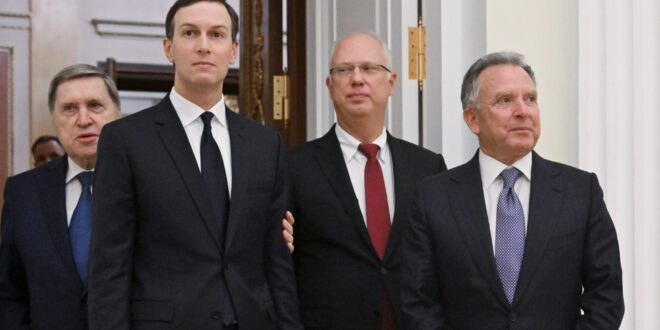
The peace plan began when Donald Trump ordered his deal-making friend, Steve Witkoff, a wealthy New York real estate developer with no prior diplomatic or government experience before 2025, and his son-in-law, Jared Kushner, another trusted unofficial envoy famous for having become a billionaire by converting US relationships with three Gulf States into private equity deals, to come up with a document to end the war in Ukraine.
The American duo took the unorthodox decision to invite the “ruthlessly ambitious” head of the Russian sovereign wealth fund, Kirill Dmitriev, who was educated at Stanford and Harvard, before working at McKinsey and Goldman Sachs, for three days of secret meetings to make sure Russian demands – as well as the credo “make money, not war” – were incorporated into the document. The Kremlin’s input screams out loud not only in the multiple conditions favouring it, but also in the awkward English construction of several points, which appear to have been translated from Russian.
The first point of the resulting 28-point document declares that “Ukraine’s sovereignty will be confirmed.” The document then quickly calls for multiple violations of Ukrainian sovereignty. This includes:
a required change to the Ukrainian constitution banning NATO membership, along with a change to the statutes of NATO confirming this;
a ban on foreign troops on Ukrainian territory;
a demand to hold elections in 100 days, without a similar demand of Russia;
a de facto recognition of all Ukrainian territories Russia currently occupies, plus Ukrainian withdrawal from the part of western Donetsk it still controls, a move which would mean giving up four fortress cities and opening up the capital to a future land invasion
Each point crosses a non-negotiable, sovereignty-demolishing red line for Ukraine.
Trump’s NSS treats European sovereignty with a similar double standard. While declaring “First and foremost, we want the continued survival and safety of the United States as an independent, sovereign republic”, based in part on a revival of the Monroe Doctrine asserting US predominance in the Western Hemisphere, the document prioritises “[c]ultivating resistance to Europe’s current trajectory within European nations.”
The bottom line: the White House will encourage Russian-style interference in European elections, as long as it favours its preferred parties on the far right. This includes (but is not limited to) the German AfD, whose voters were addressed by the quasi-official Trump envoy Elon Musk at a pre-election rally in late January, where he called the party the “best hope for Germany” and the best bet to “preserve German culture [and] protect the German people.”
Reportedly, it gets worse, if that’s possible. According to Defence One, there was a longer version of the NSS that circulated before the White House published the unclassified version on December 4. In this version, the NSS proposes that the US focus its relationships with European countries on a few nations with like-minded governments, parties and movements. Austria, Hungary, Italy and Poland are listed as countries the US should “work more with… with the goal of pulling them away from the [European Union].”
“And we should support parties, movements, and intellectual and cultural figures who seek sovereignty and preservation/restoration of traditional European ways of life… while remaining pro-American,” the document says.
Indispensable, but invisible?
The only broad consensus on the leaked peace plan is that it was dead on arrival. It had to be replaced by something other than a repetition of Russia’s maximalist demands going back to the beginning of the full-scale invasion in February 2022, couched in terms of Ukraine’s forced capitulation. For Ukraine and the countries along the eastern flank of NATO – all of which have a history of brutal Russian invasion and occupation – the “peace plan” also violates the most basic principle of drafting a diplomatic document that will influence the future security of multiple countries: inclusion of those with a stake in the long-term outcome.
Apparently, the principle “Nothing about me without me” has given way to the fear that “If you’re not at the table, you’re on the menu.” Along these lines, the current approach to NATO’s eastern flank resembles the most infamous diplomatic agreements of the twentieth century, most conspicuously the Munich Agreement of September 1938, the Nazi-Soviet Non-Aggression Treaty of August 1939, and the Yalta Agreement of February 1945. Countries marginalised in the peace process have felt part “a continent squeezed between competing powers, its leaders grasping for influence in a world their nations once dominated,” whose leaders have “worked frantically to reverse the slide, using persuasion and behind-the-scenes manoeuvring to nudge Trump’s administration toward a position that they considered more acceptable.”
While a number of recent European initiatives to rearm, improve defence coordination and close critical capability gaps, reflect an increasing awareness of their collective vulnerability, the Russian-American preference for opportunistic deal-making over sustainable peace-making has only fed the collective sense of insecurity along NATO’s eastern border.
28 points of damage control
Trump’s team began damage control after the 28-point plan leaked by convening a series of meetings, beginning in Geneva on November 23. The gathering finally included two EU representatives (Björn Seibert from the European Commission, and Pedro Lourtie from the European Council), as well as “E3” security representatives from the UK, France and Germany. EU High Representative Kaja Kallas remained in Brussels. NATO was not formally represented.
Although the Geneva meeting was the first to include EU-wide officials, no national representatives from Poland, the Baltic states, Romania or Finland – NATO’s vulnerable eastern flank – were invited. Subsequent meetings produced a revised 19-point document, the constant revision of which has been the cause of the most frenetic shuttle diplomacy in recent memory.
Although a working draft of a revised peace plan remains elusive, the biggest changes appear to include:
the cap on the size of the Ukrainian Army moving from 600,000 to 800,000;
dropping explicit recognition of Russian sovereignty over Crimea and large parts of Donbas;
eliminating a rapid timetable for elections;
no lifting of sanctions against Russia;
rejection of a blanket amnesty for Russians forces charged with war crimes.
One of the biggest points Zelensky has held as non-negotiable, Ukraine’s intention to enter NATO, has apparently been dropped at the latest round of meetings going on in Berlin, which began on Sunday with Zelensky and Merz sitting down with Witkoff and Kushner, and will continue on Monday evening when other European leaders, including French President Emmanuel Macron, British Prime Minister Keir Starmer, Polish Prime Minister Donald Tusk and European Commission President Ursula von der Leyen, arrive.
The sudden reversal came in exchange for what the Ukrainian president described as “bilateral security guarantees between Ukraine and the US, Article 5-like guarantees for us from the US, and security guarantees from European colleagues, as well as other countries – Canada, Japan – [which] are an opportunity to prevent another Russian invasion.” Those with a keen memory of the Budapest Memorandum will likely call this the “triumph of hope over experience clause.”
The inclusion of Poland in Monday’s gathering has done little to help Warsaw avoid the feeling that it has been left on the sidelines. Poland’s claim to be at the table is credible: it shares a border with the most heavily militarised enclave in Russia (Kaliningrad) and Russia’s tactical-nuclear-armed client state Belarus; it still hosts about 1 million Ukrainian refugees (Germany hosts roughly 1.2 million); it’s served as the main logistical hub for Western military support for Ukraine; it currently has the highest percentage of GDP spending on defence in NATO (roughly 4.5 per cent); it’s leading the movement in Europe to rearm; and Polish Foreign Minister Radek Sikorski is one of Europe’s most visible and experienced diplomats.
The Polish government’s hitherto absence at the table is as inexplicable as it is detrimental to the countries of NATO’s eastern flank and Ukraine, whose complex security dilemmas Poland understands better than anyone else in NATO or the EU. Although foreign policy remains the constitutional purview of the sitting government, populist-nationalist Polish President Karol Nawrocki, a political opponent of Prime Minister Tusk, is actively exploiting Trump’s preference for bilateralism as a way to maintain Poland’s post-Cold War security guarantee from the US. However, while cultivating this relationship strengthens the country’s alliance with the US, it also leads to confusion about who actually speaks for the country, while deepening domestic political polarisation.
When war is safer than peace
The year 2025 is not coming to an auspicious end. Amateur American diplomats motivated by the prospect of making money from “deals” – as opposed to securing a long-term, sustainable peace in Europe – are currently deciding the future of the international system. The sitting US president recently repeated numerous Kremlin talking points about the war in Ukraine in an interview with an influential news outlet, while boasting that “NATO calls me Daddy”, and pushing his belief that Russia’s genocidal war in Ukraine “doesn’t affect us [and] our country is no longer paying any money ever since [President] Biden gave them $350 billion so stupidly.”
Meanwhile, the latest US National Security Strategy and ongoing peace talks prioritise carving up the world into neo-imperial spheres of influence, without regard to the consequences for countries affected by Great Power ambition and aggression. In Europe, this includes first and foremost Ukraine and the eastern flank of NATO.
We should make no mistake: Vladimir Putin has no intention of stopping the war he started in Ukraine. Short of the total conquest of all of Ukraine, peace is not an option. Peace without total occupation of the entire Ukrainian land mass and subjugation of its people – the tyrant’s promise when his “special military operation” began on February 24, 2022 – would mean accountability. Accountability is fatal to reckless leaders.
Ending the war based on a US-brokered “peace agreement” would call into question why Putin started the war in the first place, and it would force a traumatic debate about whether it was worth the staggering cost in human casualties and the transformation of Russia into a war-based dystopia run by old men clinging to power at all cost.
From the Ukrainian perspective, war is safer than peace when an occupying power has come to kill you. The only path to peace, as it was in the last century’s great wars, is the defeat and ruin of the aggressor in a way which makes further war impossible, unthinkable. At least for the foreseeable future – or as long as it takes for Americans who think they “hold all the cards” to figure out that they don’t.