 Eurasia Press & News
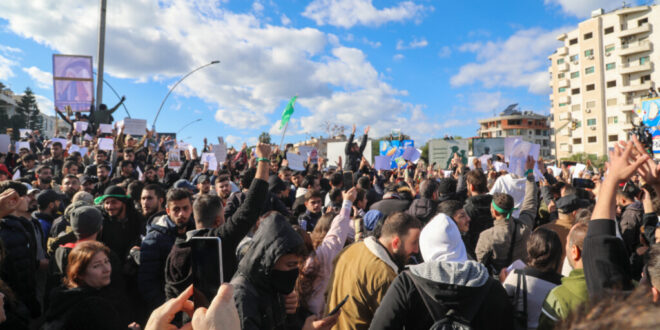
Sectarian tensions appear to be resurfacing in Syria’s Mediterranean coastal region, the home to the country’s largest concentration of the Alawite religious minority. The group held a privileged position under the ousted dictator — and co-religionist — Bashar al-Assad. On December 28, thousands of Alawites protested in cities of Latakia and Tartus following a December 26 bombing of a mosque in Homs that killed eight people. A jihadi extremist group calling itself Saraya Ansar al-Sunnah claimed responsibility for the attack, as well as a June attack on a church in Damascus. The group emerged after the fall of Assad and has pledged to “target all infidels and apostates.”
Once impoverished and marginalized, the Alawites became entrenched in the Assad regime’s power structure, with over 80 percent employed in the public sector. They dominated the upper ranks of the military and intelligence services. That has made them a target now for retribution attacks.
Violence With Impunity Strikes Home
In March, Syrian government forces, pro-Assad militias, and private individuals committed war crimes against the Alawite community and Sunni Arabs on the coast. About 1,400 people were killed in the violence, mostly civilians.
Following the massacres, a report by the human rights group Syrians for Truth and Justice warned that “the failure to hold leaders and senior officials accountable for the massacres that took place in the coastal region has opened the door to further sectarian violations against Alawites.” The organization documented a pattern of abuse that included extrajudicial killings, abductions, and torture. According to the report, at least another 64 killings were recorded between March and June. Following the protests in December, assailants attacked Alawite neighborhoods in Latakia. Hundreds of people destroyed vehicles and vandalized shops.
The Current State of the Alawites Is Tenuous
Following the fall of the Assad regime, remnants of his security apparatus regrouped along the coast and formed new factions. These include the Alawite Coastal Shield Brigade, led by a former officer, Miqdad Fatiha, who is rumored to be in Lebanon. These groups claimed they have carried out multiple ambushes against government forces last year. An Alawite religious figure named Ghazal Ghazal called for protests after the recent bombing, stressing that they must be peaceful. Still, some elements of the Coastal Brigades militia were seen taking part in violence and using inciting rhetoric.
The United States Should Hold Those Fueling Instability in Syria to Account
Syria’s fragmentation continues to deepen as the government fails to reassure the country’s various communities that it can protect them, with the Alawites being a prime example. President Donald Trump has said that “we want to see Syria become a country that’s very successful,” but stability will remain out of reach as long various extremist groups cannot be contained. That is the responsibility of the central government in Damascus. Washington should remind President Ahmad al-Sharaa that, despite the repeal of the Caesar Act sanctions, Syria remains bound by core commitments to protect minorities.
The United States should also be prepared to use its sanctions authority against actors that fuel instability, whether they are Alawite or Sunni, pro-Assad or pro-Sharaa. That includes Ansar al-Sunnah or the Coastal Shield Brigade, whose leader, Fatiha, was sanctioned earlier this month by the United Kingdom for perpetrating violence against civilians.