 Eurasia Press & News
The Critical Threats Project (CTP) at the American Enterprise Institute and the Institute for the Study of War (ISW) publish the Iran Update, which provides insights into Iranian and Iranian-sponsored activities that undermine regional stability and threaten US forces and interests. CTP-ISW publishes the Iran Update daily.
add note
tweet
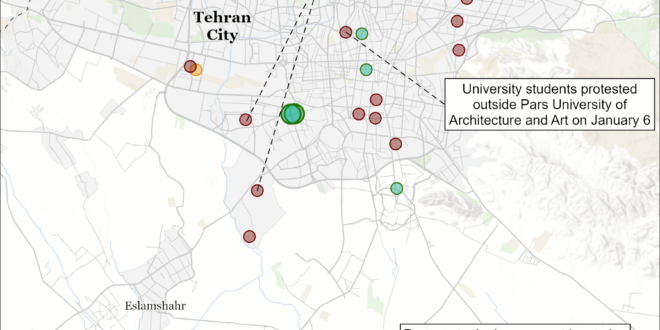
Click here to see ISW-CTP’s new interactive map showing the locations of daily protests in Iran since December 28, 2025. ISW-CTP will continue to publish daily static maps depicting the Iranian protests in forthcoming Iran Updates.
Click here to see CTP and ISW’s interactive map of assessed control of terrain in Syria, and here to see CTP and ISW’s interactive map of Israeli ground operations. The Syria map is updated daily alongside the static Syria maps in this report. CTP-ISW ended daily maps of Israeli ground operations in February 2025.
Click here to see ISW-CTP’s interactive map showing the total strikes in Iran during the Israel-Iran War, as well as an interactive timelapse showing the strikes day-by-day.
CTP-ISW has recorded 89 protests across 21 provinces in Iran since its last data cutoff on January 6. CTP has adjusted its data cutoff for protests in Iran to 3:30 PM ET to correspond with 12 AM Tehran time.[i] CTP-ISW recorded eight protests across seven provinces in Iran between 2:00 and 3:30 PM ET on January 6.[ii] Protests have continued to primarily take place in western Iran and in smaller, less-populated areas. CTP-ISW has recorded 19 protests in Tehran City since its last data cutoff, however.[iii] CTP-ISW has also recorded 14 medium-sized protests since its last data cutoff, which CTP-ISW defines as protests with more than 100 participants.[iv]
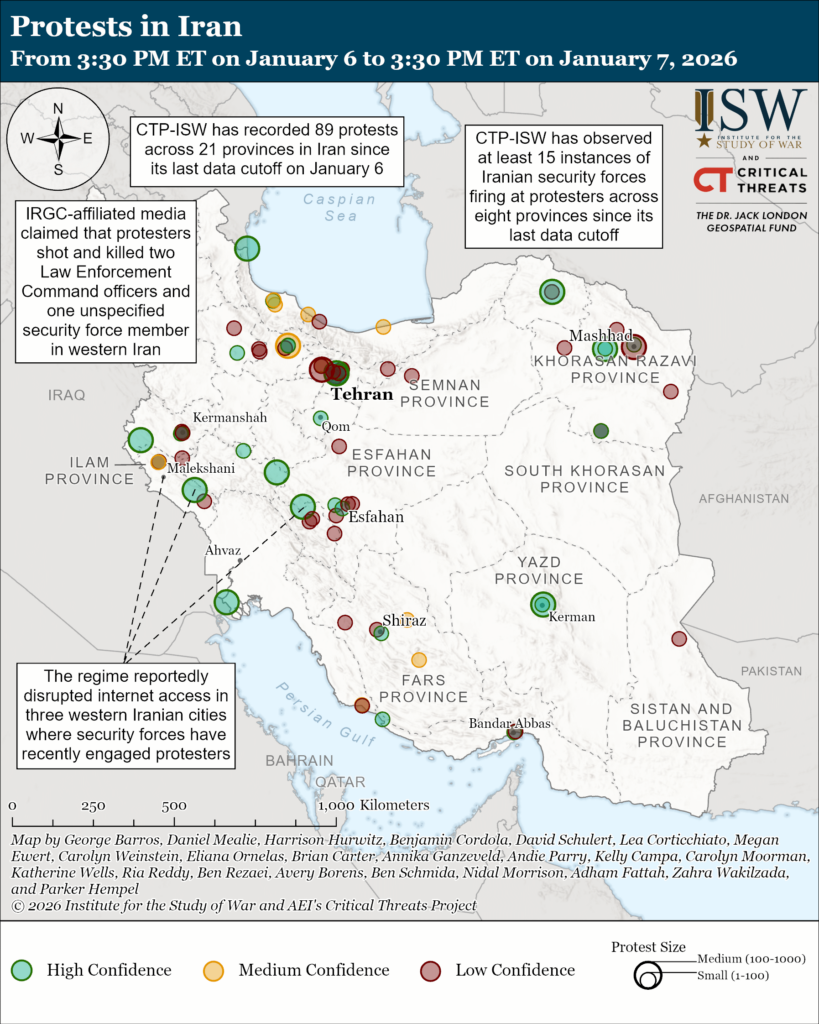
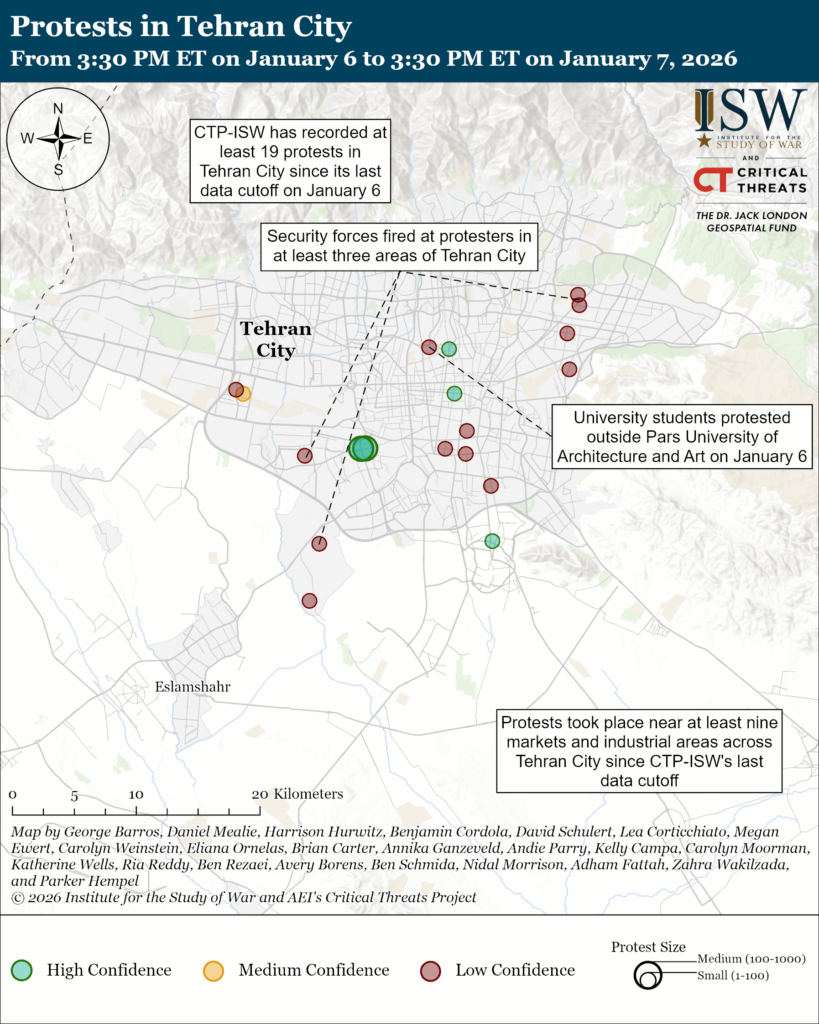
The regime continues to use violence and lethal force to suppress the protests. CTP-ISW has recorded 15 instances of security forces firing at protesters across eight provinces since its last data cutoff, most of which were concentrated in Tehran, Fars, Kermanshah, and Chaharmahal and Bakhtiari provinces.[v] The regime reportedly disrupted internet access in Lordegan, Chaharmahal and Bakhtiari Province, and Malekshahi and Abdanan cities, Ilam Province, where security forces have clashed with protesters, according to an internet access researcher on January 7.[vi] The regime has arrested at least 2,078 citizens and killed at least 24 protesters since December 28, according to a US-based human rights organization focused on Iran on January 6.[vii]
Islamic Revolutionary Guards Corps (IRGC)-affiliated media reported on January 7 that protesters killed two Law Enforcement Command (LEC) officers during protests in Lordegan, Chaharmahal and Bakhtiari Province, as well as an unspecified security force member in Malekshahi, Ilam Province.[viii] These reports mark the first time that the regime has publicly announced the death of security forces members since the start of the protests on December 28. The regime previously claimed on January 1 that protesters had killed a member of the Basij, but this claim turned out to be false.[ix] The Iranian regime could use the deaths of security personnel as justification to intensify its suppression of Iranian protesters.
An Iranian media outlet affiliated with one of Iranian Supreme Leader Ali Khamenei’s representatives to the Defense Council, Ali Shamkhani, implicitly criticized security forces’ recent raid on a hospital in Ilam Province.[x] Security forces raided a hospital in Malekshahi County, Ilam Province, on January 5, where injured protesters were being treated.[xi] The outlet argued that the incident represents “a serious test of how the government engages society during crises” and that “issuing conciliatory statements, declaring responsibility, and accepting the possibility of error” do not diminish the regime’s authority but rather strengthen it.[xii] The outlet’s implicit criticism of the raid is notable given that other parts of the regime have justified the raid.[xiii]
A group of seven Kurdish organizations, including anti-regime groups, called for a general strike across Iran on January 8.[xiv] The Kurdish Democratic Party of Iran (KDPI), Komala Party of Iranian Kurdistan, and Kurdistan Free Life Party (PJAK), among others, called for a nationwide “general strike” on January 8 in response to the regime’s violent crackdown on protests in Kermanshah, Ilam, and Lorestan provinces.[xv] CTP-ISW has recorded 67 protests in Kermanshah, Ilam, and Lorestan provinces since December 28.[xvi] The organizations’ call for a general strike is notable given that the regime previously accused Kurdish opposition groups of inciting protests in Kurdish areas during the Mahsa Amini movement.[xvii] The IRGC previously struck anti-regime Kurdish militant positions in Iraqi Kurdistan in October 2022.[xviii] Significant protest activity took place in Kurdistan and West Azerbaijan provinces, which have large Kurdish populations, during the Mahsa Amini movement.[xix] CTP-ISW has not observed any protests in Kurdistan Province nor significant protest activity in West Azerbaijan Province thus far in the current wave of protests, however.
The Mobarizoun Popular Front (MPF), which is a coalition of Baloch anti-regime groups, killed an Iranian Law Enforcement Command (LEC) officer in Iranshahr, Sistan and Baluchistan Province, on January 7 in response to the regime’s violent crackdown on protesters across Iran.[xx] The MPF claimed that it killed the Shahr-e Deraz LEC commander in response to “the killing and suppression of protesters in various parts of our country.”[xxi] The MPF claimed that the commander previously served as the Iranshahr LEC Information Protection Organization commander and had killed “Baloch fuel workers” in recent months.[xxii] The MPF previously warned on January 1 that it would respond to “every bullet” fired by Iranian security forces at protesters.[xxiii] CTP-ISW has not recorded any protests in Iranshahr at the time of this writing. The MPF’s January 7 attack marks the first time that the MPF has conducted an attack in Iranshahr. The MPF previously conducted its first attack in Zahedan, Sistan and Baluchistan Province, in early December 2025.[xxiv]
Anti-regime media and some social media users claimed that Iranian-backed Iraqi militias have deployed to Iran to support the Iranian regime’s crackdown on protests.[xxv] CTP-ISW is unable to verify these reports, and anti-regime media has circulated similar reports during previous waves of protests. Anti-regime outlet Iran International reported on January 6 that around 800 Iranian-backed Iraqi militia fighters have deployed to Iran since January 2 through border crossings in Diyala, Maysan, and Basra provinces, citing unsourced “information.”[xxvi] The Iraqi fighters are reportedly members of Kataib Hezbollah, Harakat Hezbollah al Nujaba, Kataib Sayyid al Shuhada, and the Badr Organization, among other militias.[xxvii] Iran International added that unspecified Iraqi government officials are aware of the fighters’ deployments, which have occurred under the guise of pilgrimage trips to the Imam Reza Shrine in Mashhad, Iran.[xxviii] Iranian-backed Iraqi militias frequently use their control of many Iran-Iraq border crossings to smuggle items, such as weapons, in and out of Iraq.[xxix] Several social media users have also claimed in recent days that members of the Iranian-backed Popular Mobilization Forces (PMF) are suppressing protests in Iran, including in Hamedan City, Hamedan Province.[xxx] The PMF is an Iraqi state security service that includes many Iranian-backed Iraqi militias that tend to report to Iran instead of the Iraqi prime minister.[xxxi] The militias’ deployments, if true, could bolster the regime’s efforts to contain the protests. Iraqi militias may also be more willing than Iranian security forces to use violence and lethal force against protesters given that they lack personal connections to the Iranian communities that are protesting. Anti-regime media often circulates reports about the deployment of Iranian proxy forces to Iran to suppress protests during periods of unrest. Iran International, citing Israeli media, reported in 2022 that Iranian-backed Iraqi militias under the PMF deployed to Iran during the Masha Amini protest movement to help the Iranian regime contain the protests, for example.[xxxii] The former head of Tehran’s Revolutionary Court, Musa Ghazanfarabadi, also implied in 2019 to Iranian religious students in Qom that Axis of Resistance groups, including Iranian-backed Iraqi militias, could support the regime’s suppression of future protest movements in Iran.[xxxiii] Iranian security forces notably helped the PMF violently suppress protests in Iraq in 2019.[xxxiv]
Saudi Arabia and Saudi-backed Presidential Leadership Council (PLC) President Rashad al Alimi altered the composition of the PLC by pressuring Southern Transitional Council (STC) members to sideline STC President and former PLC Vice President Aidarous al Zubaidi and other hardline secessionists. Saudi Arabia and Saudi-backed Yemeni actors have been trying to reunify Yemen’s anti-Houthi factions, de-escalate the conflict between the ROYG and the STC, and reassert the ROYG’s control over southern Yemen. The PLC convened an emergency meeting in Riyadh on January 7 and announced that it expelled Zubaidi from the council and referred him to the attorney general for prosecution on charges including “high treason.”[xxxv] Zubaidi, who recently announced the STC’s intent to form an independent state in southern Yemen, did not board a Riyadh-bound flight in Aden on January 6 after Saudi Arabia and Saudi-backed Yemeni actors, including Alimi, pressured him to travel to Riyadh to meet with the PLC.[xxxvi] The Saudi-led military coalition claimed that Zubaidi fled Aden after refusing to travel to Riyadh.[xxxvii] The coalition struck weapons and equipment depots in Dhaleh Governorate after it received intelligence that Zubaidi had moved a “large military force” to Dhaleh.[xxxviii] Zubaidi is from Dhaleh Governorate.[xxxix]
Several STC-aligned actors appear to be cooperating with Saudi Arabia and Alimi’s efforts to sideline Zubaidi and other hardline secessionists, though the STC continues to publicly support Zubaidi.[xl] Two of Zubaidi’s partners, PLC Vice President Tariq Saleh and STC Vice President and PLC Vice President Abu Zaraa al Muharrami, were present during the meeting in which the PLC decided to expel Zubaidi.[xli] Only Zubaidi and STC Vice President and PLC Vice President Farah al Bahsani—who had aligned with Zubaidi, Saleh, and Muharrami in supporting the STC’s takeover of eastern Yemeni territory in early December 2025—did not attend the PLC meeting.[xlii] President Alimi summoned these STC leaders to Riyadh on January 4.[xliii] CTP-ISW previously noted that Saudi Arabia could use the summons to reprimand the STC and attempt to compel it to de-escalate with Alimi and northern Yemeni factions within the Republic of Yemen Government (ROYG).”[xliv] Saleh and Muharrami’s activity in Riyadh since their arrival, including meetings with Saudi and Saudi-backed PLC members, suggests that both men have succumbed to pressure from Alimi and Saudi Arabia to end cooperation with Zubaidi and other secessionists. Muharrami’s Southern Giant Forces have assumed control over several positions across Aden on January 6 and 7 at the Saudi-led coalition’s request, according to local media and the coalition’s spokesperson.[xlv] A Yemen analyst reported on January 7 that other STC forces are cooperating with the Southern Giant Forces in Aden.[xlvi]
The PLC also dismissed two ministers and several Hadrami military commanders on January 7, possibly as part of an effort to purge supporters of Zubaidi or secession from ROYG political and security institutions.[xlvii] PLC President Alimi fired the ROYG’s transport and planning and international cooperation ministers on January 7 and placed both ministers under investigation as part of “urgent measures to control the security situation and strengthen state sovereignty.”[xlviii] Alimi and his ally, Hadramawt Governor Salem al Khanbashi, also dismissed commanders in Mahra and Hadramawt governorates on January 7 and referred them to courts-martial, which Saudi-backed Yemeni forces recently seized from the STC during a counteroffensive.[xlix] Neither Alimi nor Khanbashi attributed these individuals’ dismissals to support for the STC’s takeover, but the PLC notably took action against these individuals on the same day that the PLC expelled Zubaidi from the PLC and accused him of treason.
Several former Assad regime officers are reportedly attempting to organize insurgent activity against the Syrian government from Lebanese territory.[l] The Lebanese Armed Forces (LAF) does not appear to have taken actions to meaningfully disrupt these officers’ efforts to organize and support insurgent activity. Numerous Assad regime members fled to Lebanon in December 2024 after the fall of the Assad regime, including prominent Assad regime figures such as Assad’s senior adviser, Bassam al Hassan, and Fourth Division General Ghiath Dalla.[li] Dalla, who reportedly lives “just over” the Syrian border in Lebanon, has continued to organize Assadist insurgent activity from Lebanon, according to recent Western and Arab media investigations.[lii] Former Tiger Forces Commander Suhail al Hassan, who has attempted to recruit and equip Assadist insurgents, has met with collaborators in Lebanon over the past year and reportedly purchased a large office along the Lebanon-Syria border to use as a “headquarters” for future operations in Syria.[liii] Hassan claimed, according to documents obtained by the New York Times and Al Jazeera, that at least 20 former Assad regime pilots are living in Lebanon and intend to join Assadist insurgent groups.[liv] A Syrian transitional government delegation reportedly submitted a list of names of Assad regime officers living in Lebanon to the Lebanese government on December 22 and demanded that Lebanon transfer them to Syria.[lv] The Syrian government has long demanded that Lebanon extradite former Syrian regime officials accused of war crimes, which the Lebanese government has not yet done.[lvi]
Recent investigations into former Assad regime officials operating from Lebanon reportedly prompted Lebanese authorities to carry out raids and arrests nationwide. Lebanese Deputy Prime Minister Tarek Matri stated on January 2 that the investigations were “cause for concern” and publicly called on Lebanese security forces to investigate and “take appropriate measures.”[lvii] Lebanese media reported that the LAF raided an Alawite-majority neighborhood in Tripoli in search of Assad regime remnants on January 3.[lviii] The LAF announced that it arrested 35 Syrians in northern and eastern Lebanon districts on smuggling and weapons charges on January 4.[lix] Several Syrian and international media outlets claimed that the LAF arrested Assad regime remnants during this arrest campaign.[lx]
There are several indications that Alawite insurgent groups currently active in Syria may have ties to former regime networks in Lebanon. The Syrian government has alleged that Suhail al Hassan has ties to the Alawite insurgent group known as the Men of Light, for example.[lxi] Another Syrian insurgent group, Fawj Azra’il al Jabal, praised Lebanon for allegedly refusing the Syrian government’s December 22 request to extradite regime officers living in Lebanon, which suggests that Fawj Azra’il al Jabal may have connections to some of the officers in Lebanon.[lxii] The LAF’s recent arrest campaign in northern Lebanon that resulted in the arrest of 35 Syrians also prompted an aggressive reaction on social media from the Coastal Shield Brigade, another Alawite insurgent group currently active along the Syrian coast.[lxiii] The Coastal Shield Brigade’s reaction to the arrests suggests that the group possibly has ties to the insurgent or smuggling networks that were targeted in the arrests.[lxiv]
The Lebanese army can play a meaningful role in disrupting former regime networks in Lebanon that are attempting to destabilize the new Syrian government as part of the Lebanese government’s improved relationship with Syria since December 2024. CTP-ISW recently assessed that the current scale, performance, and organizational structure of Assadist insurgents suggest that the threat of these insurgents to Syrian government forces remains low at this time.[lxv] These networks may expand if allowed time and space to recruit and organize in both Syria and Lebanon, however.
Key Takeaways
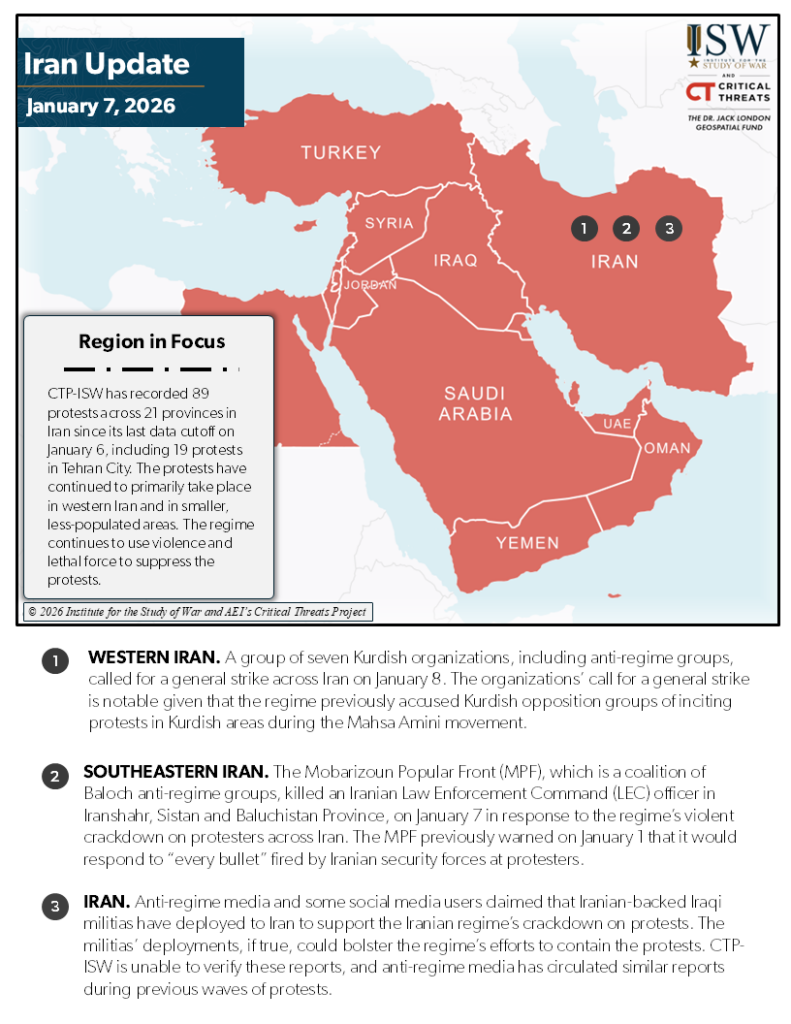
Iranian Protests: CTP-ISW has recorded 89 protests across 21 provinces in Iran since its last data cutoff on January 6, including 19 protests in Tehran City. The protests have continued to primarily take place in western Iran and in smaller, less-populated areas. The regime continues to use violence and lethal force to suppress the protests. The regime reportedly disrupted internet access in parts of Chaharmahal and Bakhtiari and Ilam provinces.
Iranian Protests: A group of seven Kurdish organizations, including anti-regime groups, called for a general strike across Iran on January 8. The organizations’ call for a general strike is notable given that the regime previously accused Kurdish opposition groups of inciting protests in Kurdish areas during the Mahsa Amini movement.
Baloch Insurgency: The Mobarizoun Popular Front (MPF), which is a coalition of Baloch anti-regime groups, killed an Iranian Law Enforcement Command (LEC) officer in Iranshahr, Sistan and Baluchistan Province, on January 7 in response to the regime’s violent crackdown on protesters across Iran. The MPF previously warned on January 1 that it would respond to “every bullet” fired by Iranian security forces at protesters.
Rumored Iraqi Militia Deployments: Anti-regime media and some social media users claimed that Iranian-backed Iraqi militias have deployed to Iran to support the Iranian regime’s crackdown on protests. The militias’ deployments, if true, could bolster the regime’s efforts to contain the protests. CTP-ISW is unable to verify these reports, and anti-regime media has circulated similar reports during previous waves of protests.
Changes Within Yemen’s PLC: Saudi Arabia and Saudi-backed Presidential Leadership Council (PLC) President Rashad al Alimi altered the composition of the PLC by pressuring Southern Transitional Council (STC) members to sideline STC President and former PLC Vice President Aidarous al Zubaidi and other hardline secessionists.
Assadist Insurgent Networks in Lebanon: Several former Assad regime officers are reportedly attempting to organize insurgent activity against the Syrian government from Lebanese territory. The Lebanese Armed Forces (LAF) does not appear to have taken actions to meaningfully disrupt these officers’ efforts to organize and support insurgent activity, despite recent arrests that are rumored to have targeted Assad regime networks.
Iran
See topline section.
Iraq
A senior member of Iranian-backed Iraqi militia Asaib Ahl al Haq, Sanad al Hamdani, denied on January 5 that Asaib Ahl al Haq supports the recent Iraqi Resistance Coordination Committee statement that rejected the disarmament of Iranian-backed Iraqi militias.[lxvi] Hamdani’s rejection of the statement indicates that there may be splinters within Asaib Ahl al Haq on the issue of disarmament. The Iraqi Resistance Coordination Committee is a coordinating body for Iranian-backed Iraqi militias, including Asaib Ahl al Haq.[lxvii] The committee released a statement on January 4 in which it rejected calls for Iranian-backed Iraqi militias to disarm, citing the continued presence of US and Turkish forces in Iraqi Kurdistan.[lxviii] CTP-ISW noted on January 6 that the statement was inconsistent with the stated positions of some militias, including Asaib Ahl al Haq, on the issue of disarmament.[lxix] Asaib Ahl al Haq head Qais al Khazali appeared to support disarmament in a December 19 speech, for example[lxx] Asaib Ahl al Haq later reiterated on January 6 its “clear and declared position since 2017” that weapons should belong exclusively to the Iraqi state.[lxxi] Asaib Ahl al Haq’s military spokesperson denied on December 22 that the group intends to surrender its weapons, however.[lxxii]
Syria
Fighting between Syrian government forces and the Syrian Democratic Forces (SDF) in Kurdish-controlled neighborhoods of Aleppo City continued for a second day on January 7. Syrian Ministry of Defense (MoD) forces and SDF internal security forces continued to exchange heavy and medium weapons fire in Ashrafiyeh and Sheikh Maqsoud on January 7.[lxxiii] Both sides blamed each other for initiating the violence on January 6.[lxxiv] The Syrian MoD declared Ashrafiyeh and Sheikh Maqsoud to be “military zones” in which SDF positions in the neighborhoods are “legitimate targets” on January 7.[lxxv] The MoD called on civilians in Aleppo City to avoid SDF positions, established two humanitarian corridors for civilians to flee Ashrafiyeh and Sheikh Maqsoud, and imposed a curfew on January 7.[lxxvi] SDF-MoD fighting in Aleppo City has killed at least eight civilians and four MoD fighters since January 6.[lxxvii] Ilham Ahmed, who is directly involved in SDF integration negotiations with Damascus, accused the MoD of “declaring a war of extermination against the Kurds” in Sheikh Maqsoud and Ashrafiyeh.[lxxviii] Continued SDF-MoD fighting in Aleppo, in tandem with the SDF’s rhetoric, could create roadblocks in future SDF integration negotiations but is unlikely to prevent future negotiations.
Arabian Peninsula
See topline section.
Palestinian Territories and Lebanon
Nothing significant to report.