 Eurasia Press & News
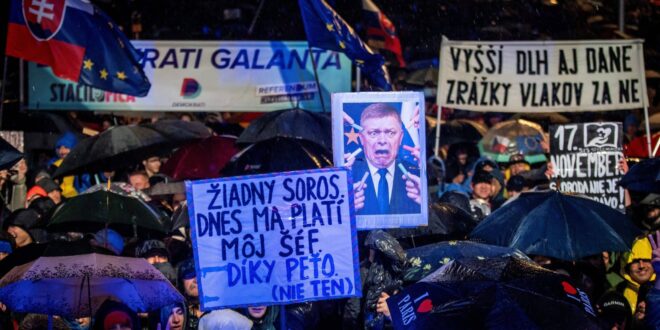
The Hungarian PM’s cautious response to a new law targeting Slovakia’s ethnic-Hungarian minority is creating credibility issues for his Fidesz party on both sides of the border and perhaps opening up an opportunity for Hungary’s extreme-right to benefit.
“We do not accept collective guilt, either in our own country or in any other European country,” Hungarian Prime Minister Viktor Orban told journalists at a press conference in Budapest on Monday. “Hungary continues to unconditionally support Hungarians living in Slovakia,” he added.
Orban was responding to a question from the (Hungarian-language) Slovak portal parameter.sk concerning a controversial new statute passed by Slovakia’s parliament on December 11. The law criminalises the public questioning of the so-called “Benes Decrees” with a penalty of six months’ imprisonment. It became effective following President Peter Pellegrini’s signature on December 23.
Since then, Orban, a close ally of his nationalist-populist Slovak counterpart Robert Fico, has faced criticism at home for his efforts to minimise the topic. Asked about the matter by journalists in Brussels on December 17, he said that he would seek “clarifying discussions [with Fico] about what this law is about”, but declined to give a timetable.
According to parameter.sk journalist Gabor Czimer, Orban’s remarks on Monday “essentially repeated his statement made on December 17”, when “he also promised to discuss this with Fico.”
This approach contrasts strongly with the combative stance Orban has taken with Ukrainian President Volodymyr Zelensky over comparatively minor issues effecting the Hungarian community in Ukraine’s Transcarpathia region.
Back to Benes
The Benes Decrees comprise 98 laws issued in 1945 by Czechoslovakia’s acting wartime president-in-exile Edvard Benes, and confirmed soon afterwards by the country’s legislature. Mostly concerned with post-war reconstruction, they are viewed as laying the foundations for both Czechia and Slovakia’s modern statehood.
However, of those decrees, 13 remain highly contentious. These variously attributed collective guilt for treason to Czechoslovakia’s Hungarian and German minorities, deprived them of citizenship, and made them liable for both forfeiture of property and expulsion. Deportation was only enforced systematically against the ethnic Germans, with most Hungarians remaining and eventually regaining citizenship.
Although never formally repealed, the latter decrees, incompatible with modern human rights law, were long regarded as inoperative. Assurances to this effect were accepted by EU officials in the course of both Czechia’s and Slovakia’s accession talks to the bloc.
In recent years, however, the decrees have been quietly invoked in Slovakia to enable fresh confiscations of land from Hungarian owners to facilitate motorway construction. Authorities have justified the procedure by claiming that the specific plots in question should have been confiscated in the 1940s, but were accidentally overlooked.
Litigation over recent confiscations is proceeding slowly through Slovakia’s courts. Meanwhile, the topic is playing out politically in different ways on both sides of the Slovak-Hungarian border.
Law has multiple targets
Slovakia’s roughly 450,000 ethnic Hungarians are the group most obviously affected by the new legislation. Some within the community, however, think they may not be its ultimate target. “Fico has not incited hatred against Hungarians in recent years, and it is questionable how far this topic resonates with his voters today,” Zoltan Szalaly, editor-in-chief of the (Hungarian-language) Slovakian newspaper Napunk told BIRN.
Rather, Szalaly thinks Fico is setting up the Benes issue as a trap for the main opposition party Progressive Slovakia (PS) and its leader Michal Simecka. In his view, by putting PS in a position where it champions the cause of a minority and appeals to European values, the governing parties of Smer, Hlas and the far-right Slovak National Party can “portray themselves as defenders of national sovereignty”, while presenting PS as “anti-national, Western puppets and servants of the EU”.
The strategy may create a useful distraction at a time when the governing coalition faces unpopularity due to major economic difficulties. Inflationary pressures intensified significantly in 2025, while the government is having to raise taxes (and cut benefits) to plug a widening budget deficit, putting a squeeze on living standards. Meanwhile, over the last year Fico’s Smer party has continuously lost ground to PS in the polls and now trails by 6 points according to Politico’s “Poll of Polls.”
Even if PS is the ultimate target, the situation is nonetheless distressing for Slovakia’s ethnic-Hungarians. Recent developments are surprising for some, given that in 2023 many followed Orban’s encouragement by lending electoral support to Fico’s Smer and and its sister Hlas party.
The situation appears to have pushed Slovakia’s (extra-parliamentary) Hungarian Coalition Party (MKP), historically close to Orban’s Fidesz, away from friendly relations with Smer and into co-operation with Slovakia’s liberal opposition. On December 16, in an unprecedented move, MKP’s president Laszlo Gubik appeared alongside opposition party leaders at a rally against the new law in the Slovak capital Bratislava. In an interview the following day with Napunk, he suggested that MKP might in future be open to formal alignment with centrist Slovak parties.
Yet, according to Szalaly, while Slovakia’s ethnic-Hungarians are “united in rejection of Fico’s new law”, their views differ greatly over how much blame to attach to Orban’s government and its current reticence, reflecting prior divisions in the community.
Impact in Hungary
Peter Magyar’s centre-right opposition Tisza party, currently leading the ruling Fidesz party in the polls, has sought to capitalise on the issue. Solidarity with ethnic-Hungarians abroad has traditionally mattered to Fidesz voters and Magyar clearly senses an opportunity to make gains ahead of the general election expected in April.
The fact that Orban waited six days before making any response to the Slovak law created significant vulnerabilities for the Hungarian government. Orban has “betrayed the Upland Hungarians: he doesn’t say a word when his buddy Fico threatens them with prison,” Magyar wrote in a Facebook post on December 19 – one of a plethora of social media comments from him on the subject over the last month.
Tisza’s rally in Szeged on December 20 prominently featured Viktoria Strompova, one of his party’s MP candidates and herself an ethnic-Hungarian born in Slovakia, together with other candidates hailing originally from cross-border Hungarian communities.
Some experts, however, question how much benefit Magyar can derive from the topic. Philosopher and theologian Dr Istvan Zalatnay served as vice president of the Government Office for Hungarian Minorities Abroad (1992-94); he remains a keen observer of how minority issues intersect with domestic politics. In his view, while the present situation is “clearly embarrassing for Fidesz”, he also doubts that Magyar can benefit from it substantially.
“Staunch Fidesz supporters are pretty unmovable,” he says. The question is rather the potential “impact on those with a weaker level of attachment.”
So far as Magyar is concerned, “the benefit is likely to be in terms of causing a limited number of wavering Fidesz voters to stay at home”, rather than prompting them to defect.
The extreme-right party Mi Hazank could, however, actually gain from the issue. Hungary has a large pool of voters with explicitly far-right sympathies, well beyond the approximately 5 per cent who currently back the party. Figures vary, but researchers typically estimate this wider group at between a further 10-15 per cent of the population – noting that at its peak in the 2010s, the (then) extreme-right party Jobbik achieved 20 per cent of the vote.
Subsequently, most far-right voters have lent support to Fidesz as the party with the greatest practical chance of delivering their policy preferences. In their hearts, though, according to Zalatnay, “really they would prefer Mi Hazank”, and are prone to complain that “almost none of what Fidesz says is true”.
In a notable contrast to Fidesz, Mi Hazank put out a statement strongly condemning the new Slovak law within 24 hours of its parliamentary passage. More widely, the party has been able not only to make use of Orban’s proximity to Fico, but also a lack of comment from the European Commission, thereby bolstering its own anti-EU agenda.
Mi Hazank’s potential to exploit the Benes Decrees issue at Fidesz’s expense raises a worrying possibility. Most analysts expect April’s election to deliver a close call between Fidesz and Tisza. With Mi Hazank the only other party polling above the 5-per-cent threshold to enter parliament, the possibility arises that, strengthened by defections, the extremist party could act as ‘king maker’ in the event of a hung parliament.