 Eurasia Press & News
Tehran has condemned capture of president Nicolas Maduro as it warns against US striking Iran
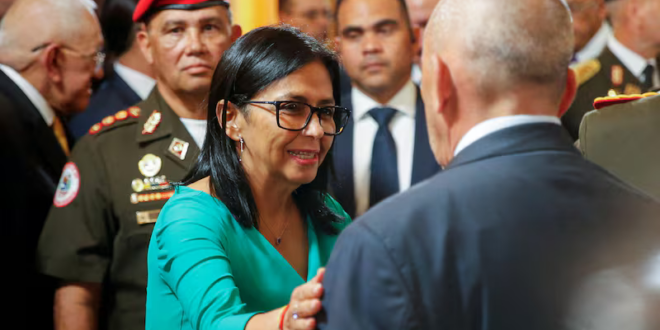
When Delcy Rodriguez was sworn in as Venezuela’s interim president on Monday, three diplomats stood out among the first people to congratulate her: the ambassadors of China and Russia, and that of Iran, Ali Chegini.
It was one indication of the close ties between Tehran and Caracas, which have strengthened over the years as the two oil-rich, highly sanction-hit nations have built a diverse partnership based on a shared ideological opposition to the US and to perceived western hegemony.
Confronted with widespread protests at home over an economy in free fall, leaders in Tehran were quick to condemn the US’s capture of former Venezuelan president Nicolas Maduro. For Tehran, the move was a reminder that US President Donald Trump is willing to rip up the rule book, and that it should be prepared for all eventualities.
“When Trump speaks of peace in the language of force, he is actually speaking of the law of the jungle and says that whoever has more force can do whatever he wants,” Iran’s Foreign Minister Abbas Araghchi told journalists after meeting legislators on Monday.
Mr Araghchi also spoke by phone with the foreign ministers in Brazil and Cuba, and called Mr Maduro’s capture “a clear violation of the fundamental rules of international law”.
US officials have described Iran and Venezuela as two pariah states and say that the Tehran had stepped up support to Mr Maduro’s regime in recent years. That included the backing of units from the Islamic Revolutionary Guard Corps, its most powerful military force.
Iran and Venezuela are in an anti-US global axis that also includes superpowers Russia and China – although the countries’ interests do not always perfectly align. Strategically located on the Caribbean Sea, Venezuela is geographically closest to the US, which has made developing the country’s enormous crude oil reserves a key tenet of its intervention.
Sanctions served as an effective lever pushing Iran and Venezuela toward greater co-operation
Nazanin Sanatkar,
Tehran-based Latin America expert
With relations dating back to the 1960s, Tehran and Caracas grew closer after the 1979 revolution in Iran and the rise of Hugo Chavez in Venezuela in the 1990s, according to Nazanin Sanatkar, an expert on Latin America at the Iranian Institute for European and American Studies, in Tehran.
“Sanctions also served as an effective lever pushing the two countries towards greater co-operation and political alignment, examples of which can be observed in international organisations and forums,” Ms Sanatkar told The National.
Alireza Ghezili, an analyst and former Iranian ambassador to Mexico, said the US imposition of sanctions on both countries was because they “opposed American hegemony”. In turn, that “strengthened their bilateral relations and co-operation in various fields”, he told The National.
Iran and Venezuela have forged economic and trade ties despite being almost 12,000km apart. In 2022, under former conservative Iranian president Ebrahim Raisi, Tehran signed a 20-year co-operation plan with Caracas during a visit by Mr Maduro to Iran. The plan included co-operation in areas including oil, petrochemicals and defence, as well as the repair of Venezuelan crude refineries. The same year, Mr Maduro said Venezuela had received at least three oil tankers built by Iranian company Sadra, which is under US sanctions.
More recently, Washington has also imposed sanctions on companies it accuses of involvement in growing military ties between Venezuela and Iran. On December 30, the US Treasury sanctioned a Palo Negro-based company and its chairman, accused of buying Iranian-made drones used by the Venezuelan Armed Forces.
At the same time, Iranians are aware that the poor economic situation in Venezuela contributed to the conditions in which the US capture of Mr Maduro took place.
“Had the Maduro government initiated more effective economic and political reforms in a timely manner and strengthened mechanisms for dialogue with its opponents, could the United States have so easily carried out such an action? The answer to this question appears to be no,” wrote Iran-based international relations expert Hassan Beheshtipour in an analysis.
Mr Trump has threatened that Ms Rodriguez will “pay a very big price, probably bigger than Maduro” if she “does not do what is right”, and has said that Washington will run Venezuela during a transitional period.
Meanwhile, the Iranian presence at her inauguration suggests that Tehran is not backing away from its ties with the South American nation, presenting a possible resistance to US involvement in the country. Already poor relations between the US and Tehran soured further last year after Washington’s strikes on Iran’s nuclear facilities at the end of a 12-day war with Israel.
“I must say that the primary resistance to America should be carried out by the people of Venezuela themselves – they are the ones who make the key decisions about their own future,” Mr Beheshtipour told The National. “Friendly or allied countries of Venezuela can be of greater assistance, provided they are genuinely asked to do so.”
Iranian observers play down the idea that Mr Maduro’s capture and Mr Trump’s statements on taking control of Venezuela are a precursor to an attempted forced regime change in Tehran.
The Venezuela raid fit closely with recent comments by Mr Trump over continuing protests over the economy and living conditions in Iran, in which at least 29 people have been killed and which have created another challenge for the country’s leadership. On Friday, Mr Trump said that “if Iran [shoots] and violently kills peaceful protesters”, the US would “rescue” them, and added that the US is “locked and loaded and ready to go”.
Aware of Mr Trump’s unpredictability, officials in Tehran are watching events in South America closely. Mr Ghezili believes Mr Maduro’s capture is a prelude to US intervention in other western hemisphere countries, “especially the region’s left-wing governments such as Cuba, Nicaragua, Colombia, Mexico and so on, and ultimately Greenland”.
All the same, there is a belief that the US will continue to use other means to pressure Tehran.
“Iran is not the next target of a Venezuela-style attack; rather, maximum pressure and hybrid warfare – across media, the economy, diplomacy and threats – will continue,” reported Nour News, an outlet close to Ali Shamkhani, an adviser to Iran’s supreme leader Ayatollah Ali Khamenei.
While playing down the similarities between Iran and Venezuela, Iranian analysts say that Washington’s operations against Mr Maduro could bring a dangerous new precedent by normalising unilateral military intervention. They have publicly stated a willingness to respond to any US intervention as a means of establishing deterrence.
“This kind of precedent risks exacerbating strategic uncertainty, leading other powers to further accelerate systemic instability,” Ms Sanatkar said. “That’s why since the attack, several high-ranking Iranian officials have explicitly stated their readiness to respond to any act of aggression against Iranian sovereignty and territorial integrity.”
On Tuesday, Iran’s Defence Council, which is under the Supreme National Security Council, said that any “aggression or continuation of hostile actions” would meet “a proportionate, decisive, and definitive response”. The council was formed after the war with Israel last June in an attempt to centralise military decision-making.
Iran’s concern is “about how far ‘American unilateralism’ might go”, Serhan Afacan, director of the Centre for Iranian Studies in Turkey, told The National. “I don’t think what happened to Maduro could happen in Iran, but even the possibility of another risk – for example, a move like the US attacking ballistic missile depots after the June [2025] attacks on nuclear facilities – is enough to alarm Iranians.”
The Hezbollah connection
In Washington’s view, Iran and Hezbollah are two sides of the same coin. The day after the US captured Mr Maduro, US Secretary of State Marco Rubio issued a warning aimed at the Lebanese group, once Iran’s most prized ally, and a member of the so-called “axis of resistance” funded by Iran. He also accused Venezuela of allowing Hezbollah to operate on its territory.
“It’s very simple,” Mr Rubio said. “In the 21st century, under the Trump administration, we are not going to have a country like Venezuela in our own hemisphere, in the sphere of control and at the crossroads for Hezbollah, for Iran and for every other malign influence in the world. That’s just not going to exist.”
Hezbollah firmly denied any presence in Venezuela. “We have nothing to do with this. Venezuela is a country where we have no influence whatsoever, no presence, no involvement, none at all,” a Hezbollah source told The National, stressing that the group’s alignment with the country stems only from a shared support for Palestine.
The source denounced an attempt by the US to “demonise” the group. “That is not surprising coming from the Americans,” a country that gave “Israel the green light to wage war on Gaza and kill tens of thousands of civilians”.
US officials have long accused Hezbollah of using Venezuela as a base for drug trafficking and illicit financial activities. “Hezbollah generates revenue from narcotics trafficking through money laundering, which the Venezuelan government has allowed so long as it receives a cut,” said Matthew Levitt, a former counter-terrorism official with the FBI and the US Treasury Department, and a leading researcher on terrorist financing.
Mr Levitt said the total amount of money generated by the alleged trafficking is unknown, but estimates put it in the “tens to hundreds of millions of dollars”.
Hezbollah’s influence in Venezuela is not new, he added, saying it predates Chavismo, the political movement associated with former president Hugo Chavez, who governed until 2013 and was succeeded by Mr Maduro. Chavismo is characterised by a strong anti-US stance and a socialist ideology.
Mass emigration from Lebanon, which began as early as the Ottoman era, led to the establishment of significant Lebanese communities around the world, including in Venezuela. With the rise of Hezbollah after 1982, Mr Levitt said, the group became increasingly influential within some of the Lebanese diaspora, particularly in parts of Africa, North America and South America.
While reports of Hezbollah military training in Venezuela may have been “overblown”, the group does not require a physical training presence to maintain a significant pro-Hezbollah community in Venezuela, he said.
Ties between Hezbollah and Venezuela strengthened under Mr Chavez, he added, due to what he described as “a natural inclination to build relationships with other countries that are anti-American”.
In recent years, US officials have accused Mr Maduro and his allies of direct involvement in Hezbollah-related activities. Washington has imposed sanctions on people it says are linked to Hezbollah-related networks in Venezuela.
Among them is Tareck El Aissami, a former Venezuelan vice president of Syrian-Lebanese descent and an ally of Mr Maduro, who was named by the US Treasury in February 2017 as a specially designated narcotics trafficker over alleged international operations.
In 2020, another close Maduro ally, Adel El Zabayar, a former member of Venezuela’s National Assembly, was charged by US prosecutors in New York with taking part in a narco-terrorism conspiracy involving armed groups including Hezbollah and Hamas.