 Eurasia Press & News
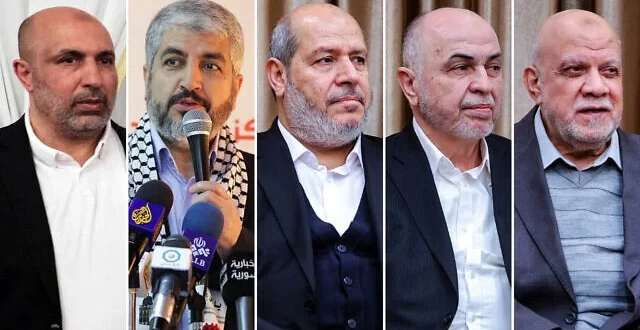
Vote for political bureau set to take place early this year, with Khalil al-Hayya and Khaled Mashaal seen as top contenders to lead terror group under pressure to disarm
Hamas is preparing to hold internal elections to rebuild its leadership, decimated by Israel during the war in Gaza, which it sparked by carrying out the October 7, 2023, massacre, sources in the terror group told AFP on Monday.
With international powers and Israel pushing for it to be disarmed and have no role in Gaza’s future governance, its new leaders will face an uncertain future.
The terror group also rules over a territory devastated by two years of war, with its more than two million residents facing harsh humanitarian conditions, and Israeli troops still deployed in about half of the Strip.
“Internal preparations are still ongoing in order to hold the elections at the appropriate time in areas where conditions on the ground allow it,” a Hamas leader told AFP on Monday.
The vote is expected to take place “in the first months of 2026.”
The leadership renewal process includes the formation of a new 50-member Shura Council, a consultative body dominated by religious figures.
Its members are selected every four years by Hamas’s three branches: the Gaza Strip, the West Bank, and the movement’s external leadership.
Hamas prisoners in Israeli prisons are also eligible to vote.
That council is responsible, also every four years, for electing the 18-member political bureau and its chief, who serves as Hamas’s overall leader.
Another Hamas source close to the process said the timing of the political bureau elections remains uncertain, “given the circumstances our people are going through.”
After Israel killed former Hamas chief Ismail Haniyeh in Tehran in July 2024, the group chose its then-Gaza chief Yahya Sinwar, the mastermind of the October 7 massacre, as his successor.
He too was killed by Israeli forces in the southern Gaza city of Rafah, three months after Haniyeh’s assassination.
Hamas then opted for an interim five-member leadership committee based in Qatar, postponing the appointment of a single leader until elections are held, given the risk of being targeted by Israel.
Two frontrunners
All the sources spoken to by AFP mentioned two frontrunners to head its political bureau: Khalil al-Hayya and Khaled Mashaal.
Hayya, 65, a Gaza native and Hamas’s chief negotiator in ceasefire talks, has held senior roles since at least 2006, according to the US-based NGO the Counter Extremism Project (CEP).
Mashaal, who led the Political Bureau from 2004 to 2017, has never lived in Gaza. He was born in the West Bank in 1956.
He joined Hamas in Kuwait and later lived in Jordan, Syria, and Qatar. The CEP says he oversaw Hamas’s evolution into a political-military hybrid.
He currently heads the movement’s diaspora office.
A Hamas member in Gaza said Hayya is a strong contender due to his relations with other Palestinian factions, including the rival Fatah party, which dominates the Palestinian Authority, as well as his regional standing.
Hayya also enjoys backing from both the Shura Council and Hamas’s military wing, the Izz ad-Din al-Qassam Brigades.
Their main immediate policy difference relates to the Israeli withdrawal from Gaza, according to the sources close to the terror group’s leadership who spoke to the Saudi outlet Asharq last month.
Hayya, who is seen as close to Iran, was said to support the continuation of “armed conflict with Israel in the Gaza Strip until the war ends and the Israeli army withdraws from the Strip entirely,” while Mashaal, who is seen as closer to Qatar, is reportedly seeking “negotiated compromises to end the occupation of Gaza.”
Mashaal also supports “trying to move Hamas away from Iran” and “closer to the moderate Arab states,” the sources told Asharq.
Qatar hosts senior Hamas leaders and, between 2018 and October 2023, funded civil service salaries and cash handouts in the Gaza Strip, which Hamas violently seized from the PA in 2007.
The terror group is also supported by Iran, where major protests against the government could prove an issue for Hamas.
“This is a critical moment for its politico-military survival, which depends as much on its regional alliances as on its ability to maintain a balance between its political and military branches,” said David Khalfa, a researcher at the Jean-Jaures Foundation in Paris.
“Iran remains a strategic pillar of this precarious balance. A collapse of the Iranian regime would be a catastrophe for Hamas,” he added.
The Hamas member in Gaza insisted there was “no interference by Arab or Islamic countries in Hamas’s internal elections.”