 Eurasia Press & News
Toplines
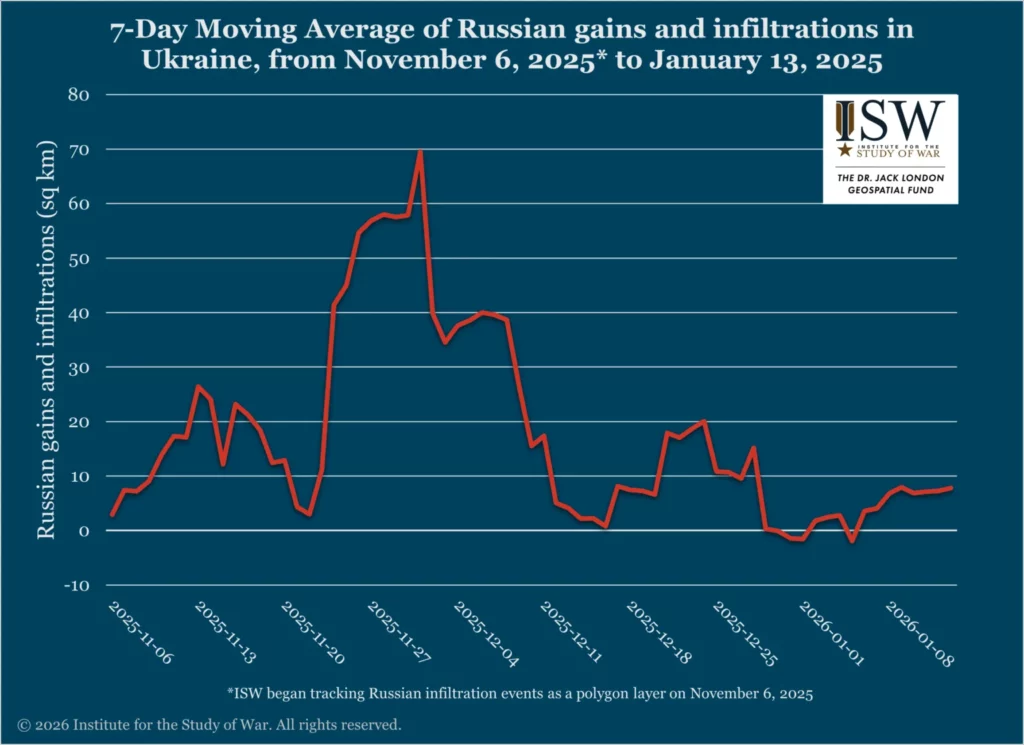
Russian advances slowed in late December 2025 and early January 2026, likely due to less advantageous winter weather conditions and the end of efforts to meet arbitrary deadlines at the end of the year. ISW observed evidence indicating that Russian forces increased their presence (either through infiltration missions or assaults) in 276.44 square kilometers of Ukraine between December 1 and 17; 89.05 square kilometers between December 17 and 31; and 73.82 square kilometers between December 31 and January 13. The 7-day moving average of Russian gains in late 2025 peaked on December 1 and 2 and then steadily declined through the end of the year. Russian forces were able to take advantage of poor weather conditions in Fall and early Winter 2025 that hindered Ukrainian drone operations to make relatively faster advances.[1] ISW previously noted, however, that these advantageous weather conditions were not permanent.[2] Russian forces are likely struggling to maintain this faster rate of advance as colder temperatures have set in, complicating Russian forces’ ability to successfully implement their new offensive template that heavily relies on infantry infiltration missions that must traverse dozens of kilometers of territory on foot with limited supplies.[3] Russian forces may also have initially increased their tempo of offensive operations in December 2025 in order to meet demands from the Russian military command to reach certain objectives by the end of the year.
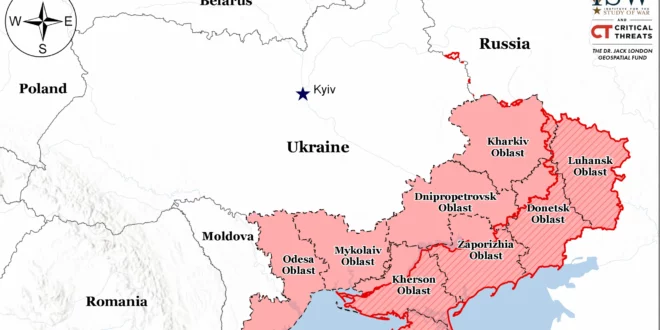
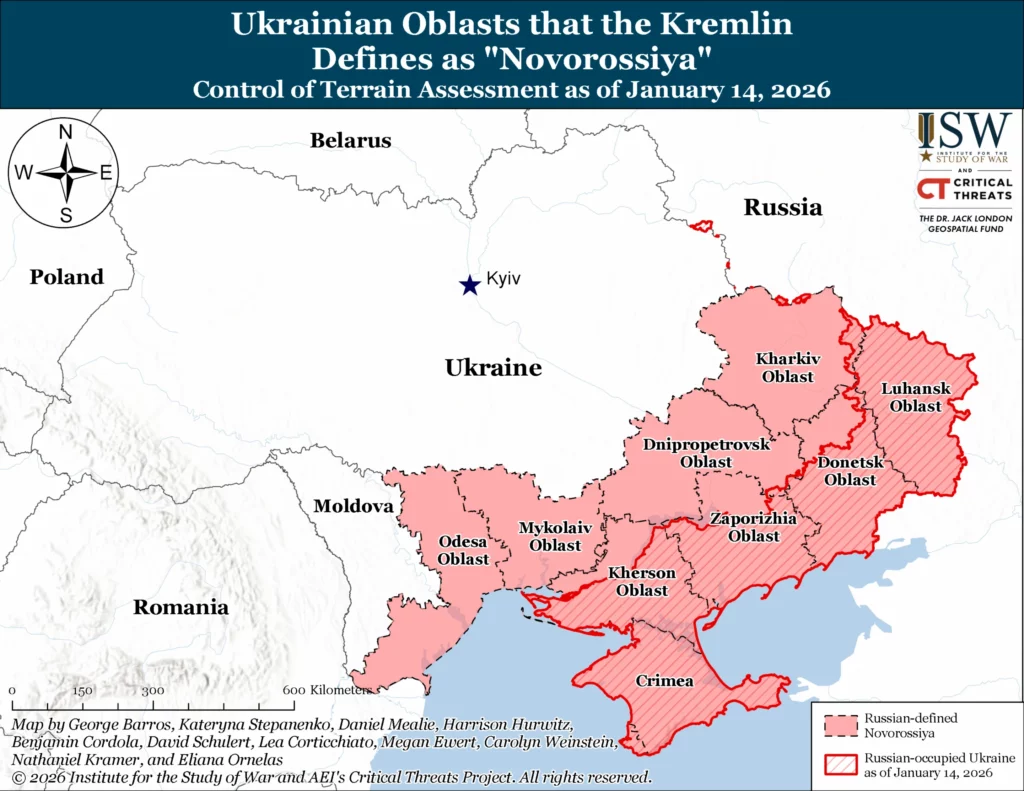
Russian Foreign Minister Sergei Lavrov indicated that Russia’s objectives in Ukraine go beyond the territory that is currently under discussion in the latest peace plans to include all of Kharkiv, Dnipropetrovsk, Mykolaiv, and Odesa oblasts. Lavrov stated on January 14 that a future peace settlement will need to resolve the “issue of the fate of the people living in Crimea, Novorossiya, and Donbas.”[4] Novorossiya is an invented region that Kremlin officials often claim is “integral” to Russia.[5] Novorossiya includes not only Crimea and the four oblasts that Russia has illegally annexed, but also Kharkiv, Dnipropetrovsk, Mykolaiv, and Odesa oblasts. Kremlin officials have repeatedly labelled Odesa City a “Russian” city and publicly discussed “Novorossiya” as a part of the Russian Federation.[6] The US-proposed 28-point peace plan only allowed for Russian occupation of Crimea, all of Luhansk and Donetsk oblasts, and the currently occupied parts of Zaporizhia and Kherson oblasts, requiring Russia to cede occupied territories outside of these five regions, including in Kharkiv, Mykolaiv, and Dnipropetrovsk oblasts.[7] Lavrov’s January 14 reference to Novorossiya is not a new demand but is further evidence that Russia’s demands are greater than those encapsulated in the original 28-point plan. Lavrov’s statement was likely an attempt to set conditions ahead of a possible upcoming meeting between US Special Envoy to the Middle East Steve Witkoff, former Senior Advisor to the US President Jared Kushner, and Russian President Vladimir Putin in Russia.[8]
Kremlin officials continue to insist that the United States, Ukraine, and Europe accept Russian demands, rejecting recent US-led peace efforts to find compromises to end the war. Lavrov claimed on January 14 that Russia is willing to negotiate with Europe but dismissed discussions of either a permanent or 60-day ceasefire.[9] Ukrainian President Volodymyr Zelensky has called for a temporary ceasefire to allow Ukraine to hold elections as a step toward ending Russia’s war.[10] Kremlin officials have repeatedly called for elections in Ukraine, yet Lavrov’s statement is a rejection of the very measures necessary for Ukraine to fulfill these demands.[11] Lavrov also claimed that a ceasefire would allow the West more time to support Ukraine, obfuscating the fact that the Kremlin has been delaying the peace process for months in order to protract the war and achieve Russia’s original war aims through military means.[12]
Russian State Duma deputies similarly dismissed the peace proposals currently under discussion within the US-led peace process. Duma Defense Committee Member Andrei Kolesnik stated that Russia is only open to negotiations with Europe about “something tangible,” “not just meaningless, formal documents,” possibly referring to the US-Ukrainian-European 20-point peace plan or agreements on security guarantees currently under discussion within the Coalition of the Willing.[13] Kolesnik stated that Europe must present approaches that Russia can “at least discuss.” Duma Deputy from occupied Crimea Mikhail Sheremet reiterated Kremlin statements that foreign troops sent to post-war Ukraine to guarantee a settlement would be “legitimate” targets for the Russian military.[14] Lavrov’s and the Duma deputies’ statements come against the backdrop of reports that four unspecified Duma deputies are going to meet with members of the US Congress to discuss peace talks in the near future.[15] The Kremlin statements continue to demonstrate that Russia is increasingly uninterested in discussing the agreements that have emerged from the peace process that US President Donald Trump has been leading since the presentation of the November 2025 28-point peace plan.
Russian forces are continuing their cognitive warfare campaign that uses small-scale cross-border attacks in previously dormant frontline areas in northern Ukraine to try to convince the West that the frontlines in Ukraine are collapsing. The Russian Ministry of Defense (MoD) claimed on January 14 that Russian forces seized Komarivka, a border settlement roughly 90 kilometers northwest of Sumy City and about 67 kilometers north of the main Russian salient in northern Sumy Oblast.[16] The Russian MoD claimed that the seizure is part of efforts to establish a “buffer zone” in northern Kharkiv and Sumy oblasts.[17] ISW has not observed evidence to confirm the MoD’s claim, and Russian milblogger reporting on the claimed seizure was limited. Select Russian milbloggers mostly amplified the MoD’s claim, with some attributing the alleged seizure to elements of the Russian 80th Arctic Motorized Rifle Brigade (14th Army Corps [AC], Leningrad Military District [LMD]).[18] The Kremlin began in late December 2025 a cognitive warfare campaign using cross-border attacks with the seizure of Hrabovske (southwest of Sumy City and immediately on the international border) and advances into Sotnytskyi Kozachok (northwest of Kharkiv City, immediately on the international border).[19] ISW continues to assess that the Kremlin likely aims to portray these limited cross-border attacks as a broad new Russian offensive that reinforces the Kremlin’s narrative that a Russian military victory in Ukraine is inevitable.[20]
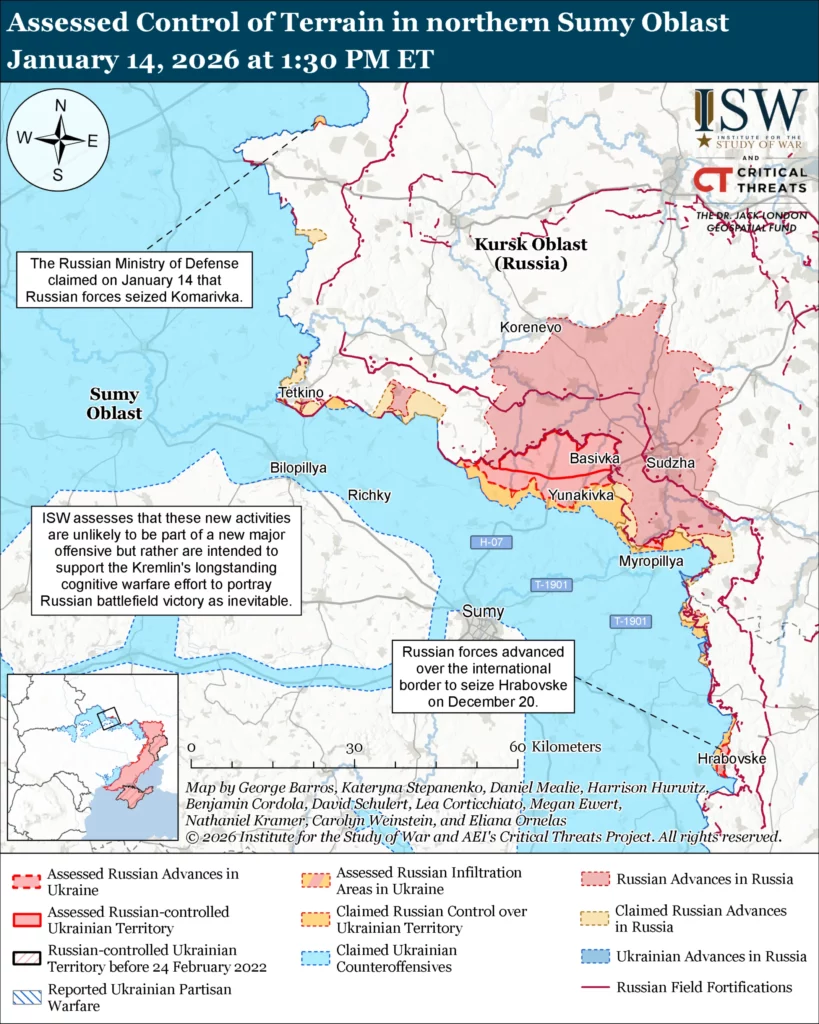
Russian forces have still not set conditions for a major ground offensive in northern Sumy or Kharkiv oblasts, however, and ISW continues to assess that these cross-border attacks are not part of a major Russian offensive. The frontline near Komarivka has been dormant since 2022, andISW has not observed any indicators that Russian forces have prepared to launch a significant new offensive into Ukraine from the north. Russian forces have not conducted a sustained battlefield air interdiction (BAI) campaign to degrade Ukrainian logistics to defensive positions and to prepare the battlefield for ground assaults along the international border in northern Sumy and Kharkiv oblasts, as Russian forces did in the Pokrovsk and Hulyaipole directions.[21] ISW also has not observed indications of a major redeployment of Russian forces to conduct such an offensive. ISW has most often observed reports of the 80th Arctic Motorized Rifle Brigade operating in Kherson Oblast, but elements of its 33rd Motorized Rifle Battalion have reportedly been operating in border areas in northern Ukraine since at least Winter 2024-2025.[22]
The recent Russian cross-border attacks near Hrabovske and Sotnytskyi Kozachok have not resulted in any notable Russian advances since they began on December 20 and 21, indicating that the Russian military command is not redeploying the additional forces that would be needed to conduct a major offensive in the area.[23] The areas that Russian forces have been targeting in these various cross-border attacks are small border villages, and Russian forces have not made significant advances toward any operationally significant objective. The Kremlin will nonetheless likely attempt to portray these limited cross-border attacks against rural villages as part of a broad new Russian offensive in order to reinforce the false narrative that Ukrainian defenses are collapsing across the theater and that a Russian military victory in Ukraine is inevitable.[24] ISW continues to assess that the frontlines in Ukraine are in no danger of imminent collapse — particularly as the rate of Russian advance has slowed in recent weeks.[25]
Russian Foreign Minister Sergei Lavrov highlighted Russia’s partnerships with Venezuela and Iran on January 14 while criticizing the Trump Administration’s recent actions in Venezuela. Lavrov stated on January 14 that Russia remains committed to maintaining strategic relations and agreements with Venezuela and condemned recent US military operations in Venezuela.[26] Lavrov also responded to potential US tariffs against countries doing business with Iran, stating that no third party can change the “fundamental nature of relations” between Russia and Iran. Lavrov claimed that the United States abandoned its principles, showing that the United States is “unreliable” and that its “competitive position” is “steadily deteriorating.” Russia has relied heavily on Iran for weapons supplies and technology, particularly to fuel Russia’s long-range drone strikes against Ukraine throughout the full-scale invasion.[27] Russia signed strategic partnership agreements with Iran and Venezuela in January and May 2025, respectively.[28]
The Ukrainian Verkhovna Rada approved several personnel changes within the Ukrainian government on January 14. The Rada approved former Minister of Digital Transformation Mykhailo Fedorov as the new minister of defense on January 14.[29] The Rada also approved former Ukrainian Defense Minister Denys Shmyhal as the new minister of energy and first deputy prime minister.[30] Ukrainian President Volodymyr Zelensky stated on January 14 that Fedorov will prioritize finding systematic solutions to Ukraine’s mobilization and recruitment problems, increasing Ukrainian air defenses, and auditing defense financing.[31] Zelensky stated that Fedorov will also focus on increasing drone supplies to Ukrainian forces, including by purchasing specialized drones to strike Russian forces at a greater depth from the front.
Polish officials reported that Russia conducted cyberattacks against the Polish energy grid in late December 2025. PolishDeputy Prime Minister and Digital Affairs Minister Krzysztof Gawkowski reported on January 13 that Russia launched a cyberattack on Poland’s energy infrastructure at the end of December 2025 that risked causing a blackout in Poland.[32] Polish Energy Minister Milosz Motyka stated that the attack was the largest cyberattack against Poland’s energy infrastructure in recent years, and targeted a thermal power plant and several renewable energy sources across Poland.[33] The Russian cyberattack is likely part of the Kremlin’s ”Phase Zero” campaign aimed at setting political, informational, and psychological conditions for a potential future war against NATO.[34]
Key Takeaways
Russian advances slowed in late December 2025 and early January 2026, likely due to less advantageous winter weather conditions and the end of efforts to meet arbitrary deadlines at the end of the year.
Russian Foreign Minister Sergei Lavrov indicated that Russia’s objectives in Ukraine go beyond the territory that is currently under discussion in the latest peace plans to include all of Kharkiv, Dnipropetrovsk, Mykolaiv, and Odesa oblasts.
Kremlin officials continue to insist that the United States, Ukraine, and Europe accept Russian demands, rejecting recent US-led peace efforts to find compromises to end the war.
Russian forces are continuing their cognitive warfare campaign that uses small-scale cross-border attacks in previously dormant frontline areas in northern Ukraine to try to convince the West that the frontlines in Ukraine are collapsing.
Russian forces have still not set conditions for a major ground offensive in northern Sumy or Kharkiv oblasts, however, and ISW continues to assess that these cross-border attacks are not part of a major Russian offensive.
Russian Foreign Minister Sergei Lavrov highlighted Russia’s partnerships with Venezuela and Iran on January 14 while criticizing the Trump Administration’s recent actions in Venezuela.
The Ukrainian Verkhovna Rada approved several personnel changes within the Ukrainian government on January 14.
Polish officials reported that Russia conducted cyberattacks against the Polish energy grid in late December 2025.
Neither Russian nor Ukrainian forces made confirmed advances on January 14.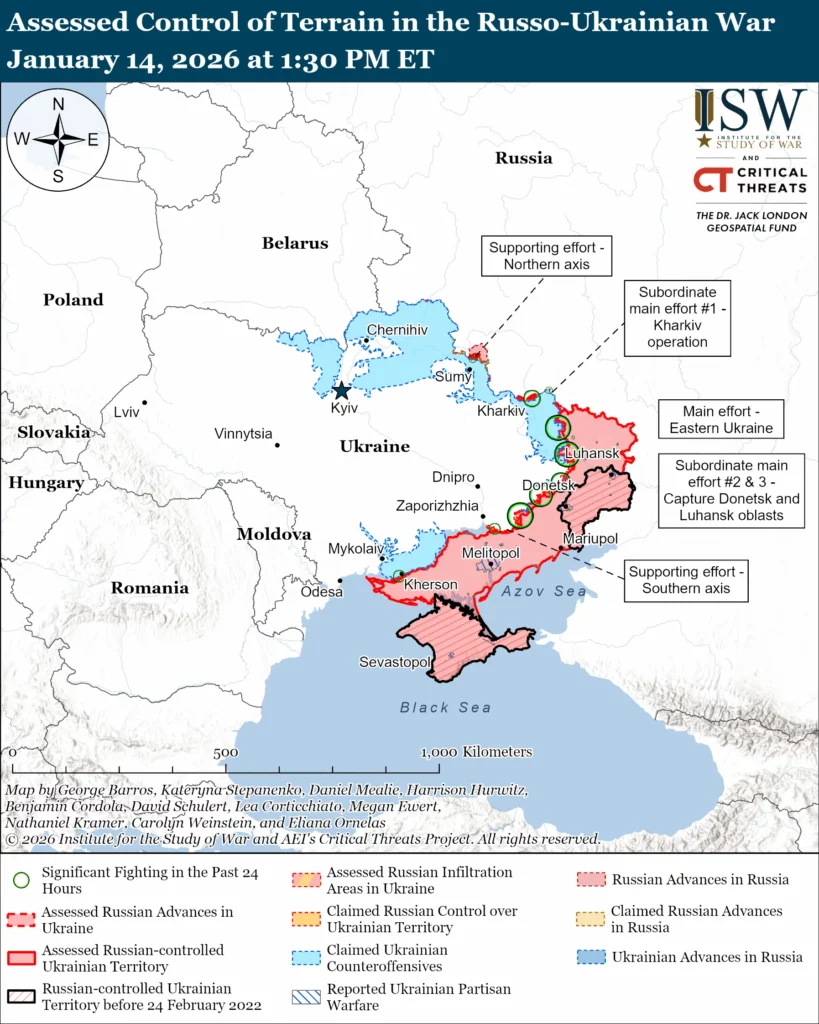
We do not report in detail on Russian war crimes because these activities are well-covered in Western media and do not directly affect the military operations we are assessing and forecasting. We will continue to evaluate and report on the effects of these criminal activities on the Ukrainian military and the Ukrainian population and specifically on combat in Ukrainian urban areas. We utterly condemn Russian violations of the laws of armed conflict and the Geneva Conventions and crimes against humanity even though we do not describe them in these reports.
Ukrainian Operations in the Russian Federation
Ukrainian forces continued their long-range strike campaign against Russian industrial infrastructure on the night of January 13 and 14. Russian opposition outlet Astra reported that likely Ukrainian drones struck an unspecified industrial zone in Rostov Oblast, causing fires.[35] Geolocated footage shows fires near the Empils varnish and chemical plant in Rostov City.[36] Rostov Oblast Governor Yury Slyusar acknowledged that Ukrainian drones struck industrial and residential infrastructure in Rostov City.[37] The Russian Ministry of Defense acknowledged on January 14 the Ukrainian drones struck the Matilda oil tanker in the Black Sea on January 13.[38]
Russian Supporting Effort: Northern Axis
Russian objective: Create defensible buffer zones in Sumy Oblast along the international border
Russian forces continued offensive operations in northern Sumy Oblast on January 14 but did not make confirmed advances.
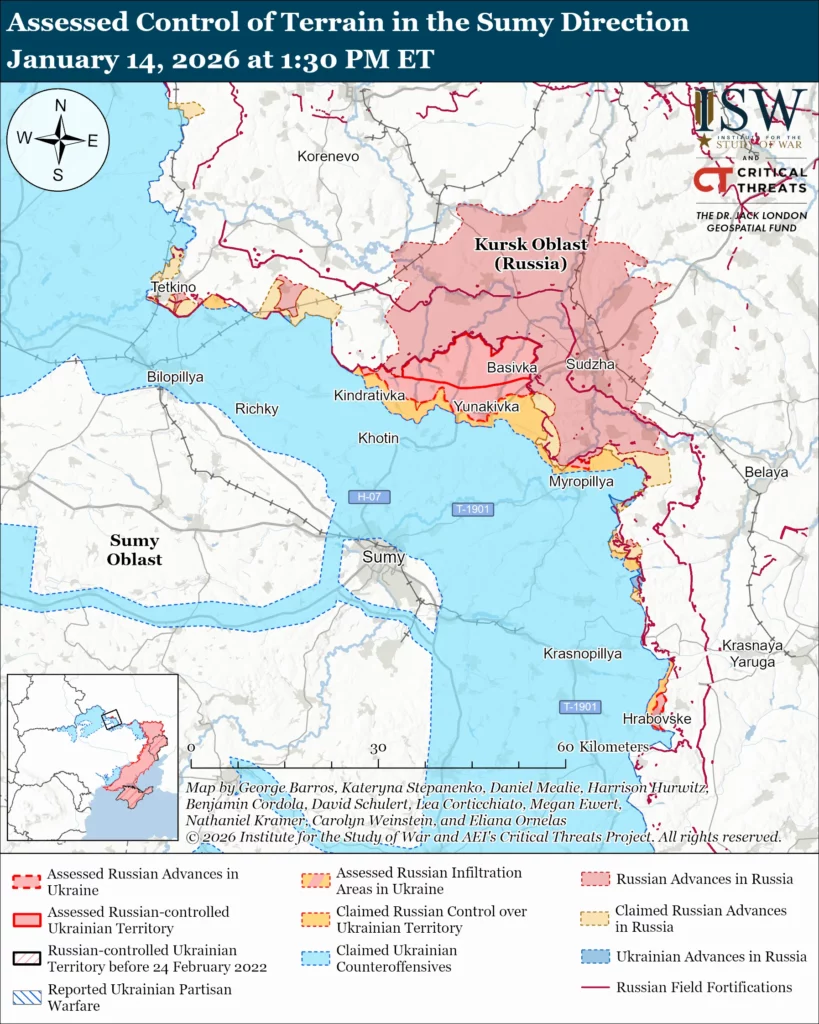
Russian forces attacked in Kursk and Sumy oblasts, including northwest of Sumy City near Komarivka; north of Sumy City near Andriivka and Kindrativka; northeast of Sumy City toward Myropillya and Yunakivka and near Plekhovo, Kursk Oblast; and southeast of Sumy City toward Krasnopillya and Ryasne on January 13 and 14.[39] A Russian milblogger claimed that Ukrainian forces counterattacked near Varachyne (north of Sumy City).[40]
Ukrainian 8th Airborne Assault Corps Spokesperson Vadym Karpak on January 13 rejected Russian claims that Russian forces seized Andriivka.[41] Karpak stated that Ukrainian forces control the settlement and regularly repel Russian attacks against Andriivka. Karpak acknowledged that some Russian infiltrators exploited bad weather a few days prior to infiltrating and seizing positions on the outskirts of Andriivka, but stated that Ukrainian forces detected and destroyed the Russian position.
Order of Battle: Drone operators of the Russian 106th Airborne (VDV) Division reportedly continue to strike Ukrainian forces in Sumy Oblast.[42]
Russian Main Effort: Eastern Ukraine
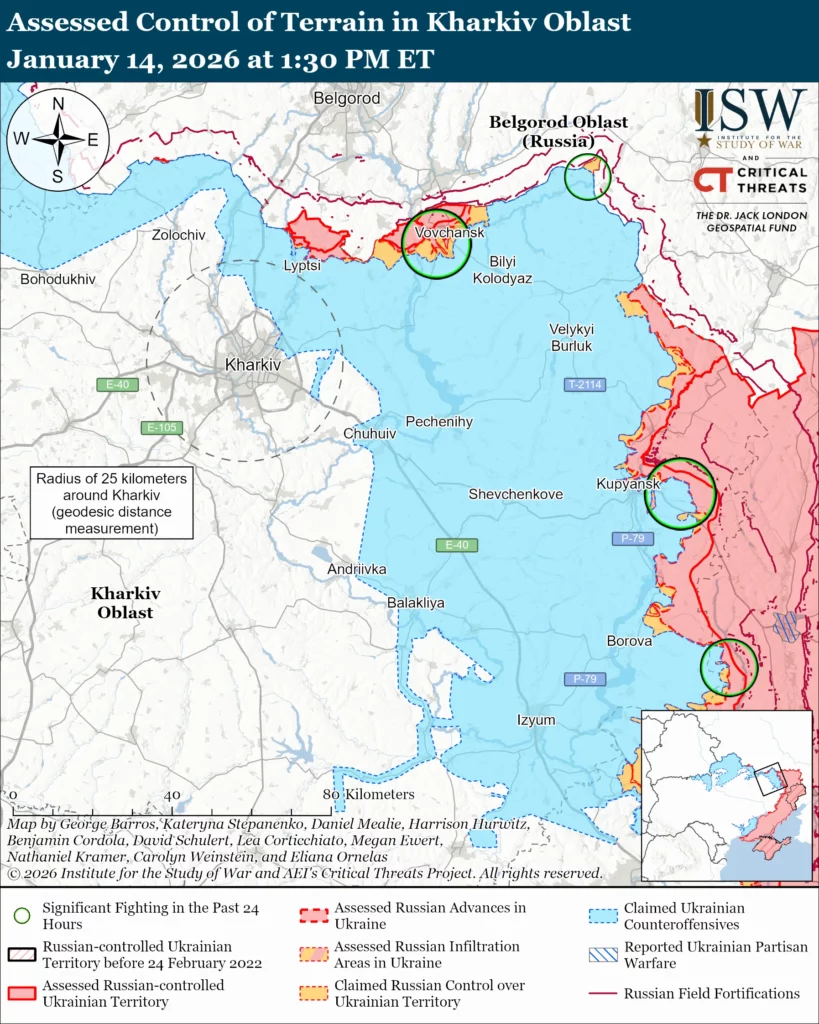
Russian Subordinate Main Effort #1 – Kharkiv Oblast
Russian objective: Push Ukrainian forces back from the international border to create a defensible buffer zone with Belgorod Oblast and approach to within tube artillery range of Kharkiv City
Russian forces continued offensive operations in northern Kharkiv Oblast on January 14 but did not advance.
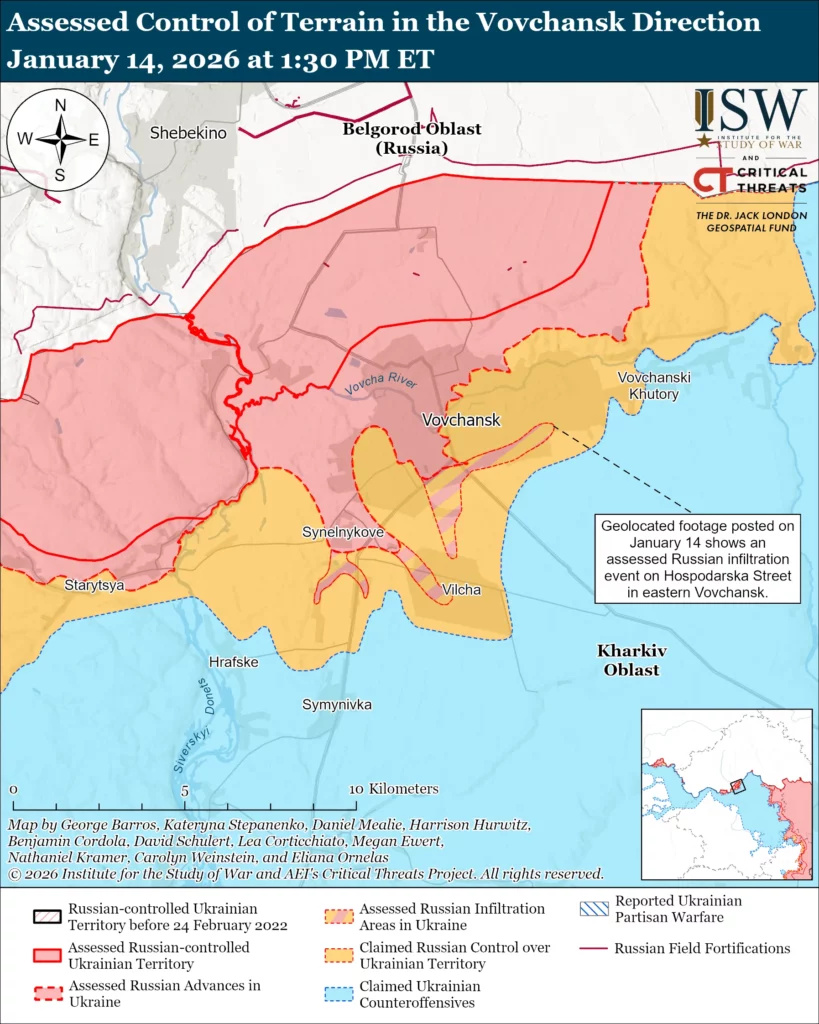
Assessed Russian infiltrations: Geolocated footage published on January 13 shows Ukrainian forces striking a Russian position in eastern Vovchansk (northeast of Kharkiv City) during what ISW assesses was a Russian infiltration mission that did not change the control of terrain or the forward edge of the battle area (FEBA) at this time.[43]
Russian forces attacked northeast of Kharkiv City near Vovchansk, Starytsya, Vovchanski Khutory, Zelene, Prylipka, Buhruvatka, and Dehtyarne, and toward Kruhle, Symynivka, and Hrafske on January 13 and 14.[44]
A Russian milblogger reportedly affiliated with the Russian Northern Grouping of Forces claimed on January 14 that the command of the Russian 128th Motorized Rifle Brigade (44th Army Corps [AC], Leningrad Military District [LMD]) is withholding fuel from its units after an inspection revealed missing fuel and supplies.[45] The milblogger claimed that the 128th Motorized Rifle Brigade’s 1st Battalion’s 3rd Company is withdrawing from Vovchansk to recuperate in occupied Luhansk after poor logistics and heavy fighting destroyed most of the company.
Order of Battle: First-person view (FPV) drone operators of the Russian 244th Artillery Brigade (11th AC, LMD) and of the 82nd Self-Propelled Artillery Regiment (68th Motorized Rifle Division, 6th Combined Arms Army [CAA], LMD) are reportedly striking Ukrainian forces in Kharkiv Oblast.[46]
Russian forces continued offensive operations northeast of Velykyi Burluk near Milove and Khatnie and southeast of Velykyi Burluk near Dvorichanske on January 13 and 14, but did not advance.[47]
Russian Subordinate Main Effort #2 – Oskil River
Russian objective: Cross the Oskil River in Kharkiv Oblast and push westward into eastern Kharkiv Oblast and northern Donetsk Oblast
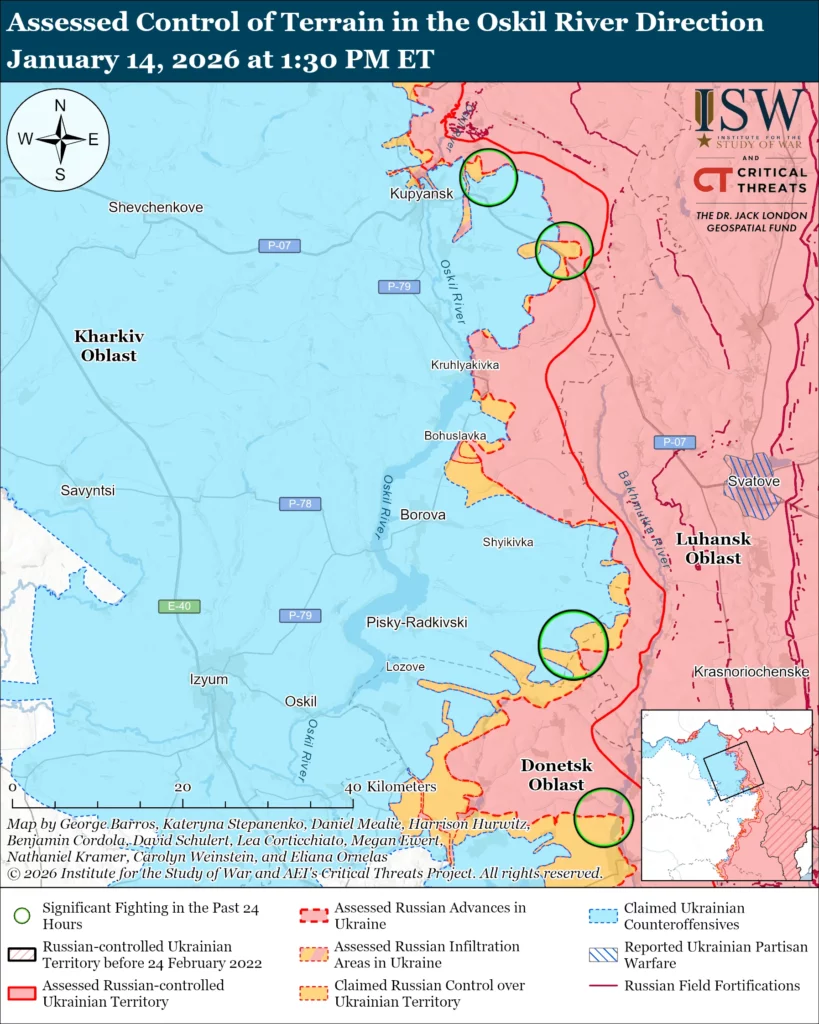
Russian forces continued offensive operations in the Kupyansk direction on January 14 but did not advance.
Russian forces attacked near Kupyansk itself; east of Kupyansk near Podoly and toward Petropavlivka; and southeast of Kupyansk toward Pishchane on January 13 and 14.[48] Russian milbloggers claimed that Ukrainian forces continue counterattacking in the Kupyansk area.[49]
One Russian milblogger claimed that Russian forces retain control over northern and eastern Kupyansk, while another milblogger claimed that Russian forces hold western and eastern Kupyansk.[50]
Footage published on January 14 shows Russian forces striking a Ukrainian bridge with FAB-500 glide bombs reportedly near Kupyansk-Vuzlovyi (south of Kupyansk).[51] Geolocated footage published on January 13 and reportedly from December 29 shows a Russian strike on a bridge in northern Kupyansk.[52] ISW continues to assess that Russian forces are targeting bridges in the Ukrainian near and operational rear as part of its ongoing battlefield air interdiction (BAI) campaign to degrade Ukrainian logistics and facilitate subsequent Russian offensive operations.[53]
Order of Battle: Drone operators of the Russian 68th Motorized Rifle Division (6th Combined Arms Army [CAA], Leningrad Military District [LMD]) are striking Ukrainian forces northwest of Podoly.[54] Drone operators of the Rubikon Center for Advanced Unmanned Technologies are reportedly striking Ukrainian forces near Prystin (south of Kupyansk).[55] Drone operators and other elements of the 352nd Motorized Rifle Regiment (11th Army Corps [AC], LMD) and of the 375th Separate Anti-Tank Artillery Battalion (47th Tank Division, 1st Guards Tank Army [GTA], Moscow Military District [MMD]) are reportedly operating in the Kupyansk direction.[56]
Russian forces continued offensive operations in the Borova direction on January 14 but did not make confirmed advances.
Unconfirmed claims: A Russian milblogger claimed that Russian forces advanced south of Oleksandrivka (south of Borova).[57]
Russian forces attacked toward Borova itself; northeast of Borova near Nova Kruhlyakivka; southeast of Borova near Novoyehorivka and Lypove; and south of Borova near Oleksandrivka on January 13 and 14.[58]
Russian Subordinate Main Effort #3 – Donetsk Oblast
Russian objective: Capture the entirety of Donetsk Oblast, the claimed territory of Russia’s proxies in Donbas, and advance into Dnipropetrovsk Oblast
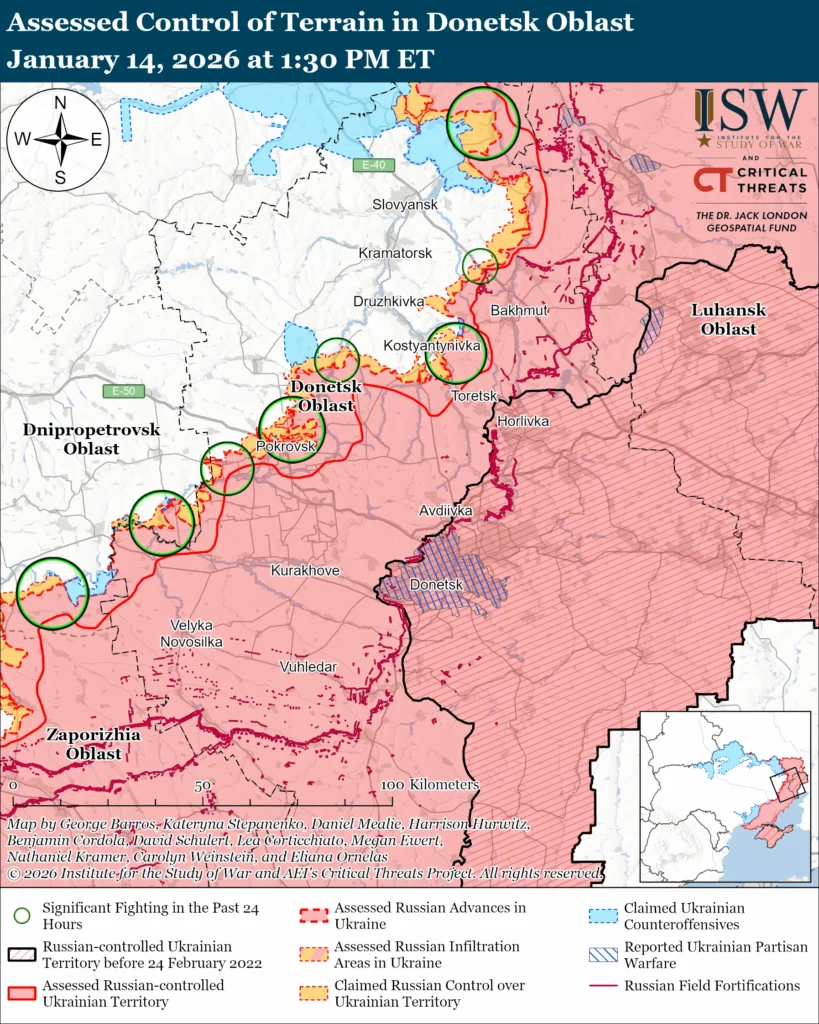
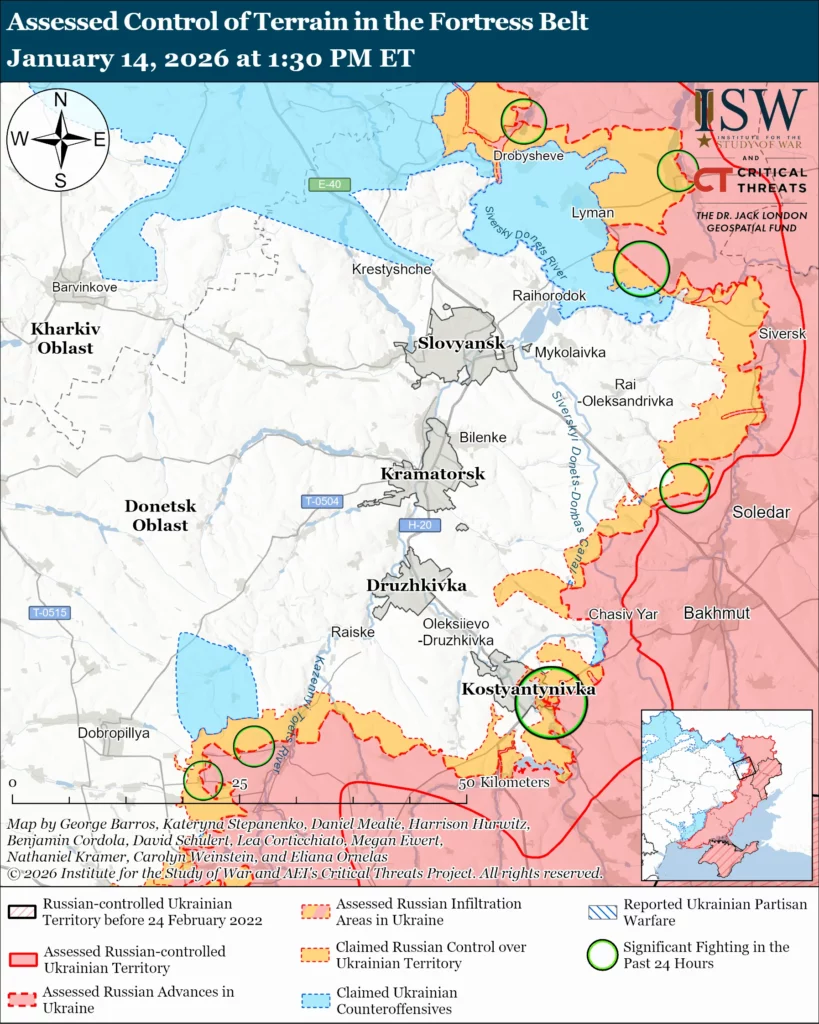
Russian forces continued offensive operations in the Slovyansk direction on January 13 but did not make confirmed advances.

Unconfirmed claims: A Russian milblogger claimed that Russian forces advanced south of Yarova and north of Svyatohirsk (both northwest of Lyman).[59]
Russian forces attacked near Lyman itself; northwest of Lyman near Yarova and Novoselivka and toward Svyatohirsk, Tetyanivka, and Pryshyb; northeast of Lyman near Kolodyazi; east of Lyman near Zarichne; southeast of Lyman near Dibrova; east of Slovyansk near Platonivka, Zakitne, and Svyato-Pokrovske and toward Riznykivka; and southeast of Slovyansk near Vasyukivka, Fedorivka, and Dronivka on January 13 to 14.[60] A Russian milblogger claimed that Ukrainian forces counterattacked near Dibrova.[61]
A Ukrainian brigade operating in the Slovyansk direction reported on January 14 that Ukrainian forces maintain positions within Svyato-Pokrovske (east of Slovyansk).[62] The brigade stated that Russian forces are trying to leverage poor weather to concentrate reserves and infiltrate the area with small infantry groups. The spokesperson of a Ukrainian brigade operating in the Lyman direction reported on January 14 that Russian forces are trying to infiltrate into Lyman and that the force ratio in the area is six or 10 to one in Russian forces’ favor.[63] The spokesperson stated that Russian forces likely aim to seize Lyman in order to gain control over its railway infrastructure to facilitate future offensive operations on Slovyansk. Ukraine’s Joint Forces Task Force reported that Ukrainian forces destroyed an unspecified number of vehicles and motorcycles near Yampolivka (northeast of Lyman) that Russian forces were preparing to use to intensify offensive operations in the area.[64] A Kremlin-affiliated Russian milblogger claimed that Russian forces aim to gain fire control over Ukrainian ground lines of communication (GLOCs) near Stavky (north of Lyman) to facilitate Russian attacks on Lyman from the north.[65] The milblogger claimed that reports of fighting on the outskirts of Lyman are unconfirmed.
Order of Battle: Drone operators of the Russian 123rd Motorized Rifle Brigade (3rd Combined Arms Army [CAA], formerly 2nd Luhansk People’s Republic Army Corps [LNR AC], Southern Military District [SMD]) are striking Ukrainian forces in Riznykivka (east of Slovyansk) and near Pazeno (southeast of Slovyansk).[66] Elements of the 752nd Motorized Rifle Regiment (3rd Motorized Rifle Division, 20th CAA, Moscow Military District [MMD]) reportedly continue to operate in the Lyman direction.[67] Elements of the 7th Motorized Rifle Brigade (3rd CAA) reportedly continue to operate along the Zakitne-Siversk line (east of Slovyansk).[68]
Russian forces recently infiltrated south of Kostyantynivka.
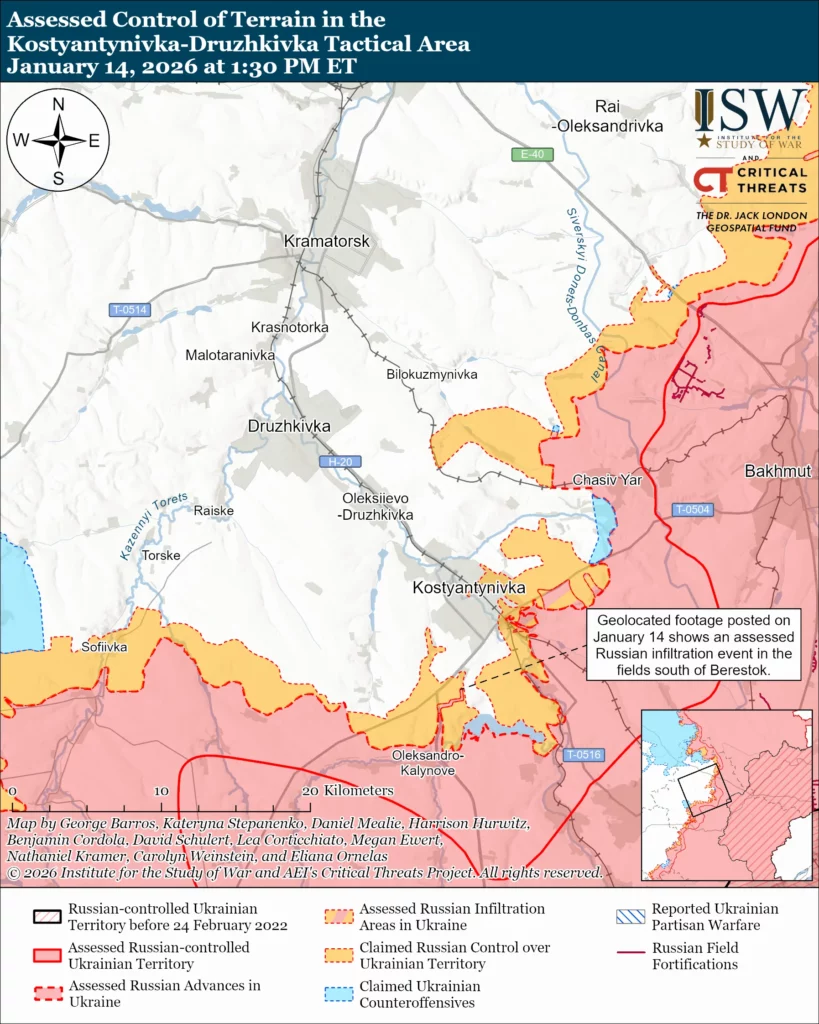
Assessed Russian infiltrations: Geolocated footage published on January 14 shows Ukrainian forces striking Russian forces south of Berestok (south of Kostyantynivka) after what ISW assesses was a Russian infiltration mission that did not change control of terrain or the forward edge of battle area (FEBA).[69]
Unconfirmed claims: A Russian milblogger claimed that Russian forces advanced west of Pleshchiivka (south of Kostyantynivka), south of Stepanivka (southwest of Kostyantynivka), and south of Novopavlivka (southwest of Druzhkivka).[70]
Russian forces attacked near and within Kostyantynivka itself; north of Kostyantynivka toward Virolyubivka; northeast of Kostyantynivka near Minkivka, Markove, and Mayske and toward Pryvillya; east of Kostyantynivka near Stupochky; southeast of Kostyantynivka near Oleksandro-Shultyne; south of Kostyantynivka near Pleshchiivka, Ivanopillya, Shcherbynivka, and Berestok; southwest of Kostyantynivka near Stepanivka and Yablunivka; and southwest of Druzhkivka near Sofiivka and toward Toretske and Pavlivka on January 13 and 14.[71] A Russian milblogger claimed that Ukrainian forces counterattacked near Mayske.[72]
The Kramatorsk City Council reported that Russian forces conducted guided glide bomb strikes and then Multiple Launch Rocket System (MLRS) strikes with cluster munitions against the city on the night of January 13 to 14, starting fires at residential buildings and commercial and industrial enterprises and killing one civilian.[73] A Russian milblogger claimed that Mayske is a contested “gray zone.”[74]
Order of Battle: Loitering munitions operators of the Russian 68th Separate Reconnaissance Battalion of the 20th Motorized Rifle Division (8th CAA, SMD) are reportedly striking Ukrainian vehicles near Toretske (southwest of Druzhkivka), Andriivka, and Varvarivka (both west of Druzhkivka).[75] First-person view (FPV) drone operators of the 58th Separate Spetsnaz Battalion (unofficially designated the Okhotnik [Hunter] Spetsnaz Detachment) (51st CAA, formerly 1st Donetsk People’s Republic [DNR] AC, SMD) are reportedly striking Ukrainian air defenses and communication equipment in the Kostyantynivka direction.[76]
Russian forces continued offensive operations in the Dobropillya tactical area on January 14 but did not advance.
Russian forces attacked northeast of Dobropillya toward Kucheriv Yar; east of Dobropillya near Novyi Donbas, Nove Shakhove, and Shakhove; and southeast of Dobropillya near Ivanivka, Zapovidne, Dorozhnie on January 13 and 14.[77]
Russian forces continued offensive operations in the Pokrovsk direction on January 14 but did not make confirmed advances.
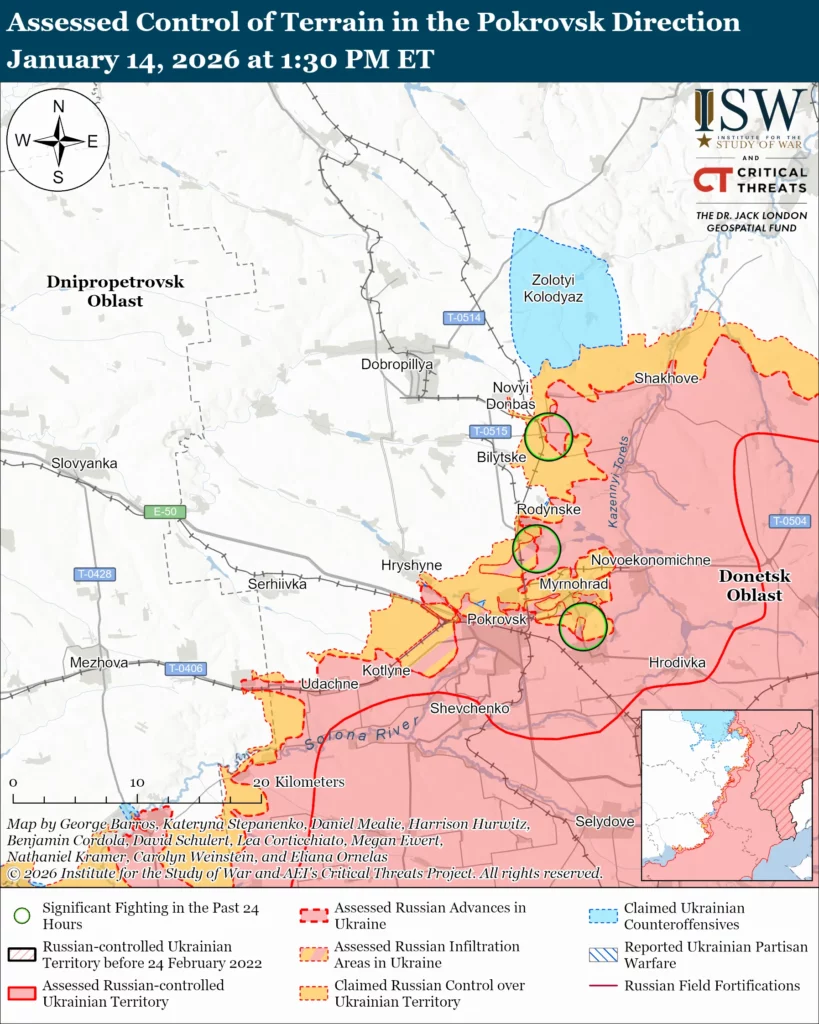
Unconfirmed claims: A Russian milblogger claimed that Russian forces advanced west of Rodynske (north of Pokrovsk).[78]
Russian forces attacked near Pokrovsk itself; northwest of Pokrovsk near Hryshyne; north of Pokrovsk near Rodynske and Bilytske; northeast of Pokrovsk near Fedorivka; east of Pokrovsk near Myrnohrad; and southwest of Pokrovsk near Udachne and Kotlyne on January 13 and 14.[79]
The commanding officer of a Ukrainian brigade operating in the Pokrovsk direction reported on January 14 that Russian forces have recently been conducting fewer assaults in Myrnohrad due to unfavorable weather conditions.[80] The commanding officer reported that there is no stable frontline in Myrnohrad, with constant fighting ongoing in most parts of the town. The commanding officer noted that there are Ukrainian and Russian positions interspersed within tens of meters of each other.
Order of Battle: Drone operators of the Russian 506th Motorized Rifle Regiment (27th Motorized Rifle Division, 2nd CAA, Central Military District [CMD]) are reportedly striking Ukrainian forces north of Pokrovsk.[81] Elements of the 5th Motorized Rifle Brigade (51st CAA, SMD) are reportedly operating in Myrnohrad.[82] Elements of the 9th Motorized Rifle Brigade (51st CAA, formerly 1st Donetsk People’s Republic Army Corps [DNR AC], SMD) reportedly continue to operate near Rodynske.[83] Artillery elements of the 1435th Motorized Rifle Regiment (likely comprised of mobilized personnel) (reportedly of the 2nd CAA, CMD) are reportedly operating in the Pokrovsk direction.[84]
Russian forces continued offensive operations near and within Novopavlivka itself; and south of Novopavlivka near Filiya on January 13 and 14, but did not advance.[85]
Russian forces continued offensive operations in the Oleksandrivka direction on January 14 but did not advance.
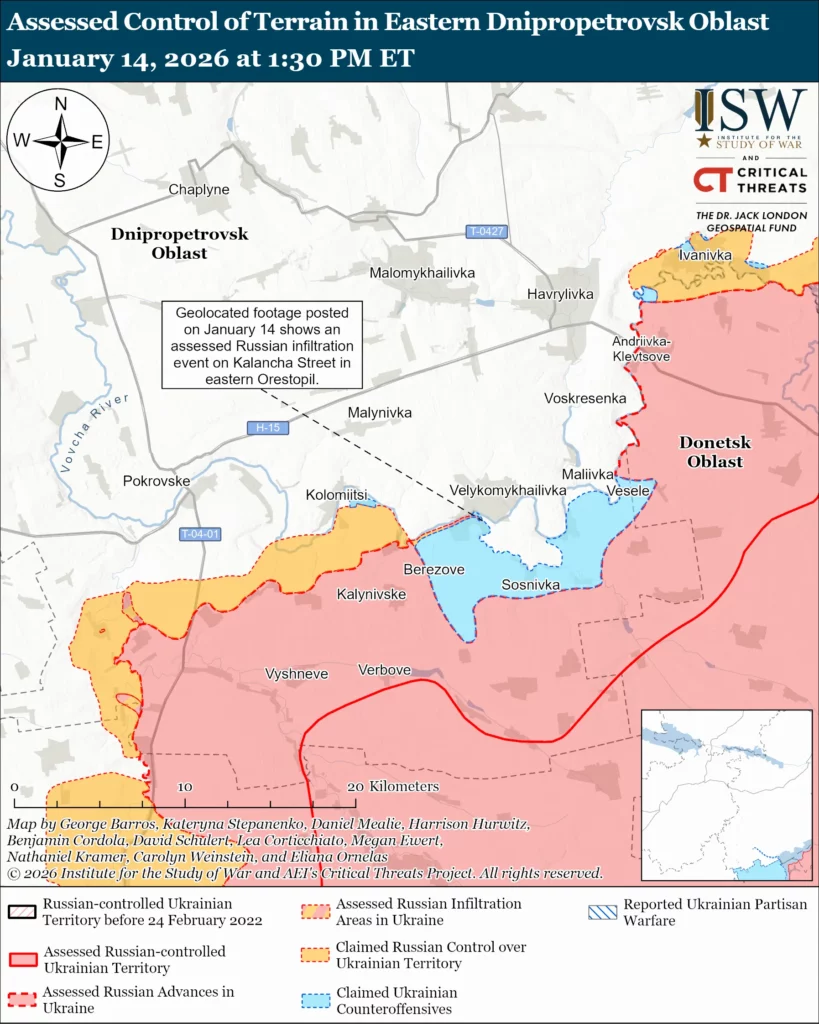
Assessed Russian infiltration: Geolocated footage published on January 14 shows Ukrainian forces striking Russian forces in eastern Orestopil (southeast of Oleksandrivka) during what ISW assesses was a Russian infiltration mission that did not change the control of terrain or the FEBA at this time.
Russian forces attacked northeast of Oleksandrivka near Ivanivka and Zelenyi Hai and southeast of Oleksandrivka near Sichneve on January 13 and 14.[86]
A platoon commander of a Ukrainian brigade operating in the Oleksandrivka direction reported on January 14 that Russian forces have shifted tactics, assaulting in units of four to five servicemembers that start 15 kilometers from the frontline and gradually leave supplies along the route before subsequently attacking.[87] The platoon commander reported that Ukrainian forces recently repelled a Russian mechanized assault in the Oleksandrivka direction.
Russian Supporting Effort: Southern Axis
Russian objective: Maintain frontline positions, secure rear areas against Ukrainian strikes, and advance within tube artillery range of Zaporizhzhia City
Russian forces continued offensive operations in the Hulyaipole direction on January 14 but did not make confirmed advances.
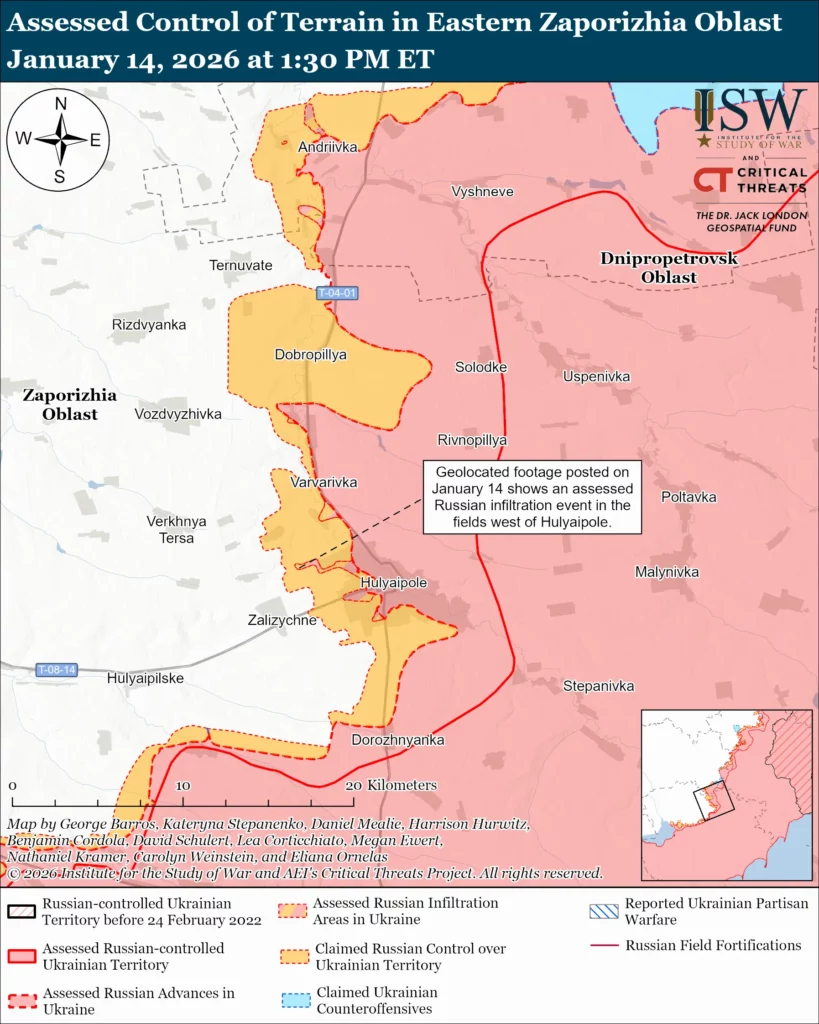
Assessed Russian infiltrations: Geolocated footage published on January 14 shows Ukrainian forces striking Russian positions west of Hulyaipole after what ISW assesses was a Russian infiltration mission that did not change the in control of terrain or the forward edge of the battle area (FEBA) at this time.[88]
Unconfirmed claims: A Russian milblogger claimed that Russian forces seized Pryluky (northwest of Hulyaipole) and advanced north of Zelene (north of Hulyaipole), south of Svyatopetrivka (northwest of Hulyaipole), and north of Dorozhnyanka (south of Hulyaipole).[89]
Russian forces attacked near and within Hulyaipole itself; northwest of Hulyaipole near Svyatopetrivka and toward Ternuvate and Vozdvyzhivka; north of Hulyaipole near Varvarivka, Zelene, Yehorivka, Nove Zaporizhzhia, and Dobropillya; and northeast of Hulyaipole near Zlahoda, Rybne, and Solodke on January 13 and 14.[90] Russian milbloggers claimed that Ukrainian forces counterattacked near Hulyaipole and Kosivtseve (northwest of Hulyaipole).[91]
Order of Battle: Drone operators of the Russian 14th Spetsnaz Brigade (Russian General Staff’s Main Directorate [GRU]) reportedly continue to strike Ukrainian forces in Zaporizhia Oblast, including near Hulyaipole.[92] Elements of the 11th Air Force and Air Defense Army (Russian Aerospace Forces [VKS] and Eastern Military District [EMD]) are reportedly striking Ukrainian forces near Barvinivka (northwest of Hulyaipole).[93] First-person view (FPV) drone operators of the 305th Artillery Brigade (5th Combined Arms Army [CAA], EMD) are reportedly striking Ukrainian forces in Zaporizhia Oblast.[94]
Russian forces continued offensive operations in western Zaporizhia Oblast on January 14 but did not advance.
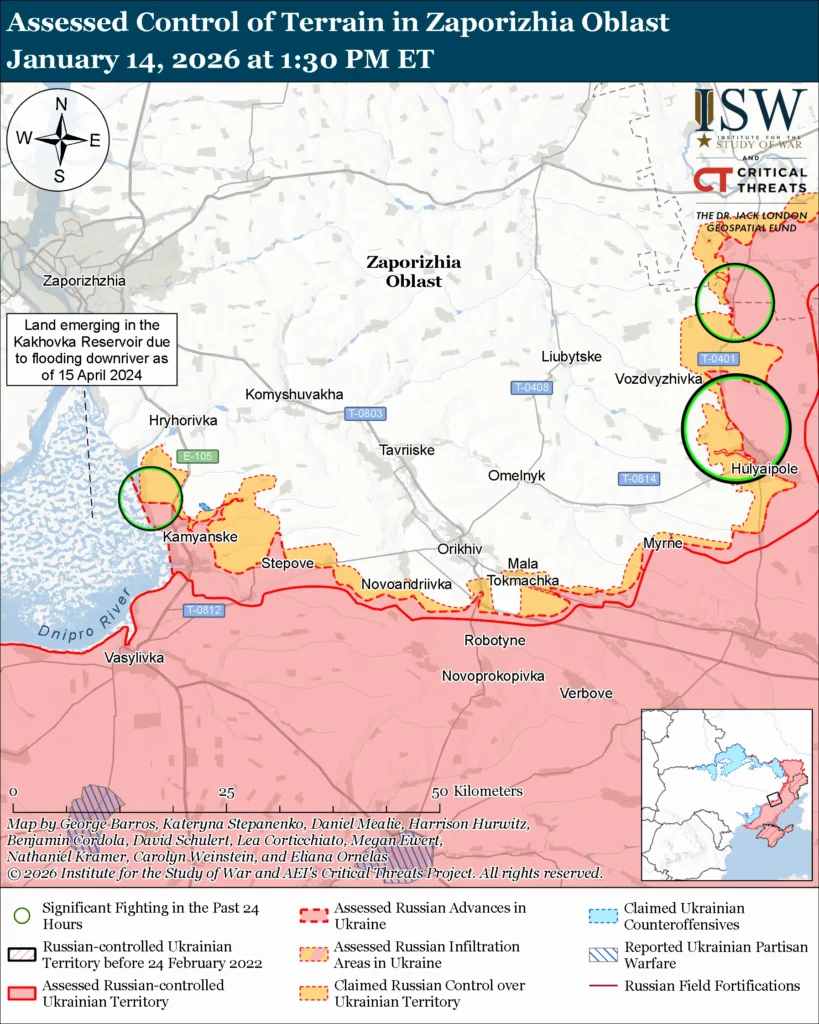
Russian forces attacked southeast of Orikhiv near Mala Tokmachka; west of Orikhiv near Prymorske, Shcherbaky, and Stepove; and northwest of Orikhiv toward Veselyanka, Mahdalynivka, and Novoyakovlivka on January 13 and 14.[95] A Russian milblogger claimed that Ukrainian forces counterattacked near Novoboikivske (northwest of Orikhiv).[96]
Order of Battle: Drone operators of the Russian 108th Airborne (VDV) Regiment (7th VDV Division) reportedly continue to operate in the Zaporizhia direction.[97]
Russian forces continued limited ground assaults in the Kherson direction on January 14 but did not advance.
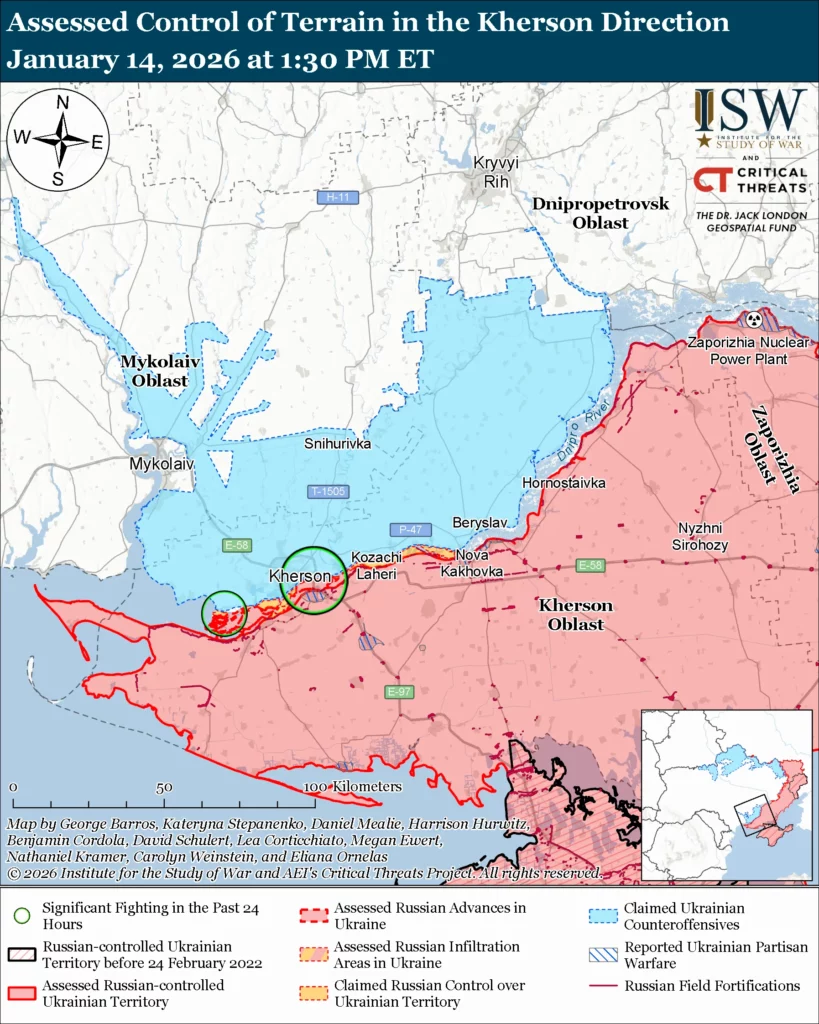
Russian forces continued limited ground assaults in the Kherson direction, including east of Kherson City near the Antonivskyi Bridge, on January 13 and 14.[98]
Ukrainian Kherson Oblast Military Administration Head Oleksandr Prokudin reported on January 13 that a Russian drone strike against a civilian car injured one in Kherson City.[99] Prokudin reported on January 14 that Russian forces struck a house and killed one civilian in Kizomys (southwest of Kherson City).[100]
Order Battle: Fiber optic crews and artillery elements of the Russian 98th VDV Division, including its 299th VDV Regiment, are reportedly operating in the Kherson direction.[101]
Russian Air, Missile, and Drone Campaign
Russian Objective: Target Ukrainian military and civilian infrastructure in the rear and on the front line
Russian forces conducted a series of drone and missile strikes against Ukraine on the night of January 13 to 14. The Ukrainian Air Force reported that Russian forces launched 3 Iskander-M ballistic missiles from Rostov and Voronezh oblasts and 113 Shahed-type, Gerbera-type, and other drones — of which about 70 were Shahed-type drones — from the directions of Kursk and Oryol cities; Millerovo, Rostov Oblast; Primorsko-Akhtarsk, Krasnodar Krai; and occupied Cape Chauda and Hvardiiske, Crimea.[102] The Ukrainian Air Force reported that Ukrainian forces downed 89 drones and one missile as of 0800 local time, that 24 drones and two missiles struck 13 locations, and that drone debris fell at three locations. The Ukrainian Air Force reported that Russian forces also launched 10 jet-powered drones targeting Kyiv Oblast between 0700 and 1700 local time, but that Ukrainian air defense downed all 10 drones.[103] Ukrainian officials reported that Russian forces struck energy, residential, and civilian infrastructure in Dnipropetrovsk, Kharkiv, and Kyiv oblasts.[104]
Significant Activity in Belarus
Russian efforts to increase its military presence in Belarus and further integrate Belarus into Russian-favorable frameworks
Nothing Significant To Report.