 Eurasia Press & News
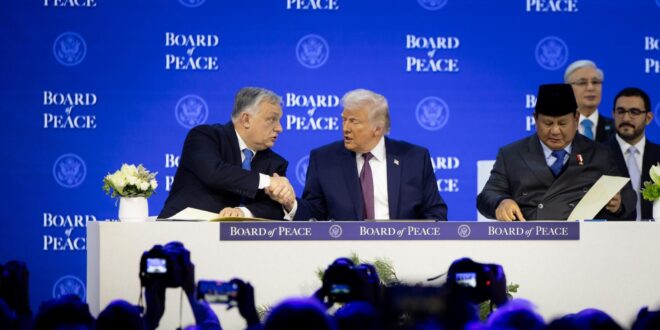
Hungarian PM Viktor Orban this week joined Donald Trump’s “Board of Peace” initiative as one of only two EU leaders to do so (alongside Bulgaria). Orban, who has stayed away from the World Economic Forum in Davos in recent years, traveled to Switzerland just to meet Trump and to visibly endorse his peace initiative – a new body aimed at promoting stability and helping to resolve conflicts and rebuild afterwards, initially focusing on Gaza but with ambitions to address other global disputes as well. However, many observers see it as potentially undermining existing international organisations such as the UN. Hungary’s official accession to the new body is still pending parliamentary approval and would not entail any financial commitment, according to a government resolution published in the national bulletin. As part of his charm offensive (probably also to encourage Trump to visit Hungary during the upcoming election campaign), Orban posted a photo of himself shaking hands with Trump, accompanied by the comment: “At the request of U.S. President Trump, Hungary has become a founding member of the Board of Peace.” Orban reiterated that his government supports “all international initiatives that can prevent wars and guarantee the security of the country.” His chief of staff, Gergely Gulyas, struck a more cautious tone, acknowledging that it remains to be seen how – and to what extent – this new initiative can contribute to peace, but adding that it is worth attempting.
Poland has been less forthcoming. On Wednesday afternoon, Polish President Karol Nawrocki met Trump on the sidelines of Davos. The meeting was closed to the press. Speaking shortly afterwards to the Polish media, Nawrocki said the two leaders focused mainly on security, and that Trump reaffirmed his commitment to “security guarantees for Poland and the presence of US troops in Poland.” The conversation also touched on economic issues, the G20 and the Board of Peace. Nawrocki is among around 60 world leaders invited to join the board, but has so far stopped short of providing a definitive answer. He has appeared visibly uneasy about the initiative. Earlier this week, his chief international policy adviser, Marcin Przydacz, commented that the body was expected to include “individuals or politicians with whom the Polish president has absolutely nothing in common,” adding pointedly that “Vladimir Putin is certainly one such politician.” In a rare attempt at coordination between the presidential palace and the government – a dynamic more common in foreign policy than at home – Nawrocki personally reached out to PM Donald Tusk to consult on the issue, and requested a formal opinion from Foreign Minister Radoslaw Sikorski. Under the constitution, Poland’s participation in international bodies requires the consent of both the government and parliament, but in this case the move appeared to be more than a procedural formality. Commentators suggest the two centres of power are deliberately dividing roles in dealings with Washington, reprising a familiar good-cop-bad-cop routine. In this case, Tusk, whose relationship with Trump has long been strained, provided Nawrocki with constitutional cover to hold off on making a decision, while the president shook Trump’s hand and talked up the bilateral relationship. The lines of this informal division of labour in Polish foreign policy have been taking shape for months. The government has focused on the EU and Ukraine, while Nawrocki has taken on the role of courting Trump. “Without a doubt, Poland’s relationship with the United States – also thanks to our personal relationship with the president – is better than that of many other European countries,” Nawrocki said after the meeting. Several hours later, his adviser Przydacz announced that while the president would attend Thursday’s inaugural meeting of the Board of Peace, he would not sign the declaration. Poland, he said, nevertheless expressed “a degree of interest in the initiative itself and in continued cooperation with the United States.”
Slovak PM meets Trump after nuclear deal signed; anti-corruption campaigner detained
Another Central European leader to have a sit-down with Trump in the past week was Slovak PM Robert Fico, though it was at the US president’s Mar-a-Lago estate in Florida rather than in the Swiss mountains. The White House issued no official statement after the meeting on Saturday, and the meeting was not a state visit. Fico portrayed the encounter as proof that his government’s sovereign, multi-directional foreign policy “is bearing fruit”, rejecting claims that Slovakia is becoming internationally isolated. He said the talks focused on the EU, migration, energy and the war in Ukraine, adding that US representatives were interested in Slovakia’s views because it was “not a Brussels parrot”. The meeting was attended by Slovak Foreign Minister Juraj Blanar and US Secretary of State Marco Rubio, and followed the signing in Washington of an intergovernmental agreement on cooperation in civilian nuclear energy. Since returning to power in late 2023, Fico has pursued a foreign policy that often diverges from that of other EU leaders. Over the past year, he has met Russian President Vladimir Putin and China’s Xi Jinping, while criticising EU sanctions on Russia and opposing military aid to Ukraine. Opposition parties argue this approach is weakening Slovakia’s credibility and influence within the EU. Political observers suggest the Florida meeting may serve primarily domestic political purposes ahead of parliamentary elections scheduled for 2027.
Slovak opposition politician and anti-corruption campaigner Zuzana Subova was detained by police on Monday following a day-long search at her home in Bratislava. She was taken in for questioning and released later the same day without charge. Police and prosecutors have not said whether she has been formally accused of anything. The investigation relates to alleged stalking following a criminal complaint filed in November 2023 by Jozef Kiss, head of Slovakia’s Financial Administration and former director of the Agricultural Paying Agency. Subova, who used to head the anti-corruption department at the agency, has been one of Kiss’s most outspoken public critics, repeatedly accusing him of covering up fraud in the distribution of EU agricultural subsidies. The opposition party Demokrati, with whom Subova’s extra-parliamentary Pirate Party of Slovakia closely cooperates, described the police action as an attempt to intimidate a whistleblower. They pointed to the timing of the search, which took place just days before Subova was due to testify before the European Parliament’s budgetary control committee on alleged misuse of EU funds, including the so-called “villa grants” scandal. Subova has denied all the allegations, arguing she has no reason to act anonymously, as she has long submitted criminal complaints and spoken publicly under her own name. Police have rejected claims of political motivation, stating the search was carried out on the basis of a court warrant. The police chief has ordered a review of the operation. The case has drawn reactions from opposition figures and Czech MEP Tomas Zdechovsky, who have raised concerns about possible intimidation of anti-corruption critics.
Czech president, govt differ over aircraft sale to Ukraine; Russia praises political change
In one of the first cases showing fundamental foreign policy differences at the highest level of Czech leadership since the new government took office in December, President Petr Pavel and the ruling coalition led by PM Andrej Babis have crossed swords over the possible sale of four L-159 military aircraft to Ukraine. During a visit to Kyiv last weekend, where he was awarded the country’s highest state decoration by President Volodymyr Zelensky, Pavel backed the idea of selling four of Czechia’s 24 L-159 aircraft to bolster Ukraine’s air and anti-drone defences, arguing the sale would not radically undermine Czechia’s own defence capabilities and would also present a good opportunity for the domestic defence and aviation industry’s clout. Government representatives quickly opposed the move. “We don’t decide about the aircraft, the army decides, and the army decided that it needs the aircraft,” Babis said, pointing to the position previously expressed by Defence Minister Jaromir Zuna. The plans were also criticised by house speaker and far-right leader Tomio Okamura as well as Foreign Minister Petr Macinka, chairman of the Motorist party, who accused the head of state of behaving “like a bull in a china shop” by failing to consult with the government over the issue. Pavel – a former Czech and NATO general – hit back, claiming the sale represented an acceptable risk and that the government’s refusal moved the country closer “to selfishness than to solidarity”. Opposition politician and chairman of the house’s defence committee Josef Flek said: “Ukraine has been asking for these aircraft for months, and an expert opinion confirms that their limited sale is possible.”
Meanwhile, Russian Foreign Minister Sergei Lavrov said on Tuesday the Czech Republic was among the European countries where “healthy forces” focused on their own national interests had awoken, alongside the likes of Hungary and Slovakia. While not overtly pro-Russian, the new coalition government has pledged to reduce support for Ukraine and includes strong EU-sceptic and anti-NATO elements – naturally a welcome development seen from Moscow. “In general, this fits into the behaviour and tactics of the Kremlin, consisting in seeking friendly forces across the European continent… and undermining mainstream voices in European politics,” Karel Havlicek, an analyst at the Prague-based Association for International Affairs, told the Czech News Agency. Since coming to power, the Czech government nevertheless pledged to continue coordinating the ammunition initiative for Ukraine, a U-turn from the PM’s campaign promises, but will not directly contribute any more funds to the scheme. “Nonsense,” Babis said on Thursday in reaction to Lavrov’s comments, adding that the Czech security and foreign policy “is still the same. These are statements that I don’t even need to comment on.” Experts nevertheless note that while the Czech position was “clear, unified and anti-Russian” under the previous government, the stance of the new ruling coalition – which includes the pro-Russian far-right SPD party – is now more nuanced.
Hungary’s Tisza party recruits top manager as economy boss
Hungary’s leading opposition party Tisza has recruited former Shell vice president Istvan Kapitany (the Hungarian word for “captain”), the highest-ranking Hungarian international corporate executive, as its chief economic and energy policy expert. At 63, Kapitany brings decades of global management experience and an extensive international network – assets seen as essential for building market confidence in a prospective new government that hopes to take power after the April 12 parliamentary election. It is widely expected that Kapitany would head a newly created “super-ministry” responsible for both the economy and energy. In a lengthy interview, the former top executive recalled that Shell’s V-Power fuel was developed by Hungarian engineers and introduced onto the market at the end of the 1990s, before being rolled out worldwide, eventually accounting for roughly 20 per cent of Shell’s global sales. He cited this as evidence that Hungary has the intellectual capacity to become far more than a mere manufacturing base for foreign companies. Kapitany also argued forcefully for increased competition, reduced government intervention, and stronger support for small and medium-sized enterprises. He criticised the generous tax incentives granted to multinational corporations, which he said amount to nearly 3 per cent of Hungary’s GDP, compared to an EU average of around 1 per cent. Following his recruitment, Kapitany was swiftly attacked by the government and pro-government media as a “globalist”, despite the fact that he had received an award from Foreign Minister Peter Szijjarto only two years ago for his outstanding contribution to the Hungarian economy. His coming onboard Tisza sends a strong signal to the markets that economic policy would be steered by a professional. Although Kapitany has never held political office, supporters point out that he brings substantial real-world business experience, something most Fidesz ministers lack, who have never worked in the competitive market economy.
No more special support for Ukrainian refugees in Poland
The Polish government approved draft legislation that would phase out the special support regime for Ukrainian refugees introduced after Russia’s full-scale invasion. After four years in force and with the situation “stabilised”, the Interior Ministry said Poland would move towards “systemic, equal rules for all foreigners” in areas such as healthcare, social benefits and employment. The bill would need parliamentary approval and the president’s signature before entering into force on March 5. Some forms of special support would end immediately, while others would be gradually withdrawn by March 2027. Under the new proposal, Poland would introduce a single, unified support system for all foreigners under temporary protection, regardless of nationality. In healthcare, Ukrainians would gradually transition to rules similar to those applying to Polish citizens, based on insurance contributions, with exemptions maintained for children, pregnant women, victims of violence, wounded soldiers and emergency cases. Access to free healthcare for uninsured individuals would be significantly reduced, aligning their status with that of uninsured Polish citizens. Special forms of assistance in schools, including additional Polish-language classes and intercultural assistants, would also end after the current school year. Ukrainians would no longer be able to start businesses under preferential rules. The Helsinki Foundation for Human Rights criticised the changes, warning of insufficient protection for vulnerable groups. While the draft law includes exemptions, the foundation said their scope is too narrow, calling for additional safeguards for large families and survivors of torture or violence.