 Eurasia Press & News
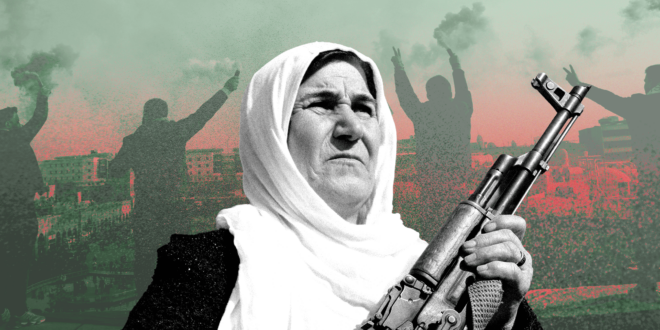
With the Autonomous Administration retreating back into the confines of Hasakah province, the project is reverting to its earliest form: a structure rooted in the Kurdish street. The Syrian Democratic Forces (SDF) have all but collapsed, leaving the People’s Protection Units (YPG) to stand alone. Amid widespread fear of massacres—after a year in which Syrians across the map endured horrors—Syrian Kurds are rallying around the SDF as the last representative of their political aspirations, and, more urgently, as their shield against the specter of extermination.
Today, the Autonomous Administration faces an existential question. After losing Raqqa and Deir ez-Zor, and withdrawing to the Kurdish-majority pockets of Hasakah and Kobani following the collapse of negotiations with Damascus, Syrian Kurds declared a general mobilization and an “existential battle” of self-defense. But what are the real prospects of survival in a zero-sum confrontation? Are we witnessing the definitive end of the Autonomous Administration and the “Democratic Nation” model derived from Abdullah Öcalan’s “Fraternity of Peoples” doctrine?
Since its establishment in 2012, the Administration has embodied two parallel—and often contradictory—projects:
First: a vessel for Kurdish political aspirations inside Syria.
Second: a Syrian political actor seeking a seat at the table and a role in shaping the region.
The second project overshadowed the first with the arrival of the international coalition and the formation of the SDF. The Administration expanded beyond Kurdish ambitions, attempting to become a central player in the Syrian equation. Ironically, this expansion later reinforced its legitimacy among Kurds themselves. Yet a closer look reveals a project riddled with contradictions, where liabilities often outweighed achievements. This article does not weigh pros and cons; it examines the internal structure—and the meaning—of its collapse.
“Direct Democracy”
The Autonomous Administration was built on the concept of communes: micro-societies—local councils—nested within neighborhoods, which then form committees. Its institutions operate through a gender-balanced co-presidency system and grant women a central role, with quotas reaching fifty percent.
Crucially, the system prioritizes the organic formation of these structures over professional competency. Expertise, efficiency, and institutional output often mattered less than ideological commitment. The underlying idea was that society should be broken into decentralized micro-cells capable of managing their own affairs through “direct democracy,” with the “Fraternity of Peoples” serving as the formula for ethnic and sectarian coexistence through cooperatives.
But translating Öcalan’s late-period theories into practice proved difficult. The model struggled to take root, especially in communities unfamiliar with its intellectual foundations or skeptical of its ideological underpinnings.
In Arab-majority areas, the project faced a dual crisis. First, it was seen as a Kurdish project infused with the ideology of the PKK and its founder, Abdullah Öcalan—an external, separatist project with an occupying character. The presence of PKK cadres—Syrian Kurds who had volunteered years earlier or non-Syrian Kurds who joined the project—deepened this perception.
Second, the lack of local familiarity with Öcalan’s theoretical framework, combined with a perpetual state of war that inflamed nationalist sentiment, produced an authoritarian, unresponsive mode of governance. The ruling party marginalized opponents and governed unilaterally. Even during the U.S. intervention—when the Administration maintained a degree of civil peace and attempted to build a balanced governance system—militia-like practices persisted: arbitrary arrests, violations, forced conscription, and enforced disappearances.
A Collision with Tribal Societies
The second major challenge was the Administration’s collision with tribal communities that rejected what they viewed as Marxist, progressive, and alien ideas. Numerous studies documented widespread Arab rejection of the SDF across al-Jazira. Complaints were frequent about what locals described as the SDF’s “incitement” of women and girls against their families. Social pressure forced many women working in the Administration’s civilian and military institutions to withdraw.
Resistance to the educational curriculum was also widespread—not only due to its ideological content but also accusations of “promoting atheism.” Objections extended to the ban on polygamy and to women’s protection institutions that received domestic violence complaints.
These tensions surfaced dramatically during the recent advance of “tribal fighters” and soldiers from Damascus into Raqqa and Deir ez-Zor, when locals toppled a statue of “Hêvîna Ereb”—“Hope of the Arabs”—the first Arab woman killed fighting ISIS. Rahaf al-Salmo of Tal Hamis, who joined the fight for four years before her death, symbolized not only the SDF but the suffering of countless women under ISIS rule.
The destruction of her statue was more than an attack on a political symbol. As videos showed, it mocked the very notion of women’s rights championed by the SDF—raising profound questions about the fate of women under the rule of Damascus and its allied armed groups.
The Zero-Sum Scenario
With the Autonomous Administration shrinking back to Hasakah, the project returns to its original Kurdish core. The Kurdish street—and most Kurdish political forces—never sought to dismantle the project. On the contrary, they accepted it as a structure that spared the region civil war where possible, even as they demanded broader political space and greater inclusivity.
Since the fall of the Assad regime, the Administration’s primary goal has been to preserve its societal gains. It offered a social contract in which women enjoyed rights surpassing those in many Middle Eastern states. For Kurds, it was the first model that approximated their dream of living as Kurds—with their national identity recognized—and provided them with security amid an era of massacres.
For the Administration, the collapse of negotiations is not merely about surrendering weapons or integrating into a sectarian, ideological army accused of atrocities. It is about clinging to the dream of living with their true identity—an identity not granted by Decree No. 13 issued by Acting President Ahmed al-Shar on the eve of the assault on their areas, a decree that would return them to the pre-2011 era.
For Kurds, the SDF’s weapons protect these gains—not only from extermination but from political erasure. The alternative to the Autonomous Administration—an alternative Damascus demands be dismantled entirely—is a political vacuum and the disappearance of Kurdish political agency.
The Administration will likely reconstitute itself among its remaining adherents, even if after a period of fragmentation. For at its core, the project is not merely an armed group seeking power (the SDF), but a human collective seeking political agency and defending its existence (the Autonomous Administration and the YPG).
If the zero-sum battle continues—the worst-case scenario—the result may resemble what happened in Suweida and the coast: the further isolation of Kurds from Syria, just as other communities rejecting government authority were isolated. This path leads toward multiple Syrias—not one—each stripped of the ability to engage politically with the others.