 Eurasia Press & News
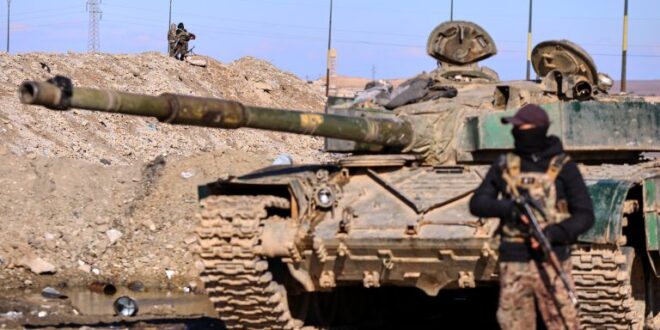
Despite the announcement of a ceasefire between the Syrian government and the Syrian Democratic Forces (SDF), the Kurdish militia said that fighting continues near Raqqa, and that clashes are leading to an “extremely dangerous development,” which leaves prisons and detention centers vulnerable.
While it is unclear how many individuals have escaped from al-Shaddadi prison, Damascus has vowed to find and arrest those individuals.
The fighting over the past few weeks saw Syrian military forces, augmented by tribal militias, capturing towns and villages long controlled by Kurdish forces.
In online pro-Islamic State chat forums, there is both outrage about SDF abuses against children and women during the recent clashes, while excitement about the future of the different camps in Northeast Syria is also growing, with many calling to support those who have been able to escape al-Shaddadi prison.
Despite the announcement of a ceasefire over the weekend between the Syrian government and the Syrian Democratic Forces (SDF), the Kurdish militia said that fighting continues near Raqqa, and that clashes are leading to an “extremely dangerous development,” which leaves prisons and detention centers vulnerable. Both sides accused the other of violating the ceasefire amid an escalating war of words and heated rhetoric that harkens back to a March deal between the sides that also collapsed. The government in Damascus accused the SDF of allowing some prisoners to escape, including from al-Shaddadi prison in Hasakah Province, accusing it of doing so for political leverage. Meanwhile, the SDF has accused “Damascus factions” of storming the prison and liberating thousands of Islamic State (IS) fighters. The SDF went on to say, “The level of threat is escalating significantly, amid attempts by these factions to reach the prison and seize control of it. Such actions could lead to serious security repercussions that threaten stability and open the door to a return to chaos and terrorism.” The Kurdish Rudaw website reports that upwards of 1,500 Islamic State militants could have escaped. Many have viewed the ceasefire agreement as a capitulation by the SDF and a victory for Ankara, which has long opposed Kurdish factions operating in Syria.
As part of the March agreement, the SDF had committed to handing over control of Syria’s security infrastructure, including the prisons housing Islamic State detainees, to the central government. The SDF also purportedly agreed to fold its fighting force into Syria’s national military, an integration that is certain to be fraught with serious challenges. Further, the oil and gas fields in territories previously administered by the Kurds will now fall under the authority of Damascus. The Syrian government offensive, which caught the Kurds off guard, also enabled the administration of Syrian President Ahmad al-Sharaa to take control over other infrastructure, including two hydroelectric dams on the Euphrates River. The SDF withdrew from Taqba, on the Euphrates, followed by parts of Raqqa and Deir Ezzor. Despite recent gains by Damascus, there are still pockets of Syria out of the control of the government, where Islamic State fighters hold sway and maintain the allegiance of local populations who support its ideology and are committed to rebuilding the organization. Al-Sharaa spoke by phone with U.S. President Donald Trump over the weekend, amidst the continued clashes between the Syrian government and the Kurds, and told Trump that he would ensure that the Kurdish people’s rights would be protected. The two leaders also agreed on the importance of continuing the fight against IS. In neighboring Iraq, protesters scaled the wall of the new U.S. consulate in Erbil, demanding an American statement on the Syrian government’s attacks on Kurdish forces.
For years, terrorism experts have identified the prison and detention centers in northeastern Syria, containing Islamic State fighters and their families after the defeat of the territorial caliphate, as a latent threat. Islamic State fighters in these prisons are deemed an important faction for the reconstitution of the group, while the children in al-Hol and al-Roj camp, many from non-Syrian origin, have for years been exposed to grooming by the group, and have been coined ‘ISIS cubs,’ that will carry the legacy of the organization in the Levant forward. The international community has made little progress in addressing these camps, which remain a glaring vulnerability that has gone unaddressed for years. Many Western governments have feared backlash from their constituents, bringing back these Islamic State fighters, prioritizing short-term political capital over long-term security and stability. Some countries have been proactive in returning their foreign nationals, while many have not. Iraq announced that it plans to repatriate the Iraqis currently remaining in Syrian camps.
The Islamic State has long threatened to free these prisoners as part of its ‘Breaking the Walls’ campaign. In January 2022, a prison break in Hasakah province provided a glimpse of that strategy. The fighting over the past week saw Syrian military forces, augmented by tribal militias, capturing towns and villages long controlled by Kurdish forces. The clashes between the Syrian government and the SDF come as the Islamic State has rapidly built up its capabilities and operational tempo in the last months, with nearly half of all deaths in Syria in December 2025 caused by the group, according to a dataset maintained by Charles Lister. Insurgent groups win by simply not losing, and in a self-fulfilling cycle, mediatized attacks or prison breaks can spur further activity.
In online pro-IS chat forums, there is both outrage about SDF abuses against children and women during the recent clashes, while excitement about the future of the different camps in Northeast Syria is also growing, with many calling to support those who have been able to escape al-Shaddadi prison. Some have called on IS remnants in Raqqa to fight both the SDF and the Syrian government and liberate more detainees. Of note, on some of the social media accounts surveyed by TSC that are allegedly operated by IS-affiliated women in al-Hol, videos have been posted over the past day denying that any escapes from the camp have been made and declaring such narratives as Kurdish propaganda to draw in Western support to reinforce the security of the camps. As is typical in the early hours and days of such skirmishes, disinformation floods the airwaves as multiple stakeholders vie to shape the narrative.