 Eurasia Press & News
Syria’s government has reached a milestone agreement with the Kurdish-led militia in the country’s north-east, aimed at gradually integrating the group into the central army as part of a transition following Bashar Al Assad’s ousting in December 2024.
The “comprehensive agreement” between Damascus and the Syrian Democratic Forces is to start being implemented immediately, the two sides announced on Friday.
It comes after weeks of fighting that sparked fears of another full-blown war.
A loss of land and a sense of betrayal: How Syria’s Kurds saw their autonomy unravel
A loss of land and a sense of betrayal: How Syria’s Kurds saw their autonomy unravel
Read More
Under the agreement, forces amassed on front lines in the north of the country are to pull back, while Syrian government troops will be deployed to the centres of Hasakah and Qamishli – north-eastern cities held by the SDF.
The integration will involve the formation of a military division made up of three SDF brigades, as well as the incorporation of a brigade in Kobani – also known as Ain Al Arab − into a division affiliated with Aleppo Governorate.
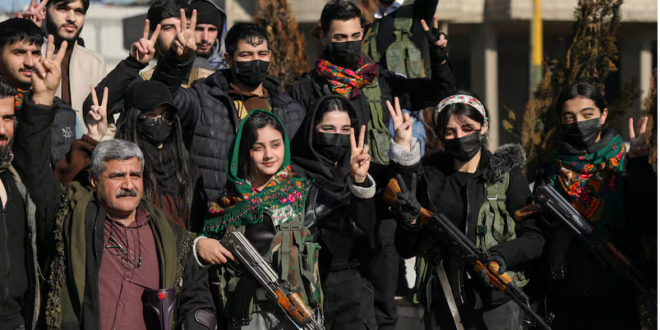
The Hasakah division would include members of the YPJ, the all-female Kurdish fighting force, said official Ilham Ahmed, who oversees foreign relations for areas under SDF control.
At a press conference, Ms Ahmed characterised the agreement between the SDF and the Syrian government as “cautious”, citing several outstanding issues – such as the official enshrinement of Kurdish rights into Syria’s legal framework.
“A presidential decree is not a constitution,” she said, referring to a decision issued by Syrian President Ahmad Al Shara in mid-January which formally recognised Kurdish as a national language and pledged citizenship for stateless Syrian Kurds.
“Our full rights should be enshrined under the constitution. We will continue negotiations for this in the future, and meanwhile we will be cautious.”
As of Friday afternoon the Syria’s Ministry of Interior had appointed a new head of internal security to the governorate of Hasakah, Brig Gen Marwan Al Ali. A large convoy of internal security troops waited just outside the frontlines in preparation to enter – but their entry was postponed until next Monday, Syrian state TV announced, without providing a reason.
Syrian government authorities apparently had not discussed Mr Al Ali’s new posting as head of internal security in the region prior to his assignment, according to Ms Ahmed, the foreign relations official for the Kurdish-led northern administration.
The Ministry of Education also immediately issued an order aimed at integrating pupils in the previously Kurdish-administered governorates of Raqqa, Hasakah and Deir Ezzor, as well as parts of eastern Aleppo, into the public school system. Authorities vowed to simplify procedures for their enrollment.
The comprehensive deal follows the recapture of parts of northern and eastern Syria by Syrian government forces from the SDF earlier this month, which forced the Kurdish-led militia to retreat into a shrinking enclave. The north-east was previously under de facto control of SDF-aligned forces and operated with semi-autonomy. The ceasefire agreement signals the end of the self-administration, which the Kurdish-led forces carved out as a civil war raged across the country between 2011 and 2024, which culminated in Al Assad’s removal.
Over the past two weeks, the SDF has lost large, resource-rich territories that it acquired with US support during the civil war.
“Autonomous administration institutions will be integrated into Syrian state institutions, with civil employees retained,” a statement by the SDF said. “Provisions were made to secure civil and educational rights for the Kurdish population and to facilitate the return of displaced residents to their homes.”
The Syrian government published a nearly identical statement.
A Syrian government source told state-run Al Ekhbariya TV that the agreement aims to unify Syrian territory.
Fighting had escalated sharply in north-eastern Syria on Thursday, with at least 10 members of the SDF killed in government attacks aimed at cutting off the group’s supply lines and squeezing it further into a pocket near Turkey.
The escalation occurred as US envoy Tom Barrack met Turkish Foreign Minister Hakan Fidan in Ankara. A day after that meeting, Mr Barrack was quick to endorse the ceasefire deal announceed by the Syrian parties.
“By facilitating the phased integration of military, security and administrative structures into unified state institutions – while ensuring senior SDF representatives have opportunities to contribute at high levels – it affirms the principle that Syria’s strength emerges from embracing diversity and addressing the legitimate aspirations of all its peoples,” Mr Barrack said in a post on X.
“This approach not only consolidates sovereignty across the territory but also sends a clear message of openness and fairness to the international community.”
Mr Barrack also applauded Syrian government measures to give stateless Kurds Syrian citizenship and recognising Kurdish alongside Arabic as one of Syria’s national languages.
“These measures correct longstanding injustices, affirm the Kurds’ integral place within the Syrian nation, and open pathways for their full participation in shaping a secure, prosperous and inclusive future,” he said.
Turkey is the main regional backer of the government of Mr Al Shara and wants the SDF to be dismantled. The group’s demise would enhance Turkey’s role in Syria and strengthen the domestic position of Turkish President Recep Tayyip Erdogan.
The SDF has been the most powerful rival of the central government that replaced Bashar Al Assad’s regime after Mr Al Shara led rebels into Damascus in December 2024. The SDF’s importance as a US ally has diminished since then.