 Eurasia Press & News
Toplines
Russian Foreign Minister Sergei Lavrov explicitly blamed the United States on February 9 for the lack of progress in ending Russia’s war against Ukraine. Lavrov used a February 9 interview with TV BRICS, a Russian outlet covering BRICS states and candidate states, to accuse the United States of reneging on the peace proposals the United States itself allegedly proposed at the August 2025 US-Russia Alaska Summit by imposing new sanctions on Russia, seizing Russian shadow fleet tankers, and placing secondary tariffs on importers of Russian oil.[1] Lavrov claimed that the United States and Russia “seemingly…resolv[ed]” the war at the Alaska Summit and moved toward “broad and mutually beneficial collaboration,” but the United States has since “creat[ed] artificial barriers” to cooperation. Kremlin Spokesperson Dmitry Peskov similarly claimed on February 9 that the United States and Russia reached a “number of understandings” in Alaska, which Peskov claimed could lead to a “breakthrough” in peace negotiations.[2] The Kremlin has been exploiting the lack of publicly available documents from the Alaska Summit to claim that Russia and the United States came to an understanding to end the war during the meeting.[3] Kremlin officials have claimed that the Alaska Summit agreed to principles based on Russian President Vladimir Putin’s June 2024 speech to the Russian Ministry of Foreign Affairs (MFA), in which Putin insisted on capitulation to Russia’s original war demands of both Ukraine and NATO.[4] Kremlin officials have been trying to push the United States to abandon the recent US-led negotiations with Ukraine and Europe in favor of a US-Russian settlement based almost entirely on Russia’s demands.[5]
Lavrov reiterated Russia’s demand for effective control over Ukraine’s post-war government and the size and composition of its military. Lavrov stated that he has “no doubt” that Russia will prevent the deployment of “any weapons that threaten [Russia] on Ukrainian territory” in order to ensure Russia’s security.[6] The Kremlin has long demanded Ukraine’s “demilitarization” to prevent Ukraine from being able to defend itself.[7] Lavrov’s February 9 statement demonstrates that Russia wants to dictate not only the number of troops in Ukraine’s post-war military but also the weapons and equipment in Ukraine’s arsenal, a position codified in the 2022 Istanbul Protocols, to which the Kremlin periodically refers as the appropriate basis for a peace agreement.[8] The limitations in the Istanbul Protocols would have left Ukraine helpless against future Russian aggression. Lavrov’s demand about Western weapons would likely prohibit any meaningful Western military assistance to post-war Ukraine in the future, rejecting US-backed efforts to stand up a strong Ukrainian military to guarantee Ukraine’s security after a peace settlement. Lavrov further claimed that a peace settlement must eliminate Ukraine’s “Nazi roots” in order to ensure Russia’s security and the rights of ethnic Russians and Russian-speakers in “Crimea, Donbas, and Novorossiya.”[9] The Kremlin has called for the “denazification” of Ukraine since 2022 in order to demand the removal of the current Ukrainian government and its replacement with a pro-Russian puppet government. Lavrov’s reference to “Novorossiya” — an amorphous invented region in southern and eastern Ukraine that extends beyond Crimea and the four oblasts that Russia has illegally annexed – continues to demonstrate that Russia’s territorial demands go beyond Luhansk, Donetsk, Zaporizhia, and Kherson oblasts.[10] Lavrov also stated that Russia must ensure its security in the face of an alleged European threat to “unleash a war” against Russia.[11] Russia issued ultimatums to NATO in 2021, demanding “security guarantees” from the United States and NATO that amounted to the destruction of the current NATO alliance, with demands that NATO reverse the deployment of forces or weapons systems to member-states that joined NATO after 1997.[12] Lavrov’s February 9 statements are all implicit reiterations of Putin’s original war aims from 2021 and 2022 that amount to complete Ukrainian and NATO capitulation, effectively signaling that any peace deal that does not address Russian demands of not only Ukraine but also of NATO and the West will not satisfy Russia. The Kremlin’s insistence on these demands are calls for the United States to discard the negotiations process that the United States has conducted with Ukraine and Europe since the publication of the US-proposed 28-point plan.
Russian State Duma deputies are explicitly demanding that the United States concede to all Russian demands. Duma International Affairs Committee Deputy Chairperson Svetlana Zhurova stated on February 9 that a draft peace deal could be ready by March 2025, but only if Ukraine and the West agree to Russia’s terms.[13] Kremlin officials, including Lavrov, have repeatedly made demands that amount to nothing less than complete Ukrainian capitulation. Zhurova, however, is explicitly stating what Lavrov has been implying – that the Kremlin will not agree to any peace settlement that does not concede to all of its 2021 and 2022 war demands. The Kremlin is trying to deflect blame for the lack of progress away from Russia and onto Ukraine, Europe, and now the United States.
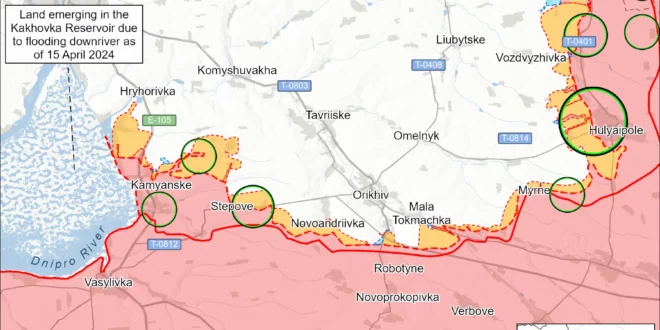
Russian forces are likely falsely claiming that Ukrainian forces are conducting a “counteroffensive” near the Dnipropetrovsk-Zaporizhia Oblast administrative border to rectify earlier false reports about alleged Russian advances in the area. A Russian milblogger claimed that Ukrainian forces are taking advantage of foggy weather and the recent block on Russian forces’ use of Starlink terminals in Ukraine to conduct a “counteroffensive” near Sosnivka, Novooleksandrivka (both southeast of Oleksandrivka), and Nechaivka (north of Hulyaipole).[14] The milblogger claimed that Ukrainian forces have advanced toTernuvate (northwest of Hulyaipole). A Kremlin-affiliated Russian milblogger claimed that Ukrainian forces launched a “local counteroffensive” in eastern Zaporizhia Oblast for the first time in a long time.[15] Other milbloggers similarly claimed that Ukrainian forces are counterattacking, including with armored vehicles, near Velykomykhailivka (east of Oleksandrivka), Orestopil (southeast of Oleksandrivka), Ternuvate, Pryluky, Zarichne, Pishchane, and Dobropillya (all north of Hulyaipole) during foggy weather and reduced Russian communications capabilities.[16] The milbloggers claimed that Ukrainian forces have pushed Russian forces out of positions west of Pryluky and in Prydorozhnie (northwest of Hulyaipole).[17] Ukrainian Southern Defense Forces Spokesperson Colonel Vladyslav Voloshyn reported that Ukrainian forces maintain control over Ternuvate after Russian forces unsuccessfully tried to conduct a flag-raising in the settlement to provide alleged evidence of its seizure.[18] Voloshyn stated that the frontline is currently at least 10-15 kilometers from Ternuvate. Voloshyn denied, however, Russian milbloggers’ claims about an alleged Ukrainian “counteroffensive” at the Dnipropetrovsk-Zaporizhia Oblast border.[19] Voloshyn reported that Ukrainian forces in the area are conducting reconnaissance and search missions to identify Russian infiltration and sabotage groups, but noted that these Ukrainian actions do not constitute a counteroffensive. Voloshyn noted that Russian forces have been inflating their advances in the area and assessed that they are now trying to use claims of a Ukrainian counteroffensive to manage their lies. ISW has observed widespread complaints from Russian milbloggers themselves about the systematic practice of Russian commanders sending false reports to their superiors about alleged advances.[20] Russian forces – and subsequently some Russian milbloggers — likely overstated recent Russian advances in the Oleksandrivka and Hulyaipole directions and are now trying to use the guise of a Ukrainian “counteroffensive” to justify recessing Russian advances back to the forward positions that Russian forces have likely maintained for some time.
Russian and Ukrainian sources recently reported that Russian forces have increased the range of their guided glide bombs to 200 kilometers, but this is not a new Russian innovation. A Russian milblogger claimed on February 6, and a Ukrainian OSINT source stated on February 8, that Russian forces are employing UMPB-5R guided glide bombs with a range of up to 200 kilometers.[21] Reports of Russian forces using glide bombs with such ranges are not new, however. Ukrainian electronic and radio warfare expert Serhiy “Flash” Beskrestnov reported in October 2025 that Russian forces introduced the UMPB-5R bombs with an extended range of 100 to 180 kilometers.[22] Ukrainian Main Military Intelligence Directorate (GUR) Deputy Chief Major General Vadym Skibitskyi also stated in November 2025 that Russia planned in 2025 to produce 500 of the longer-range glide bomb variants that can fly up to 200 kilometers.[23]
India will reportedly dramatically decrease or halt its direct and indirect purchases of Russian oil. Refining and trade sources told Reuters on February 8 that Indian refiners are not buying Russian oil for delivery in April 2026 and will likely continue to avoid such purchases beyond this time frame.[24] A trader reported that Indian oil refiners Indian Oil, Bharat Petroleum, and Reliance Industries have already scheduled some deliveries for March but are no longer accepting offers to load Russian oil in March and April. Sources noted that most other Indian refiners have stopped buying Russian crude. Sources indicated that Russian-backed private refiner Nayara, which relies solely on Russian oil, may be allowed to keep buying Russian oil since other crude sellers pulled back after the EU sanctioned Nayara in July 2025. Sources noted, however, that Nayara does not plan to import Russian crude in April 2026 due to a maintenance shutdown at the facility. Sources assessed that Indian refiners may order Russian oil but only if the Indian government were to advise such a move. An Indian Ministry of External Affairs spokesperson stated that India is attempting to diversify its energy sources. US President Donald Trump stated on February 2 that Indian Prime Minister Modi agreed to stop buying Russian oil and to increase purchases of US and possibly Venezuelan oil as part of US efforts to end the war in Ukraine.[25] ISW has previously assessed that a curb in India’s purchase of Russian oil would likely further strain the Russian budget and hinder Russia’s ability to fund its war effort in Ukraine without suffering more economic consequences.[26]
The United States seized another Russian shadow fleet oil tanker. The US Department of Defense (DoD) reported on February 9 that the United States conducted a right-of-visit, maritime interdiction, and boarded the Aquila II on the night of February 8 to 9 in the area of responsibility of US Indo-Pacific Command (INDOPACOM).[27] The DoD stated that the vessel was violating the US quarantine of sanctioned vessels in the Caribbean Sea and noted that the DoD tracked the vessel from the Caribbean Sea to the Indian Ocean. Data from the Starboard Maritime Intelligence ship-tracking platform indicates that the Aquila II sailed under the Panamanian flag and briefly transmitted its automatic identification systems (AIS) signal in the Indian Ocean on February 8. Starboard data indicates that the ship’s last AIS transmission before that was near the Strait of Hormuz on March 10, 2025. The United States sanctioned Sunne Co Limited, which owns the Aquilla II, in 2025 for its involvement in illegally transporting Russian oil above the G7 price cap.[28]
Likely Belarusian balloons violated Polish airspace on the night of February 8 to 9. The Polish Armed Forces Operational Command reported that Polish radar detected balloon-like objects violating Polish airspace overnight.[29] The command did not explicitly state from which direction the balloons entered Polish airspace, but balloons have violated Polish airspace from Belarus five times since January 27.[30] ISW continues to assess that Russia has de facto annexed Belarus and that Russia is likely using airspace incursions into NATO states like Lithuania and Poland from Belarus as part of its “Phase Zero” effort — the informational and psychological condition-setting phase — to prepare for a possible NATO-Russia war in the future.[31]
Key Takeaways
Russian Foreign Minister Sergei Lavrov explicitly blamed the United States on February 9 for the lack of progress in ending Russia’s war against Ukraine.
Lavrov reiterated Russia’s demand for effective control over Ukraine’s post-war government and the size and composition of its military.
Russian State Duma deputies are explicitly demanding that the United States concede to all Russian demands.
Russian forces are likely falsely claiming that Ukrainian forces are conducting a “counteroffensive” near the Dnipropetrovsk-Zaporizhia Oblast administrative border to rectify earlier false reports about alleged Russian advances in the area.
Russian and Ukrainian sources recently reported that Russian forces have increased the range of their guided glide bombs to 200 kilometers, but this is not a new Russian innovation.
India will reportedly dramatically decrease or halt its direct and indirect purchases of Russian oil.
The United States seized another Russian shadow fleet oil tanker.
Likely Belarusian balloons violated Polish airspace on the night of February 8 to 9.
Ukrainian forces recently advanced near Velykyi Burluk. Russian forces recently advanced in northern Sumy Oblast, near Velykyi Burluk, Kupyansk, Slovyansk, and in the Kostyantynivka-Druzhkivka tactical area.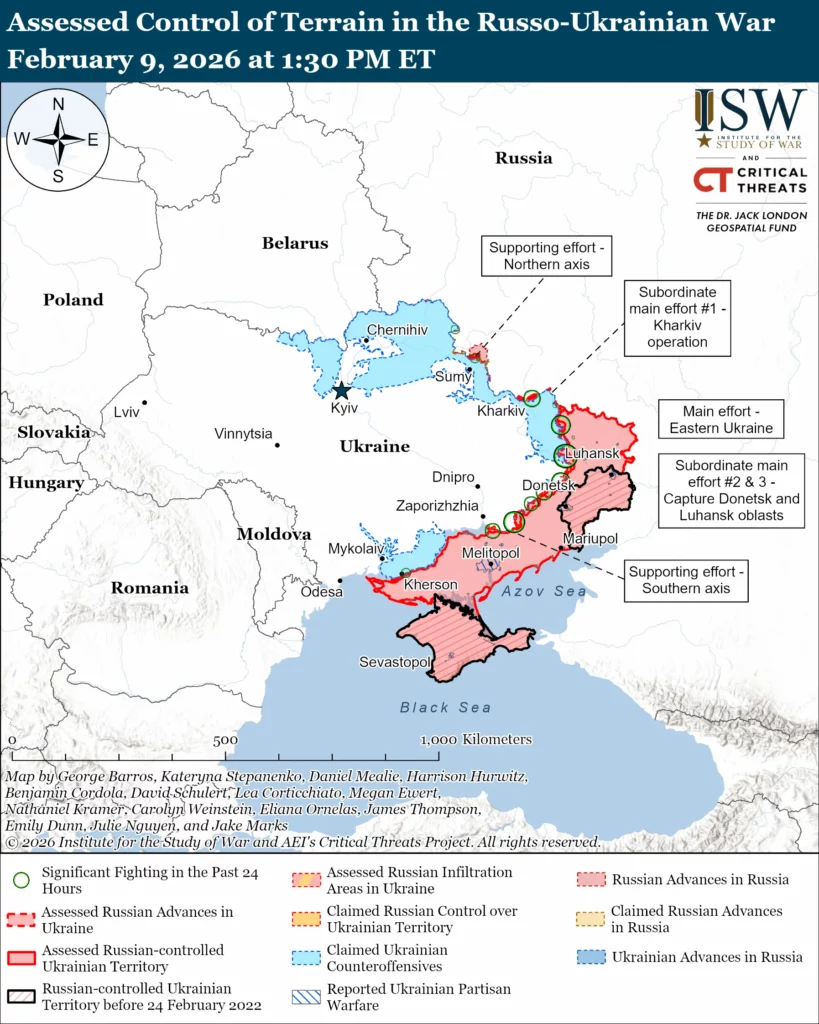
We do not report in detail on Russian war crimes because these activities are well-covered in Western media and do not directly affect the military operations we are assessing and forecasting. We will continue to evaluate and report on the effects of these criminal activities on the Ukrainian military and the Ukrainian population and specifically on combat in Ukrainian urban areas. We utterly condemn Russian violations of the laws of armed conflict and the Geneva Conventions and crimes against humanity even though we do not describe them in these reports.
Ukrainian Operations in the Russian Federation
Ukrainian forces continued their mid-to-long range strikes campaign in Russia. The Ukrainian General Staff reported on February 9 that Ukrainian forces struck a command post of the Russian Airborne (VDV) forces in Sudzha, Kursk Oblast, (roughly 10 kilometers from the international border) on the night of February 8 to 9.[32] The Ukrainian General Staff confirmed that Ukrainian forces destroyed three containers with first-person view (FPV) drones and components near Rostov-on-Don, Rostov Oblast, during a previous strike, destroying roughly 6,000 FPV drones.
Russian Supporting Effort: Northern Axis
Russian objective: Create defensible buffer zones in Sumy Oblast along the international border
Russian forces recently advanced in northern Sumy Oblast.
Assessed Russian advances: Geolocated footage published on February 8 indicates that Russian forces advanced into northern Pokrovka (southeast of Sumy City).[33]
Unconfirmed claims: Russian milbloggers claimed that Russian forces seized Sydorivka (northwest of Sumy City along the international border).[34]
Russian forces attacked in Kursk and Sumy oblasts, including north of Sumy City near Oleksiivka and toward Nova Sich; northeast of Sumy City near Yunakivka, Yablunivka, and toward Myropillya; and southeast of Glushkovo near Kucherov, Ozerki, and Milayevka; on February 8 and 9.[35] Russian sources claimed that Ukrainian forces counterattacked near Myropillya and Varachyne (north of Sumy City).[36]
A Ukrainian army corps operating in northern Sumy Oblast reported on February 9 that Russian forces attempted to enter Yunakivka through a pipe but that Ukrainian forces repelled the assault, eliminating 22 Russian servicemembers.[37]
Russian Main Effort: Eastern Ukraine
Russian Subordinate Main Effort #1 – Kharkiv Oblast
Russian objective: Push Ukrainian forces back from the international border to create a defensible buffer zone with Belgorod Oblast and approach to within tube artillery range of Kharkiv City
Russian forces continued offensive operations in northern Kharkiv Oblast on February 9 but did not advance.
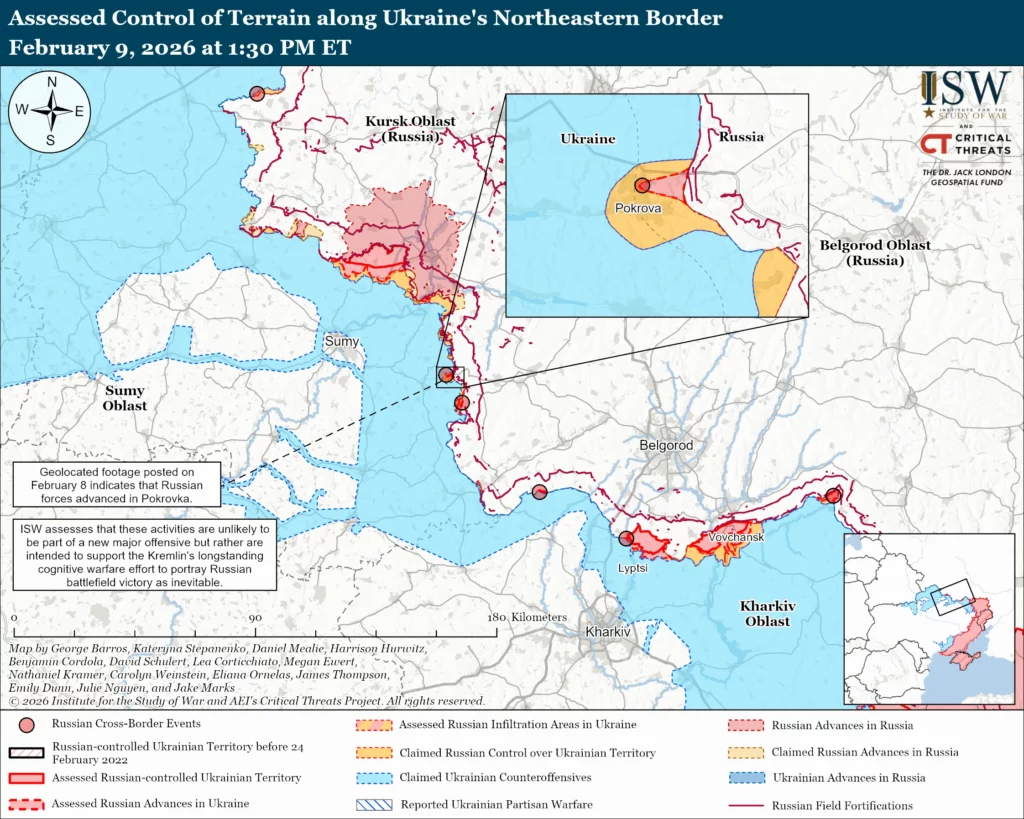
Russian forces attacked northeast of Kharkiv City near Prylipka, Zelene, Starytsya, Symynivka, Hrafske, Vovchanski Khutory, and Vovchansk on February 8 and 9.[38]
Ukrainian and Russian forces recently advanced in the Velykyi Burluk direction.
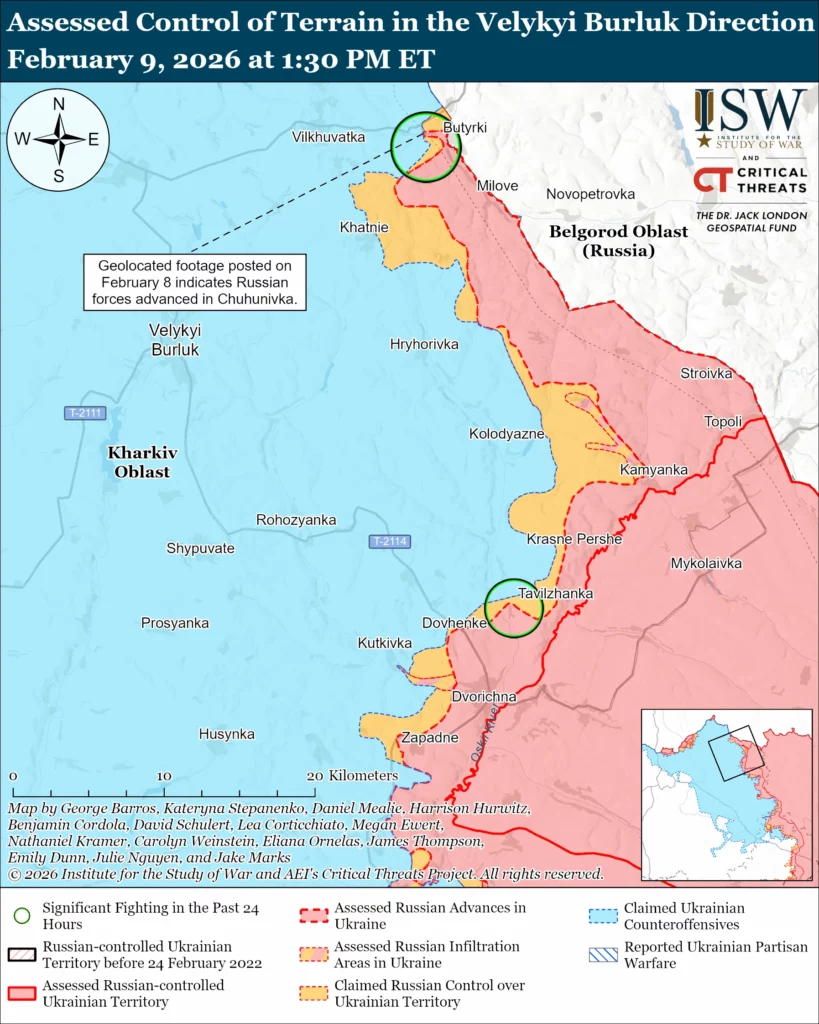
Assessed Ukrainian advances: Geolocated footage published on February 8 shows Ukrainian forces clearing western Chuhunivka (northeast of Velykyi Burluk).[39]
Assessed Russian advances: The geolocated footage published on February 8 indicates that Russian forces likely advanced westward from the international border into western Chuhunivka on a prior date.[40]
Russian milbloggers claimed that Ukrainian forces counterattacked near Chuhunivka on February 8 and 9.[41]
Ukrainian Joint Forces Task Force Spokesperson Colonel Viktor Trehubov reported on February 9 that Russian forces attempted to infiltrate into Chuhunivka on February 8, but that Ukrainian forces repelled the attack.[42] Trehubov reported that Russian forces continue to look for gaps in Ukrainian forces’ defensive lines while exploiting poor weather conditions to advance in small groups. Trehubov added that Russian forces continue attempts to establish a buffer zone along the international border in the Velykyi Burluk direction.
Russian Subordinate Main Effort #2 – Oskil River
Russian objective: Cross the Oskil River in Kharkiv Oblast and push westward into eastern Kharkiv Oblast and northern Donetsk Oblast
Russian forces recently advanced in the Kupyansk direction during a platoon-sized mechanized assault.
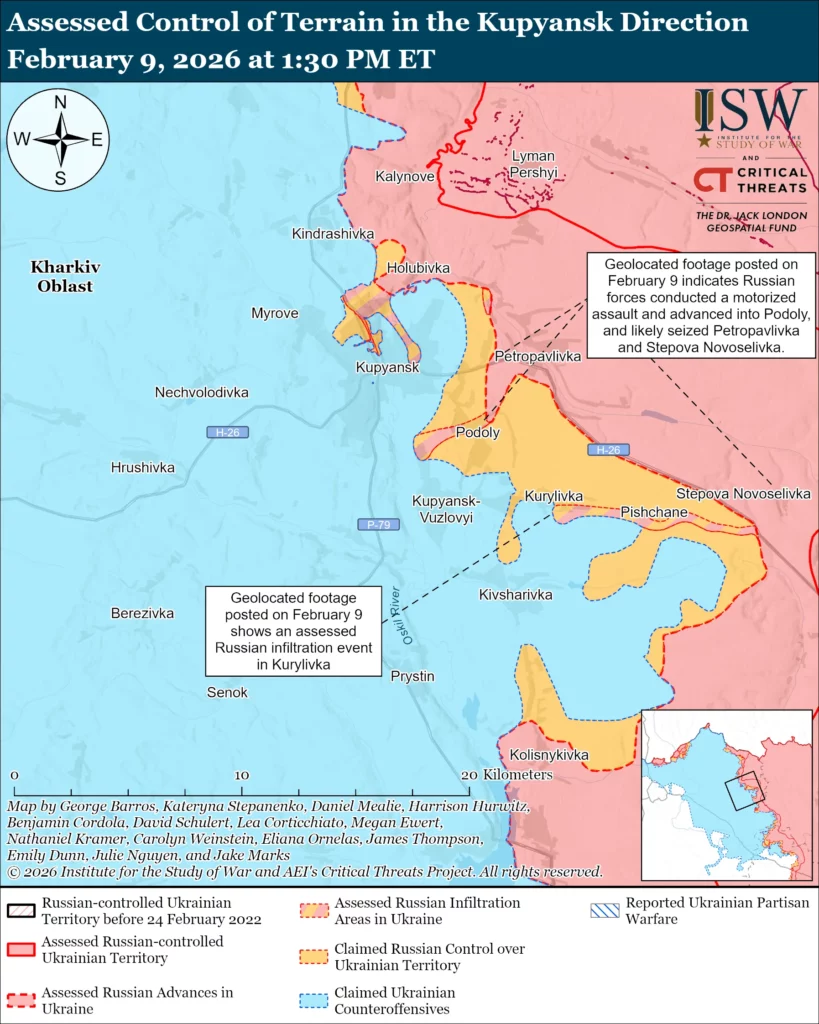
Assessed Russian advances: Geolocated footage published on February 9 indicates that Russian forces seized Petropavlivka (east of Kupyansk) and Stepova Novoselivka and advanced into northwestern Podoly (southeast of Kupyansk) during a platoon-sized mechanized assault.[43] The Ukrainian 10th Army Corps published footage of the mechanized assault and reported that Ukrainian forces repelled that assault and destroyed two multi-purpose armored fighting vehicles (MTLBs), 11 all-terrain vehicles (ATVs), and two buggies, and inflicted 21 Russian casualties, including 17 killed in action (KIA).[44]
Assessed Russian infiltrations: Geolocated footage published on February 9 shows Ukrainian forces striking a Russian position in eastern Kurylivka after what ISW assesses was an infiltration operation that did not change the control of terrain or forward edge of battle (FEBA) at this time.[45]
Russian forces attacked near Kupyansk itself; north of Kupyansk near Dovhenke; northeast of Kupyansk near Fyholivka; east of Kupyansk near Petropavlivka; and southeast of Kupyansk near Pishchane, and Podoly and toward Novoosynove on February 8 and 9.[46]
The Ukrainian Joint Forces Task Force (JFTF) reported on February 9 that Ukrainian forces retain control over Hlushkivka, refuting Russian claims that Russian forces seized Hlushkivka on February 8.[47] The JFTF reported that Ukrainian forces also maintain control of Kupyansk itself and Kupyansk-Vuzlovyi. The JFTF also reported on February 8 that isolated Russian groups in Kupyansk are having communications problems and problems conducting continuous rotations.[48] JFTF reported that the RUAF are determined to seize Kupyansk City despite a lack of resources. A Kremlin-affiliated Russian milblogger claimed on February 9 that Russian forces have chronic issues with making false reports of seizing settlements in the Kupyansk direction, including Kucherivka (east of Kupyansk), and Podoly (southeast of Kupyansk).[49]
Order of Battle: Elements of the Russian 26th Tank Regiment (47th Tank Division, 1st Guards Tank Army [GTA], Moscow Military District [MMD]) are reportedly operating near Hlushkivka (southwest of Kupyansk).[50]
Russian forces continued offensive operations north of Borova near Novoplatonivka; northeast of Borova near Nova Kruhlyakivka; and southeast of Borova near Shyikivka and Druzhelyubivka on February 8 and 9 but did not advance.[51]
Russian Subordinate Main Effort #3 – Donetsk Oblast
Russian objective: Capture the entirety of Donetsk Oblast, the claimed territory of Russia’s proxies in Donbas, and advance into Dnipropetrovsk Oblast
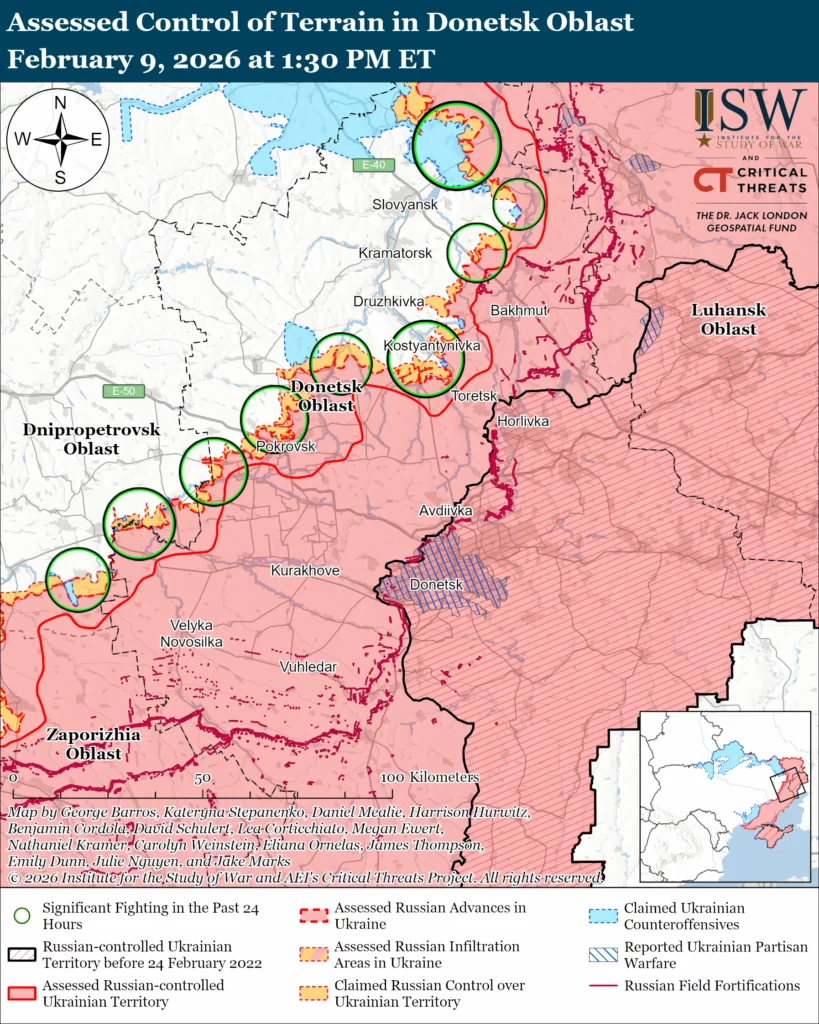
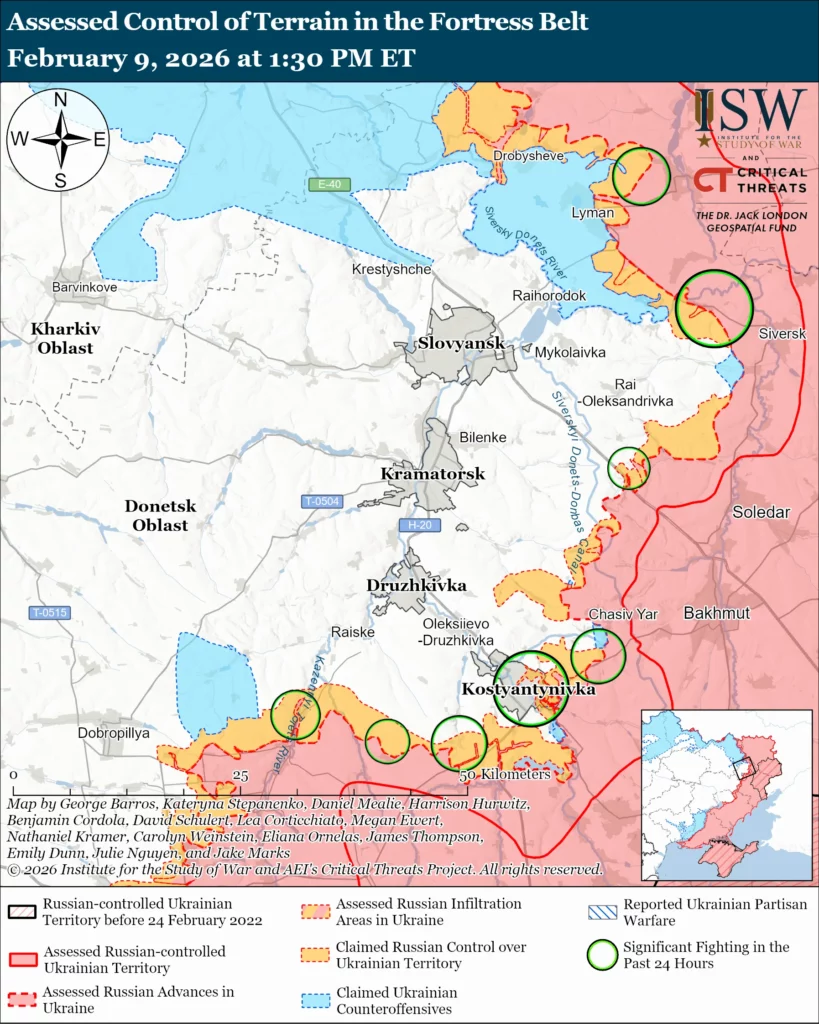
Russian forces recently advanced in the Slovyansk direction.
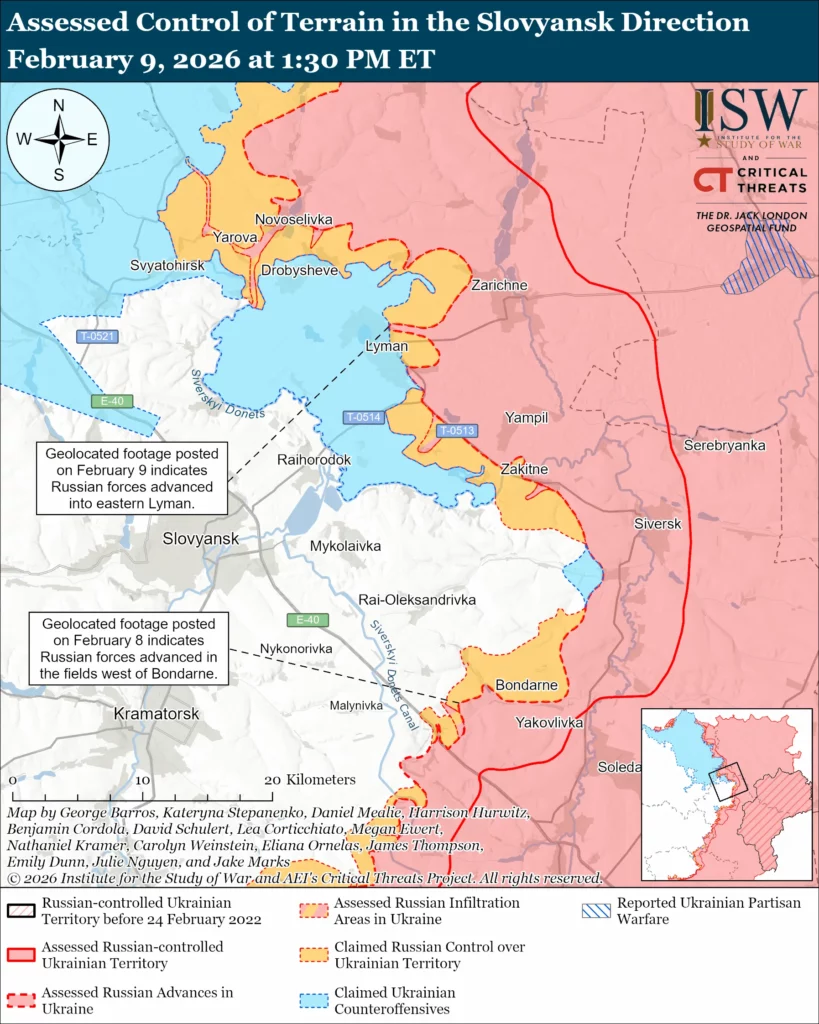
Assessed Russian advances: Geolocated footage published on February 8 and 9 indicates that Russian forces advanced in eastern Lyman and west of Bondarne (southeast of Slovyansk).[52]
Unconfirmed claims: A Russian milblogger claimed that Russian forces advanced east of Kryva Luka (east of Slovyansk).[53]
Russian forces attacked near and within Lyman itself; northwest of Lyman near Novoselivka, Svyatohirsk, Yarova, and Serednie; north of Lyman near Drobysheve and Stavky; east of Lyman near Zarichne; northeast of Slovyansk near Zakitne, Dronivka, and Platonivka; east of Slovyansk toward Riznykivka and Kryva Luka; and southeast of Slovyansk near Bondarne, Ozerne, Nykyforivka, Khromivka and Vasyukivka toward Rai-Oleksandrivka on February 8 and 9.[54]
Russian forces recently advanced in the Kostyantynivka-Druzhkivka tactical area.
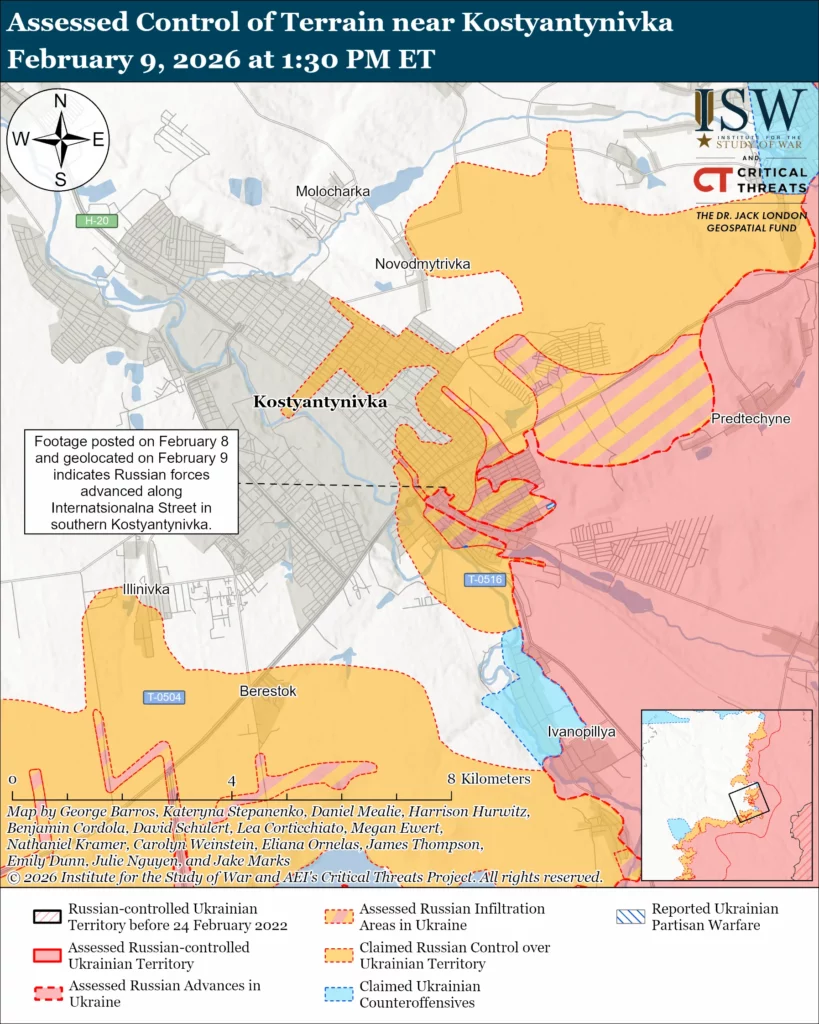
Assessed Russian advances: Geolocated footage published on February 9 indicates that Russian forces recently marginally advanced in southern Kostyantynivka.[55]
Unconfirmed claims: A Russian milblogger claimed on February 9 that Russian forces advanced northwest of Pryvillya (north of Kostyantynivka) and south of Chervone (northeast of Kostyantynivka).[56]
Russian forces attacked near and within Kostyantynivka itself; north of Kostyantynivka near Pryvillya and Markove; northeast of Kostyantynivka near Orikhovo-Vasylivka and Minkivka; east of Kostyantynivka near Stupochky; southeast of Kostyantynivka near Kleban-Byk, Pleshchiivka, and Ivanopillya; south of Kostyantynivka near Illinivka and Berestok; southwest of Kostyantynivka near Stepanivka and Yablunivka; south of Druzhkivka near Rusyn Yar and toward Mykolaipillya; and southwest of Druzhkivka near Sofiivka and toward Pavlivka on February 8 and 9.[57]
Ukrainian military observer Kostyantyn Mashovets reported on February 9 that the Russian command likely intends to capture the Kostyantynivka-Druzhkivka agglomeration in stages and then advance to the outskirts of Kramatorsk from the east and southeast and has concentrated elements of Russian 8th CAA along the Yablunivka-Illinivka line (southwest and southeast of Kostyantynivka) and elements of the 3rd CAA along the Bila Hora (east of Kostyantynivka)-southeastern Kostyantynivka and the Predtechyne (northwest of Bila Hora)-Kostyantynivka lines.[58] Mashovets reported that Russian forces have not been able to cross the T-0504 Bakhmut-Kostyantynivka highway and are conducting persistent assaults in southern Kostyantynivka, while continuing assaults on the northern and southern flanks of the Kostyantynivka-Druzhkivka agglomeration near Sofiivka and northwest of Chasiv Yar (northeast of Kostyantynivka), attempting to set conditions to encircle the agglomeration and reach the outskirts of Druzhkivka. Mashovets noted that Russian small-group infiltration tactics are spreading out Russian losses over time and have also dramatically slowed down the Russian rate of advance in the area.
Order of Battle: Mashovets stated that elements of the Russian 70th Motorized Rifle Division (18th Combined Arms Army [CAA], Southern Military District [SMD]) are operating north and northeast of Kostyantynivka along the Chasiv Yar-Virolyubivka line; that elements of the 6th Motorized Rifle Division (3rd Army Corps [AC], under operational control of the Southern Grouping of Forces), including its 89th Tank Regiment, 1008th, 1307th, and 1442nd motorized rifle regiments, are operating east of Kostyantynivka near Oleksandro-Shultyne and along the Bila Hora-Kostyantynivka and Predtechyne-Kostyantynivka lines; and that elements of the 72nd Separate Motorized Rifle Brigade (3rd AC) are operating in southeastern Kostyantynivka.[59] Mashovets stated that elements of the 1436th Motorized Rifle Regiment (51st CAA, formerly 1st Donetsk People’s Republic Army Corps [DNR AC], SMD), the 4th Motorized Rifle Brigade (3rd CAA, formerly 2nd Luhansk People’s Republic Army Corps [LNR AC], SMD), the 10th Tank Regiment (20th Motorized Rifle Division, 8th CAA, SMD), the 103rd Motorized Rifle Regiment (150th Motorized Rifle Division, 8th CAA), and of the 55th Naval Infantry Division (Pacific Fleet, newly formed from the 155th Naval Infantry Brigade) are operating south of Kostyantynivka near Illinivka and Berestok.[60] Mashovets stated that elements of the 77th Motorized Rifle Regiment (7th Military Base, 49th CAA, SMD) are operating southwest of Kostyantynivka along the Yablunivka-Stepanivka line.[61] Mashovets stated that elements of the 54th Motorized Rifle Regiment (6th Motorized Rifle Division, 3rd AC), the 77th Motorized Rifle Regiment (7th Military Base, 49th CAA), the 20th “consolidated” Naval Motorized Rifle Regiment, the Chechen 78th Sever-Akhmat Motorized Rifle Regiment (42nd Motorized Rifle Division, 58th CAA, SMD), the 1194th Motorized Rifle Regiment (4th Motorized Rifle Brigade, 3rd CAA), the 1219th Motorized Rifle Regiment (20th Motorized Rifle Division), and the 1465th Motorized Rifle Regiment (reportedly of the 20th Motorized Rifle Division) are operating southwest of Kostyantynivka near Stepanivka and Dovha Balka (west of Kostyantynivka).[62] Mashovets stated that other elements of the 20th Motorized Rifle Division, the 150th Motorized Rifle Division (8th CAA), and the 120th Naval Infantry Division (Baltic Fleet) (newly formed from the 336th Naval Infantry Brigade) are operating east of Dobropillya and southwest of Druzhkivka along the Shakhove-Nomykolaivka and the Sofiivka-Novopavlivka lines.[63]
Russian forces continued offensive operations in the Dobropillya tactical area on February 9 but did not advance.
Russian forces attacked northeast of Dobropillya toward Kucheriv Yar and east of Dobropillya near Toretske and Novyi Donbas on February 8 and 9.[64]
Order of Battle: First-person view (FPV) drone operators of the Russian 57th Motorized Rifle Regiment (20th Guards Motorized Rifle Division, 8th CAA, SMD) are reportedly striking Ukrainian forces near Novomykolaivka (northeast of Dobropillya).[65] Loitering munitions operators of the 132nd Motorized Rifle Brigade (51st CAA, SMD) are reportedly striking Ukrainian forces near Kucheriv Yar.[66]
Russian forces continued offensive operations in the Pokrovsk direction on February 9 but did not advance.
Unconfirmed claims: A Russian milblogger claimed that Russian forces advanced west of Sukhetske (northeast of Pokrovsk) and west of Rodynske (north of Pokrovsk).[67]
Russian forces attacked near Pokrovsk itself; northwest of Pokrovsk near Hryshyne and toward Shevchenko and Novooleksandrivka; north of Pokrovsk near Rodynske and Bilytske; east of Pokrovsk near Myrnohrad; southwest of Pokrovsk near Kotlyne, Udachne, Molodetske, and Novopidhorodne; and west of Pokrovsk toward Serhiivka on February 8 and 9.[68] A Russian milblogger claimed that Ukrainian forces are counterattacking near Sukhetske and Rodynske.[69]
A spokesperson of a Ukrainian brigade operating in the Pokrovsk direction stated on February 9 that Russian forces are attacking in small infantry groups and rarely use motorcycles or all-terrain vehicles (ATVs).[70] The spokesperson stated that the number of Russian drone strikes against the Ukrainian rear, including with Starlink-enabled Molniya fixed-wing drones, has decreased since SpaceX shut down Russian forces’ access to Starlink terminals in Ukraine. ISW recently assessed that the blocking of Russian Starlinks in Ukraine would likely impact Russian battlefield air interdiction (BAI) efforts.[71] A Russian milblogger denied Russian claims that Russian forces have seized Bilytske, stating that the settlement remains a contested “gray zone.”[72] The milblogger noted that increased Ukrainian drone activity in the area is hindering Russian advances.
Order of Battle: Artillery elements of the Russian 27th Motorized Rifle Division (2nd CAA, Central Military District [CMD]), Molniya-2 drone operators of the 1st Motorized Rifle Brigade (51st CAA, SMD), and air defense elements of the 74th Motorized Rifle Brigade (41st CAA, CMD) are reportedly striking Ukrainian forces in the Pokrovsk direction.[73]
Russian forces continued offensive operations near Novopavlivka itself, northeast of Novopavlivka near Muravka, and south of Novopavlivka near Filiya and Dachne on February 8 and 9 but did not advance.[74]
Russian forces continued offensive operations northeast of Oleksandrivka near Ivanivka, Novokhatske, and Andriivka-Klevtsove, and east of Oleksandrivka near Oleksandrohrad on February 8 and 9 but did not advance.[75]
Russian Supporting Effort: Southern Axis
Russian objective: Maintain frontline positions, secure rear areas against Ukrainian strikes, and advance within tube artillery range of Zaporizhzhia City
Ukrainian forces recently maintained positions or advanced in the Hulyaipole direction.
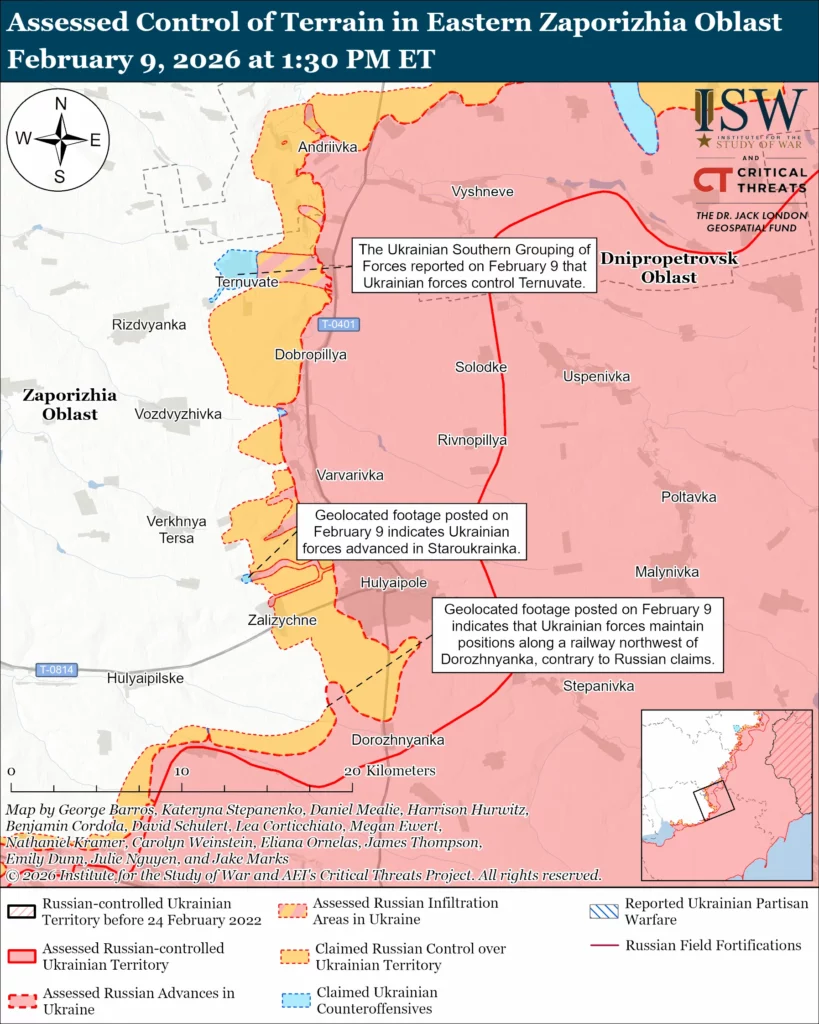
See topline text for reports of Ukrainian counterattacks and refinements of areas under Russian claims.
Refinement of areas under Russian claims: Geolocated footage published on February 9 shows Russian forces striking Ukrainian positions northwest of Dorozhnyanka (south of Hulyaipole) – an area where Russian sources previously claimed that Russian forces maintained positions.[76]
Russian forces attacked near and within Hulyaipole itself; northwest of Hulyaipole near Ternuvate, Svyatopetrivka, Krynychne, and Olenokostyantynivka and toward Tsvitkove and Verkhnya Tersa; north of Hulyaipole near Zelene, Pryvillya, and Dobropillya; northeast of Hulyaipole near Solodke south of Hulyaipole near Dorozhnyanka; southwest of Hulyaipole near Myrne and Zahirne and toward Hulyaipilske; and west of Hulyaipole near Zaliznychne and toward Hirke on February 8 and 9.[77]
A Kremlin-affiliated milblogger claimed that Ternuvate is a contested “gray zone.”[78]
Order of Battle: Artillery and other elements of the Russian 305th Artillery Brigade (5th Combined Arms Army [CAA], Eastern Military District [EMD]) and of the 38th Motorized Rifle Brigade (35th CAA, EMD) are reportedly operating in the Zaporizhia direction.[79]
Russian forces continued offensive operations in western Zaporizhia Oblast on February 8 and 9 but did not advance.
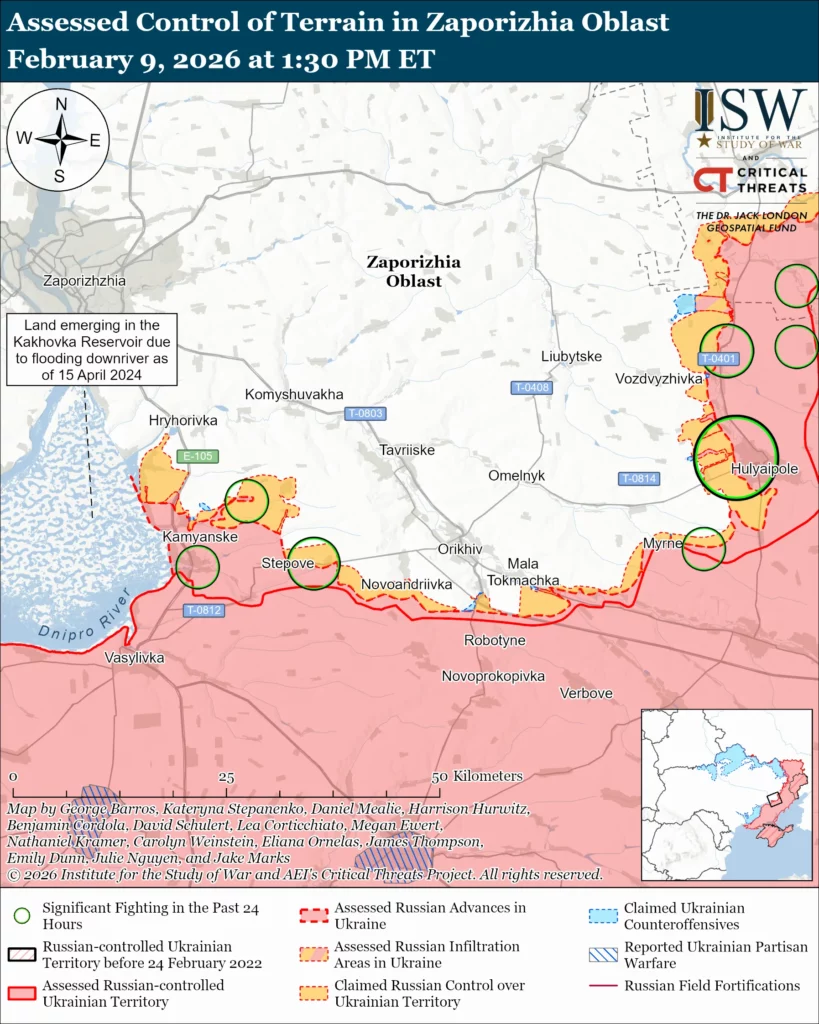
Russian forces attacked west of Orikhiv near Mali Shcherbaky, Shcherbaky, and Kamyanske and northwest of Orikhiv near Lukyanivske, Richne, and Prymorske on February 8 and 9.[80]
Order of Battle: Drone operators of the Russian 42nd Motorized Rifle Division (58th CAA, Southern Military District [SMD]) are reportedly striking Ukrainian forces near Orikhiv.[81] Elements of the 7th Airborne (VDV) Division reportedly continue to operate in the Zaporizhia direction.[82]
Neither Russian nor Ukrainian sources reported ground attacks in the Kherson direction on February 9.
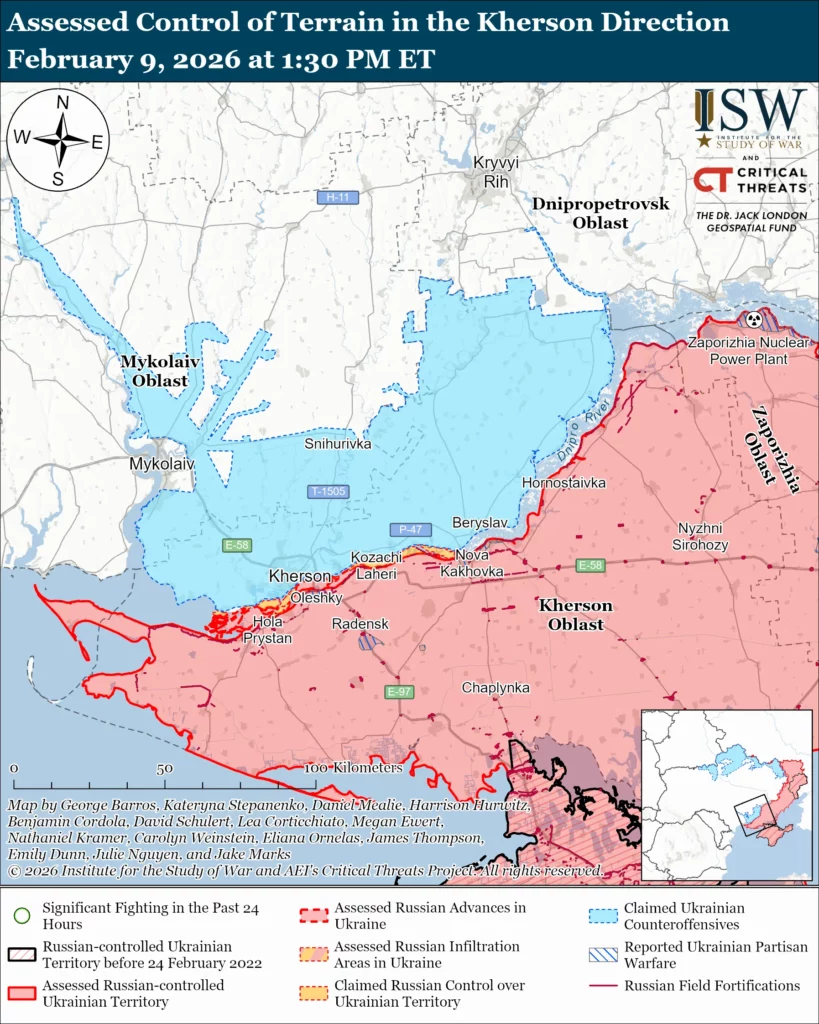
Order of Battle: Drone operators of the Russian 98th VDV Division are reportedly striking Ukrainian forces in Kherson City.[83]
Ukrainian forces continue their mid-range strike campaign against Russian military assets in occupied Kherson Oblast. The Ukrainian General Staff reported on February 9 that Ukrainian forces struck a Russian ammunition depot near occupied Novooleksiivka (approximately 102 kilometers from the frontline).[84]
Russian Air, Missile, and Drone Campaign
Russian Objective: Target Ukrainian military and civilian infrastructure in the rear and on the front line
Russian forces conducted a series of drone and missile strikes against Ukraine on the night of February 8 and 9. The Ukrainian Air Force reported that Russian forces launched 11 Iskander-M ballistic missiles from Bryansk Oblast and 149 Shahed-type, Gerbera-type, Italmas-type, and other drones — of which roughly 90 were Shaheds — from the directions of Kursk, Oryol, and Bryansk cities; Primorsko-Akhtarsk, Krasnodar Krai; Shatalovo, Smolensk Oblast; occupied Donetsk City; and occupied Hvardiiske, Crimea.[85] The Ukrainian Air Force reported that Ukrainian forces downed an unspecified number of ballistic missiles and 116 drones, that 23 drones and several missiles struck 15 locations, and that drone debris fell on six locations as of 0930 on February 9. Ukrainian officials reported that Russian forces struck energy, residential, and railway infrastructure in Chernihiv, Sumy, Kharkiv, Dnipropetrovsk, and Odesa oblasts.[86]
Significant Activity in Belarus
Russian efforts to increase its military presence in Belarus and further integrate Belarus into Russian-favorable frameworks
Nothing Significant To Report.
Note: ISW does not receive any classified material from any source, uses only publicly available information, and draws extensively on Russian, Ukrainian, and Western reporting and social media as well as commercially available satellite imagery and other geospatial data as the basis for these reports. References to all sources used are provided in the endnotes of each update.