 Eurasia Press & News
Toplines
The Kremlin continues to discuss future elections in Ukraine to advance its false claim that the current Ukrainian government is illegitimate and insists on means of controlling Ukraine’s politics. In an interview with Kremlin newswire TASS on February 15, Russian Deputy Foreign Minister Mikhail Galuzin repeated the debunked claim that Ukrainian President Volodymyr Zelensky is “illegitimate” and said that Russian President Vladimir Putin’s March 2025 proposal for the United Nations (UN) to create a temporary external administration in Ukraine is still an option.[1] Galuzin claimed that UN governance would allow for “democratic” elections and the establishment of a government with which Russia can sign a peace treaty and “legitimate” documents on future bilateral cooperation – implying that Russia cannot sign binding agreements with the current Ukrainian government and that any future elections that the current government would oversee would be undemocratic. The Kremlin’s calls for UN governance over Ukraine are a rejection of Ukraine’s sovereignty and legitimacy. UN Secretary General Antonio Guterres and White House National Security Council Spokesperson James Hewitt rejected such proposals when Putin first presented them in March 2025, stating that UN governance would be a violation of the legitimate Ukrainian government, the Ukrainian Constitution, and the Ukrainian people’s right of choice.[2] The Kremlin’s proposal for UN election oversight is an attempt to give Russia, a permanent member of the UN Security Council, veto power over any resolution that does not establish a UN governance system that will produce Russia’s desired outcome of a pro-Kremlin political arrangement in Kyiv.
The Kremlin continues to signal that it will reject any election result that does not produce such a pro-Russia government in Ukraine. Galuzin claimed that Ukraine will try to prevent “Ukrainian citizens” living in Russia from voting in a future Ukrainian election.[3] The Kremlin is setting conditions to claim that any future Ukrainian election that does not “sufficiently” allow “Ukrainians” under Russian control to vote is not free and fair. It is far from clear how the Kremlin would determine who is a Ukrainian for purposes of voting, considering the intensive, forced passportization efforts Russia has undertaken to coerce Ukrainians in territories under Russian control to renounce their Ukrainian citizenship in favor of Russian citizenship.[4] The Kremlin’s pressure on Ukraine to hold an election before a final peace agreement comes into effect ensures that Ukrainian authorities would be completely unable to oversee electoral processes within the Russian Federation, always granting that the Kremlin would give any Ukrainian government it does not already control the right to do so. The Kremlin likely further aims to use “Ukrainians,” or at least those whom the Russians decide are Ukrainians for purposes of the election, voting in Russia to enable massive Russian election interference. Galuzin trumpeted the 2024 Russian presidential election as alleged evidence of the viability of wartime elections. Kremlin officials have similarly claimed that Russia’s illegal sham referendums in occupied Luhansk, Donetsk, Zaporizhia, and Kherson oblasts in 2022 show that Ukraine does not need an extended ceasefire to hold elections.[5] Russian elections and referendums in 2022 and 2024 were neither free nor fair; they were autocratic and rigged.[6] The Russian legal regime in place during those events, moreover, did not explicitly ban elections, whereas the Ukrainian Constitution and martial law legislation do. Zelensky has repeatedly indicated his intent to hold free, fair, and democratic elections in accordance with the Ukrainian Constitution and law as soon as possible.[7]
Russian Foreign Minister Sergei Lavrov recently claimed that any postwar Ukraine must be ”friendly“ and ”benevolent” to Russia, explicitly rejecting any future Ukrainian government that is not pro-Kremlin.[8] Russian insistence on elections in Ukraine as somehow tied to the legitimacy of any peace agreement is disingenuous, as the Kremlin has made it clear that it will deny the legitimacy of any Ukrainian government that does not allow Russian control over its composition and political orientation. ISW will outline Russia’s efforts to use calls for Ukrainian elections to manipulate the Ukrainian political process and establish the narrative basis for violating any peace agreements made with the current Ukrainian government in a forthcoming special report.
Long-term, meaningful US security guarantees for Ukraine must precede a war termination agreement to prevent the Kremlin from following through on its stated intent to reject such guarantees after Ukraine has committed to ceding territory. Ukrainian President Volodymyr Zelensky reported on February 14 that he met with US Secretary of State Marco Rubio and had a telephone conversation with US Special Envoy to the Middle East Steve Witkoff and former Senior Advisor to the US President Jared Kushner.[9] Zelensky stated that the United States is proposing security guarantees for post-war Ukraine that would last 15 years but called for guarantees for at least 20 years, if not longer.[10] Zelensky also called on the United States to provide security guarantees “first” – echoing Zelensky’s February 14 statement that any security guarantees agreement must precede any war termination agreement.[11] Zelensky stated that Russia is looking to control the whole of Ukraine – in line with ISW’s long-running assessments.[12] Kremlin officials have repeatedly rejected any meaningful Western security guarantees for Ukraine.[13] Any future Ukrainian territorial concessions made before a US-Ukrainian security guarantees agreement would commit Ukraine to the withdrawals before security guarantees are in place and without reason to expect that Russia would even accept such guarantees.[14] Russian officials also repeatedly rejected US President Donald Trump’s and Zelensky’s proposal for a ceasefire that would allow for a sustainable peace agreement to be concluded and implemented.[15] ISW continues to assess that accepting the Kremlin’s demanded sequencing of agreements runs the high risk of leaving Ukraine open to rapidly renewed Russian attack with no assurance of US or other partner military support to deter or respond to such an attack and therefore of producing a “peace agreement” likely to fail rapidly.
Russia’s long-term goal is to occupy all of Ukraine, and Russian officials have repeatedly attempted to justify Russia’s territorial expansion in the face of pressure to negotiate a peace settlement. Kremlin rhetoric and Russia’s efforts on the battlefield indicate that Russia’s objectives extend beyond simply controlling territory in Donbas (Donetsk and Luhansk oblasts). Russian forces are currently conducting offensive operations across the entire frontline, rather than focusing their efforts on seizing the rest of Donetsk Oblast. ISW observed a report that the Russian military command is also preparing for a possible summer 2026 offensive in Zaporizhia Oblast.[16] Kremlin officials often claim that all of Zaporizhia and Kherson oblasts are part of the Russian Federation and that Russia intends for areas of occupied Kharkiv Oblast to act as a “buffer zone” to protect occupied Luhansk Oblast.[17] The Kremlin has also demonstrated its commitment to its original war aims, including the replacement of the current Ukrainian government with a pro-Russian puppet government that would grant Russia political control over Ukraine even if Russia does not physically control all of its territory.[18] Consistent Kremlin rhetoric about Russia’s commitment to its original war aims, particularly statements aimed at domestic audiences in Russia, demonstrates that the Kremlin is not preparing Russian society to give up on these original goals.[19] The Kremlin’s repeated rejections of meaningful Western security guarantees for Ukraine aim to set conditions for Russia to renew its aggression in the future at a time of its choosing in pursuit of these wider, long-term goals.
General Staff Army General Valery Gerasimov continues to aggrandize Russian seizures of small villages and fields to influence ongoing negotiations and push the West and Ukraine to give in to Russian territorial demands. Gerasimov claimed on February 15 that Russian forces seized 12 settlements and 200 square kilometers of Ukrainian territory in the first half of February 2026.[20] ISW has observed evidence to assess that Russian forces seized roughly 203 square kilometers between February 1 and 14. Gerasimov made a big deal out of Russian gains in tiny villages throughout the frontline in an effort to frame these advances as significant. Gerasimov’s report obscures the fact that the seizures of these small villages and open fields do not require the same resources and effort as large, well-defended cities like those that Russian forces will have to take to seize the rest of Donetsk Oblast. Russian aggrandizement of the seizures of tiny villages also takes advantage of the fact that most people have no idea where or how large the named locations are.
Gerasimov attempted to downplay Ukrainian successes in eastern Zaporizhia Oblast. Gerasimov acknowledged recent Ukrainian counterattacks in the Hulyaipole direction but claimed that elements of the Russian Eastern Grouping of Forces are repelling the attacks. Gerasimov also claimed that Russian forces continue to expand the “buffer zone” in Sumy and Kharkiv oblasts and highlighted the claimed seizures of Sydorivka and Popivka (both northwest of Sumy City). ISW previously assessed that Russian forces were conducting limited cross-border attacks in previously dormant areas of northern Sumy Oblast to convince the West that the frontlines in Ukraine are collapsing and that Ukraine should concede to all of Russia’s demands.[21]
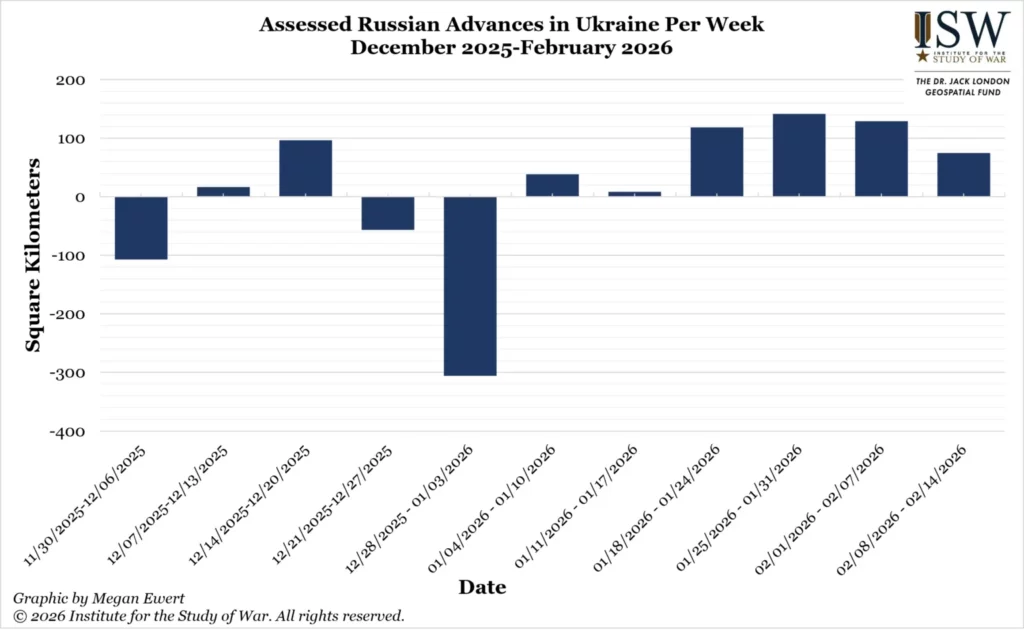
Russian gains continue to move at a footpace and do not portend the collapse of the Ukrainian lines. Russia’s weekly advances between late November 2025 and mid-February 2026 have fluctuated widely. At their height, Russian forces seized 141 square kilometers the week of January 25-31, but Russian gains subsequently fell to 74 square kilometers in the past week (February 8 to 14). Ukrainian forces liberated territory in November and December 2025, decreasing Russian gains during some weeks. Ukrainian forces liberated territory in the Kharkiv, Kostyantynivka, Pokrovsk, and Novopavlivka directions in late November and early December, such that Russian forces lost control over 106 square kilometers of Ukrainian territory. Ukrainian forces also liberated much of Kupyansk and its surroundings in late December, and Russian forces lost control over 305 square kilometers.
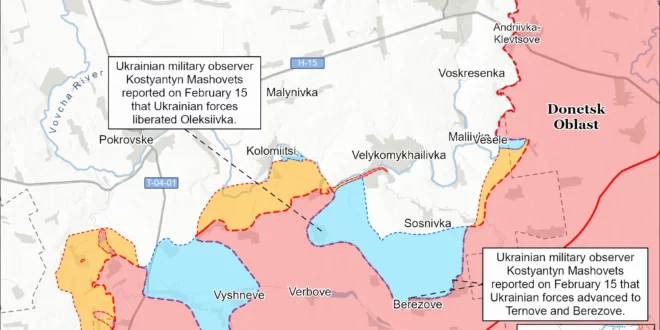
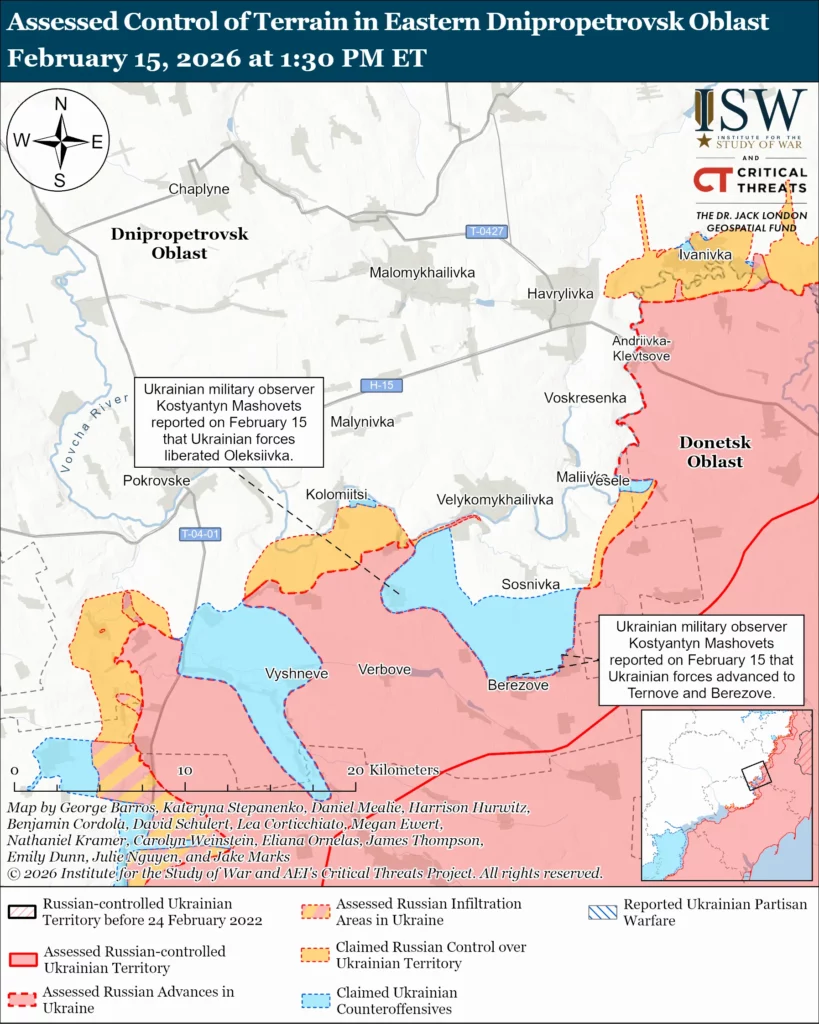
Recent Ukrainian tactical counterattacks have reportedly liberated multiple small settlements along the Yanchur and Haichur rivers in the Oleksandrivka and Hulyaipole directions. Ukrainian military observer Kostyantyn Mashovets stated on February 15 that the tempo of Russian advances in the Oleksandrivka and Hulyaipole directions began to slow about one week ago (starting roughly February 8) and has since largely stopped.[22] Mashovets assessed that Ukrainian forces have been able to significantly reduce Russian advances in a few narrow sectors of the Oleksandrivka and Hulyaipole directions, pushing Russian forces back nine to 9.5 kilometers in some areas. Mashovets, noted, however, that Ukrainian forces are not conducting a “counteroffensive” – in line with recent Ukrainian official statements denying Russian milblogger claims that Ukrainian forces launched a “counteroffensive” in the area.[23] ISW uses the term “counteroffensive” to refer to a large-scale operational-level undertaking such as those that liberated much of Kharkiv Oblast and western Kherson Oblast in 2022. It uses the term “counterattack” to refer to the smaller, tactical actions Ukrainian forces have been conducting recently in Zaporizhia Oblast. Mashovets stated that Ukrainian forces pushed Russian forces from Oleksiivka and Orestopil and advanced to Berezove and Ternove (all southeast of Oleksandrivka). Mashovets stated that Ukrainian forces also pushed Russian forces from Danylivka; liberated Vyshneve, Yehorivka, Zlahoda, and Rybne (all southeast of Oleksandrivka along the Yanchur River); and are fighting for Pryvilne (just southeast of Rybne along the Yanchur River).
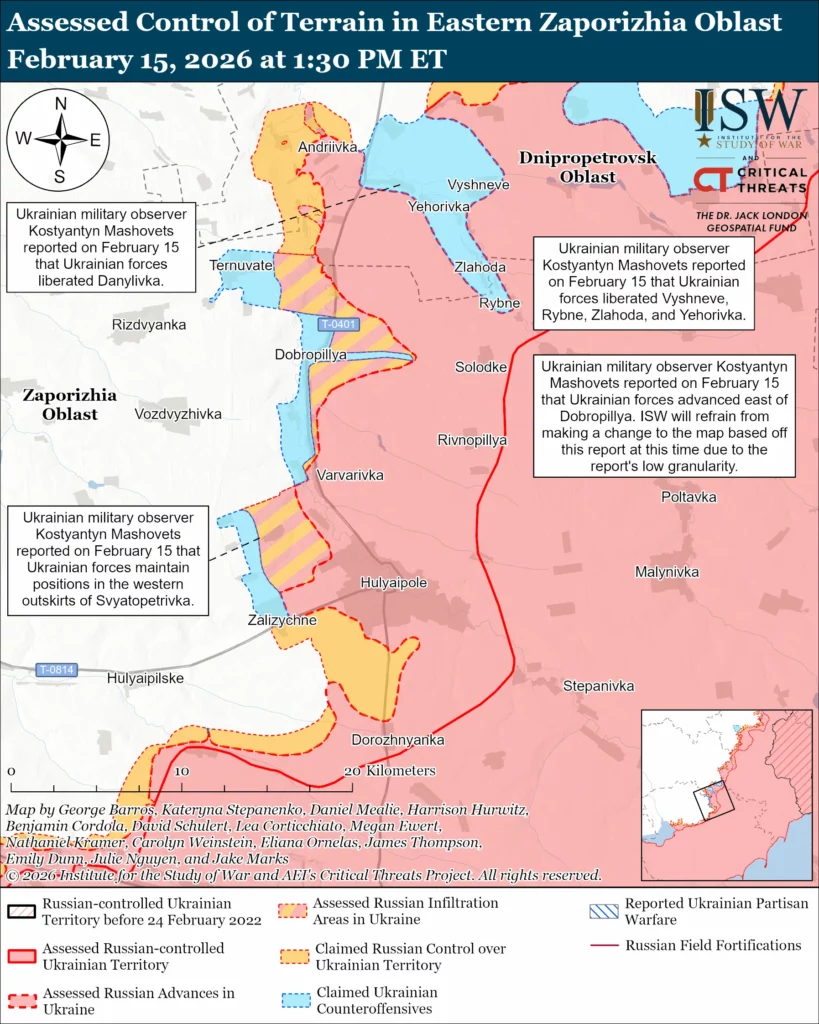
Mashovets reported that Ukrainian forces pushed Russian forces from Ternuvate and Kosivtseve (both northwest of Hulyaipole), crossed the Haichur River, liberated Dobropillya (north of Hulyaipole and east of the Haichur River), and are currently operating east of Dobropillya. Mashovets reported that Ukrainian forces pushed Russian forces from Pryluky and Olenokostyantynivka (both northwest of Hulyaipole), crossed the Haichur River, and have begun fighting for Varvarivka (just south of Pryluky and east of the Haichur River). Mashovets reported that Ukrainian counterattacks along the Tsvitkove-Zaliznychne line (northwest to west of Hulyaipole) stopped Russian advances but that Russian forces still advanced up to 1.2 kilometers south of Zaliznynche.
These Ukrainian counterattacks are likely leveraging the recent block on Russian forces’ access to Starlink, which Russian milbloggers have claimed is causing communications and command and control (C2) issues on the battlefield.[24] Mashovets reported on February 5 that the Russian military command is preparing for the summer 2026 offensive in the Slovyansk-Kramatorsk direction and/or the Orikhiv-Zaporizhzhia City direction but that Russian forces are struggling to seize the necessary starting positions to launch the offensive on the command’s intended timeline.[25] Recent tactical Ukrainian counterattacks in the Oleksandrivka and Hulyaipole directions have likely further hindered Russian forces’ ability to properly prepare for a summer offensive toward Orikhiv and Zaporizhzhia City from the east.
Russia is reportedly testing a stratospheric communications system as an alternative to Starlink, which some Russian milbloggers have already dismissed as an inadequate replacement. The Russian Foundation for Advanced Research Projects, a Kremlin-established advanced military research agency, claimed to Kremlin newswire TASS on February 12 that Russia conducted the maiden flight of the Barrage-1 unmanned stratospheric platform, which could carry 5G Non-Terrestrial Network (NTN) off-ground communications equipment.[26] The research agency claimed that the platform can carry up to 100 kilograms and fly at an altitude of 20 kilometers. Russian milbloggers framed the test of the Barrage-1 as part of efforts to find an alternative to Starlink after Russian forces in Ukraine recently lost access to the SpaceX system.[27] Russian milbloggers cautioned, however, that Barrage is not a full replacement for Starlink, with one Kremlin-affiliated Russian milblogger stating that a single launched aerostat cannot replace a low-orbit constellation of several thousand satellites but may play a role in a layered communications system.[28] Ukrainian Ministry of Defense (MoD) advisor on defense technology and drone and electronic warfare (EW) expert Serhiy “Flash” Beskrestnov called on Ukrainian forces to use S-300 air defense systems to strike objects like the Barrage-1 system at altitudes of 20-30 kilometers.[29]
Key Takeaways
The Kremlin continues to discuss future elections in Ukraine to advance its false claim that the current Ukrainian government is illegitimate and insists on means of controlling Ukraine’s politics.
The Kremlin continues to signal that it will reject any election result that does not produce such a pro-Russia government in Ukraine.
Long-term, meaningful US security guarantees for Ukraine must precede a war termination agreement to prevent the Kremlin from following through on its stated intent to reject such guarantees after Ukraine has committed to ceding territory.
General Staff Army General Valery Gerasimov continues to aggrandize Russian seizures of small villages and fields to influence ongoing negotiations and push the West and Ukraine to give in to Russian territorial demands.
Russian gains continue to move at a footpace and do not portend the collapse of the Ukrainian lines.
Recent Ukrainian tactical counterattacks have reportedly liberated multiple small settlements along the Yanchur and Haichur rivers in the Oleksandrivka and Hulyaipole directions.
Russia is reportedly testing a stratospheric communications system as an alternative to Starlink, which some Russian milbloggers have already dismissed as an inadequate replacement.
Ukrainian forces recently advanced in northern Kharkiv Oblast and in the Oleksandrivka and Hulyaipole directions.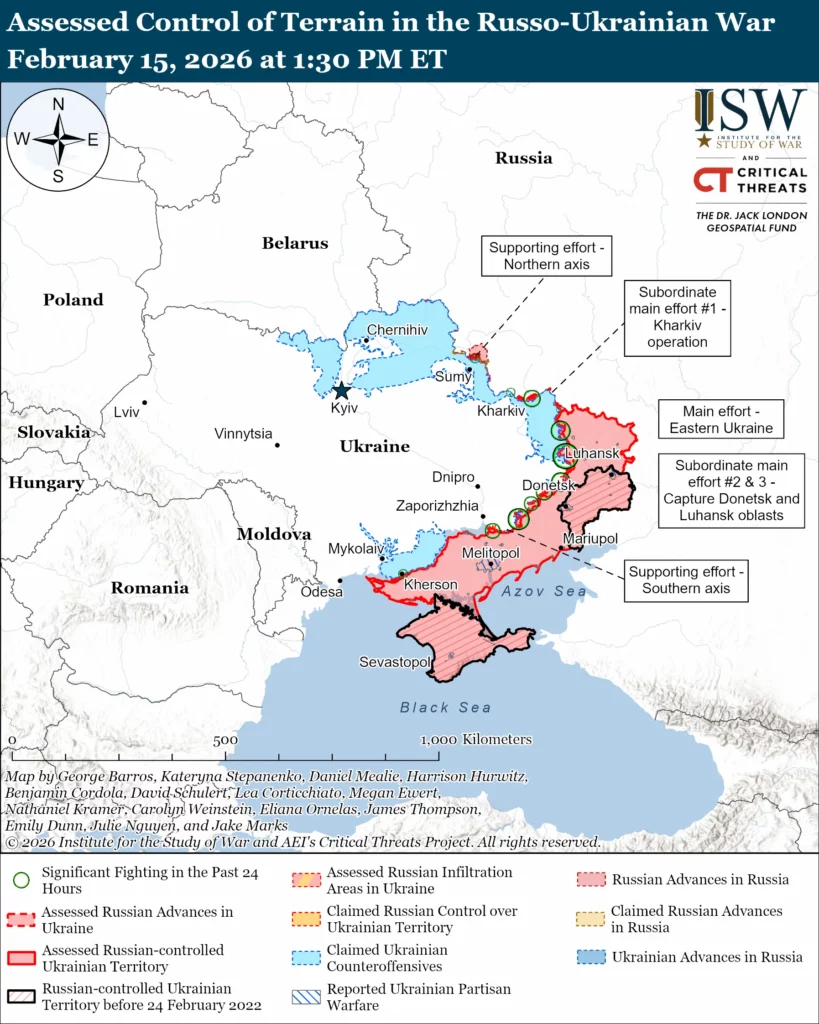
We do not report in detail on Russian war crimes because these activities are well-covered in Western media and do not directly affect the military operations we are assessing and forecasting. We will continue to evaluate and report on the effects of these criminal activities on the Ukrainian military and the Ukrainian population and specifically on combat in Ukrainian urban areas. We utterly condemn Russian violations of the laws of armed conflict and the Geneva Conventions and crimes against humanity even though we do not describe them in these reports.
Ukrainian Operations in the Russian Federation
Ukrainian forces reportedly struck Russian oil infrastructure in Krasnodar Krai on the night of February 14 to 15. The Ukrainian General Staff reported that Ukrainian strikes damaged and started a fire at the Tamanneftegaz oil terminal near Volna, Krasnodar Krai.[30] Krasnodar Krai Governor Veniamin Kondratyev claimed that Ukrainian strikes damaged an oil storage tank, warehouse, and terminals in Volna.[31] Kondratyev claimed that Russian air defenses damaged a home in Sochi and a boiler room in Yurovka while repelling the strike. The Krasnodar Krai Operational Headquarters claimed that falling drone debris started a fire at an oil tank in Volna.[32]
Russian Supporting Effort: Northern Axis
Russian objective: Create defensible buffer zones in Sumy Oblast along the international border
Russian forces continued offensive operations in Sumy Oblast on February 15 but did not make confirmed advances.
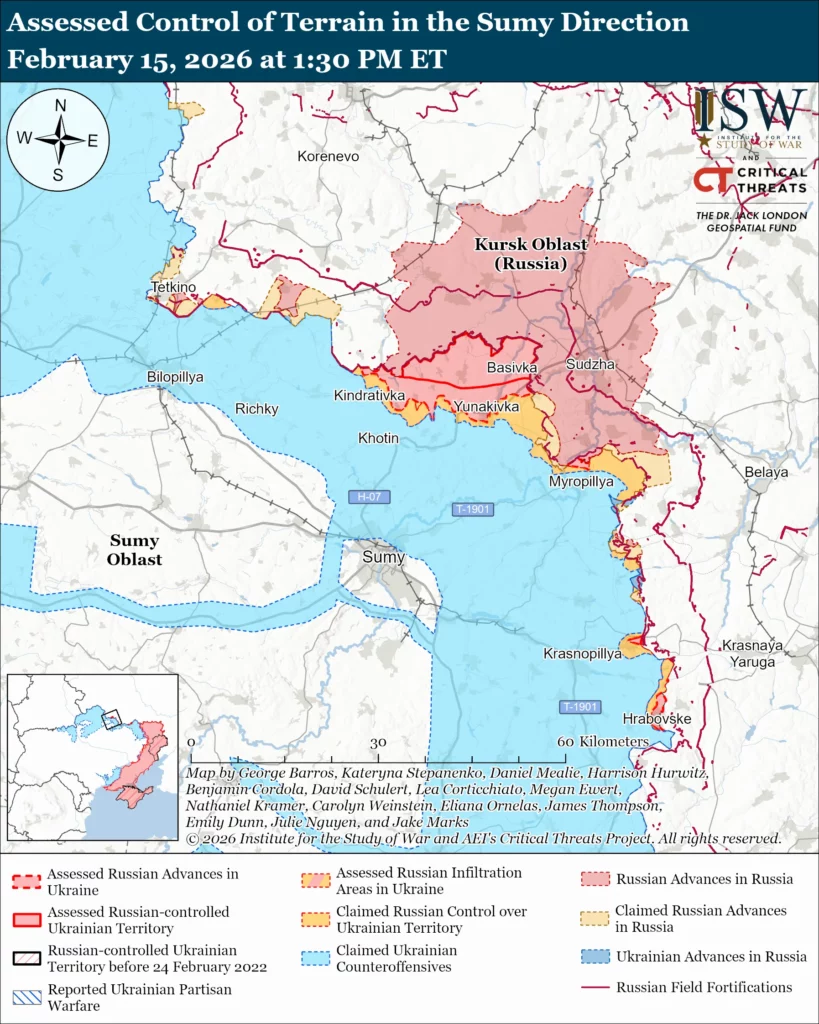
Unconfirmed claims: A Russian milblogger claimed that Russian forces advanced northwest of Mala Korchakivka (north of Sumy City).[33]
Russian forces attacked in Sumy and Kursk oblasts, including northwest of Sumy City toward Komarivka; north of Sumy City near Varachyne, Andriivka, Kindrativka, and Oleksiivka, and toward Mala Korchakivka; northeast of Sumy City near Yablunivka; and southeast of Sumy City near Hrabovske on February 14 and 15.[34]
A Russian milblogger reportedly affiliated with the Russian Northern Grouping of Forces claimed that all 100 Russian servicemembers from the 83rd Separate Airborne (VDV) Brigade who entered Sumy Oblast on December 13 were killed in action (KIA) as of February 15.[35]
Russian Main Effort: Eastern Ukraine
Russian Subordinate Main Effort #1 – Kharkiv Oblast
Russian objective: Push Ukrainian forces back from the international border to create a defensible buffer zone with Belgorod Oblast and approach to within tube artillery range of Kharkiv City
Ukrainian forces recently advanced in northern Kharkiv Oblast.
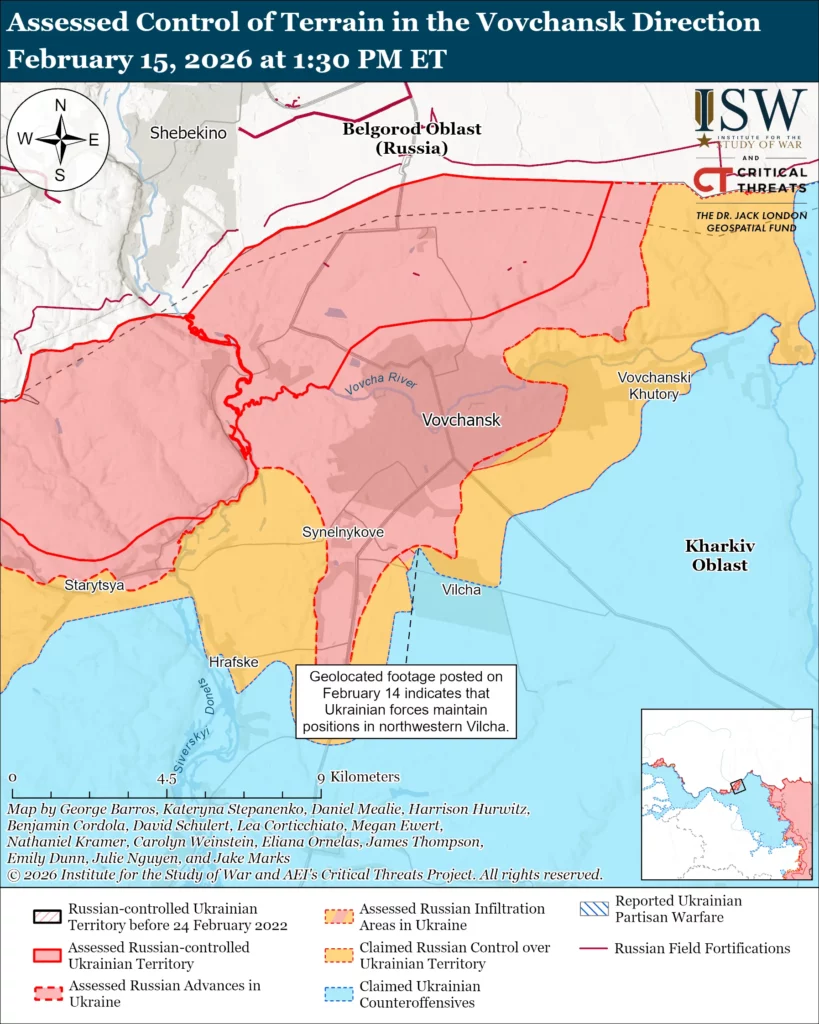
Assessed Ukrainian advances: Geolocated footage published on February 14 indicates that Ukrainian forces recently advanced in northwestern Vilcha (northeast of Kharkiv City).[36]
Refinement of areas under Russian claims: Geolocated footage published on February 14 shows Ukrainian forces operating in northwestern Vilcha – an area where Russian sources previously claimed that Russian forces maintained a presence.[37]
Russian forces attacked north of Kharkiv City near Veterynarne and northeast of Kharkiv City near Vovchansk, Vovchanski Khutory, Hrafske, Starytsya, Symynivka, and Vilcha, and toward Okhrimivka and Rybalkyne on February 14 and 15.[38] A Russian milblogger reportedly affiliated with the Russian Northern Grouping of Forces claimed that Ukrainian forces counterattacked in Vilcha.[39]
Order of Battle: Elements of the Russian 83rd Motorized Rifle Regiment (69th Motorized Rifle Division, 6th Combined Arms Army [CAA], Leningrad Military District [LMD]) are reportedly operating in the Kharkiv direction.[40]
Russian forces continued offensive operations southeast of Velykyi Burluk near Kolodyazne on February 14 and 15 but did not advance.[41]
Russian Subordinate Main Effort #2 – Oskil River
Russian objective: Cross the Oskil River in Kharkiv Oblast and push westward into eastern Kharkiv Oblast and northern Donetsk Oblast
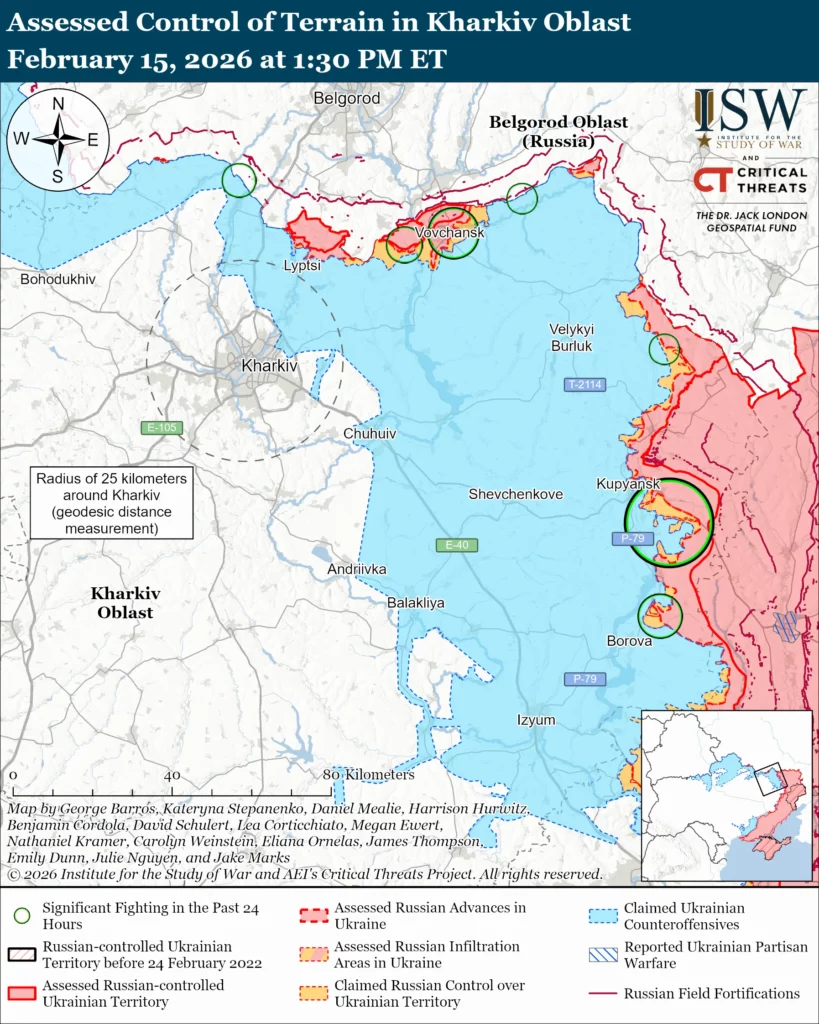
Ukrainian forces recently advanced or maintained positions in the Kupyansk direction.
Refinement of areas under Russian claims: Geolocated footage published on February 15 shows Ukrainian forces operating in northern Kupyansk, an area where Russian sources previously claimed that Russian forces maintained a presence.[42]
Russian forces attacked east of Kupyansk near Petropavlivka and Kucherivka and southeast of Kupyansk toward Kupyansk-Vuzlovyi, Kurylivka, Pishchane, and Hlushkivka on February 14 and 15.[43]
The commander of a Ukrainian battalion operating in the Kupyansk direction reported on February 15 that Russian servicemembers operating in the Kupyansk direction are poorly trained and avoid small arms engagements with Ukrainian forces.[44] The commander reported that Russian forces attempt to infiltrate during foggy and snowy conditions and that Russian forces send unarmed servicemembers to advance to test the terrain and expose Ukrainian positions.
Russian forces continued offensive operations in the Borova direction on February 15 but did not advance.
Russian forces attacked north of Borova near Novoplatonivka, northeast of Borova near Borivska Andriivka, and southeast of Borova near Hrekivka on February 14 and 15.[45] A Russian milblogger reportedly affiliated with the Russian Western Grouping of Forces claimed that Ukrainian forces counterattacked near Korovii Yar and Oleksandrivka (both south of Borova).[46]
Russian Subordinate Main Effort #3 – Donetsk Oblast
Russian objective: Capture the entirety of Donetsk Oblast, the claimed territory of Russia’s proxies in Donbas, and advance into Dnipropetrovsk Oblast
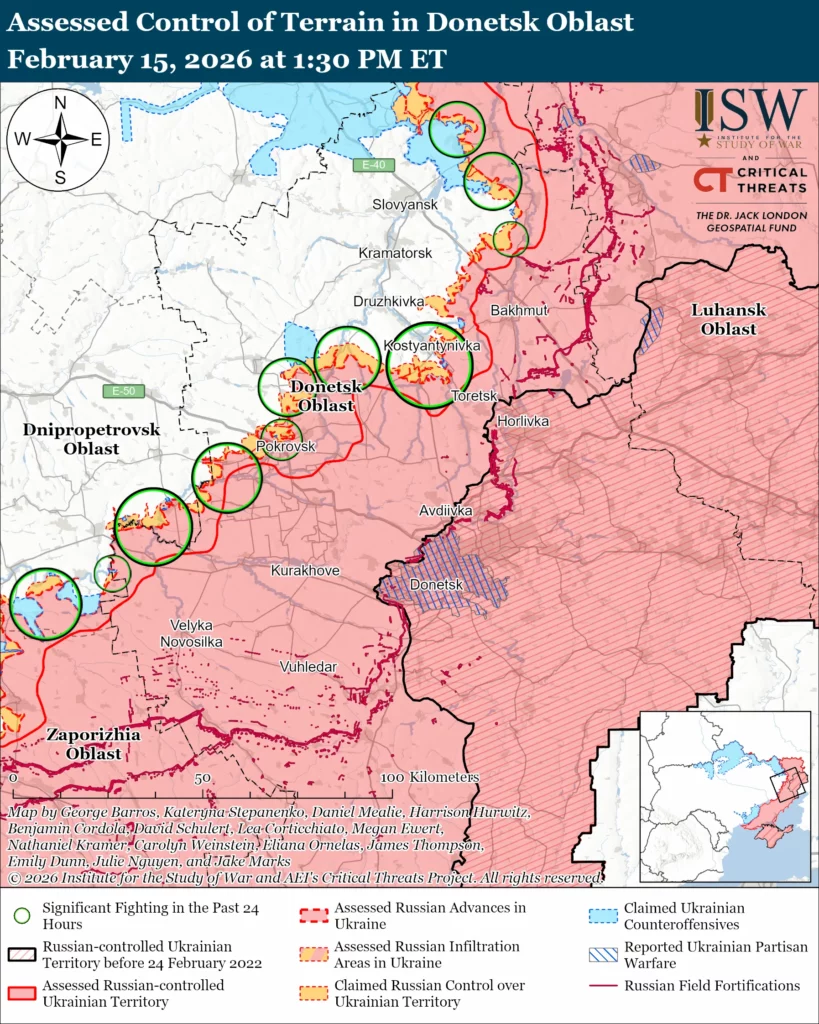
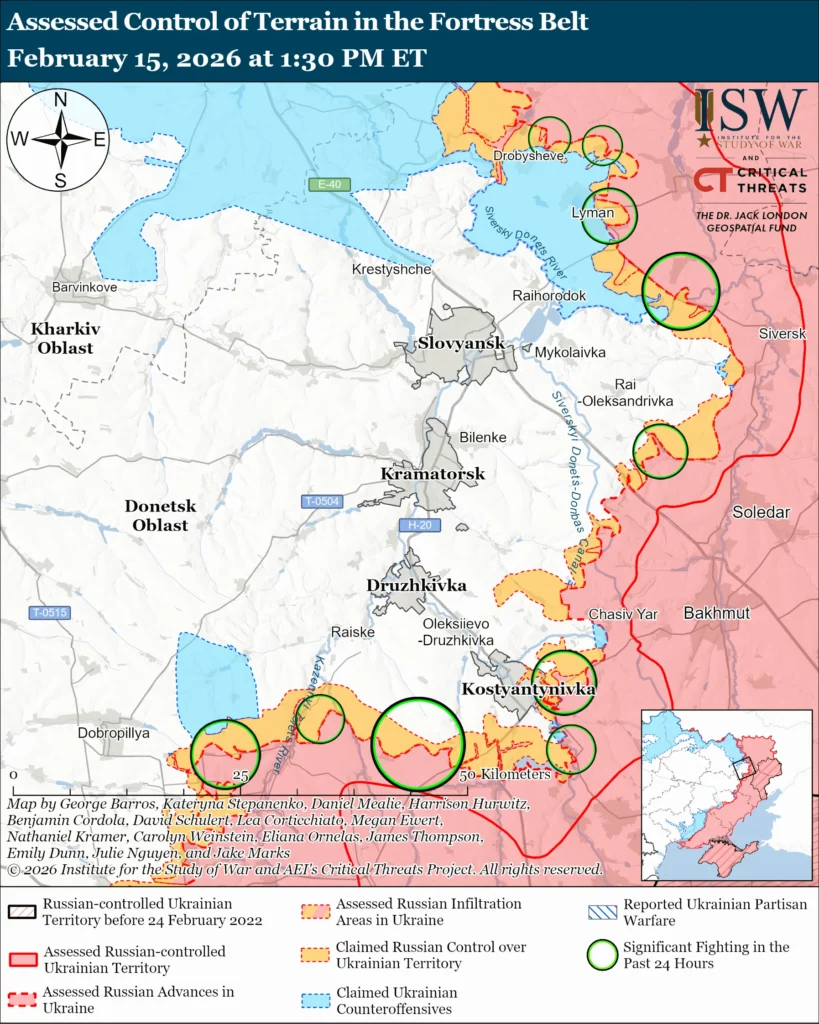
Russian forces continued offensive operations in the Slovyansk direction on February 15 but did not make confirmed advances.
Unconfirmed claims: A Russian milblogger claimed that Russian forces advanced to the northeastern outskirts of Kryva Luka (east of Slovyansk).[47]
Russian forces attacked toward Lyman itself; northwest of Lyman near Drobysheve and Svyatohirsk; north of Lyman toward Stavky; southeast of Lyman near Yampil and Dronivka; east of Slovyansk near Platonivka, Zakitne, and Riznykivka, and toward Rai-Oleksandrivka, Kalenyky, and Kryva Luka; and southeast of Slovyansk near Nykyforivka and toward Fedorivka Druha on February 14 and 15.[48] A Russian milblogger reportedly affiliated with the Russian Western Grouping of Forces claimed that Ukrainian forces counterattacked in Lyman and near Drobysheve.[49]
A Ukrainian brigade operating in the Slovyansk direction reported on February 15 that Russian forces continue to infiltrate in small groups of up to three servicemembers and to exploit cold weather conditions to cross the frozen Siverskyi Donetsk River.[50] The Ukrainian brigade reported that Russian servicemembers sometimes disguise themselves as civilians — an act of perfidy, a war crime under the Geneva Convention to which Russia is a signatory.
Order of Battle: First-person view (FPV) drone operators of the Russian 85th Motorized Rifle Brigade (3rd Combined Arms Army [CAA], formerly 2nd Luhansk People’s Republic Army Corps [LNR AC], Southern Military District [SMD]) are striking Ukrainian forces in Dibrova (southeast of Lyman).[51]
Ukrainian forces recently maintained positions or advanced in the Kostyantynivka–Druzhkivka tactical area.
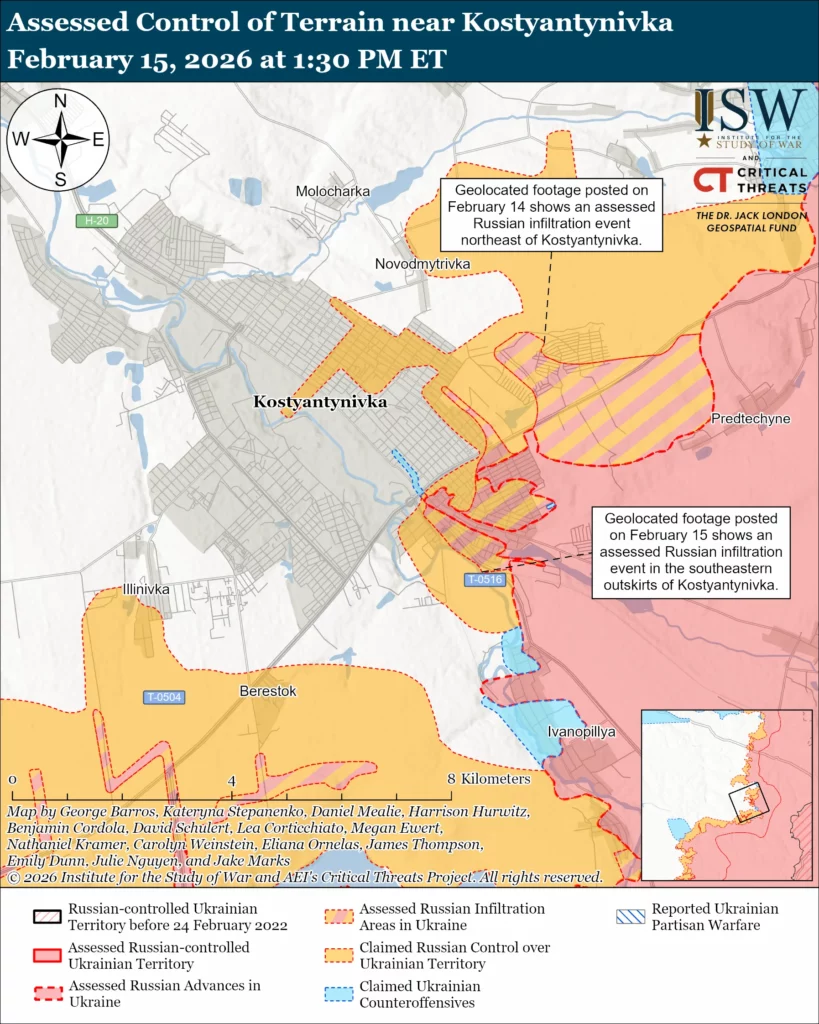
Assessed Russian infiltrations: Geolocated footage published on February 14 and 15 shows Ukrainian forces striking Russian forces northeast of and in the southeastern outskirts of Kostyantynivka during what ISW assesses were Russian infiltration missions that did not change the control of terrain or the forward edge of battle area (FEBA).[52]
Russian forces attacked near Kostyantynivka itself; east of Kostyantynivka toward Predtechyne and Novodmytrivka; southeast of Kostyantynivka near Pleshchiivka, Ivanopillya, and Shcherbynivka; south of Kostyantynivka near Berestok and toward Illinivka; southwest of Kostyantynivka near Stepanivka; south of Druzhkivka near Mykolaipillya and Rusyn Yar; and southwest of Druzhkivka near Sofiivka and toward Novopavlivka on February 14 and 15.[53]
A Kremlin-affiliated Russian milblogger claimed on February 15 that exaggerated claims of Russian advances are complicating the situation for Russian forces in the Kostyantynivka direction.[54] The milblogger claimed that recent footage indicates Ukrainian forces continue to conduct attacks toward central Chasiv Yar (northeast of Kostyantynivka) from positions in southwestern Chasiv Yar despite Russian claims of the seizure of the town. The milblogger claimed that newly released footage suggests Russian forces previously falsely claimed control of Chervone (east of Kostyantynivka).
Order of Battle: Elements of the Russian 1008th Motorized Rifle Regiment (6th Motorized Rifle Division, 3rd AC, under operational control of the Southern Grouping of Forces) are operating near Stupochky (east of Kostyantynivka).[55] Drone operators of the 27th Artillery Regiment (6th Motorized Rifle Division, AC, under operational control of the Southern Grouping of Forces) are reportedly striking Ukrainian vehicles near Kostyantynivka.[56] FPV drone operators of the 57th Spetsnaz Company (8th CAA, SMD) are reportedly striking Ukrainian equipment near Mykolaipillya.[57]
Russian forces continued offensive operations in the Dobropillya tactical area on February 15 but did not make confirmed advances.
Unconfirmed claims: A Russian milblogger claimed on February 15 that Russian forces advanced south and southeast of Novyi Donbas (east of Dobropillya).[58]
Russian forces attacked northeast of Dobropillya near Kucheriv Yar; east of Dobropillya near Vilne, Nove Shakhove, Novyi Donbas, and Toretske; and southeast of Dobropillya near Ivanivka on February 14 and 15.[59]
Order of Battle: FPV drone operators of the Russian 56th Separate Spetsnaz Battalion (51st CAA, formerly 1st Donetsk People’s Republic [DNR] AC, SMD) are reportedly striking Ukrainian vehicles near Krasnoyarske (south of Dobropillya).[60]
Russian forces continued offensive operations in the Pokrovsk direction on February 15 but did not advance.
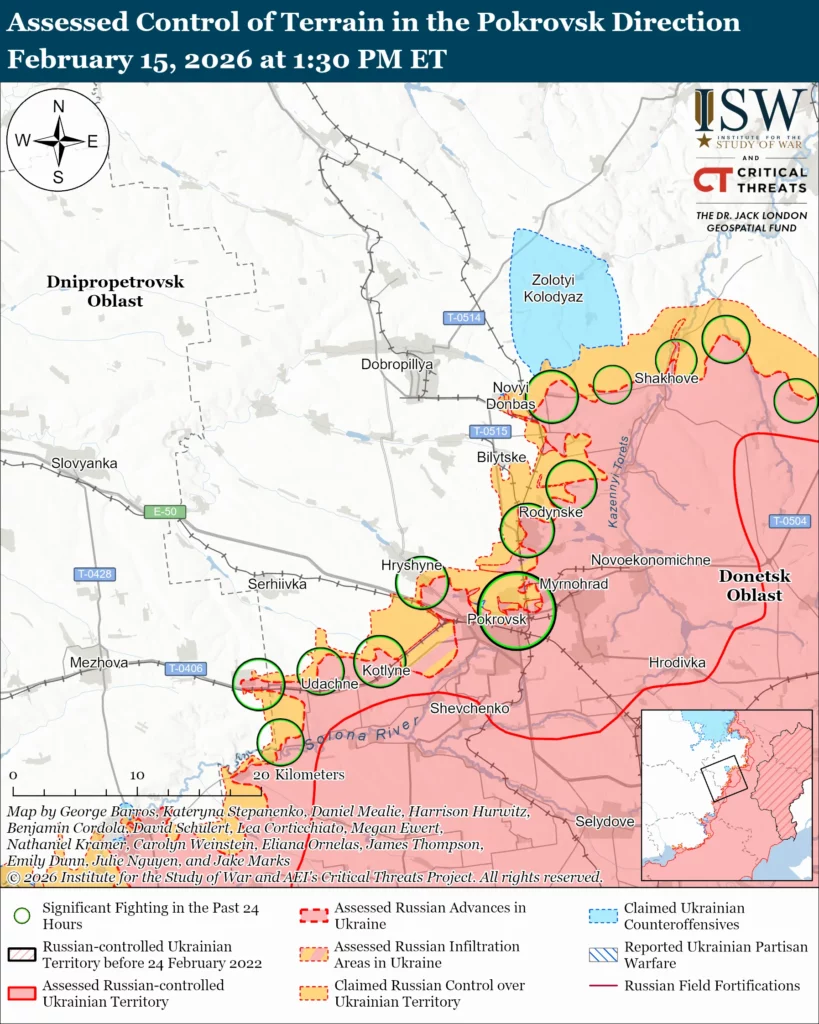
Russian forces attacked near Pokrovsk itself; northwest of Pokrovsk toward Shevchenko and Novooleksandrivka; north of Pokrovsk near Rodynske and Bilytske; northeast of Pokrovsk near Zatyshok; southwest of Pokrovsk near Kotlyne, Udachne, Molodetske, and Novopidhorodne; and west of Pokrovsk toward Serhiivka on February 14 and 15.[61] A Russian milblogger claimed that Ukrainian forces counterattacked near Molodetske and Udachne.[62]
Order of Battle: Drone operators of the Russian Irlandtsy Strike Detachment of the Grom-Kaskad Drone Brigade (reportedly of the 4th Air Force and Air Defense Army, Russian Aerospace Forces [VKS]) are striking Ukrainian equipment in Vodyankse (northwest of Pokrovsk).[63] FPV drone operators of the 74th Motorized Rifle Brigade (41st CAA, Central Military District [CMD]) are striking Ukrainian positions southwest of Hryshyne (northwest of Pokrovsk).[64] FPV drone operators of the 56th Separate Spetsnaz Battalion are reportedly striking Ukrainian equipment in Svitle (east of Pokrovsk).[65] Artillery elements of the Russian 35th Motorized Rifle Brigade (41st CAA) are reportedly operating in the Pokrovsk direction.[66]
Russian forces continued offensive operations near Novopavlivka itself, northeast of Novopavlivka near Novomykolaivka and Novoserhiivka, and south of Novopavlivka near Filiya and Dachne.[67]
Ukrainian forces recently advanced in the Oleksandrivka direction.
See topline text for assessed Ukrainian advances in the Oleksandrivka direction.
Russian forces attacked northeast of Oleksandrivka near Ivanivka and Zelenyi Hai and southeast of Oleksandrivka near Oleksandrohrad, Vyshneve, Oleksiivka, Verbove, and Stepove on February 14 and 15.[68] Russian milbloggers claimed that Ukrainian forces counterattacked near Orestopil and toward Stepove, Berezove, Ternove, Hai (all southeast of Oleksandrivka), and Andriivka (southwest of Oleksandrivka).[69]
Order of Battle: Ukrainian military observer Kostyantyn Mashovets reported that elements of the Russian 36th Motorized Rifle Brigade and 430th Motorized Rifle Regiment (both of the 29th CAA, Eastern Military District [EMD]) are operating on both sides of the H-15 Donetsk City-Zaporizhzhia City highway (northeast of Oleksandrivka).[70] Mashovets reported that elements of the 37th Motorized Rifle Brigade and the 5th Tank Brigade (both of the 36th CAA, EMD) are operating south of the Vovcha River in the Oleksandrivka direction.[71] Aircraft of the 11th Air Force and Air Defense Army (VKS and EMD) are reportedly striking Ukrainian positions near Kolomiitsi.[72]
Ukrainian forces continued their mid-range strike campaign against Russian military targets in occupied Donetsk Oblast on February 14. The Ukrainian General Staff reported on February 15 that Ukrainian forces struck a repair unit of an unspecified Russian artillery brigade near occupied Vilne (roughly 65 kilometers behind the frontline).[73]
Russian Supporting Effort: Southern Axis
Russian objective: Maintain frontline positions, secure rear areas against Ukrainian strikes, and advance within tube artillery range of Zaporizhzhia City
Ukrainian forces recently advanced in the Hulyaipole direction.
See topline for additional assessed Ukrainian advances and reports of Ukrainian counterattacks in the Hulyaipole direction.
Assessed Ukrainian advances: Ukrainian military observer Kostyantyn Mashovets’ reports that Ukrainian forces liberated Danylivka, Yehorivka (both north of Hulyaipole), Vyshneve, Rybne, and Zlahoda (all northeast of Hulyaipole) indicate that Ukrainian forces also likely liberated Kyrpychne (just east of Yehorivka) and Vidradne (northwest of Danylivka).[74]
Unconfirmed claims: The Russian Ministry of Defense (MoD) claimed on February 15 that elements of the Russian 218th Tank Regiment (127th Motorized Rifle Division, 5th Combined Arms Army [CAA], Eastern Military District [EMD]) seized Tsvitkove (northwest of Hulyaipole).[75]
Russian forces attacked near Hulyaipole itself; west of Hulyaipole near Zaliznychne and Staroukrainka; northwest of Hulyaipole near Ternuvate, Varvarivka, Tsvitkove, Prydorozhnie, and Pryluky; north of Hulyaipole near Dobropillya, Zelene, Yehorivka, Nove Zaporizhzhia, Danylivka, and Nechaivka; and northeast of Hulyaipole near Zlahoda and Pryvillya on February 14 and 15.[76] Russian milbloggers claimed that Ukrainian forces counterattacked toward Ternuvate, Rizdvyanka, and Olenokostyantynivka (all northwest of Hulyaipole).[77]
Russian forces continued offensive operations in western Zaporizhia Oblast on February 15 but did not make confirmed advances.
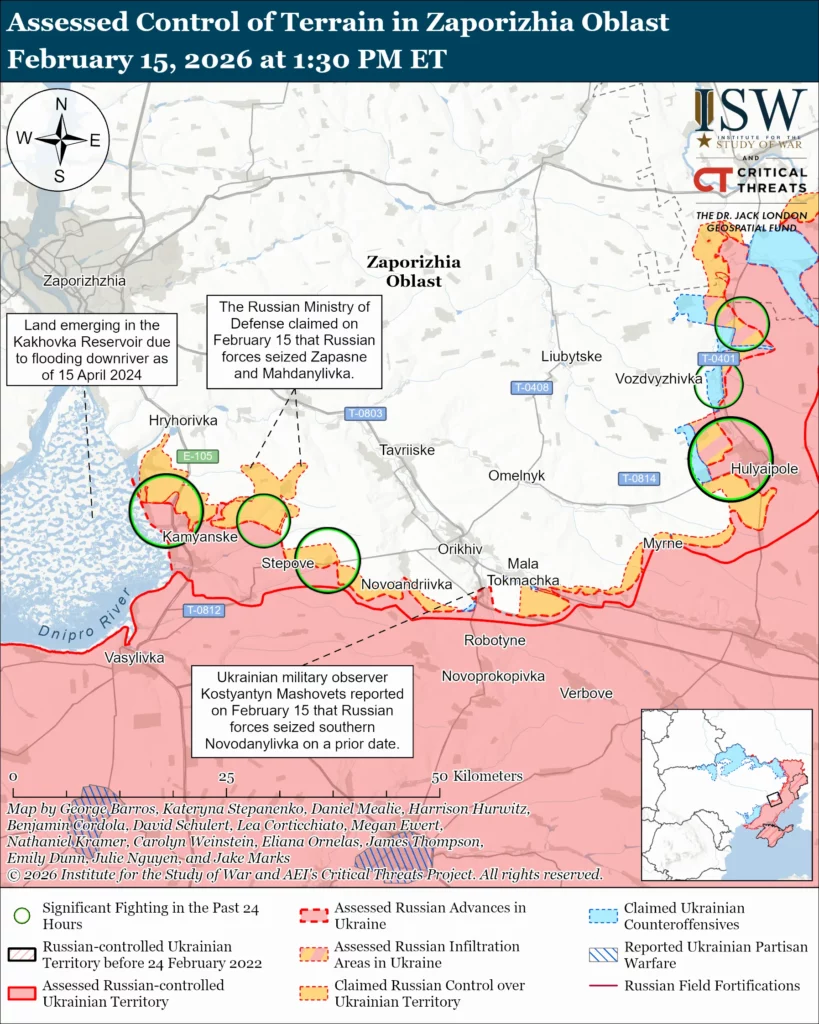
Unconfirmed claims: The Russian Ministry of Defense (MoD) claimed on February 15 that Russian forces seized Zapasne and Mahdalynivka (both northwest of Orikhiv).[78]
Russian forces attacked southwest of Orikhiv near Shcherbaky; west of Orikhiv near Stepnohirsk; and northwest of Orikhiv near Prymorske, Pavlivka, Lukyanivske, and Novoboikivske on February 14 and 15.[79] Ukrainian military observer Kostyantyn Mashovets reported that Ukrainian forces counterattacked near Stepnohirsk.[80]
Ukrainian Southern Defense Forces Spokesperson Colonel Vladyslav Voloshyn stated that Russian forces are trying to move along the shore of the former Kakhovka Reservoir, which largely dried up following the Russian detonation of the Nova Kakhovka Dam in early June 2023, and to push Ukrainian forces out of Prymorske.[81] Voloshyn stated that the Russian military command has brought up assault groups to the area south of Orikhiv but that the groups have not started active offensive operations. A Russian milblogger continued to complain that Russian forces in the Zaporizhia direction are submitting false reports about seized settlements and cautioned that limited Russian infiltrations into a settlement do not constitute a Russian seizure.[82] The milblogger claimed that Russian forces only confidently and fully control a settlement once the frontline has moved tens of kilometers away, as drones, sabotage and reconnaissance groups, and small infantry groups can still operate in the area until then.
Mashovets reported that Ukrainian forces pushed Russian forces from positions near Lukyanivske and have halted Russian advances in the Stepove-Pavlivka direction (southwest to west of Orikhiv).[83] Mashovets stated that small Russian groups are trying to hold both sides of the E105 Vasylivka-Zaporizhzhia City highway north of Stepnohirsk.
Order of Battle: Mashovets stated that elements of the Russian 108th and 247th Airborne (VDV) regiments (both 7th VDV Division) are operating near Stepnohirsk and Mali Shcherbaky (southwest of Orikhiv).[84] Mashovets reported that elements of the 76th VDV Division are operating south and southeast of Orikhiv. Mashovets stated that elements of the 392nd, 429th, 503rd motorized rifle regiments (all three of the 19th Motorized Rifle Division, 58th CAA, Southern Military District [SMD]); 70th and 291st motorized rifle regiments (both of the 42nd Motorized Rifle Division, 58th CAA); 100th Reconnaissance Brigade; 4th Military Base (both of the 58th CAA); and 45th Spetsnaz Brigade of the Russian Airborne Forces (VDV) are operating in the Zaporizhia direction. Elements of the 108th VDV Regiment are reportedly operating in Prymorske.[85]
Ukrainian forces continued their mid-range strike campaign against Russian military targets in occupied Zaporizhia Oblast. The Ukrainian General Staff reported that Ukrainian forces struck a Russian manpower concentration near Lyubymivka (southwest of Orikhiv and roughly 25 kilometers from the frontline).[86]
Russian forces continued limited offensive operations in unspecified areas in the Kherson direction on February 14 and 15 but did not advance.[87]
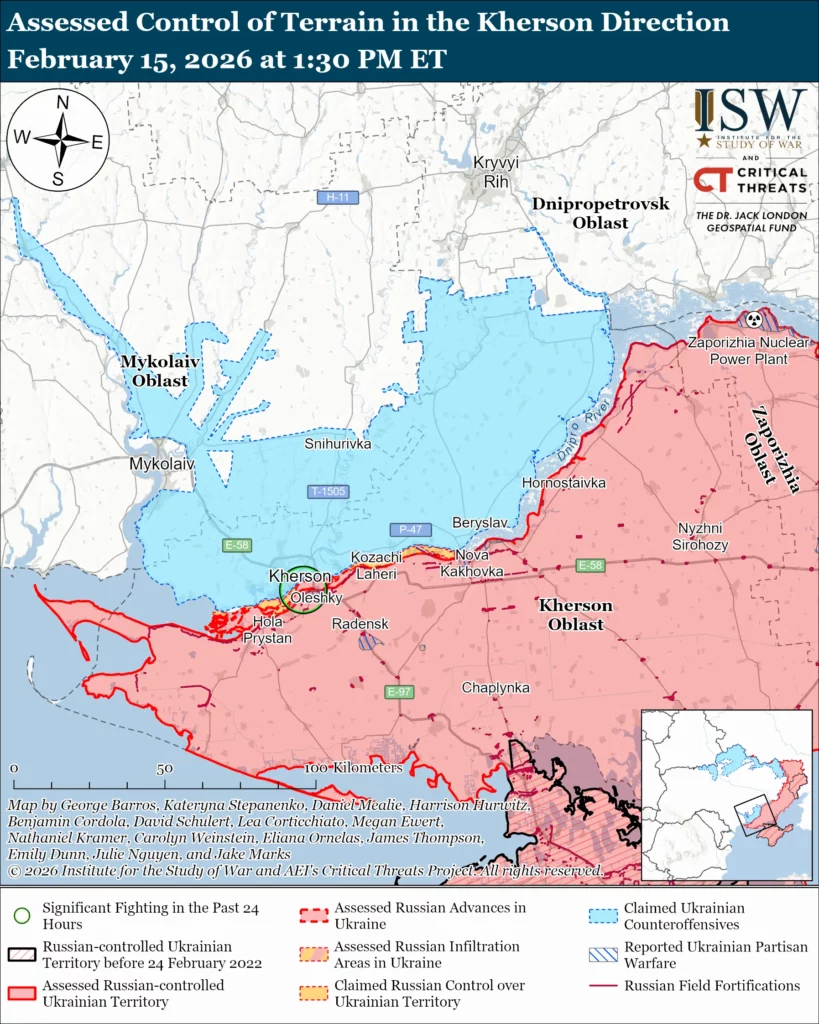
Ukrainian forces continued their long-range strike campaign against Russian military infrastructure in occupied Crimea on February 14. The Ukrainian General Staff reported that Ukrainian forces struck a Russian Pantsir-S1 air defense system near occupied Kacha (roughly 220 kilometers from the frontline).[88]
Russian Air, Missile, and Drone Campaign
Russian Objective: Target Ukrainian military and civilian infrastructure in the rear and on the front line
Russian forces conducted a series of drone strikes against Ukraine on the night of February 14 to 15. The Ukrainian Air Force reported that Russian forces launched 83 Shahed-, Gerbera-, Italmas-type, and other drones – of which roughly 50 were Shaheds – from the directions of Bryansk City; Millerovo, Rostov Oblast; Primorsko-Akhtarsk, Krasnodar Krai; and occupied Cape Chauda and Hvardiiske, Crimea.[89] The Ukrainian Air Force reported that Ukrainian forces downed 55 drones, that 25 drones hit 12 locations, and that debris fell at three locations. Ukrainian officials reported that Russian forces struck energy, civilian, and railway infrastructure in Odesa, Donetsk, Zaporizhia, Dnipropetrovsk, and Sumy oblasts.[90]
Ukrainian President Volodymyr Zelensky reported that Russian forces launched roughly 1,300 drones, more than 1,200 glide bombs, and more than 50 missiles – almost all of which were ballistic missiles – against Ukraine in the past week (roughly February 8 to 14).[91] Zelensky noted that Russian forces are combining their strikes deliberately to destroy Ukraine’s power generation, substations, and grid. Zelensky stated that Ukraine has lost about 10 gigawatts of its electricity generation capacity due to Russian strikes against Ukrainian energy infrastructure.[92] Zelensky reported that a previous Russian missile strike destroyed a major Ukrainian production line of its FP-5 Flamingo cruise missiles but that Ukraine has since relocated and partially resumed production.[93]
Significant Activity in Belarus
Russian efforts to increase its military presence in Belarus and further integrate Belarus into Russian-favorable frameworks
Nothing Significant To Report.
Note: ISW does not receive any classified material from any source, uses only publicly available information, and draws extensively on Russian, Ukrainian, and Western reporting and social media as well as commercially available satellite imagery and other geospatial data as the basis for these reports. References to all sources used are provided in the endnotes of each update.