 Eurasia Press & News
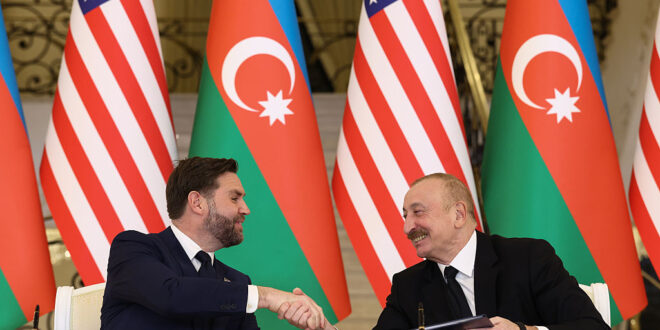
The U.S. is using diplomatic and economic carrots to project influence in a region that Russia has long regarded as its backyard.
Vice President JD Vance visited Armenia and Azerbaijan from February 9 to 11, making him the highest-level U.S. official to visit either country. The trip signaled a sharper U.S. push into the South Caucasus, with Vance announcing up to $9 billion in nuclear investment for Armenia, an $11 million reconnaissance drone sale to Armenia, and a broader security-focused strategic partnership with Azerbaijan.
Since the Trump administration brokered a peace deal between the two warring countries in August 2025, Washington has boosted its focus on the South Caucasus, which serves as a gateway to the mineral-rich nations in Central Asia. In turn, both Armenia and Azerbaijan are pivoting from Russia to the West.
Azerbaijan Seeks To Compete With Russia
Azerbaijan’s access to the Caspian Sea is a critical strategic draw. Economically, Azerbaijan is Central Asia’s only alternative to Russia and Iran for goods heading westward to Mediterranean ports. Militarily, Russia and Iran rely on the Caspian to transport weapons to each other, passing through Azerbaijani waters. Historically, Azerbaijan has also offered support and air access for U.S. and allied efforts in Kosovo, the Middle East, and Central Asia.
Under the new strategic partnership, Vance agreed to provide an unspecified number of ships to Azerbaijan. This indicates growing American commitment to protecting Azerbaijan’s logistical corridor from the potential for Russo-Iranian interference while supporting an Azerbaijani naval force capable of competing with Russia’s Caspian Flotilla.
Defense Ties With Armenia Come With Strings Attached
In Armenia, where Vance began his trip, the proposed construction of American small modular nuclear reactors — regarded as lower-cost, safer options — is a major step in reducing Russian strategic leverage.
Armenia’s Metsamor nuclear power plant — serviced by Russia’s state-run nuclear program, Rosatom — generates roughly 40 percent of Yerevan’s total electricity. This leaves Armenia exposed to Russian political pressure. Metsamor is also overdue for an upgrade. The plant is aging and vulnerable to earthquakes, and Armenia has continued to prolong its life despite signing an agreement with the European Union to close the plant by the end of 2004.
More broadly, Armenia’s turn toward the West, though significant, is politically fragile and faces domestic opposition. This environment matters when it comes to the pending sale of U.S.-made drones.
Armenia’s lingering defense ties to Moscow — coupled with Russia’s hard-security footholds via military bases it operates in Armenia — could compromise cooperation. The proposed drones are not among the most sensitive technologies, but Armenia’s relationship with Russia nevertheless raises concerns about counterintelligence and technology security risks. With Armenia’s next parliamentary election scheduled for June 7, Russia-linked influence operations are already moving to polarize the campaign and undercut pro-Western leaders.
A similar problem is posed by Armenia’s significant trade and transit connections with Iran. Iran’s ambassador to Armenia announced on February 12 that the countries plan to form a comprehensive strategic partnership this year.
The U.S. Is Becoming a Key Regional Player
The U.S. focus on military and strategic partnerships can help supplant Russian influence in the region. However, long-term investment may prove more powerful for sustained influence. Initiatives like the so-called “Trump Route for International Peace and Prosperity” — a U.S.-funded infrastructure corridor bridging former conflict zones in Azerbaijan and Armenia — as well as nuclear and logistics projects, create semi-permanent ties to the region and promote economic integration.
Armenia and Azerbaijan are distinguished by their volatile and oppressive political climates, significant ties to Russia, and corruption problems. American investment and security cooperation, complemented by the threat of Global Magnitsky sanctions, which target officials involved in corruption and human rights violations, may provide leverage for reform. However, reforms require oversight, such as political monitoring mechanisms and the audits of expenses to reduce opportunities for fraud.