 Eurasia Press & News
Key Takeaway: Hezbollah is attempting to prevent its complete disarmament through a combination of military and political measures. The Lebanese state has taken unprecedented steps to disarm Hezbollah since December 2024 and has made moderate progress in disarming the group south of the Litani River. Hezbollah, however, has employed a cognitive warfare campaign to delay or ultimately reverse the government’s disarmament plan, which appears to have affected Lebanese leaders’ willingness and complicated the Lebanese Armed Forces’ (LAF) ability to disarm Hezbollah north of the Litani River. Delaying the disarmament of Hezbollah will make disarmament harder because Hezbollah is reconstituting.
Hezbollah is attempting to prevent its complete disarmament through a combination of military and political measures. Israeli military action in Fall 2024 significantly degraded Hezbollah capabilities and infrastructure and led to a ceasefire under which Hezbollah would be forced to disarm.[1] The ceasefire, backed by the United States, enabled Israel to conduct airstrikes and take other action if Hezbollah did not comply with disarmament.[2] Hezbollah began efforts to reconstitute itself immediately after the ceasefire, but a combination of its weakness and US and Saudi diplomatic pressure led to the election of a new Lebanese president and the formation of a government that did not support Hezbollah’s use of arms outside of the state. The new Lebanese government—with the support of the president—approved an LAF plan to disarm Hezbollah in September 2025.[3] Hezbollah has not openly resisted disarmament in southern Lebanon, but it has attempted to deter the government from disarming it north of the Litani River and has been somewhat successful in doing so. The hesitant Lebanese commitment to moving the disarmament program north of the Litani River has created an opportunity for Hezbollah to continue key reconstitution efforts. The United States and its regional partners will need to consistently increase support for the Lebanese state, including support for the state’s financial, political, and security institutions. This campaign should seek to create a Lebanese state that is stronger than Hezbollah and able to fulfill civilian needs, rendering Hezbollah unable to provide its social services.
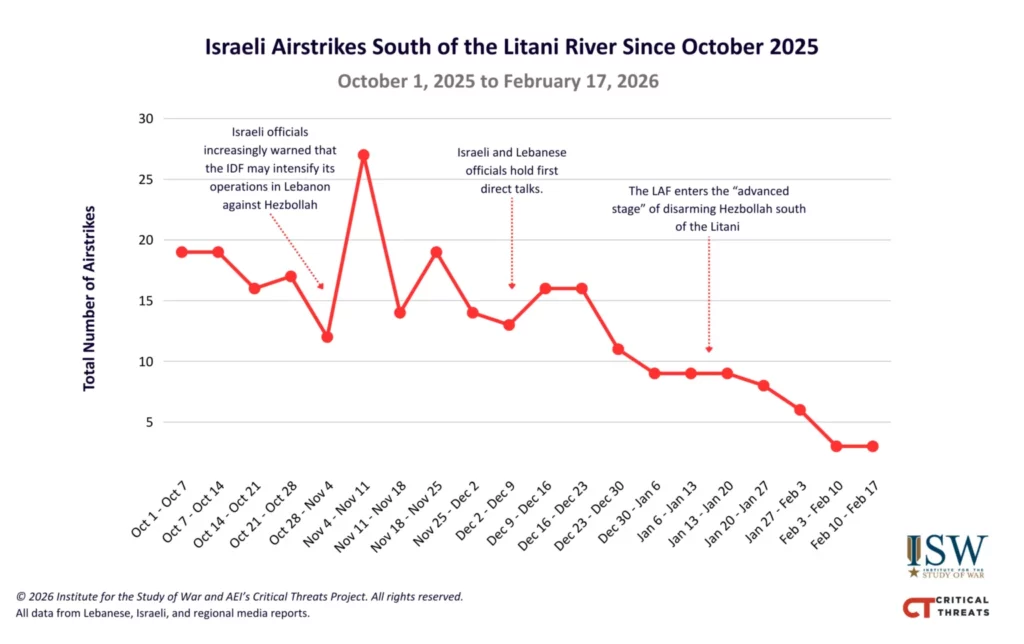
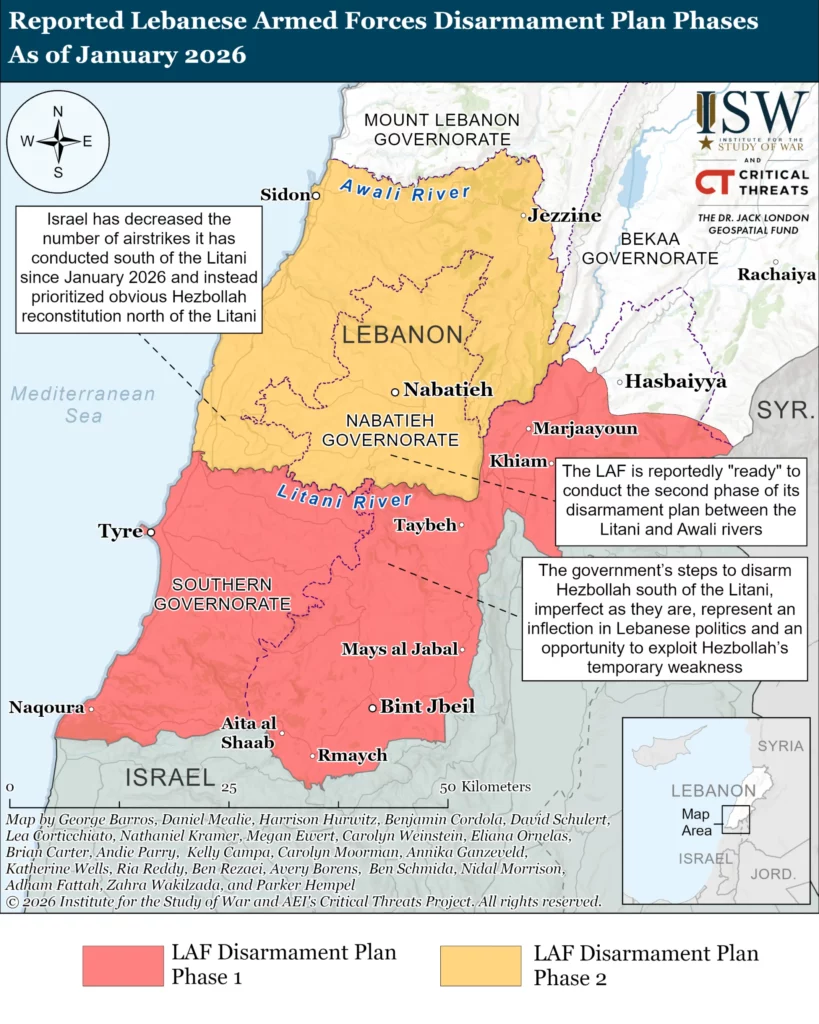
The Lebanese state has made progress in disarming Hezbollah south of the Litani River. It is difficult to confirm the degree to which Hezbollah is disarmed south of the Litani, but Israel has decreased the number of airstrikes it has conducted south of the Litani since January 2026 and instead prioritized obvious Hezbollah reconstitution north of the Litani.[4] Israel would almost certainly strike if Hezbollah remained capable of attacking Israel from southern Lebanon, so the decrease in airstrikes suggests that Hezbollah is now weaker in the south. The decrease in Hezbollah capabilities limits the group’s ability to directly fire into northern Israel or conduct an October 7-like ground attack, both of which are preeminent concerns for Israel.[5] Israeli and Lebanese officials have stated, however, that Hezbollah retains some weapons in southern Lebanon, which is reflected in Israel’s one-off strikes targeting Hezbollah weapons and reconstitution activities in the south.[6]
The government’s steps to disarm Hezbollah south of the Litani, imperfect as they are, represent an inflection in Lebanese politics and an opportunity to exploit Hezbollah’s temporary weakness. Many Lebanese governments have been unable or unwilling to challenge the principle of Hezbollah’s armament, in part because Hezbollah, supported by Iran and Bashar al Assad’s Syria, previously dominated Lebanese decision-making.[7] A combination of factors, including Israel’s Fall 2024 campaign, the collapse of the Assad regime, and the weakness of Hezbollah’s allies in Iran, badly weakened Hezbollah politically and militarily and created an opportunity for the Lebanese state to rapidly weaken the group.[8] The Lebanese state and government, with US and Saudi support and pressure, took several steps after Israel’s campaign to constrain Hezbollah’s ability to operate by reducing its number of cabinet seats, intensifying counter-smuggling efforts, and restricting its financial institutions.[9] The government followed these efforts by approving the September 2025 disarmament plan, which made it the first Lebanese government to order Hezbollah’s disarmament and take steps to do so.[10] Stopping disarmament at the Litani, however, is insufficient to permanently limit Hezbollah’s ability to threaten US interests. The LAF is creating a plan to disarm Hezbollah between the Litani River and the Awali River, but has not taken any tangible steps to disarm the group in the north.[11]
Hezbollah has responded to the government’s initial efforts by employing a cognitive warfare campaign that seeks to delay or ultimately reverse the government’s disarmament plan. An actor uses cognitive warfare—including threats and real actions designed to achieve cognitive effects—to change the behavior of its adversary and accomplish its objectives using less military force than would be required.[12] Top Hezbollah officials, including the secretary general, have used threats of political unrest, protests, and internal conflict to encourage the LAF to slow or cease its disarmament efforts.[13] Hezbollah also amplified reports that the Lebanese military was divided over whether to confront the group, an effort that sought to sow doubt about whether the LAF could maintain stability through force, if necessary.[14] Claims of s divisions would suggest to the government that some Lebanese security force members could refuse to fight or, worse, take Hezbollah’s side in the case of internal fighting. These threats all imply that Hezbollah would take military or political action against the Lebanese government and are designed to cause government officials to change their behavior.
These threats have been effective in changing government behavior because Hezbollah has a history of inciting violence against the Lebanese government. Hezbollah has destabilized previous governments and attacked other Lebanese institutions over issues far less significant to Hezbollah’s long-term survival than the government’s efforts to disarm the group. Hezbollah, on behalf of the Syrian government, played a central role in the 2005 assassination of former Lebanese Prime Minister Rafik Hariri, who was a leading figure in the government’s anti-Syrian bloc that threatened Hezbollah’s interests.[15] Hezbollah also responded violently to government decisions in May 2008 and October 2021 that attempted to punish Hezbollah for illegal activities.[16] Hezbollah’s precedents of inciting violence have made the Lebanese state fearful of taking any direct action against the group it strongly opposes.[17] These examples highlight how Hezbollah can employ a mix of tactics without openly triggering a civil war.
Hezbollah’s threats have heightened Lebanese government and LAF officials’ concerns over internal unrest in Lebanon, but ultimately did not prevent the LAF from partially disarming Hezbollah south of the Litani River. Lebanese and LAF officials have raised concerns since August 2025 that aggressive action against Hezbollah could spark internal unrest, noting that the Lebanese government will not do anything to upset internal stability.[18] The LAF, nonetheless, implemented the first phase of its disarmament plan in southern Lebanon and is attempting to exert control over the south.[19] Hezbollah, despite its threats, did not actively resist LAF efforts to disarm it in the south, and Hezbollah officials even claim the group ”cooperated” with the LAF.[20]
Israeli military and US diplomatic pressure contributed to the implementation of the first phase and the lack of Hezbollah resistance. Israel threatened to launch a new attack to destroy Hezbollah if Hezbollah was not disarmed at least south of the Litani.[21] Both the Lebanese government and Hezbollah understood that the United States would not oppose an Israeli operation because the United States had given Israel several assurances in the ceasefire agreement.
Hezbollah’s cognitive campaign, however, has likely affected Lebanese leaders’ willingness and complicated the LAF’s ability to disarm Hezbollah north of the Litani River. Lebanese officials have become increasingly sensitive to the potential risk of disarming Hezbollah outside southern Lebanon since October 2025. Lebanese officials told Reuters on October 28 that the LAF wants to avoid inflaming tensions and to buy time for Lebanese politicians–including Hezbollah politicians–to reach a consensus on the state’s approach to Hezbollah’s weapons north of the Litani River.[22] LAF Commander Rodolphe Haykal stated in December 2025 that the LAF is carefully approaching the disarmament issue north of the Litani River, likely because Hezbollah has framed its disarmament north of the Litani as an existential issue.[23] Hezbollah often frames disarmament north of the Litani as an attempt to strip its rights and an attack on Shia communities, which in turn causes its Shia constituency to fear losing their “rights“ if Hezbollah is disarmed.[24] Hezbollah officials have indicated that Hezbollah will not cooperate or hand over its weapons in areas north of the Litani, as it claims to have done in southern Lebanon.[25] Hezbollah officials’ statements are part of an information operation designed to have decision-making effects on the Lebanese state by implying that the group will resist these efforts.[26]
Hezbollah is also preparing militarily for another round of conflict with Israel, possibly to deter an attack and make Israeli military pressure less effective. Regional reports suggest that Hezbollah may be reinforcing its positions in Lebanon’s mountainous northern and central areas, an effort that is likely designed to create defense positions against Israeli forces.[27] These mountainous areas are places from which it would be difficult for Israeli forces to dislodge Hezbollah infrastructure, but from where Hezbollah could launch missiles targeting Israel.
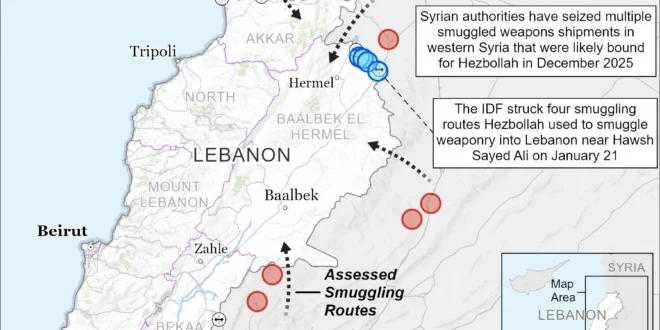
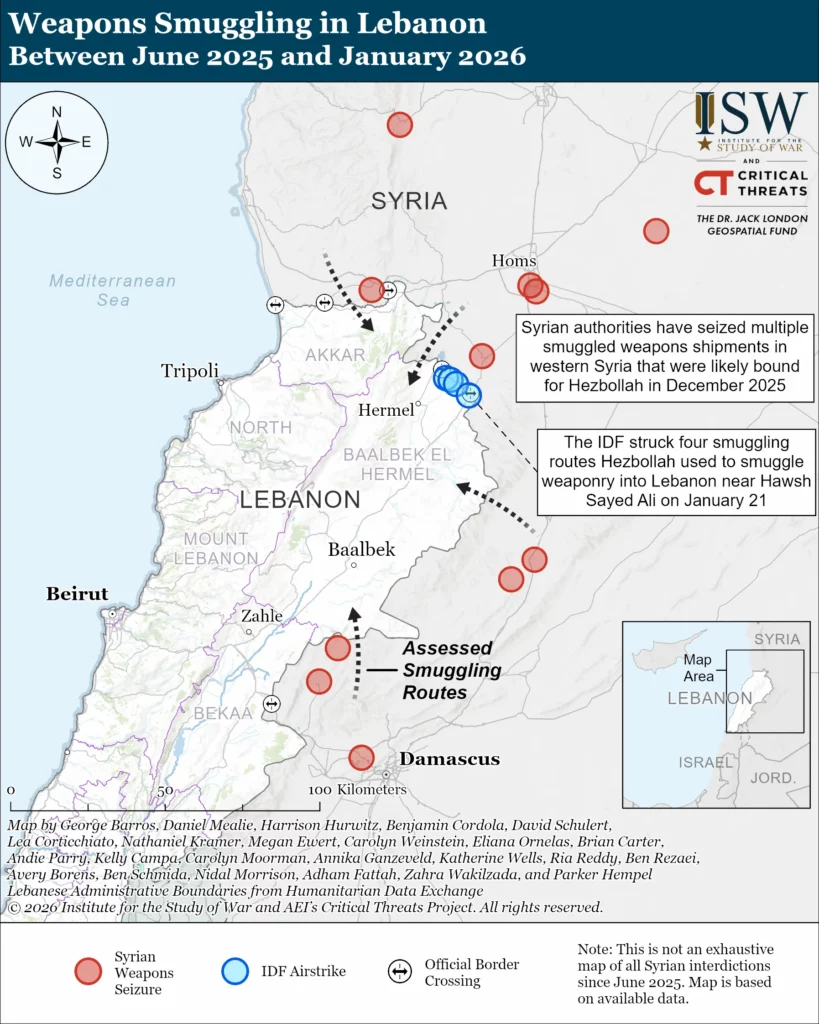
Delaying the disarmament of Hezbollah will make disarmament harder because Hezbollah is, in fact, reconstituting. Hezbollah has replenished at least one-fifth of its pre-war weapons stockpiles via domestic production and smuggling from Syria, according to Israeli intelligence assessments.[28] Hezbollah has appointed new commanders to vacant positions and attempted to recruit new fighters since December 2024.[29] Hezbollah has reportedly acquired at least $1 billion USD worth of Iranian funds in 2025, which it needs to rebuild its social welfare programs and maintain its Shia support base.[30] Hezbollah has also begun to rebuild its buildings, launch sites, and defensive positions across Lebanon with support from its reconstruction organizations.[31] Hezbollah’s actions highlight how it is actively trying to reconstitute its military forces. Hezbollah will slowly militarily strengthen because of these efforts unless disarmament proceeds quickly, which will make it more likely that Hezbollah will respond more forcefully to Israeli military pressure north of the Litani than it did during disarmament efforts in the south.
The LAF’s ability to push Hezbollah out of and diminish its strength in southern Lebanon presents a major opportunity for Lebanese partners to demonstrate what the LAF and Lebanese state can do for the people of southern Lebanon. Hezbollah is already struggling to maintain its social services and financial commitments in southern Lebanon, which will only be further exacerbated by its reduced presence there.[32] Hezbollah’s financial struggles have generated unprecedented discontent among its Lebanese Shia support base, which could grow over time if Hezbollah is unable to fulfill these commitments.[33] Hezbollah’s weakened presence in southern Lebanon and ongoing financial struggles present an opportunity for the Lebanese state, with economic support, to reinstate itself as the primary social service and reconstruction provider. The Lebanese state will need to take steps to begin reconstructing southern Lebanese villages, provide support to civilians impacted by the conflict, and reinstate government-provided social services.
Lebanese partners and allies – particularly in Europe – need to accelerate their efforts to help the Lebanese state support the Lebanese population in the south, which will increase support for the state while undermining Hezbollah and separating it from the population. The Lebanese government has previously struggled to take these steps because the state lacks sufficient funds.[34] An accelerated US-led and European-supported effort could help the Lebanese state provide reconstruction funds to Lebanese civilians and begin reconstruction in southern Lebanon. Lebanese civilians have been consistently demanding support for the reconstruction of southern Lebanon, something that Hezbollah itself has historically undertaken to do. Helping the Lebanese government supplant Hezbollah in this role could increase popular support for the state in this area.[35] Economic and financial support provided across many sectors can support the population and isolate it from Hezbollah, which is facing financial struggles of its own. This approach would gradually strip Hezbollah of its ability to embed itself in the population, which has enabled it to goad Israel into firing into civilian areas and, in turn, caused Israel to suffer reputational damage. Any support must be conditioned on demonstrated commitment and ability by the Lebanese state and government to curb corruption and disarm Hezbollah.
The United States and its allies could also help Lebanon fund soldiers’ salaries. The LAF and Lebanese Internal Security Forces’ effective strength is severely limited because many soldiers work a second job to augment their salaries.[36] Other support, including intelligence, surveillance, and reconnaissance overflight and cooperation to counter Hezbollah smuggling and military activity, could also weaken the group. US intelligence enabled an LAF raid on February 10, 2026, that seized nearly 400,000 rounds of ammunition, for example.
A more pro-state southern Lebanese population can have outsized effects. This economic, financial, and military support would probably embolden anti-Hezbollah Lebanese government officials to maintain their efforts to reform the Lebanese government, which could weaken Hezbollah’s political influence over time. The United States and its allies have an opportunity to support Lebanese officials, such as President Joseph Aoun and Prime Minister Nawaf Salam, who have courageously spearheaded efforts to diminish Hezbollah’s political influence and have called out Hezbollah’s false narratives that it uses to justify its political and military standing.[37] US support can help these officials demonstrate to Lebanese civilians that they will have a better quality of life in southern Lebanon under the state’s control, which would garner more domestic support for disarming Hezbollah.
Israeli strikes will probably continue in areas of central Lebanon where Hezbollah remains. Continued Israeli strikes in central Lebanon targeting Hezbollah will contrast sharply with a relatively stable southern Lebanon free from Hezbollah and Israeli strikes targeting the group. Disarmament in southern Lebanon has already decreased IDF airstrikes, and the number should continue to dwindle if the LAF makes serious progress in weakening Hezbollah there. Decreasing IDF airstrikes will undermine Hezbollah’s narrative that it is “protecting” Lebanon from Israel by demonstrating that Hezbollah’s presence is itself the cause of Israeli strikes. The IDF has stated that it will continue to strike Hezbollah threats across Lebanon, which will largely be in central and northern Lebanon, where the group has moved its weaponry. Lebanese civilians have expressed outrage with Hezbollah for causing the war in Lebanon and are unhappy with Hezbollah’s inability to protect Lebanese civilians and provide the social safety net it promised.[38] This discontent suggests that some Lebanese civilians may no longer support Hezbollah if they believe that the group is creating more conflict in Lebanon and threatens their safety and prosperity.
This strategy can only work if support is conditioned upon demonstrated Lebanese willingness and ability to take steps to disarm Hezbollah and curb corruption. Many civilians, despite discontent, will likely continue to support Hezbollah because a lot of citizens benefit from the group’s social services.[39] The United States and its allies will need to adopt an incremental and conditional campaign that gradually limits Hezbollah’s ability to maintain its social services and strengthens the Lebanese government with capable institutions that are stronger than Hezbollah. Ignoring or failing to support the state’s efforts would cause the United States to miss an opportunity to badly damage a major regional adversary.