 Eurasia Press & News
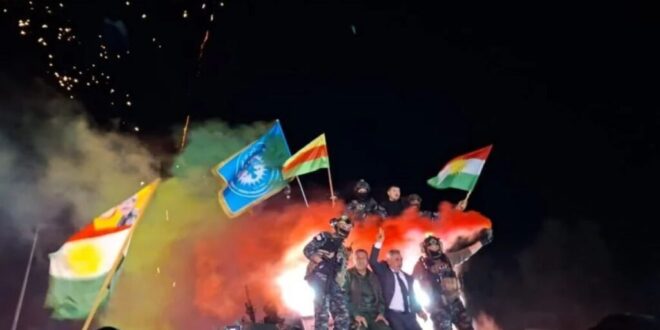
The Syrian Ministry of Interior has outlined the procedures for submitting applications to obtain Syrian citizenship for Kurdish residents covered under Decree No. 13 of 2026, issued on January 16.
According to a decision published by the ministry on Friday, February 20, applications may be submitted individually or on a family basis. The head of household may apply on behalf of himself, his wife, and his minor children at designated centers set by the ministry.
Applicants must attach a duly certified identification certificate issued by the relevant local mukhtar, along with proof of residence supported by documents confirming the applicant’s presence on Syrian territory.
Additional official documents proving residency must also be submitted. These may include electricity or water bills, a telephone bill, school registration documents for children certified by the relevant Directorate of Education, or any other legally acceptable document deemed sufficient by the committee assigned to review applications.
The ministry has designated nine centers to receive applications: one each in Damascus, Aleppo, Raqqa, and Deir Ezzor, and five centers in al-Hasakah.
The submission period will last 30 working days, starting from the date the committees begin their work, which will be set later by the central committee. The ministry noted that this period may be extended if necessary by a decision of the Minister of Interior upon the committee’s recommendation.
Central and subcommittees
The central committee consists of five members and is chaired by the Deputy Minister of Interior for Civil Affairs. Its members include a judge with the rank of counselor at the Court of Cassation nominated by the Minister of Justice, a counselor from the State Council nominated by its president, the Director of Civil Affairs at the central administration, and a first-class civil affairs official appointed by the Minister of Interior who will serve as rapporteur.
In addition to the central committee, subcommittees will be formed in the governorates. These will be chaired by the respective governors and will include a judge with the rank of counselor at the Court of Appeal nominated by the Minister of Justice, as well as the provincial Director of Civil Affairs, who will act as rapporteur.
Decree No. 13
Transitional President Ahmad al-Sharaa issued Decree No. 13 of 2026 granting Syrian citizenship to all residents of Kurdish origin living in Syria, including those registered as “unregistered” (maktoumei al-qayd)
The decree abolishes all exceptional laws and measures stemming from the 1962 al-Hasakah census.
It also declares Nowruz, celebrated by Kurds on March 21, a national holiday, describing it as a day of fraternity and spring.
The decree affirms that Syrian Kurds are an integral and authentic part of the Syrian people and that their cultural and linguistic identity is inseparable from Syria’s unified and diverse national identity.
The state commits to protecting cultural and linguistic diversity and guarantees Kurdish citizens the right to preserve their heritage, arts, and develop their mother tongue within the framework of national sovereignty.
Kurdish is recognized as a national language and may be taught in public and private schools in areas where Kurds constitute a significant portion of the population, either as part of optional curricula or as cultural educational activities.
State media and educational institutions are required to adopt inclusive national discourse. Any discrimination or exclusion based on ethnicity or language is legally prohibited, and incitement to ethnic strife is punishable under applicable laws.
A large segment of Syria’s Kurdish community lacks official documents proving Syrian nationality and is legally classified as unregistered (maktoumei al-qayd) Addressing this issue has been one of the Kurds’ most prominent demands for years.
These measures come amid ongoing understandings between the Syrian government and the Syrian Democratic Forces regarding the latter’s integration into state institutions. Meanwhile, the SDF and Kurdish political formations continue to demand constitutional guarantees for the rights of Syrian Kurds.