 Eurasia Press & News
Trump wants Britain’s help with another illegal war in the Middle East, which could have far reaching consequences
US president Donald Trump has signalled that British military bases may be crucial to an attack on Iran, without offering a legal justification for bombing that country.
Trump posted on Wednesday: “Should Iran decide not to make a Deal, it may be necessary for the United States to use Diego Garcia and the airfield located in Fairford in order to eradicate a potential attack by a highly unstable and dangerous Regime.”
RAF Fairford in Gloucestershire has a 10,000-foot runway and is the US Air Force’s only European airfield for heavy bombers.
It can host B-52s, which flew daily missions from the base to bomb Iraq during the 2003 invasion.
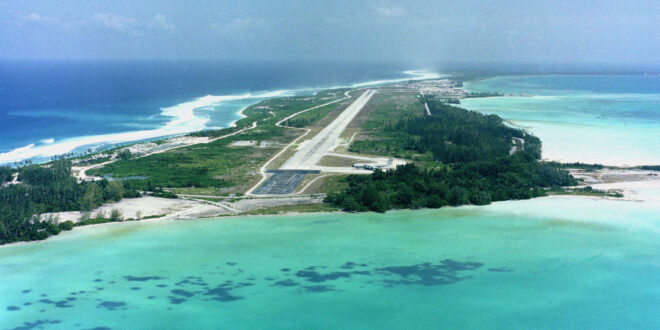
Diego Garcia is part of the Chagos Islands, an archipelago in the Indian Ocean which has a runway long enough for US B-2 stealth bombers that could bomb deep inside Iran.
Britain illegally occupies the Chagos Islands and has only just agreed to return them to Mauritius, while retaining a 99-year lease on Diego Garcia for US-UK military purposes.
Trump now opposes the proposed handover, despite it being necessary to comply with a ruling from the International Court of Justice, and denounced it as “wokeism”.
The Times reported his opposition is based on Britain’s apparent refusal to let him use Diego Garcia to stage attacks on Iran, which could happen over the coming days.
Trump did not use Diego Garcia or Fairford last June when he bombed Iran in Operation Midnight Hammer, opting instead to send heavy bombers all the way over the Atlantic from US soil.
Britain’s Ministry of Defence (MoD) declined to comment on Thursday when asked by Declassified if Trump had permission to use Diego Garcia or Fairford to bomb Iran this time.
An MoD spokesperson said: “As routine, we do not comment on the operational activity of other nations, including third party use of UK bases.
“The US is the UK’s principal defence and security partner. The depth of our defence relationship with the US remains an essential part of our security.”
‘Not enough’
The ministry also refused to comment on whether such an attack on Iran would be lawful.
Trump is not publicly making any legal case for his potential attack on a sovereign state, other than to suggest Iran might try to attack the US in future.
For a strike to be conducted in self-defence, the attack must be imminent.
This threshold was highlighted during the debate on invading Iraq in 2003, when Keir Starmer himself wrote: “The mere fact that Iraq has a capacity to attack at some unspecified time in the future is not enough”.
Trump’s bombardment of Iran in June 2025 also failed to reach that threshold, according to Sir Richard Dalton, the UK’s former ambassador to Tehran.
He told Declassified: “By every standard, this was not a legal preemptive attack.”
Despite these legal concerns, Starmer has allowed Trump to use US bases in Britain for his troop build-up around Iran.
There has been a surge in US fighter jets and refuelling aircraft passing through RAF Lakenheath and Mildenhall in Suffolk on their way to the Middle East since January.
‘Unprecedented’
Any British participation in an attack on Iran could result in serious consequences for UK troops abroad, as well as triggering an economic or refugee crisis.
Iranian officials have vowed an “unprecedented” response against “all who support the aggressor” if Trump attacks, signalling they will go much further than previous choreographed responses.
Britain has hundreds of military personnel in the Gulf that are well within range of Iran’s missile arsenal, especially the naval facility HMS Juffair in Bahrain, spy stations in Oman and airbases in Qatar and the UAE.
Although protected by air defences including Typhoon fighter jets, these could potentially be overwhelmed if Iran fires a high volume of short-range missiles at the bases.
UK military and intelligence personnel stationed at bases further from Iran could be within range, including staff in Jordan and even on Cyprus.
British naval personnel may also be dotted throughout the US carrier battle groups being deployed to the region, as several were believed to be ahead of Trump’s attack on Venezuela.
They too could be vulnerable to Iranian counter-attacks.
Tehran could also mine the narrow Strait of Hormuz, through which a fifth of the world’s oil supplies flow each day, causing an energy price shock.
Iran announced the temporary closure of the Strait of Hormuz on Tuesday for the first time since the 1980s for “live-fire naval drills”.
In any retaliatory strike, Iran is likely to target Israel, whose prime minister Benjamin Netanyahu has advocated for a US-led war against Tehran for decades.
In October 2024, RAF Typhoons and Voyager refuelling aircraft played a role in intercepting missiles which were fired by Iran at Israel.
Several of Britain’s most advanced fighter jets, the F-35, were moved to Cyprus a fortnight ago to boost air defences in the eastern Mediterranean.