 Eurasia Press & News
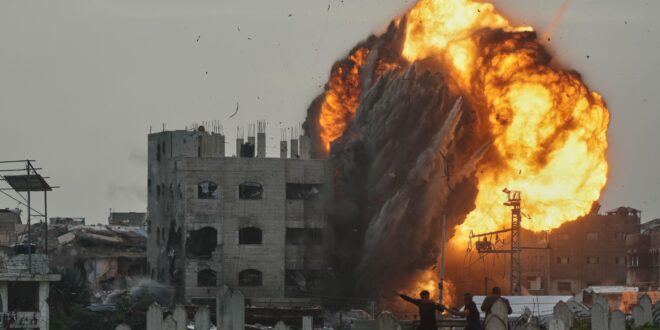
‘What happened proves that targeting of civilians continues,’ says grandmother who survived Gaza tent attack
Hanan Abu Hadaid’s family was fast asleep in their tent when the attack began.
“Suddenly, everything was turned upside down,” the 60-year-old told Declassified of the Israeli airstrike on 31 January that hit their shelter in al-Mawasi, an area in southern Gaza that the Israeli military has designated as a “safe zone”.
“The place filled with shrapnel. I was injured in my foot and thigh, and when I looked around, I saw my sons and grandchildren lying on the ground. I started calling out to them one by one, screaming, but no one answered.”
Her husband, Rebhi, and her sons, Muhammad, Hazem, and Hajar, as well as her grandchildren, Lia, Sham, and Jibril, were all dead.
The tent where they were living – after being displaced four times- had burned to the ground, together with all of their belongings, from bedding and blankets to kitchen utensils and clothes.
Hanan, who had been awake to perform dawn prayers when the explosion erupted, was the sole member of the family in the tent to survive.
Speaking to Declassified as a constant stream of surveillance drones buzzed above, she said the attack had dispelled any illusions she might have had that there is a ceasefire in Gaza.
“We posed no danger and were not a threat to anyone,” Hanan said.
“What happened is proof that the targeting of civilians and displaced people continues, even in the places we are told to flee to.”
Repeated ceasefire violations
The family is among at least 581 Palestinians who have been killed by Israel since the October ceasefire agreement.
Despite these violations, trade secretary Peter Kyle said last month that 30 UK arms export licences to Israel suspended in 2024 could be “unblocked” when the ceasefire entered phase two. US officials announced in mid-January that phase two had begun.
Asked on Monday whether the suspended licences would be resumed soon, the business department pointed Declassified to recent comments from trade minister Chris Bryant in which he said the situation continued to be regularly assessed.
In private, some ministers have gone much further, with health secretary Wes Streeting saying in WhatsApp messages last July that “Israel is committing war crimes before our eyes”.
Streeting said Netanyahu’s government “talks the language of ethnic cleansing”, was behaving like a “rogue state” and should be treated like “pariahs”.
But comments in private mean nothing to victims like Hanan who stressed that staying silent on such massacres encourages Israel to commit more violations and reduces treaties to little more than ink on paper.
Many Palestinians in Gaza are wary of the ceasefire plan led by US president Donald Trump, which has also seen the establishment of the so-called “Board of Peace” and the Civil-Military Coordination Centre (CMCC).
The CMCC is responsible for monitoring the truce and facilitating the entry of aid into the enclave among other tasks, but has come under heavy criticism including for failing to halt ceasefire violations.
Several European countries are now reportedly having doubts about participating in the CMCC and are considering reducing or pulling back personnel working at the centre.
In late October, a small team of British planning officers embedded within the CMCC. The government said at the time that they were there “to ensure that the UK remains integrated into the US-led planning efforts for Gaza post-conflict stability”, but were not monitoring the ceasefire in Gaza.
Declassified understands that this team is still in place, and asked the Ministry of Defence on Monday what role they were playing.
A ministry spokesperson said: “The UK is committed to supporting the transition from a ceasefire to a sustainable peace.
“We will continue to play our part, not just in supporting the implementation of phase one of the peace initiative, but also on the crucial work on progressing phase two, towards recovery and reconstruction.”
Shattered lives
Nearby the Abu Hadaids’ tent at the moment of the attack was Nozha Abu Hadid, the sister of Hanan Abu Hadaid’s husband, Rebhi, who was living in a neighbouring tent.
More than 20 people were injured in the vicinity of the targeted tent, she said.
“We pulled the wounded out from the fire and shrapnel with our bare hands. There were only burned bodies and cries for help,” Nozha recounted.
Among the injured, Nozha said, was a young woman who was four months pregnant.
“A single piece of shrapnel shattered the fetus inside her. Doctors struggled greatly to save her life and were forced to clear the uterus of the fetal remains. She is now receiving treatment at Nasser Medical Complex,” she said.
An Israeli military source told journalists that several attacks on 31 January, including the one in al-Mawasi were “in response to Hamas’ blatant violations of the ceasefire agreement” without further detail.
Nozha said she is profoundly shocked after losing her brother and his family during what was supposed to be a ceasefire.
“The presence of [ceasefire] monitors is meaningless if massacres are being committed before their eyes without accountability,” Nozha said.
“Silence here is not neutrality; it is a clear form of bias.”
She added: “There is no safe place in the Gaza Strip. Everyone is either conspiring against the Palestinian people here or hiding behind silence.”
Her sister-in-law, Hanan, recalled her husband’s words before he was killed: “He was not optimistic about the ceasefire. He used to tell me: this is a devastating war, a war of annihilation. I didn’t want to believe him, but he was right.
“After my entire family was wiped out, I no longer believe a single word about a ceasefire. The occupation killed them in cold blood and took them all from me: my husband, my sons, my grandchildren.”