 Eurasia Press & News
How much aid has the United States provided Ukraine?
As of December 31, 2025, the U.S. Congress had made available $188 billion in spending related to the war in Ukraine, according to the U.S. Special Inspector General for Operation Atlantic Resolve. Of the $188 billion, $164 billion comes from five pieces of legislation, the last of which was passed in April 2024. The remainder comes from annual agency budgets and other appropriations.
In late 2024, the United States also provided the Ukrainian government with a $20 billion loan, not included in the $188 billion figure, provided via the World Bank and to be repaid by interest generated from frozen Russian assets.
It’s important to note that not all of the U.S. government spending related to the war directly aids the government of Ukraine, as shown in the chart below. The amount of U.S. aid directly supporting Ukraine is about $127 billion, according to the Kiel Institute for the World Economy. Most of the remaining spending has funded various activities associated with the war such as the U.S. military presence in Europe, while a small portion has supported other affected countries in the region.
A large share of the money in the aid bills has been spent in the United States, paying for U.S. factories and workers to produce weapons that are either shipped to Ukraine or used to replenish stocks of U.S. weapons the Pentagon has sent to Ukraine during the war. A 2023 analysis by the American Enterprise Institute found that Ukraine aid spending was funding defense manufacturing in more than seventy U.S. cities.
Dozens of other countries, including most members of the North Atlantic Treaty Organization (NATO) and European Union (EU), have also provided large aid packages to Ukraine. While the United States made no new aid commitments in 2025, European countries significantly increased their support, and collectively have provided more aid than the United States has since the start of the war (see below).
Is the United States still providing aid to Ukraine under President Trump?
Since Trump assumed office in January 2025, there has been no legislation or other authorizations of significant new aid to Ukraine. However, a substantial amount of the aid appropriated under the Biden administration is still in the pipeline, and deliveries of aid packages have continued, although on two occasions the Trump administration temporarily paused some deliveries. As of December 31, 2025, the U.S. had disbursed 58 percent of the $188 billion in spending related to the conflict (U.S. spending is first appropriated, then obligated, then disbursed). Nonetheless, the lack of new aid commitments means that U.S. aid deliveries are running out.
Trump has allowed the sale of U.S. weapons to Ukraine through a plan known as the Prioritized Ukraine Requirements List (PURL), in which NATO allies pay for U.S. weapons and transfer them to Ukraine. The program is providing advanced U.S. weapons such as Patriot missiles and is supplying the majority of the missiles used in Ukraine’s air defense systems.
Why has the United States provided aid to Ukraine?
Much of the U.S. aid has gone toward providing weapons systems, training, and intelligence that Ukrainian commanders need to defend against Russia, which has one of the world’s most powerful militaries. Many Western analysts say the military aid provided by the United States and other allies has played a pivotal role in Ukraine’s defense and counteroffensive against Russia. But Russia made incremental gains in 2024 and 2025, capturing some territory along the eastern front.
During the Biden administration, the United States and top European allies considered Russia’s invasion an illegal war of aggression on NATO’s frontier that, if successful, would subjugate millions of Ukrainians; encourage Russian President Vladimir Putin’s revanchist aims; and invite similar aggression from other rival powers, especially China. But President Donald Trump has changed the U.S. position, at various times accusing Ukraine of starting and prolonging the war and presenting himself as an impartial broker looking to reach a peace deal in the near future.
Trump’s frustration with Russian President Vladimir Putin has also grown as ceasefire talks have dragged on unsuccessfully, and the United States levied tariffs on India for buying Russian oil before removing them in early 2026. The Trump administration has imposed far fewer sanctions than the Biden administration, although in October 2025 it did so on the Russian oil companies Rosneft and Lukoil. Various sanctions bills are pending in Congress but the Trump administration has told Republican leaders not to move them to a floor vote.
What weapons and equipment has the United States sent Ukraine?
Since Russia’s invasion in 2022, the United States has provided or agreed to provide Ukraine with a long list of defense capabilities, including widely used items such as artillery shells as well as more expensive systems.
NATO allies are particularly wary of being pulled directly into the hostilities, which could dramatically raise the risk of a nuclear war. However, as the fighting has progressed, many donor governments have shed their reluctance to give Ukraine more sophisticated assets, such as battle tanks and modern fighter aircrafts. In the summer of 2023, the United States agreed to allow its European allies to provide Ukraine with U.S.-made F-16s. As of 2025, the Netherlands had sent twenty-four F-16s, and Denmark, Belgium, and Norway had pledged additional jets.
In early 2024, the Biden administration started supplying Ukraine with significant numbers of long-range precision missiles, known as ATACMS, that can strike targets nearly 200 miles (322 kilometers) away. After some initial restrictions, the Biden administration eventually permitted Ukraine to use ATACMS to strike inside Russian territory. The Trump administration initially blocked use of the missiles in 2025, though Ukraine announced their use later in the year. The Trump administration considered providing Tomahawk cruise missiles to Ukraine, as requested by Ukrainian President Volodymyr Zelenskyy, but ultimately chose not to do so.
How does the aid to Ukraine compare to that for other recipients of U.S. assistance?
When compared to U.S. assistance to other top recipients in recent years, the extraordinary scale of the aid prior to 2025 comes into view. This data comes from ForeignAssistance.gov.
Looking back over the last several decades, aid to Ukraine also ranks among the largest relative to the size of the U.S. economy at the time.
However, the magnitude of U.S. aid to Ukraine can seem less remarkable in comparison to what the Pentagon budgets each year, or what the Treasury Department was authorized (via the Troubled Asset Relief Program) to bail out Wall Street banks, auto companies, and other sectors of the economy during the U.S. financial crisis.
How does U.S. aid to Ukraine compare to that from Europe?
Nearly all aid to Ukraine has come from the United States and Europe. The United States has provided more aid than any other country, although European countries have collectively provided more than the United States. While the U.S. made no new aid commitments in 2025, aid from Europe increased significantly during the year.
European countries are providing aid individually and through the EU, with EU members agreeing on a loan of about $106 billion in late 2025, although Hungary has threatened to block the plan.
Data comparing aid from different countries is from the Kiel Institute for the World Economy, which tracks aid as “committed”, defined as declarations of support, and “allocated”, defined as delivered or specified for delivery.
When compared to individual countries, the U.S. contribution stands out, particularly in the case of military aid.
However, many European governments are making much larger contributions to Ukraine relative to the size of their economies.
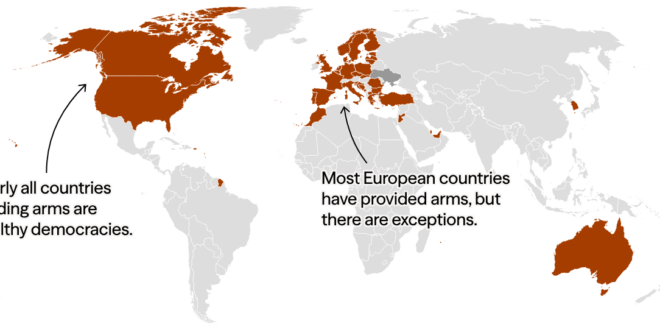
Thirty-five countries made major arms transfers to Ukraine from 2022 to 2024. Nearly all were wealthy democracies.