 Eurasia Press & News
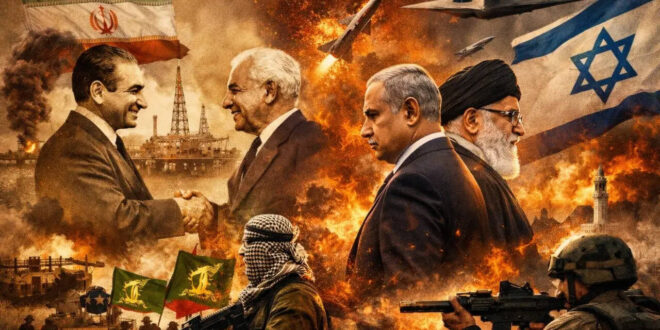
The historical relationship between Iran and Israel has transformed dramatically from alliance to hostility over the decades. On February 28, Operation Epic Fury marked a significant escalation, as the US and Israel launched attacks on Iran
It seems totally out of a Bollywood flick, where best friends become worst enemies, but it is true that Iran and Israel were friends, and Tehran was among the first few in the Middle East to recognise Israel. That was 1948. Fast forward February 28, 2026: American and Israeli jets are bombing Iran together as part of ‘Operation Epic Fury’. Seventy-eight years. That’s how long it took to get from handshake to airstrike.
When Israel declared independence in May 1948, almost all Arab nations waged war against the newly formed Jewish state. Iran did not. And when Israel won, Iran recognised it, becoming only the second Muslim-majority country to do so after Turkey. This wasn’t sentiment. It was a calculation. The friendship was based on a ‘common enemy’ and ‘common alignment’ – Iran and Israel were both aligned with the West, unlike Arab countries, and both countries were surrounded by nations bound by Arab nationalism and against the concept of the Israeli nation.
Israel’s first Prime Minister David Ben-Gurion had a name for this logic. He called it the “periphery doctrine” — building alliances with the non-Arab countries on the edges of the Arab world. Turkey was one. Pre-revolution Iran was the centrepiece. As the Brookings Institution later analysed, Ben-Gurion wanted to “forge an alliance with non-Arab, yet mostly Muslim, countries in the Middle East” who had “their own reasons to feel isolated.” Iran fit that description perfectly.
What followed was three decades of quiet partnership. The Shah sold oil to Israel while Arab states ran an economic boycott against it. Iran’s intelligence service SAVAK and Israel’s Mossad cooperated on training and operations. The two countries collaborated, reportedly, on missile development. Yes, they did then. None of this was trumpeted publicly — it couldn’t be, given the politics of the region — but it was real, and it was sustained.
But then came the 1979 Iranian revolution, and all of it changed. The Iranian Revolution led to the change in regime. Ayatollah Ali Khamenei took over, and the DNA of the nation changed, as did that of its friends and enemies.
The Supreme Leader of Iran, Khamenei, had two clear enemies – one, of course, was the United States, which he referred to as the ‘Great Satan’, and the next was Israel, the ‘Little Satan’.
It took less than a few weeks for Iran to end all diplomatic ties with Israel. Friendship shifted from Israel to Palestine. Within weeks of Khomeini taking power, Palestinian Liberation Organisation (PLO) chairman Yasser Arafat flew to Tehran, and the Supreme leader of Iran embraced him like a brother. The loyalties had changed overnight. “Death to Israel” moved from protest chant to the state slogan.
What Iran built in the years after the revolution was a network. Hezbollah was founded in the Syrian capital Lebanon, in 1982 with Iran’s direct involvement, shortly after Israel’s invasion of the country. Hamas in Gaza received Iranian weapons and training. The Houthis in Yemen. Militias across Iraq and Syria. Tehran called it the ‘Axis of Resistance’, a ring of armed groups positioned to respond to Israel from multiple directions while keeping Iran itself safely out of direct line of fire.
That arrangement held for over four decades. Iran supplied. Proxies fought. Tehran denied involvement or admitted it proudly, depending on who was asking.
The nuclear question changed the stakes entirely.
In 2002, a report revealed that Iran had been secretly building uranium enrichment facilities at Natanz and a heavy water reactor at Arak. Iran admitted to the fact but insisted that the programme was for civilian energy. Israel said it was a weapons programme and a future threat to the region.
In 2010, a computer worm called Stuxnet, developed, according to widespread reporting cited by Reuters and others, by the US and Israel, infected the control systems at Natanz and destroyed roughly a thousand centrifuges. It was the first known cyberattack to cause physical destruction of industrial machinery. Iran’s nuclear programme was set back by years, and this hit the current Iranian regime hard. “Death for Israel” and “Death for America” echoed yet again.
This was followed by the assassinations of four Iranian nuclear scientists between 2010 and 2012, which Tehran alleged were targeted attacks. Iran blamed Mossad. Israel said nothing.
Meanwhile, Israel was conducting hundreds of strikes in Syria, hitting Iranian weapons convoys, IRGC bases, missile stockpiles, to prevent Hezbollah from receiving advanced weapons. Iran absorbed the strikes and avoided direct retaliation.
Hamas attack on October 7, 2023 broke the rules… at least for Israel.
Hamas’s attack on Israel that day killed around 1,200 Israelis, inclduing men and women. There was a nude display of brutality, one of the deadliest single days for Jewish people since the Holocaust. Iran celebrated the attack publicly. Israel vowed revenge and waged a war in Gaza and, over the following year, systematically dismantled much of Iran’s Axis of Resistance, killing the heads of Hamas and Hezbollah, watching the Assad regime in Syria collapse, and degrading the Houthis.
When the direct conflict began between Iran and Israel: April 2024
Israel had struck the Iranian consulate annex in Damascus on April 1, 2024, killing 12 people including a senior IRGC general. On the night of April 13-14, Iran launched what it called Operation True Promise: over 300 missiles and drones toward Israel. The US, UK, France and Jordan all helped shoot them down. Israel’s damage was minimal. Analysts called it a calculated response wherein Iran wanted to make a point and not start a war.
Guess Israel did the same – its counterstrike on an air defence site near Isfahan was equally restrained. Measured. A message but not an escalation.
But neither side could maintain the calm. Israel, while chasing the perpetrators of the October 7 attack, killed Hamas leader Ismail Haniyeh in Tehran in July 2024, then Hezbollah leader Hassan Nasrallah in Beirut in September 2024. Iran’s Axis of Resistance was collapsing, and it had to respond to put up a face. And, it did. In October, Iran fired around 180 ballistic missiles at Israel. In response, Israel’s response demolished nearly all of Iran’s Russian-built S-300 air defence systems.
By the end of 2024, the rules of the shadow war were gone. The war was out in the open.
In June 2025, Israel launched what Netanyahu called Operation Rising Lion — its largest attack on Iran in history. Over 200 jets. More than 100 targets. Nuclear sites, military bases, missile infrastructure. Car bombs in Tehran killed nuclear scientists. IRGC commanders died in targeted Israeli strikes. Iran’s president narrowly escaped an assassination attempt. Netanyahu addressed the Iranian people directly, like they are doing this time, telling them that it was time to “stand up for freedom”.
Unfazed Iran retaliated with hundreds of missiles. Some got through. Nine people were killed in one strike on the Israeli city of Bat Yam. On June 22, the “Big Satan” United States entered the conflict under Operation Midnight Hammer. B-2 stealth bombers dropped 14 GBU-57 bunker-buster bombs on the underground facilities at Fordow, Natanz and Isfahan. US President Donald Trump said the sites were “completely and totally obliterated.”
Under global pressure, a ceasefire was announced on June 24, 2025.. Iran said at least 610 of its citizens were killed. Rights groups put the figure above 1,100. Israel reported 29 dead.
The US, however, kept on pushing Iran via mediator Oman to end their alleged nuclear programme. Several rounds of talks occurred till about Friday, February 27. Oman said that Iran has agreed to zero stockpiling of uranium and to convert existing enriched material into fuel, calling it an unprecedented breakthrough in nuclear negotiations. Trump, meanwhile, expressed frustration with Tehran as the country stepped up its military presence in the region. All this was happening amidst violent protests in Iran against the “oppressive regime”. Iranian authorities allegedly killed thousands of people to quell the mass protests that broke out in December 2025.
On February 28, 2026, “Operation Epic Fury” was launched. ‘Allies at War’ – the US and the Israel bombed several targets in Tehran, even as negotiators in Geneva were trying to agree on Iran’s nuclear programme. The talks had been going since February 6, mediated by Oman, which has spent fifty years being the room where these two sides could speak without admitting they were speaking.
Coming back to the question where we started – how did two countries that were partners end up in war?
The answer is a revolution in 1979 that changed the regime and created enemies, a nuclear programme (for peace or maybe for war!) that shook neighbours and beyond, four decades of proxy war, and the October 7 attack on Israel.
The history says this, so far, and the rest is still being written.