 Eurasia Press & News
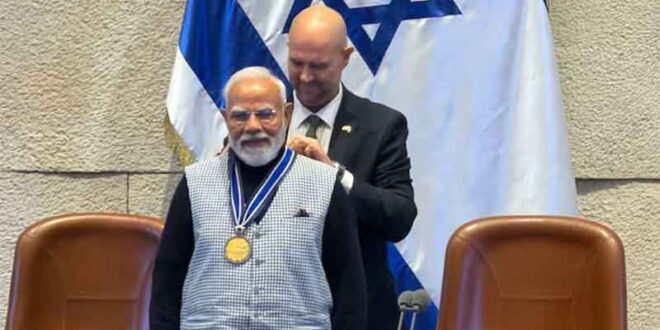
February 25, 2026, marked the so called significant diplomatic moment as the Indian Prime Minister Narendra Modi visited Jerusalem and was received with exceptional warmth by Israeli Prime Minister Benjamin Netanyahu. Netanyahu personally welcomed him at the airport and publicly greeted him on social media. This was his second visit to Israel especially during the time when Israel stands alone without any of his previous allies for being ruthless to the people of Gaza.
During the visit, Modi addressed the Israeli Parliament, the Knesset and was awarded the Medal of the Knesset. Speaker MK Ohana described Modi as a leader whose policies reflect “courageous, consistent and sincere friendship with Israel.” The event symbolized deepening bilateral ties and was presented as a prestigious diplomatic milestone.
However, the visit unfolded against a backdrop of intense global controversy surrounding Netanyahu’s leadership and Israel’s military actions in Gaza and the West Bank. International legal and political scrutiny, including proceedings at the International Court of Justice, has sharply polarized global opinion. Many nations have distanced themselves from Israel’s current leadership, while others continue engagement based on strategic interests.
The Netanyahu Factor
The visit took place amid intense international scrutiny of Netanyahu’s leadership, particularly over the Gaza conflict. Several countries have distanced themselves diplomatically from Israel’s current government. Legal and political controversies surrounding Netanyahu—both internationally and domestically have shaped global perceptions of Israel’s leadership. In this environment, Modi’s public embrace of Netanyahu has raised questions: Was this a purely strategic engagement? Or does it signal a deeper political alignment?
India–Israel Ties: The Strategic Core
To understand the visit, one must examine the structural depth of India–Israel relations.
Defence Partnership
Since the 1990s, Israel has been one of India’s key defence suppliers. According to data frequently cited from the Stockholm International Peace Research Institute (SIPRI), India has been among the largest buyers of Israeli arms in recent years. Military cooperation includes:
Advanced drones and loitering munitions
Missile defence systems such as Barak-8
Radars, surveillance systems, and sensors
Reports suggest that Israeli-origin systems have been deployed in key Indian military operations. Defence cooperation has become institutionalized, extending to intelligence sharing and counter-terrorism coordination.
Trade and Technology
Beyond arms, bilateral trade has crossed approximately $10 billion in non-defence sectors. Both countries are exploring cooperation in:
Artificial Intelligence
Critical minerals
Cybersecurity
Quantum technologies
A Free Trade Agreement has long been under discussion and may gain renewed momentum after this visit.
The Geopolitical Chessboard
There are reports in Israeli media of discussions around a possible multilateral security framework involving countries such as Greece and Cyprus, potentially aimed at regional stability. While India has not officially committed to such an alliance, speculation reflects Israel’s broader regional strategy.
India, however, must carefully balance its relationships not only with Israel but also with traditional partners in West Asia, including Gulf nations and Iran. Millions of Indian expatriates live and work in the Middle East, and India’s energy security remains deeply tied to the region. A visible tilt toward Israel could complicate this delicate balancing act.
Corporate Interests and Defence Deals
The next probable layer of analysis relates to growing corporate ties. Indian conglomerates, including groups led by Gautam Adani, have expanded investments in Israeli infrastructure and defence-linked ventures. Joint ventures in drone manufacturing and port management have drawn public attention.
Gautam Adani has frequently been at the forefront of major India–Israel deals during the Modi era. Adani Elbit Advanced Systems India Ltd, based in Hyderabad, became the first entity outside Israel to manufacture the Hermes 900 drones through a joint venture in the defence sector.
In 2022, the Adani Group secured the Haifa Port deal worth approximately $1.2 billion, acquiring a 70% stake in the India–Israel venture that manages one of Israel’s largest ports. The group also acquired a 51% stake in PLR Systems, a subsidiary linked to Israel’s defence manufacturing ecosystem.
Also, Israel Weapon Industries (IWI) delivered 40,000 Negev NG7 machine guns to the Indian Army in 2026 under a ₹2,200 crore deal associated with Adani’s defence ventures, further strengthening the company’s footprint in India–Israel strategic cooperation.
So considering these favours, these close political ties may intersect with corporate interests, Modi is likely to bring something for Adani. While, supporters particularly the Godi media view such collaborations as part of India’s expanding global economic footprint.
Is this a Ideological Convergence?
Observers have also pointed to ideological parallels between certain right-wing political currents in India and Israel. Since October 7, 2023, India has strongly condemned terrorism against Israel. However, critics argue that India’s abstentions in several UN resolutions related to Gaza have signaled a shift from its historically pro-Palestine position.
India was among the first non-Arab nations to recognize the State of Palestine in 1988. For decades, New Delhi balanced its ties—supporting Palestinian statehood while building security cooperation with Israel. The current phase appears less ambiguous and more visibly aligned with Tel Aviv.
The Palestine Question
India historically supported Palestinian statehood and was among the first non-Arab nations to recognize Palestine in 1988. It also maintained funding support to Palestinian institutions while gradually building defence ties with Israel after 1992.
Since 2014, India’s visible engagement with Israel has intensified, though official statements continue to emphasize support for a two-state solution and humanitarian concerns. India has often abstained in United Nations resolutions related to Gaza ceasefires, framing its position as balanced neutrality rooted in national interest.
Critics argue that this approach risks diluting India’s traditional moral standing. Supporters contend that evolving security challenges necessitate pragmatic engagement.
Reputation and Risk
The core question is whether this visit strengthens India’s global standing or complicates it.
Potential gains:
Enhanced defence cooperation
Technology transfers
Intelligence sharing
Stronger counter-terror capabilities
Potential risks:
Diplomatic strain with Arab partners
Reputational cost in Global South politics
Perceived departure from balanced foreign policy
Conclusion: Strategy or Gamble?
Prime Minister Modi’s Jerusalem visit represents more than ceremonial diplomacy. It symbolizes a recalibration of India’s West Asia policy—one rooted in strategic realism but shadowed by moral and reputational debates.
Whether this move proves to be a masterstroke or a miscalculation will depend on how effectively India balances its defence interests, regional relationships, and historical commitment to principled diplomacy.
For now, the images from the Knesset reflect confidence and camaraderie. But in geopolitics, symbolism is only the beginning. The real test lies in consequences.
Only time will tell whether February 25, 2026, becomes a milestone of strategic maturity—or a moment of diplomatic overreach.