 Eurasia Press & News
Key Takeaways
Iran continued drone and ballistic missile attacks on Gulf states despite President Masoud Pezeshkian’s order to suspend strikes unless attacks on Iran originated from their territory.
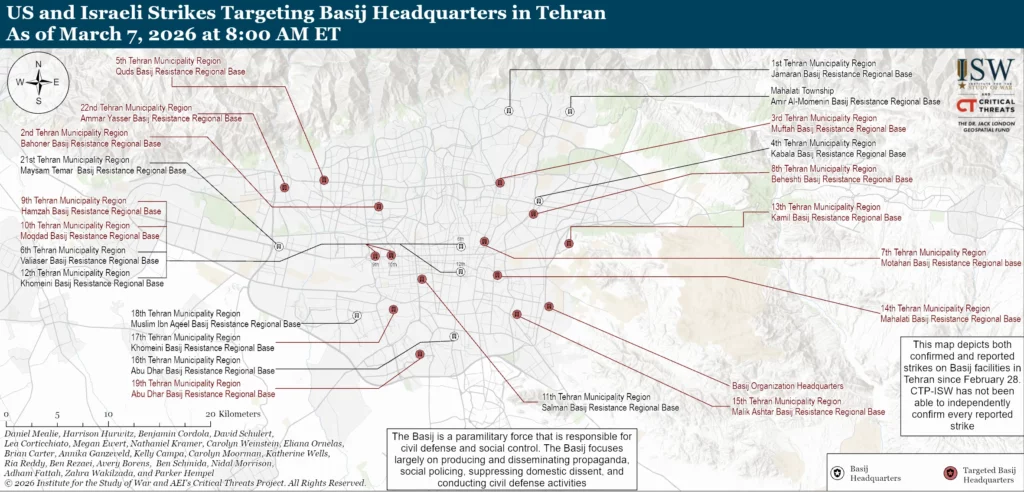
The combined force has continued to target Basij bases in Tehran to degrade the regime’s ability to maintain domestic control. The Basij is a paramilitary force that is responsible for civil defense and social control. Commercially available satellite imagery shows that the combined force has targeted at least nine of the 23 Basij regional bases in Tehran as of March 6.
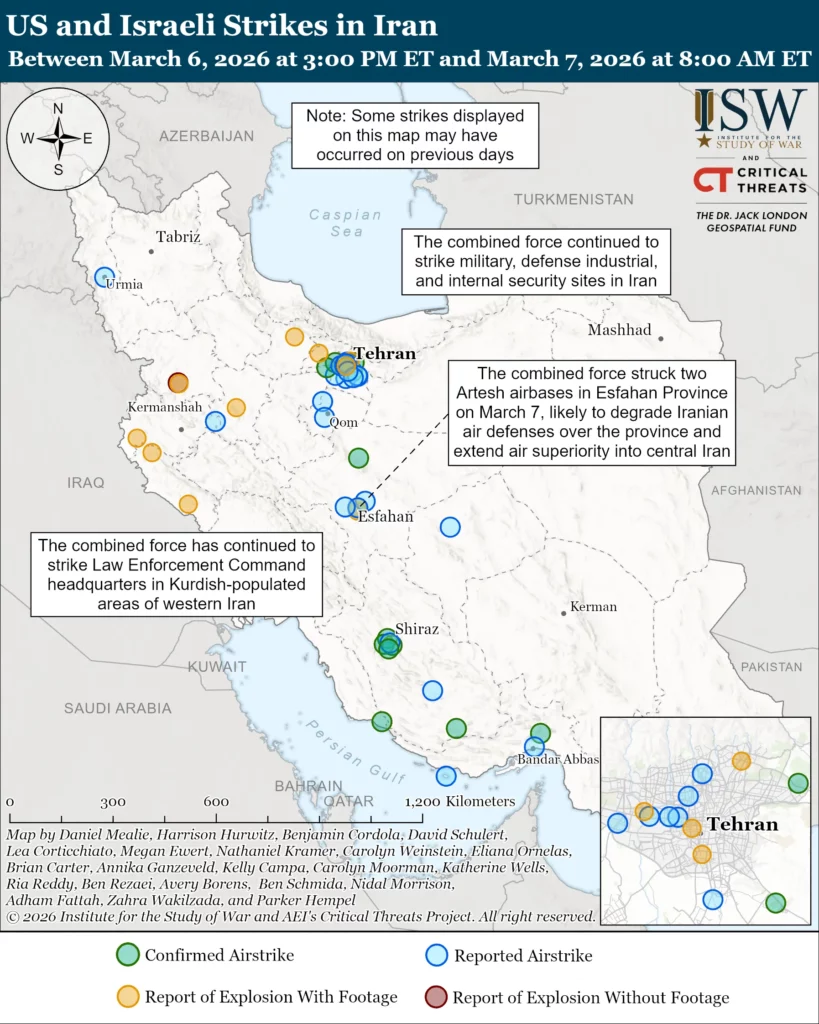
The combined force struck two Artesh airbases in Esfahan Province on March 7 to suppress and destroy Iranian air defenses over the province and extend air dominance into central Iran. The combined force has established air superiority over Tehran and has likely done so over parts of western Iran.
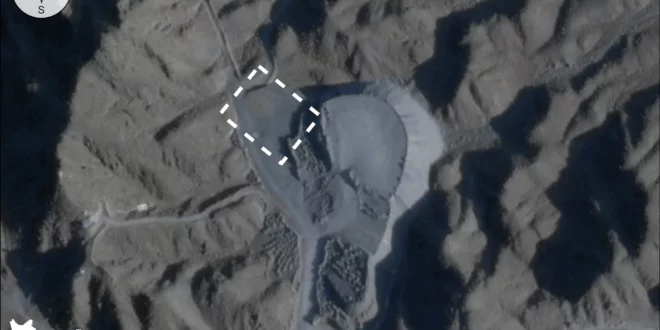
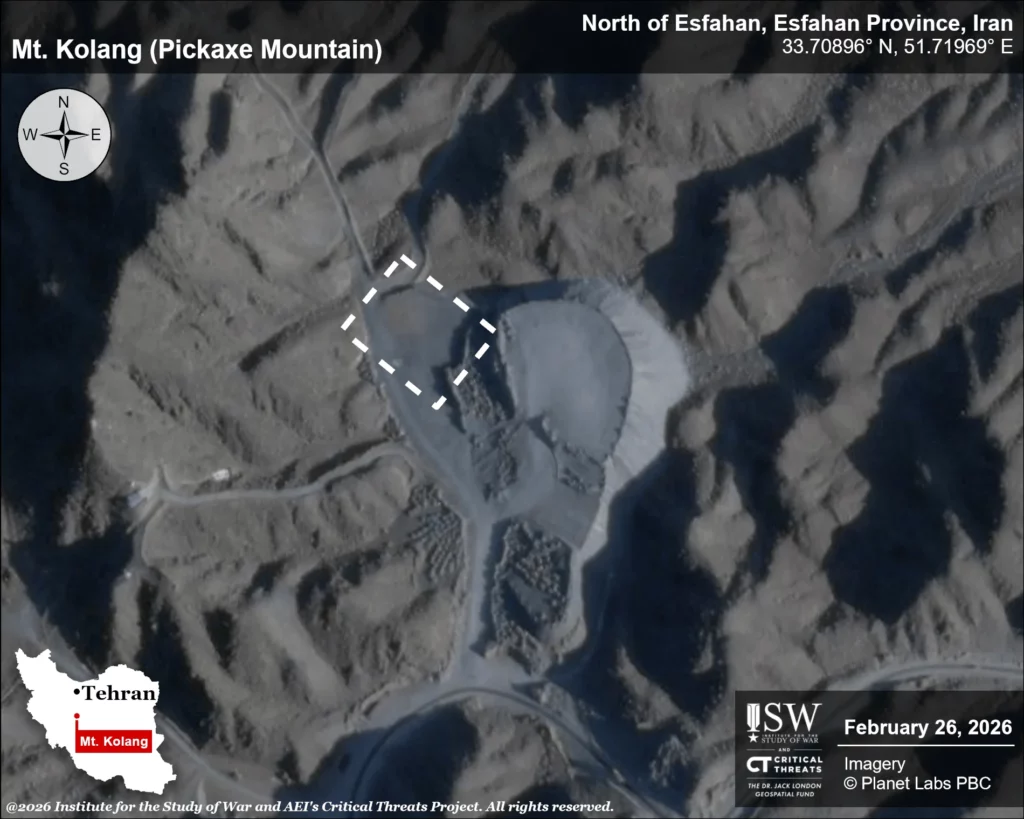
The combined force struck an unidentified vehicle at the Mount Kolang Gaz La facility, south of the Natanz Enrichment Complex, on March 6. The Institute for Science and International Security reported that US-Israeli strikes targeted and destroyed a vehicle at the Mount Kolang Gaz La facility, citing March 6 satellite imagery. The Institute assessed that the vehicle may be related to air defense, but ISW-CTP could not come to an independent conclusion based on the available evidence.
Toplines
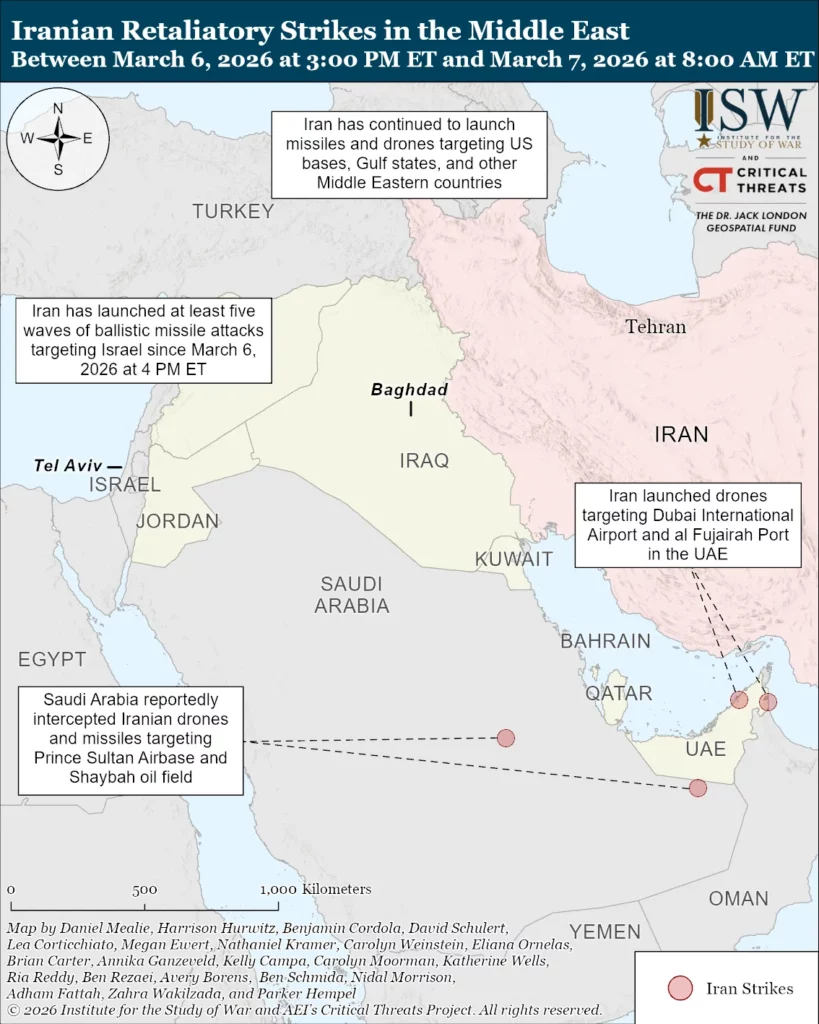
Iran continued drone and ballistic missile attacks on Gulf states despite President Masoud Pezeshkian’s order to suspend strikes unless attacks on Iran originated from their territory.[1] Two Iranian drones struck United Arab Emirates (UAE) territory between March 6 at 3:00 PM ET and March 7 at 8:00 AM ET, including a strike on the Dubai International Airport.[2] Iranian drone and ballistic missile strikes from March 6 to March 7 also targeted US bases in Saudi Arabia, Saudi energy infrastructure, and civilian infrastructure. The Saudi Defense Ministry said it intercepted eight Iranian drones and one ballistic missile.[3] A separate missile that targeted US forces at Prince Sultan Airbase fell in an uninhabited area.[4]
Iran has continued to launch ballistic missile barrages at Israel since ISW-CTP’s last data cutoff on March 6. Iran conducted at least six ballistic missile barrages targeting Israel between March 6 at 3:00 PM ET and March 7 at 8:00 AM ET.[5] ISW-CTP has not observed any missile impacts at the time of this writing.
The combined force has continued to target Basij bases in Tehran to degrade the regime’s ability to maintain domestic control. The Basij is a paramilitary force that is responsible for civil defense and social control. The IDF struck the 27th Mohammad Rasoul Ollah Provincial Unit’s headquarters in southeastern Tehran on March 4.[6] Commercially available satellite imagery captured on March 6 showed damage to several buildings on the unit’s compound. The 27th Mohammad Rasoul Ollah Provincial Unit is the IRGC Ground Forces’ provincial unit for Tehran City and the IRGC’s main unit in the city.[7] The 27th Mohammad Rasoul Ollah Provincial Unit oversees the 23 Basij regional bases throughout Tehran City.[8]
Commercially available satellite imagery shows that the combined force has targeted at least nine of the 23 Basij regional bases in Tehran as of March 6.[9] These Basij security units are trained and equipped to suppress urban protests and conduct anti-riot operations and intimidate and arrest protesters under IRGC direction.[10] Commercially available satellite imagery from March 6 showed moderate damage to the western and southwestern sections of the 13th Tehran Municipality Region‘s Kamil Basij Resistance Regional Base. Iranian sources noted strikes at three additional facilities on March 7. These sources reported on March 7 that the combined force struck the 9th Tehran Municipality Region’s Hamzah Basij Resistance Regional Base, the 10th Tehran Municipality Region‘s Moqdad Basij Resistance Regional Base, and the 11th Tehran Municipality Region’s Salman Basij Resistance Regional Base.[11] The 9th Regional Base and 10th Regional Base are located approximately one kilometer from each other on the same street, and it is possible that Iranian sources describing strikes on both bases are referring to one strike on one or the other.
The combined force has continued to strike Law Enforcement Command (LEC) headquarters or stations in Kurdish-populated areas of western Iran. The LEC is the premier Iranian internal security and law enforcement service, and its chief mission is to conduct ordinary police activities and ensure regime stability.[12] Commercially available satellite imagery captured on March 7 showed damage to several buildings at the LEC headquarters for Kermanshah Province. The combined force has previously also struck the provincial LEC headquarters for West Azerbaijan, Kurdistan, and possibly Ilam provinces.[13] Commercially available satellite imagery captured on March 7 showed damage to buildings in the southern part of the Kurdistan Province LEC Special Unit complex in Sanandaj. Iranian sources also circulated photos on March 7 showing damage from a purported combined force strike to Kangavar District’s LEC headquarters in Kermanshah Province.[14]
The combined force struck two Artesh airbases in Esfahan Province on March 7 to suppress and destroy Iranian air defenses over the province and extend air dominance into central Iran. The combined force struck the 4th Artesh Ground Forces Aviation Base in Esfahan City on March 7, according to Iranian and OSINT sources.[15] Iranian opposition media reported that the combined force struck the 8th Tactical Air Force Base northwest of Esfahan City on March 7.[16] The combined force has established air superiority over Tehran and has likely done so over parts of western Iran.[17] The combined force may have also struck either of these bases on March 2, given that Israeli Army Radio reported explosions near an unspecified air base in Esfahan on March 2.[18]
The combined force struck an unidentified vehicle at the Mount Kolang Gaz La facility, south of the Natanz Enrichment Complex, on March 6.[19] The Institute for Science and International Security reported that US-Israeli strikes targeted and destroyed a vehicle at the Mount Kolang Gaz La facility, citing March 6 satellite imagery.[20] The Institute assessed that the vehicle may be related to air defense, but ISW-CTP could not come to an independent conclusion based on the available evidence.[21] This is the first strike on the Mount Kolang Gaz La facility since the war began on February 28. Iran has been conducting construction at the facility and likely hardened infrastructure at the site in recent weeks in preparation for potential strikes.[22] The combined force struck Natanz on March 2 and destroyed at least three buildings, including two personnel entrances to the underground enrichment plant.[23]
The combined force struck at least six defense industrial sites on March 7 to further degrade Iran’s ability to develop its ballistic missile, air defense, and drone program.[24] Three of the sites that the combined force struck are under US sanctions. These include the Defense Industries Organization, which develops Iran’s nuclear and missile programs, and the Shiraz Electronics Industries, which produces air defense technology.[25] The strikes also targeted Jahan Electric Industrial Park for its involvement in Iran’s nuclear program.[26]