 Eurasia Press & News
Hezbollah’s entry into the war has generated significant anger within the Lebanese government, which has long tolerated, accommodated, or at times been constrained by the group.
If Israeli defenses are already engaged in intercepting longer-range missiles from Iran, shorter-range missiles from Hezbollah could be synced so that the probability of penetrating the Israeli defense system is increased.
Israel has reportedly warned residents in Lebanon to move north of the Litani River, a step that often signals the possibility of a ground operation.
A ground invasion in Lebanon would align with Iran’s regional strategy to open several fronts for Israel, while allowing Hezbollah to frame the conflict as a resistance struggle against occupation — an environment where the group historically excels.
Hezbollah’s entry into the conflict with Iran, Israel, and the U.S. appears to be driven by broader strategic considerations, rather than merely a spontaneous reaction to the assassination of Iran’s Supreme Leader, Ayatollah Ali Khamenei. By the fifth day of the conflict, signs of a coordinated campaign between Iran and Hezbollah began to emerge, with both actors launching joint attacks against Israel. This coordination suggests an effort to expand the battlefield and increase pressure on Israel from multiple fronts as the conflict continues to escalate.
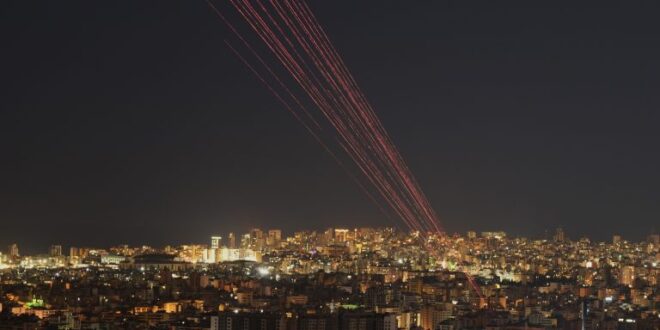
By launching missiles simultaneously from different directions, Hezbollah and Iran likely aim to overwhelm Israeli air defense systems, including the Iron Dome. Missiles launched from Lebanon have a much shorter flight time and distance than those fired from Iran. If Israeli defenses are already engaged in intercepting longer-range projectiles coming from Iran, the shorter-range missiles from Lebanon may arrive during those interception cycles, helping Hezbollah to exploit limited reaction time, which would increase the probability that some missiles are able to penetrate the Israeli defense system. A senior Israeli official admitted to reporters that they were surprised by Hezbollah’s operational intensity, exclaiming that they “were mistaken about Hezbollah – we didn’t think they would fire at these ranges.” It also appears Hezbollah may be following Iran’s approach of targeting military installations outside of Israel. Three days ago, the attack drone that struck the UK’s Royal Air Force base in Cyprus on Sunday was reportedly Iranian-made and launched from Lebanon by Hezbollah.
Nevertheless, Hezbollah’s entry into the war has generated significant anger within the Lebanese government, culminating in an emergency cabinet decision that declared Hezbollah’s military wing illegal — an unprecedented move in the realm of Lebanese politics, which has long tolerated, accommodated, or at times been constrained by the group. Despite this decision, the Lebanese state appears to have very limited capacity to actually halt Hezbollah’s military operations against Israel. Many Lebanese citizens — including some within Hezbollah’s broader support base — are reluctant to see the country drawn into another war, particularly as many villages and towns in southern Lebanon remain heavily damaged from previous conflicts with Israel, ignited by the October 7, 2023, Hamas attacks. Reconstruction in the southern region of the country has been slow, in part due to international and Israeli ceasefire conditions being tied to ultimatums that Hezbollah must relinquish its weapons, which has impacted investments for reconstruction.
Hezbollah frames its involvement in the present conflict as motivated by more than retaliation for the killing of the Iranian Supreme Leader, who is viewed by many as not only a political leader but also as a religious authority. The group argues that since its November 2024 ceasefire with Israel, the country has continued to conduct frequent strikes inside Lebanon, including targeted killings of its members. Hezbollah’s Secretary General Naim Qassem has publicly claimed that its current attacks constitute retaliation for those “15 months of violations.”
After years of severe operational decapitation at the hands of Israel, Qassem stated “we will confront the aggression, which for us is an existential defence that will continue until our goals are achieved.” Hezbollah’s view that this conflict is a struggle for its very survival likely means that many usual strategic calculations — cost, risk, and proportionality — may become secondary to the group. Hezbollah’s leadership is also likely aware that if Iran were to suffer a decisive defeat, the group itself could become Israel’s next primary target. From this perspective, waiting on the sidelines may only delay an inevitable confrontation under far less favorable conditions.
Israel has reportedly warned residents in Lebanon to move north of the Litani River, a step that often signals the possibility of a ground operation. This would not be the first time Israel has issued such warnings. Historically, Israeli military operations in southern Lebanon have focused on this same area.
Under current arrangements—particularly those tied to UN Security Council Resolution 1701 and the 2024 ceasefire—the Lebanese Armed Forces (LAF) are expected to maintain security in southern Lebanon alongside the United Nations Interim Force in Lebanon (UNIFIL). A monitoring mechanism involving Lebanon, Israel, the United States, and France was designed to manage violations and prevent escalation. However, if Israeli forces were to move back into the area, it could significantly alter these dynamics.
However, the presence of Israeli troops on Lebanese soil may benefit Hezbollah, allowing it to frame the conflict as a resistance struggle against occupation — an environment in which the group historically excels. This type of conflict may be more advantageous for Hezbollah than aerial confrontation with Israel’s superior military, especially given that Hezbollah’s leadership structure and military capabilities have been significantly degraded in recent years, particularly following Israeli assassinations of much of its leadership, including Hassan Nasrallah. More broadly, a ground invasion would also align with Iran’s regional strategy, which relies on allied groups to open multiple fronts and stretch U.S. and Israeli military resources.