 Eurasia Press & News
The Institute for the Study of War (ISW) and the Critical Threats Project (CTP) at the American Enterprise Institute are publishing two updates daily to provide analysis on the war with Iran. The morning update will focus on US and Israeli strikes on Iran and the Axis of Resistance’s response to the strikes. The evening update will be more comprehensive, covering events over the past 24-hour period and refining items discussed in the morning update.
Key Takeaways
The US-Israeli combined force has severely degraded Iran’s missile and drone capabilities, which has limited Iran’s ability to launch retaliatory attacks in the region.
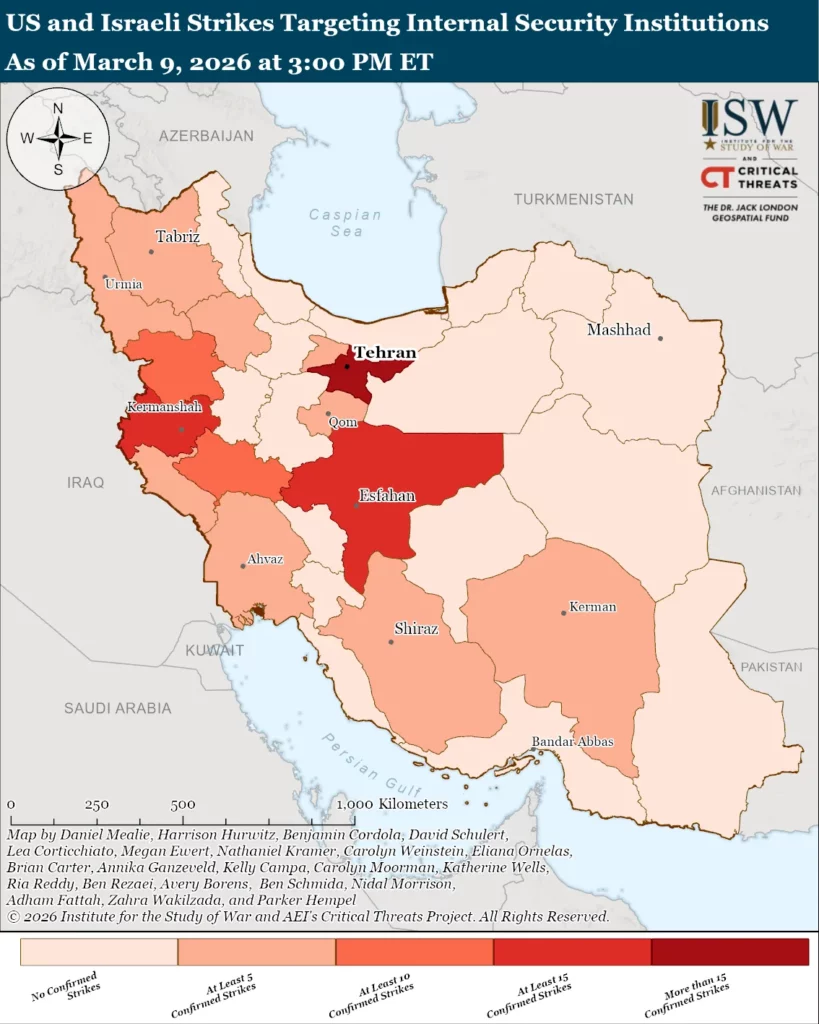
The combined force has degraded Iran’s internal security apparatus in Tehran and parts of western Iran. The combined force has struck dozens of internal security institutions across central and western Iran since February 28.
The combined force targeted a company in Tehran that is involved in the regime’s censorship and filtering of the internet. The combined force struck the Sahab Pardaz Company, which the United States sanctioned in October 2022 for providing “censorship, surveillance, and espionage tools” to the Iranian regime.
The IDF confirmed that Hezbollah is using long-range projectiles to attack Israel. Senior Israeli officials said that they expect Hezbollah to increase the volume of its rocket and drone attacks against Israel in “the coming days” as part of an effort to “draw Israeli attention away” from Iran.
Toplines
US and Israeli Air Campaign
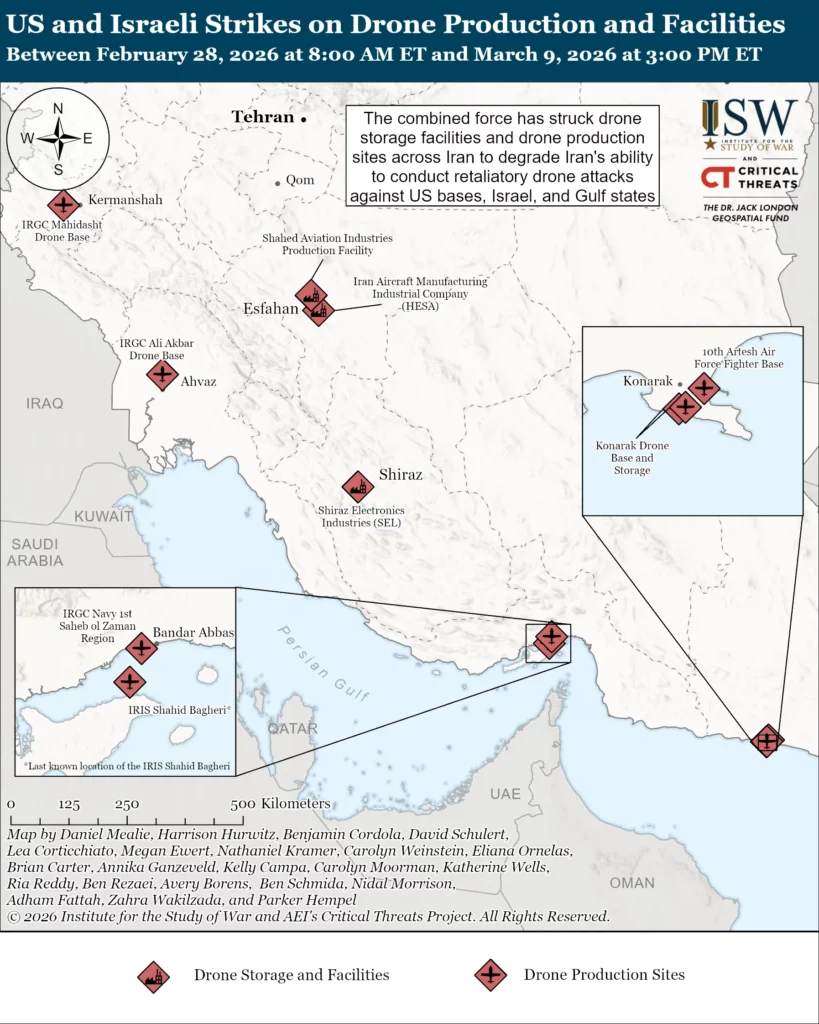
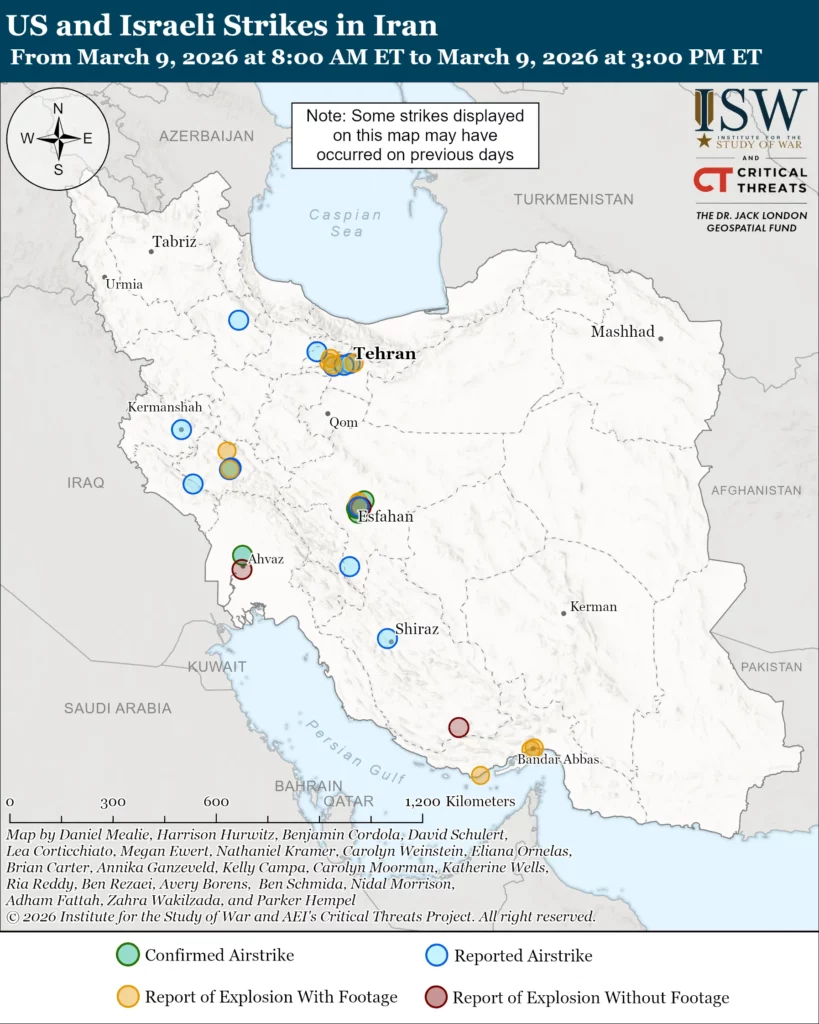
The combined force has severely degraded Iran’s missile and drone capabilities, which has limited Iran’s ability to launch retaliatory attacks in the region. The Israel Defense Forces (IDF) confirmed on March 9 that it destroyed three missile launchers in unspecified locations in Iran that Iran had used to launch missile attacks against Israel.[1] Commercially available satellite imagery on March 8 confirmed that the combined force struck underground facilities at the Esfahan Missile Complex in Esfahan Province, presumably making it harder for military personnel to access underground missile silos. Commercially available satellite imagery on March 8 also confirmed that the combined force cratered the runway of and caused significant damage to the northeastern area of the Islamic Revolutionary Guards Corps (IRGC) Aerospace Force’s Ali Akbar Drone Base in Ahvaz, Khuzestan Province, in southwestern Iran near the Iraqi border. The IDF separately confirmed on March 9 that it conducted airstrikes targeting an “IRGC Drone Command Headquarters” in an unspecified location in Iran that Iranian forces used to launch drones against Israel.[2] Open-source intelligence (OSINT) accounts reported that the combined force targeted a vehicle inspection center in Zanjan, Iran, on March 8.[3] One of the OSINT accounts identified a hidden missile launcher at the center in satellite imagery.[4]
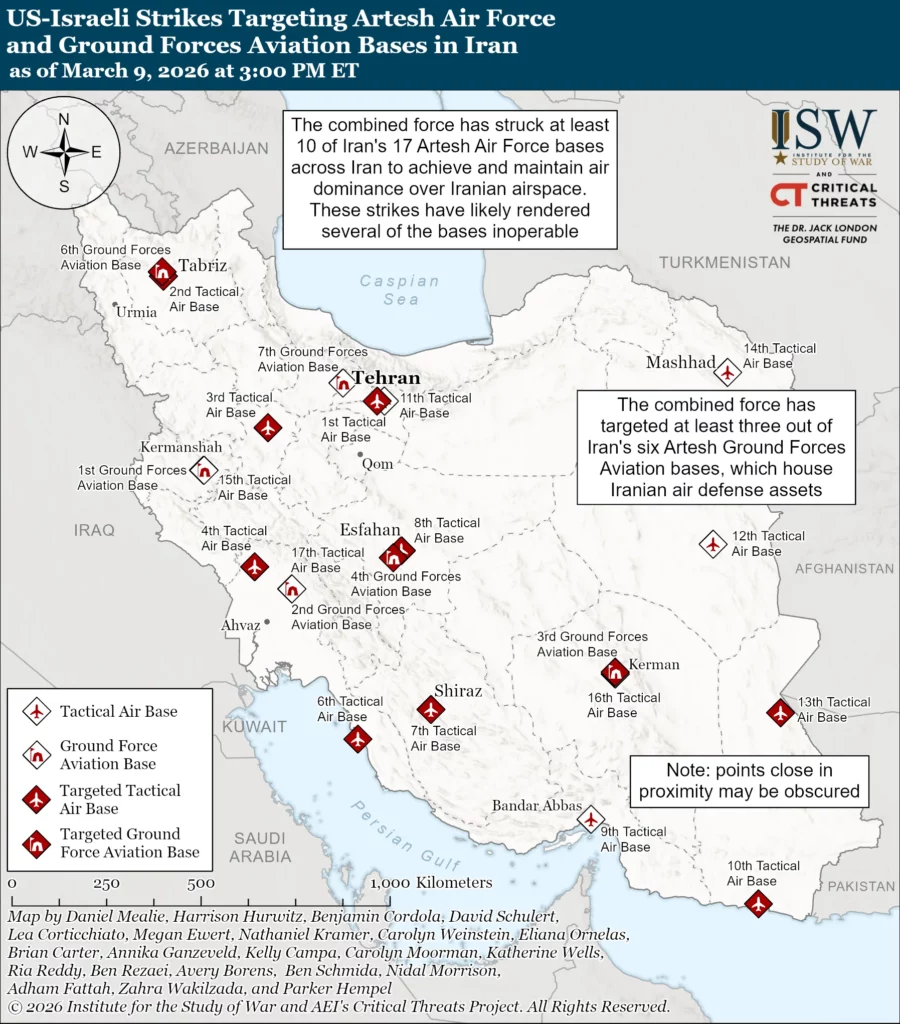
ISW-CTP has recorded combined force airstrikes targeting 10 out of Iran’s 17 Artesh Air Force tactical airbases and three out of Iran’s six Artesh Ground Forces Aviation bases across Iran since February 28 (see map below).[5] The IDF announced on March 9 that the Israeli Air Force (IAF) has targeted six Iranian airbases since the start of the war on February 28.[6] The IDF confirmed on March 8 that IAF airstrikes on March 7 destroyed F-14 fighter jets at an unspecified airbase in Esfahan. These strikes likely took place at the Artesh Air Force 8th Tactical Airbase. Israeli research and education center Alma confirmed on March 9 that the combined force has dropped at least 12 munitions on the Artesh Air Force 8th Tactical Airbase in Esfahan, citing commercially available satellite imagery from March 8.[7] IAF airstrikes previously destroyed 16 aircraft used by the IRGC Quds Force at the Mehrabad Airport in Tehran on March 6.[8] Alma and OSINT analysts separately confirmed damage to two buildings and the runway at the IRGC Aerospace Force Badr Base at Esfahan Airport in southeastern Esfahan City, citing commercially available satellite imagery from March 8.[9] Alma reported that the combined force struck a surface-to-air missile site at the Badr Base earlier in the war, citing commercially available satellite imagery from March 2.[10] Alma noted that Israeli airstrikes in April 2024 destroyed a radar at the Badr Base, likely referring to the destroyed Tomb Stone target engagement radar of one of Iran’s S-300 systems.[11] Another OSINT analyst reported on March 9 that the two damaged buildings at the Badr Base belonged to the Shahed Aviation Industries Production Facility (read more below).[12]
The combined force has continued to target defense industrial sites in Iran. Commercially available satellite imagery published on March 8 shows that the combined force struck the Shahed Aviation Industries Production Facility in Esfahan City.[13] Shahed Aviation Industries produces Shahed-136, Shahed-129, and Shahed-171 drones, among other Shahed variants.[14] The United States sanctioned Shahed Aviation Industries in November 2022 for supporting the IRGC Aerospace Force.[15] An OSINT account separately published a video of an explosion in Dolatabad Industrial Town north of Esfahan City.[16] It is unclear what the combined force may have targeted in this town, although Iranian defense industrial sites are often located in industrial zones. An explosion previously occurred at an electronics manufacturing factory in Dolatabad Industrial Town in December 2025, killing nine individuals.[17] The combined force also reportedly struck an “IRGC-affiliated” warehouse in Khorramabad, Lorestan Province, on March 8.[18] It is unclear what the IRGC used the warehouse for.
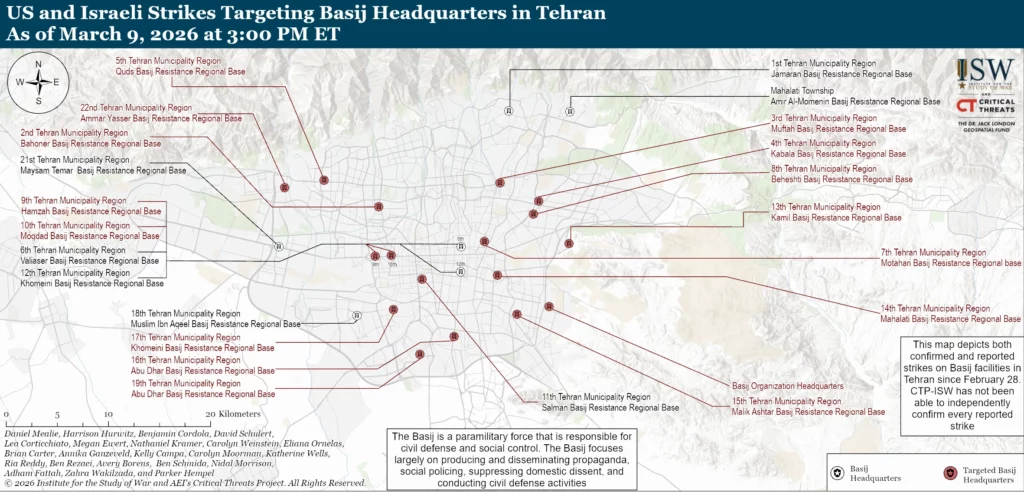
The combined force has degraded Iran’s internal security apparatus in Tehran and parts of western Iran. The combined force has struck dozens of internal security institutions across central and western Iran since February 28. The combined force struck the 4th Tehran Municipality Karbala Basij Resistance Regional Base in northeastern Tehran on March 9.[19] This base is one of the 23 Basij regional bases in Tehran.[20] The Basij is a paramilitary force that is responsible for civil defense and social control. The combined force has struck at least 11 other Basij regional bases in Tehran since February 28.[21] Commercially available satellite imagery captured on March 9 shows damage to the 15th Tehran Municipality Malik Ashtar Basij Resistance Regional Base, which the combined force targeted on March 2.[22] These bases operate under the IRGC Ground Forces Mohammad Rasoul Ollah Provincial Unit, which operates under the IRGC Ground Forces Sarallah Headquarters.[23] An OSINT account separately reported that the combined force targeted an IRGC base in Nazarabad, Alborz Province, which may refer to the Nazarabad Basij Resistance Regional Base.[24]
The combined force continued to strike Law Enforcement Command (LEC) institutions in Tehran and western Iran. The combined force struck the Greater Tehran LEC Relief Unit on March 9.[25] LEC relief units are responsible for suppressing protests, providing assistance to other LEC units, and conducting special operations.[26] The combined force separately reportedly struck an LEC headquarters in Kermanshah City, Kermanshah Province, on March 9.[27] It is unclear whether the combined force targeted the Kermanshah City or Kermanshah Province LEC Headquarters. Each Iranian province has a provincial LEC headquarters in its capital that is responsible for overseeing LEC units across the province. The combined force previously struck the Eslamabad-e Gharb City, Kermanshah Province, LEC Headquarters on March 8.[28] The combined force also reportedly targeted local LEC stations in Aleshtar and Khorramabad, Lorestan Province, on March 9.[29]
The combined force targeted a company in Tehran that is involved in the regime’s censorship and filtering of the internet. The combined force struck the Sahab Pardaz Company, which the United States sanctioned in October 2022 for providing “censorship, surveillance, and espionage tools” to the Iranian regime.[30] Sahab Pardaz signed a contract worth millions of dollars with a company affiliated with Iran’s Information and Communications Technology Ministry in 2016 to create “a system of cultural and social protection.”[31] The strike on the Sahab Pardaz Company comes as the regime sustained its nationwide internet shutdown for the tenth consecutive day on March 9.[32]
The combined force struck an unspecified intelligence office in Darreh Shahr, Ilam Province, and a reported IRGC Intelligence Organization building in Esfahan City, Esfahan Province, on March 9.[33] The intelligence office in Darreh Shahr is located near many local governance institutions, including the Darreh Shahr governor’s office and courthouse.
Anti-regime media claimed on March 8 that the combined force killed the IRGC Ground Forces Saheb ol Zaman Provincial Unit coordination deputy.[34] The Saheb ol Zaman Provincial Unit is based in Esfahan and operates under the Seyyed ol Shohada Operational Base.[35] The coordination deputy most likely died in a combined force airstrike against the Saheb ol Zaman Provincial Unit on March 8.[36] The IDF announced on March 9 that it has killed 1,900 Iranian commanders and soldiers since the start of the war on February 28.[37]
The combined force continued to attack Iranian naval capabilities. The combined force reportedly struck a Shahid Soleimani-class corvette off the coast of Bandar Lengeh, Hormozgan Province, on March 9.[38] It is unclear which Soleimani-class warship the combined force struck on March 9. The combined force previously struck the IRGC Navy’s IRIS Shahid Sayyad Shirazi, another Shahid Soleimani-class warship, off the coast of Bandar Abbas, Hormozgan Province, on March 3.[39] The United States has sunk over 30 Iranian ships since the start of the war on February 28.[40]
Iranian Domestic Affairs
Prominent Iranian regime figures congratulated Mojtaba Khamenei on his selection as Iran’s next Supreme Leader. Supreme National Security Council Secretary Ali Larijani stated on March 8 that Mojtaba can guide Iran “on the path of development.”[41] Ali Larijani’s brother and Expediency Discernment Council Chairman Sadegh Amoli Larijani, who was considered a possible successor to Ali Khamenei, also congratulated Mojtaba on March 8.[42] Iranian President Masoud Pezeshkian congratulated Mojtaba on March 9 and wished him success in building an “independent Iran.”[43] ISW-CTP assessed on March 8 that Mojtaba will likely face several immediate challenges, including trying to establish his legitimacy and attempting to unite and gain the support of various regime factions.[44]
The IRGC announced on March 9 that forces operating under the IRGC Ground Forces Hamzeh Seyyed ol Shohada Operational Base dismantled an armed anti-regime group in the northwestern region of Kurdistan Province in northwestern Iran.[45] The IRGC forces reportedly killed one individual, arrested six others, and seized large quantities of weapons and ammunition, including Kalashnikov rifles, rocket-propelled grenades, and grenades.[46] The Iranian regime is particularly concerned about anti-regime insurgent groups in Kurdish-populated areas in northwestern Iran.[47]
Iranian Response
Iran launched nine missile barrages at Israel between 3:00 PM ET on March 8 and 3:00 PM ET on March 9. Israeli media and journalists reported that Iranian ballistic missiles with cluster munition warheads impacted seven different locations in Israel, killing at least one Israeli civilian and injuring several others.[48] Iran has used several cluster munition warheads in its ballistic missile attacks on Israel since February 28.[49] All ballistic missiles have a circular error probable (CEP). The CEP is “the radius of a circle, centered at the intended target, within which 50 percent of the missiles would be expected to impact.”[50] The stated and publicly known CEPs of Iranian medium-range ballistic missiles are between 20 and 500 meters.[51] The relatively poor accuracy of these missiles compared to precision-guided munitions means that previous Iranian missile attacks against Israeli military targets have been largely ineffective and caused little to no causalities or damage. A cluster munition warhead contains submunitions that disperse over a wide area and are intended to maximize damage.[52] Iran likely began using cluster warheads to maximize the damage inflicted by its ballistic missiles given their relatively low accuracy when fitted with standard warheads.[53] Iran may calculate that using cluster munitions is more likely to cause Israeli casualties and impose costs on Israel for its air campaign against Iran.
Iran continued to target Gulf countries on March 8 and 9.[54] Gulf countries have reportedly been able to intercept and destroy around 94 percent of Iran’s missiles and drones.[55] Ukrainian President Volodymyr Zelenskyy reported that 11 countries have requested Ukraine’s experience in countering Shahed drones.[56] Zelenskyy did not specify which countries asked for Ukraine’s expertise, but noted that the countries include Iran’s neighbors, likely referring to Gulf states.[57] Gulf countries have continued to condemn Iranian attacks.[58] Qatari Prime Minister Mohammad bin Abdulrahman al Thani stated on March 9 that Iran “betrayed” the Gulf with its “miscalculation” in attacking Gulf countries and noted that Iran has destroyed its relationship with Gulf states, for example.[59]
US Central Command (CENTCOM) announced on March 8 that a US servicemember passed away from injuries sustained during Iran’s “initial attacks” against regional countries.[60] CENTCOM stated that the servicemember was seriously wounded in an Iranian attack on US forces in Saudi Arabia on March 1.[61] This marks the seventh US servicemember who has been killed since the start of the war.[62] CENTCOM separately announced on March 8 that a US National Guard soldier passed away due to a “medical emergency” in Kuwait.[63]
Israeli Campaign Against Hezbollah and Hezbollah Response
Hezbollah claimed 22 attacks targeting IDF forces and positions in northern Israel and southern Lebanon between 3:00 PM ET on March 8 and 3:00 PM ET on March 9. Hezbollah’s claimed attacks suggest that Hezbollah is increasingly focused on preventing Israeli forces from advancing deeper into southern Lebanon. Hezbollah claimed that it conducted several rocket, mortar, and drone attacks targeting Israeli forces and positions along both sides of the Israel-Lebanon border.[64] Hezbollah claimed two separate attacks targeting the Zeev Air Defense Base in Haifa and the IDF 146th Division Headquarters in Jaatoun, northern Israel.[65] The IDF reported that it intercepted dozens of drones launched from Lebanon.[66]
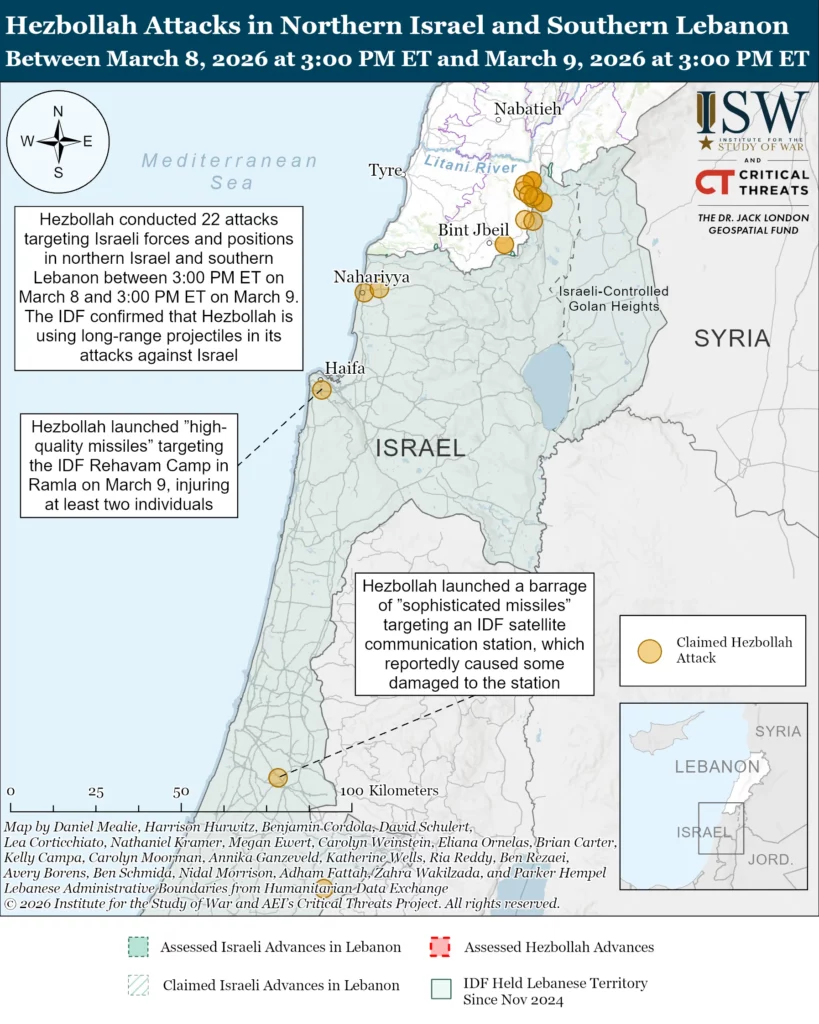
The IDF confirmed that Hezbollah is using long-range projectiles to attack Israel.[67] Hezbollah’s use of long-range weaponry is notable given that Hezbollah was hesitant to use these weapons in the Fall 2024 Israel-Hezbollah conflict.[68] Hezbollah claimed that it launched “high-quality missiles” targeting the IDF Rehavam Camp in Ramla on March 9.[69] The IDF Rehavam Camp is approximately 135 kilometers from the Israel-Lebanon border, which indicates that Hezbollah likely used medium- or long-range rockets or missiles, such as the Khaibar-1 rocket, Fadi 6 rocket, or Fateh-110 ballistic missile, in this attack.[70] A Hezbollah missile struck an open area in Mateh Yehuda Regional Council.[71] Israel’s national emergency service, Magen David Adom, reported that Hezbollah’s attacks on Ramla and Mateh Yehuda injured at least 16 people.[72] Hezbollah also launched a barrage of “sophisticated missiles” targeting an IDF satellite communication station in Elah Valley, central Israel.[73] Hezbollah claimed that the station is 160 kilometers from the Israel-Lebanon border, which suggests that Hezbollah also used medium- or long-range weapons in this attack.[74] The Hezbollah attack caused some damage to the satellite station, according to an OSINT analyst.[75] ISW-CTP previously forecasted in a February 28 report that Hezbollah would likely use its long-range weapons to conduct attacks against Israel from central and northern Lebanon.
Senior Israeli officials told Israeli media on March 9 that they expect Hezbollah to increase the volume of its rocket and drone attacks against Israel in “the coming days” as part of an effort to “draw Israeli attention away” from Iran.[76] Senior Israeli defense officials met with Israeli Defense Minister Israel Katz and Israeli Prime Minister Benjamin Netanyahu on March 9, during which the officials warned that Hezbollah seeks to “wear down” the IDF, specifically in northern Israel, by launching a greater number of missiles and drones.[77] Senior officials told Israeli media that Hezbollah still has a large number of launchers and the capability to launch attacks despite Israeli attacks.[78]
The IDF has continued to conduct airstrikes targeting Hezbollah sites across Lebanon to degrade the group’s ability to launch retaliatory attacks. The IDF has struck more than 120 Hezbollah targets across Lebanon in the past day.[79] The IDF targeted Hezbollah commanders, rocket launchers, and other unspecified military infrastructure on March 8 and 9.[80] The IDF killed Hezbollah Nasr Unit Commander Abu Hussein Ragheb.[81] The Nasr Unit is responsible for the eastern sector of southern Lebanon.[82] Each of Hezbollah’s geographical units possesses independent capabilities, such as combat engineering, rocket operation, logistics, drone, and medical capabilities.[83] The Nasr Unit played a crucial role in Hezbollah’s attacks against Israel after October 7, 2023, and during the Fall 2024 conflict.[84]
The IDF has advanced further into southern Lebanon.[85] An Israeli think tank reported that additional IDF soldiers have deployed to southern Lebanon “over the last few days” and are operating at “strategic observation posts” along the border.[86] The IDF 300th Regional Brigade (146th Division) identified a Hezbollah cell entering an unspecified checkpoint in southern Lebanon and directed the IAF to strike the cell.[87] The IDF announced that the IDF 36th Division, including the 7th Armored Brigade, conducted a targeted raid in Rab el Thalathine, southern Lebanon.[88] The IDF stated that Israeli forces sought to locate and destroy Hezbollah infrastructure and killed Hezbollah fighters during the raid.[89] The IDF 401st Brigade, which operates under the 91st Division, is also conducting operations in southern Lebanon to destroy Hezbollah infrastructure.[90] Israeli Defense Minister Israel Katz reported that over 650,000 Lebanese civilians have evacuated from Beirut’s southern suburbs and another 500,000 civilians have evacuated from southern Lebanon following IDF evacuation warnings.[91]
Five sources “with knowledge of the matter” told Axios on March 9 that the Lebanese government proposed immediate direct negotiations with Israel under US auspices to reach a peace agreement.[92] Sources told Axios that Israel rejected the outreach. Lebanese officials, including President Joseph Aoun, have accused Hezbollah of attempting to ”collapse” the Lebanese state and have harshly condemned its attacks against Israel.[93] The government’s outreach is notable given that the Lebanese government has long rejected direct and high-level negotiations with Israel because such negotiations would presumably require the Lebanese government to make firm commitments to disarm Hezbollah across all Lebanese territory.[94] The Lebanese government has recently taken steps against Hezbollah and the IRGC in Lebanon, including deeming Hezbollah security and military activity illegal and banning IRGC activity in Lebanon.[95]
Other Axis of Resistance Response
Members of Iran’s Axis of Resistance have widely welcomed the appointment of Mojtaba Khamenei as Iran’s new Supreme Leader. Lebanese Hezbollah, the Houthis, and several Iranian-backed Iraqi militias, including Kataib Hezbollah, the Badr Organization, Kataib Sayyid al Shuhada, and Harakat Hezbollah al Nujaba, all congratulated Iran on Mojtaba’s appointment in statements on March 8 and 9.[96]
The United States and Israel continue to attack Iranian-backed Iraqi militia positions in Iraq in order to prevent the militias from retaliating against the United States and Israel. The US-Israeli combined force conducted an airstrike targeting the 30th Popular Mobilization Forces (PMF) Brigade in Ninewa Province on March 9.[97] Several Iranian-backed Iraqi militias operate under the PMF, and some of these militias answer to Iran instead of the Iraqi prime minister.[98] The combined force has conducted several waves of strikes targeting the 30th PMF Brigade in Ninewa Province since March 2.[99] The 30th PMF Brigade is primarily composed of Shabak fighters and is aligned with the Badr Organization, which is both an Iranian partner militia and a political party.[100]
Iranian-backed Iraqi militia Kataib Hezbollah threatened on March 9 to attack the “economic interests,” businesses, and bases of unspecified Iraqi Kurdish parties if they work with Kurdish opposition groups to destabilize Iran.[101] A military adviser to Iranian-backed Iraqi militia Harakat Hezbollah al Nujaba similarly threatened on March 5 to attack an unspecified Barzani family member and his businesses if his militia attacks Iraqi security forces or Iranian-backed Iraqi parties.[102]
Iranian-backed Iraqi militias continue to claim attacks against US forces. The Islamic Resistance in Iraq, which is a coalition of Iranian-backed Iraqi militias, claimed on March 8 that it conducted 26 drone and missile attacks targeting “enemy” bases in Iraq and the region in the past 24 hours.[103] Likely Iranian-backed Iraqi militia front group Rijal al Baas al Shadid separately claimed that it conducted three drone attacks targeting three US bases in Jordan and two drone attacks targeting Harir Airbase at Erbil International Airport in Iraqi Kurdistan on March 8.[104] A security source told Iraqi media on March 9 that US-led coalition air defense systems intercepted drones near Erbil International Airport.[105]
Likely Iranian-backed Iraqi militias also targeted the former US Victory Base at Baghdad International Airport on March 8 and 9.[106] A security source told Iraqi media on March 9 that air defenses intercepted missiles and a drone targeting the base.[107] Rijal al Baas al Shadid claimed that it fired two drones targeting the former US Victory Base on March 9.[108] A security source told Iraqi media on March 9 that air defenses shot down two drones targeting the base.[109]
The Kuwaiti Ambassador to Iraq informed the Iraqi Foreign Ministry on March 9 that the Kuwaiti government has recorded attacks originating from Iraqi territory that targeted locations in Kuwait.[110] Two likely Iranian-backed Iraqi militia front groups claimed drone attacks targeting Kuwait on March 7 and 8.[111] ISW-CTP assessed on March 6 that Iranian-backed Iraqi militias may be using front groups in an attempt to avoid US and Israeli strikes on militia positions and obfuscate culpability.[112]