 Eurasia Press & News
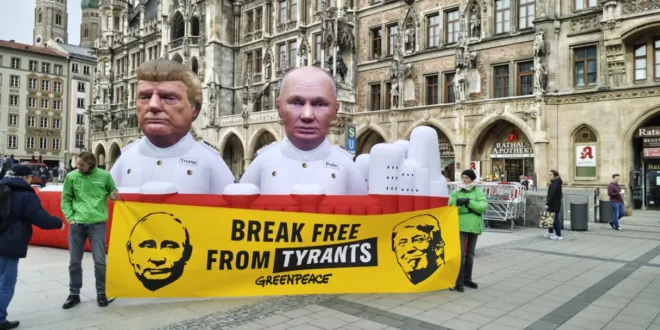
On the sidelines of the Munich Security Conference, anxiety over a world in crisis.
Over the weekend of Valentine’s Day, the United States was marching toward war with Iran and grappling with a partial government shutdown that impacted the Department of Homeland Security. Meanwhile, the Trump administration was making light of its increasingly aggressive foreign policy: On social media, government accounts posted mock Valentine’s cards joking about the president’s threats against Greenland and the kidnapping of Venezuela’s president in January. For my part, I found myself in the shadows of Munich’s historic palaces. At the Munich Security Conference, I shuttled from room to room, listening as world leaders offered technocratic — and seemingly hollow — diagnoses of a world in crisis.
Reporters from around the world had flooded the conference. Many white-knuckled their way into closed-door briefings, where more than 40 heads of state convened in private. The journalists sat in silence, wary of making any noise that a nearby microphone or recording device could pick up. With the planet coming apart at the seams, a silent, unsettling anxiety loitered in every room.
That anxiety was acutely felt at a press conference with Reza Pahlavi. Reporters jotted down notes as he presented what he called the Iran Prosperity Project, his vision for a democratic transition in the country. A curious candidate for democratic transition, Pahlavi’s primary claim to oversee such a process is that he is the son of a former monarch. His father, Shah Mohammad Reza Pahlavi, ruled Iran on and off for nearly four decades. He was briefly exiled in August 1953, but a CIA and MI6-orchestrated coup that same month returned him to power. In Iran, the Shah’s regime is still known for its imprisonment of political dissidents, use of torture, and suppression of free speech. The Islamic Republic of Iran, which took the monarchy’s place, has kept these practices alive, and in January, thousands of people were killed for protesting its rule.
“Why is it that Western countries are not supporting you or endorsing you as the voice of the Iranian opposition?” one reporter asked Pahlavi.
Pahlavi replied defiantly. “I’m not asking for an endorsement,” he said. “I’m asking them to support the Iranian people and back them on their right to determine their own future.”
“I hear there will be a protest later,” another journalist asked, referencing the pro-democracy, anti-regime protests slated for later that afternoon. “Will you be attending?”
The question lingered until Pahlavi said, “We haven’t decided that yet.”
At last year’s Munich Security Conference, US Vice President JD Vance launched a blistering attack on Washington’s European allies. Across some 20 minutes, he dressed down Europe over immigration, claimed free speech on the continent was “in retreat,” and blasted governments for not working with far-right parties. A year later, the United States had bombed seven countries, threatened to take over Greenland, and racked up a harrowing record on free speech.
This year, though, the sentiment was different. US Secretary of State Marco Rubio took a somewhat subtler tack. He insisted that American leaders would not be “polite and orderly caretakers” of Western decline, but also announced that the Trump administration wanted a “reinvigorated alliance” with its old friends. Still, the distrust lingered. It wasn’t that world leaders had suddenly embraced multilateralism. Rather, they appeared to recognize the Trump administration’s growing commitment to standing alone. Across panels and private discussions, questions about whether Washington was still reliable dominated the conversation. The United States had changed, everyone seemed to agree, and the rest of the world needed to create a bulwark against its unpredictability.
Every year, the Munich Security Conference draws hundreds of decision-makers — heads of state, ministers, and other senior figures — from around the world. Journalists, civil society groups, and protesters also descend on the city for the conference.
The press center is surrounded by the Munich Residenz, a former royal palace whose symmetry and silence stood in stark contrast to the frenzied conversations unfolding nearby. Meanwhile, a different sort of conversation was happening on the sidelines.
Between panels, I learned that at least 21 anti-militarism demonstrations were scheduled to take place across the city leading up to the conference. Undeterred by the threat of rain, thousands of protesters filled public squares to denounce the defense policies being debated just a few blocks away. After translating two German news articles, I grabbed my backpack and headed to a nearby demonstration hosted by the Anti-Siko Alliance, one of several events taking place alongside the International Munich Peace Conference, two German groups that oppose the Munich Security Conference, or, in its activist shorthand, SiKo. Together, they brought together activists and grassroots organizations all with the same core vision: an anti-imperialist, anti-militarist world. Though their political power may pale in comparison to the decision-makers inside the conference, their visibility is growing across Europe. That afternoon, they had packed a corridor of central Munich.
While the sentiment at the Munich Security Conference was buttoned-up, the crowd at the International Munich Peace Conference was freer, more expressive. The Munich Security Conference —alongside NATO, the European Union, and the Troika — makes up the architecture of Europe’s security frameworks. In this, European politics is also fertile ground for public contestation. That much was evident even at the Munich Security Conference, where the Alternative für Deutschland (AfD), a far-right, anti-immigrant, German political party, lobbied to be invited after having previously been banned. Activists wearing keffiyehs waved signs that read “Free Palestine.” Small silos quickly converged into a yawning group as demonstrators took to the stage in hazmat suits. Protesters braved the cold and held signs that read, “I reject war. I reject your profit.” Demonstrators both young and old stood amid the sea of flags belonging to DiEM25, of Germany, and of MeRA25, both part of a leftist, pan-European political alliance.
“The UN charter asks for peaceful solutions and dialogue between states.” – Heinz Michael VilsmeierOne such protester was Heinz Michael Vilsmeier, a core organizer of the International Munich Peace Conference. The way he put it, participating in the demonstration was a defense of international law. “For more than 60 years, this conference takes positions that lead to confrontation between states,” he told me. “The UN charter asks for peaceful solutions and dialogue between states.” A decade or two ago, these activists’ positions may have seemed fringe. But with the world in the midst of the most violent conflicts since World War II, their demands seem simple.
Maria Regina Feckl, another local organizer, has been at the helm of the International Munich Peace Conference since 2020 and has advocated for more peaceful conflict resolution. “We are part of the broader protest movement taking place today, opposing the Munich Security Conference — both what happens there and who participates, including actors tied to the military-industrial complex,” she explained. “Who bears the cost of these political decisions? Not the people sitting inside the Munich Security Conference.”
On that point, she was onto something. European governments have historically invested more in social spending than the United States. However, growing pressure within NATO — and more specifically from the United States — for European countries to increase their military budgets has left a growing gap between global defense spending and investment in social programs. Two days before this year’s Munich Security Conference kicked off, ONE released a report examining the dangers of overinvesting in the military rather than in social programs. In 2024, that report found that the top-10 defense spenders in the Organisation for Economic Co-operation and Development “devoted more than 85% of security-relevant spending to defense,” effectively spending “65 times more on defense than on global health in 2024.”
Data from Brown University’s Cost of War Project corroborates this. American-led conflict since 9/11 — in Iraq, Afghanistan, Pakistan, Syria, and elsewhere — has cost around $8 trillion. Staggering as that sum is, it doesn’t include “future investment costs on borrowing for the wars. What’s more, during the two years of Israeli war on the Gaza Strip following the Hamas-led attacks on Oct. 7, 2023, the US shipped Israel an estimated $21.7 billion in military aid. All that on top of a death toll that, according to health authorities in Gaza, has surpassed 70,000.
Such massive sums lend weight to what angers people like those who demonstrated in Munich last month. War is both expensive and profitable, and everyday people — far more than the leaders who advocate for conflict — are left to absorb its lethal consequences.
That was what brought Atan, a local DiEM25 coordinator, into the streets during the conflict. Though he was born in Iraq, he lives in Germany. When I asked him why he braved the sharp cold, he replied, “Many of the people discussing so-called security inside those halls are responsible for the genocide in Gaza, for repression elsewhere, and for the rise of authoritarian and fascist movements. This is not acceptable.”
As the first drops of rain began to fall, I looked around and noticed that the number of police officers had substantially swelled. Officers largely stood idle in clusters, awaiting a need that never came. The crowd, though, remained peaceful. I passed two teenagers holding a massive sign in German that read “NEIN ZUR WEHRPFLICHT!” I asked them what it meant, and they said they were protesting the German government’s recent attempts to reintroduce conscription.
Thomas, one of the teenagers, argued that his government’s efforts can be traced back to the Munich Security Conference — and why it prompted him to protest. “The Munich Security Conference brings together high-ranking government officials and private companies that profit from war,” he said. “Calling this ‘security’ masks what is really happening: deals are being made. It’s essentially a large arms trade conference under the banner of security.”
That banner of security has — in the eyes of many of the protesters — grown smaller and more reflective of the interests of a small class of power brokers.
At the same time, the demonstrations grew, and protestors joined arms to form a human chain; a different kind of consensus was being tested elsewhere. At another protest nearby, Reza Pahlavi emerged amid a sea of Iranian flags. Standing behind a protective screen, he took to the stage, as an estimated 250,000 people joined him to rally for regime change. He told the crowd, “We gather at an hour of profound peril to ask: Will the world stand with the people of Iran?”
Before the weekend ended, Pahlavi had won an endorsement from US Senator Lindsey Graham, a Republican and longtime advocate of regime change in Iran. Within a few days, Trump had further escalated tensions by issuing an ultimatum to the Iranian regime, vowing that “bad things” would happen if Tehran didn’t reach an agreement with Washington on its nuclear program. Then, on the last day of the month, the bombs started raining down across Iran.