 Eurasia Press & News
The war in Iran is currently in a phase in which the military trajectory is relatively positive: the United States is steadily destroying Iran’s ability to use its most essential tool in the war — drone and missile attacks — which in turn underpin the entire Iranian strategy. Iran has still done some damage to US forces, and it is still firing drones and missiles, though the overall attack rate is slowly decreasing. These attacks still pale in comparison to the major attacks Iran sought to conduct in an existential war and have caused neither operationally significant damage nor widespread casualties. The US-Israeli combined force will need time to achieve its military objectives and prevent Iran from inflicting further political and economic pain upon the United States and its allies in the region, but the campaign remains incomplete, and it is too soon to forecast its outcome. Declaring it an operational failure is unquestionably premature.
Iran has developed and sought to implement a multi-pronged theory of how it will defeat the United States and Israel in a major, existential conflict. This theory is that inflicting enough political and economic pain upon the United States, Israel, and America’s Gulf allies will make the combined force cease its operations. The Iranians have developed five lines of effort to compel the United States and Israel to end the war: drone and ballistic missile attacks to inflict US and Israeli casualties and economic damage in the Gulf; drone, missile, and naval attacks including mines to disrupt shipping in the Persian Gulf; proxy attacks from Hezbollah and other Iranian-backed groups; global terrorism; and cyber attacks on critical infrastructure.[1] The US-Israeli combined campaign has focused on stopping drone, ballistic missile, and traditional naval attacks most urgently because these assets are the most essential Iranian tools that Tehran needs to execute its strategy.[2] Both aerial and naval drones remain a threat to shipping and oil infrastructure in the Gulf, and the threat of Iranian mining of the Strait remains real, if complex. The combined force will likely knock the drone and missile threat down to levels that would permit renewed maritime transit through the Strait if the current campaign succeeds in its aims, but oil and shipping prices depend in part on the risk-tolerance of third parties, so even an immediate end to the Iranian threat may not cause prices to drop quickly.
Iran’s military weakness relative to the United States led it to adopt an asymmetric strategy against Washington that seeks to outlast Washington rather than to militarily defeat it outright.[3] The various lines of effort that comprise this strategy have changed over the years, but during this war, Iran has relied on the five key efforts outlined above. Iran has likely calculated that if these five prongs cause US casualties, drive up oil prices, and impose economic costs on both the US and its Gulf allies, the United States and Israel would make a political decision to end the war without achieving their objectives. Iran’s naval and aerial drones, missiles, and fast attack craft are the critical requirements for its approach, however. These assets can cause the most lasting damage to oil markets and the most consistent and highest casualties and thus impose the most severe political pressure. Global terrorism, cyber attacks, and proxy attacks are less effective and impose only limited political pressure on the US government. Naval mines, which could close the strait, will be cleared in time.
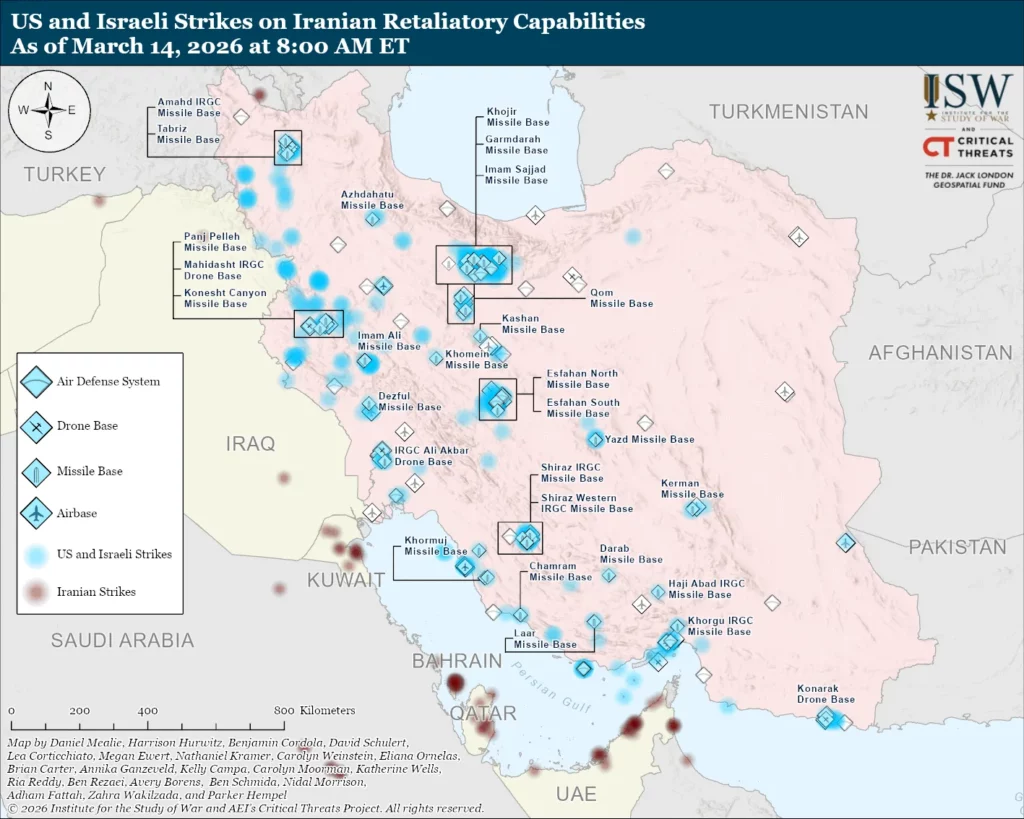
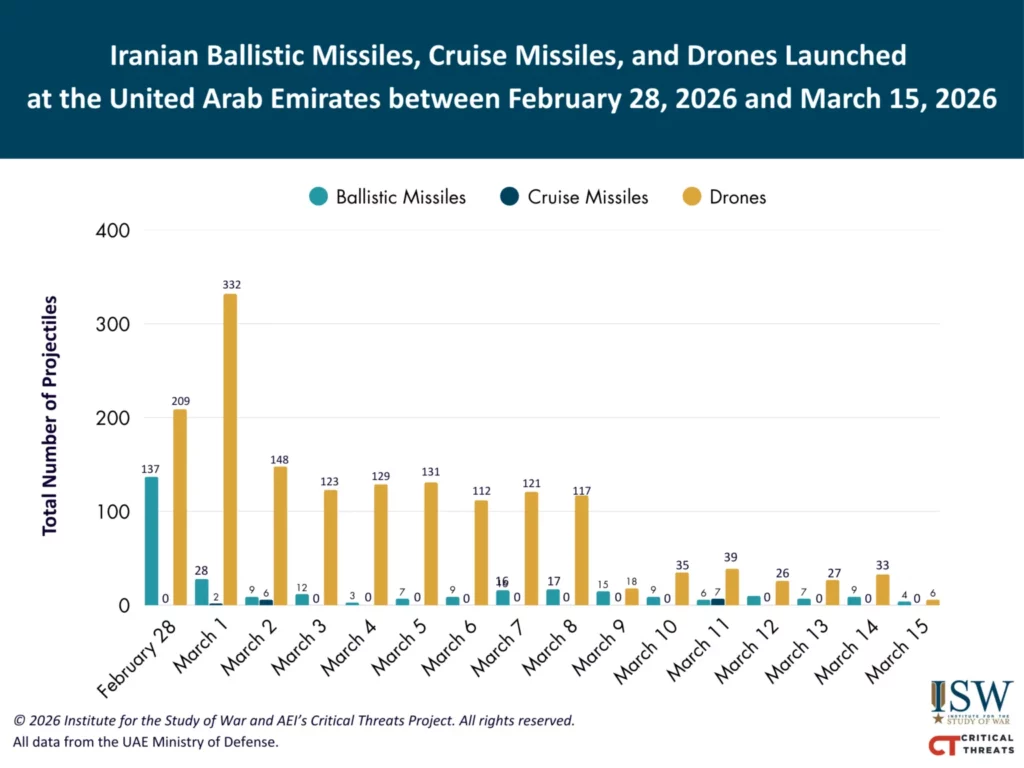
The US-Israeli combined campaign, which has focused on stopping missile and drone attacks as soon as possible, is successfully limiting attacks on US partners and interests in the region. The combined force began this effort on the first day of the campaign, and it has gradually decreased Iran’s ability to fire missiles and drones. A senior Israeli military official said that Israel has destroyed or rendered combat ineffective between 260 and 290 of an estimated 410 to 440 launchers.[4] The Iranian missile force troops are reportedly also demoralized, deserting, and refusing orders, according to Israeli intelligence.[5] The campaign has struck drone launchers, though neither the United States nor Israel has released information about the numbers or type of drone targets struck. Iranian ballistic missile and drone launches have in any case decreased gradually since the beginning of the war.[6] Some individual drones have penetrated air defenses and caused politically unacceptable damage to oil infrastructure, but the overall trend in attacks is overwhelmingly positive.[7]
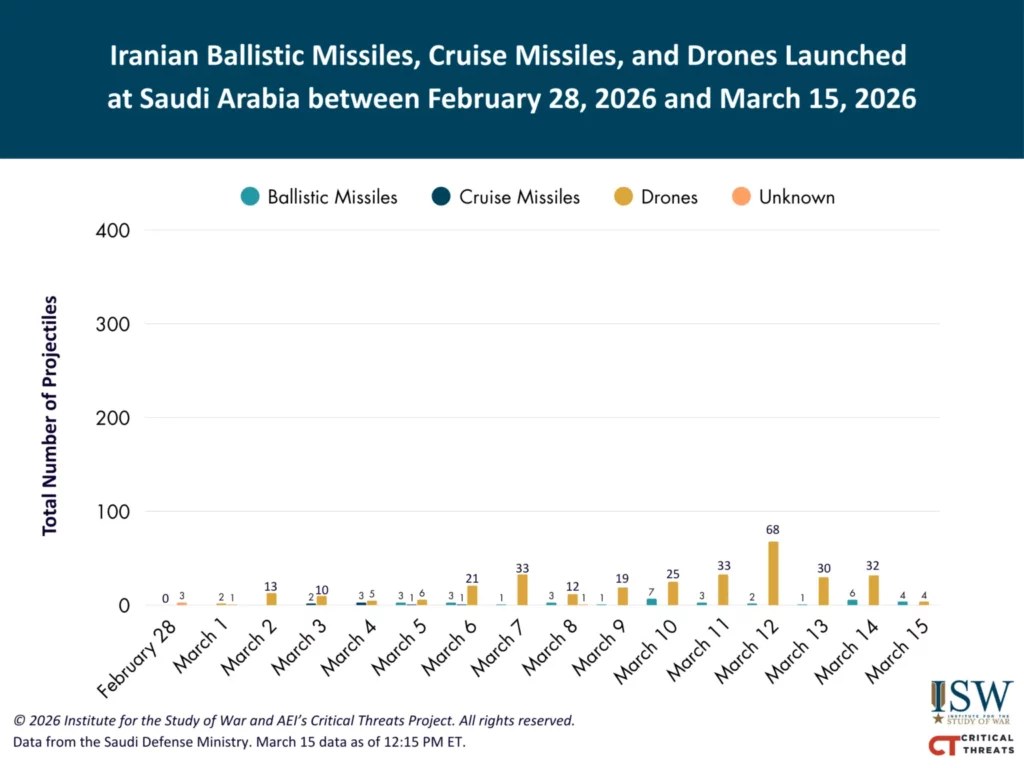
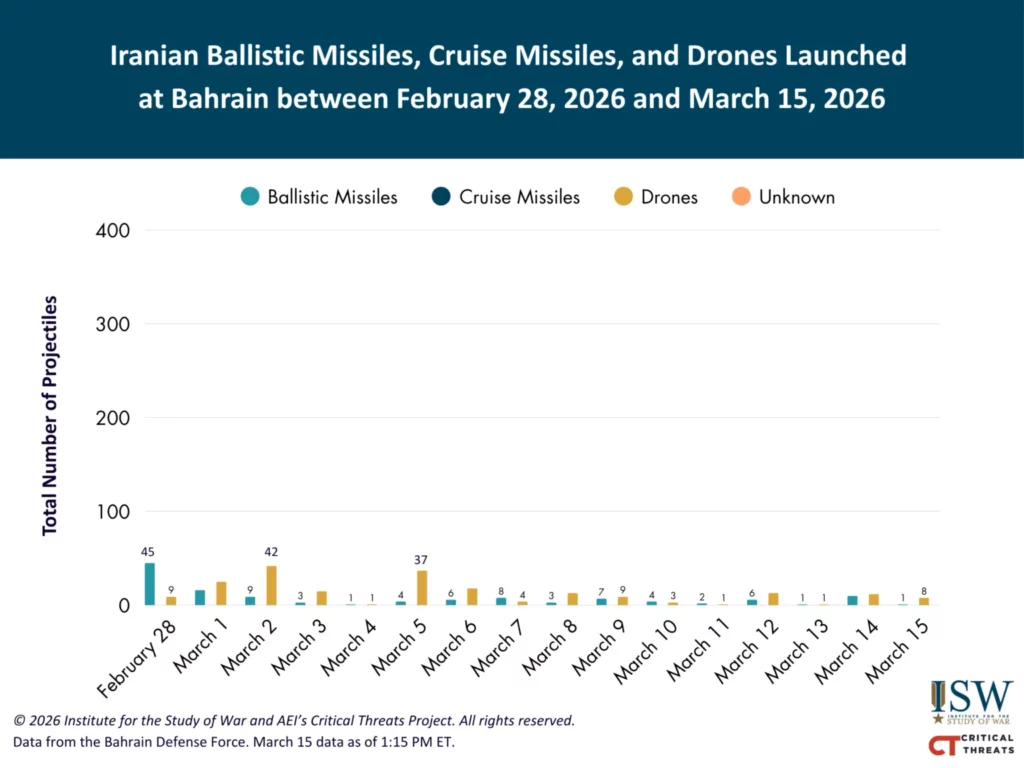
There is little to no evidence that Iran is holding missiles or drones in reserve to expend after the U.S. and its allies run out of interceptors. Drones, of course, are intercepted by air-to-air missiles and machine guns, not expensive Patriot, THAAD, or Arrow ballistic missile interceptors.[8] Some commentators have alleged that Iran is hoarding advanced missile systems to fire after the United States and its allies are out of interceptors, but there is little to no evidence to support these assertions. Iran is using advanced missile systems, including the Sejjil, the Khorramshar, and others, to target Israel.[9] There is no publicly available information at this time about the type of close range and short range ballistic missiles fired at the Gulf states or US bases, so it is impossible to assess whether Iran is using advanced missiles to target the Gulf.
Holding missiles in reserve would be a gamble that Iran cannot afford in any case. Such a gamble would assume that Iran will retain sufficient launchers to continue firing “advanced” missiles once the United States expends all its interceptors. The validity of this assumption is unclear because the United States and Israel are systematically rendering Iranian missile launchers combat ineffective. The gamble also assumes the United States will run out of interceptors before Iran runs out of missiles, and Iran has no obvious way of accurately assessing the US or Israeli interceptor stockpile. Hoarding missiles in reserve will do Iran no good if it cannot launch them or if they get shot down before they reach their targets.
The IRGC almost certainly lacks the command-and-control necessary to execute a centrally-directed operation that prioritizes certain munitions over others, even if it wanted to. Iranian officials in November 2025 said that they would launch thousands of missiles targeting Israel in any future war, indicating that IRGC commanders likely expressed a desire for mass attacks to their subordinates before the war.[10] Tehran has repeatedly noted that it has decentralized its operations and adopted a “fire at will” approach in response to US and Israeli decapitation strikes, however.[11] Any change in strategy during the war to focus on cruder systems or intentionally withhold missiles for later strikes would require central direction to ensure the different elements of the organization respond as headquarters desires. The combined force attacks on Iranian command and control and military leadership have very likely disrupted Iran’s ability to manage such sophisticated central planning and direction of its missile operations.
The US Central Command clearly planned to suppress Iran’s maritime attacks, regardless of the administration’s reported surprise at the intensity of attacks in the Persian Gulf.[12] The campaign to suppress maritime attacks has multiple phases that mirror the phases of the overall campaign: suppression of enemy air defenses along the coast to enable additional strikes and helicopter patrols; suppression of Iranian ballistic missile and drone attacks; destruction of Iran’s navy; and ultimately, the defeat of Iran’s anti-ship missile and drone capabilities.[13] Suppressing air defenses, the ballistic missile and drone attacks, and destroying Iran’s navy will support successful operations to suppress Iranian maritime attacks. The completion of these three tasks will enable the US Navy to undertake defensive operations on behalf of merchant shipping with minimal interference. Meanwhile, air assets can undertake offensive operations to suppress Iran’s naval and aerial drones and anti-ship missiles targeting maritime shipping. The last Iranian attack on merchant shipping was on March 11, though it remains unclear if this is because there is less shipping transiting the strait or due to military operations that suppressed Iranian capabilities.[14] Iran may decide to mine the Straits if it has a much more limited ability to target shipping, but minesweeping operations will eventually clear the Strait and open it to traffic. Iran must also calculate the effects on its own ability to export oil of mining the Strait as mines, unlike missiles and drones, do not distinguish between ships Tehran wants to pass through and those it wishes to attack. It remains difficult to determine with any degree of certainty how the markets will react to future developments in the maritime situation, however. The US Navy can open the strait, but the risk-tolerance of the market will ultimately determine the length of the disruption in the Strait.
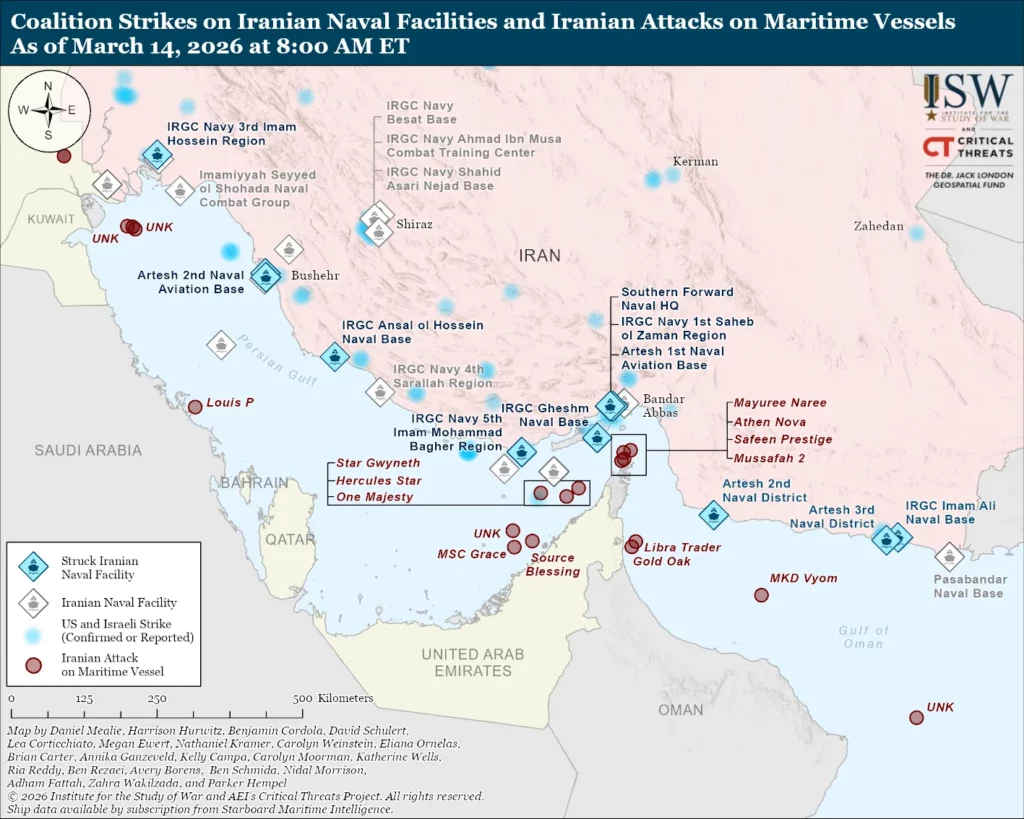
Iran remains a relatively strong state adversary with substantial military capabilities that it is using to damage US and allied infrastructure and forces and impose political costs. Missile and drone attacks, while trending downwards, have not stopped, and even a single drone or missile attack could enable Iran to emerge victorious. An Iranian drone attack struck Omani oil facilities on March 11, and a missile attack most recently damaged five tankers in Saudi Arabia on March 13, for example.[15] Iran and its proxies have previously used small-scale drone attacks to achieve strategic victory, however. The Houthis, for example, fired a small number of drones at an oil facility in Jeddah, Saudi Arabia, in 2022, which ultimately forced Saudi Arabia to accept a ceasefire that was beneficial to the Houthis.[16] Military operations must prevent Iran from using economic damage and political pressure to amplify otherwise small and militarily insignificant tactical actions into strategic successes.
Iran’s attacks have not yet affected US military operations and fallen far short of Iran’s hopes for attacks with thousands of missiles and drones, however. The available evidence supports the assessment that the combined campaign is achieving its military objectives thus far but is not yet complete. Declaring the campaign a failure at this stage is therefore premature. The collapse of Iranian drone and missile attacks — down significantly since February 28 — presents a compelling picture that the military campaign is degrading ballistic missile and drone capabilities.[17] Continued drone and missile attacks — not to mention the remaining 150 launchers — indicate that these assets remain a threat and will need to be fully suppressed, of course. The maritime threat will need to be similarly suppressed. But the military campaign against both the missile and drone attacks and the maritime attacks must be evaluated based on whether the evidence shows progress is being made towards the military objectives. It is far too early to forecast whether the current military campaign will achieve overall political objectives or how long disruptions to the flow of oil through the Strait of Hormuz will last. But declaring this operation a military failure is premature while the campaign remains underway and incomplete, particularly as the evidence clearly shows progress being made towards accomplishing its core objectives.