 Eurasia Press & News
Key Takeaways
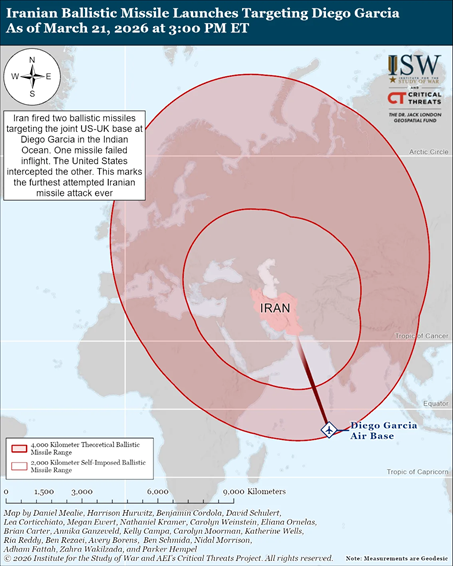
Iran launched two ballistic missiles targeting the US-UK base at Diego Garcia in the Indian Ocean on March 21, marking the furthest ever attempted Iranian missile strike. The attack demonstrated that Iranian missiles can reach beyond the 2,000-kilometer limit that the regime has long claimed to have self-imposed. One missile failed inflight, and the United States intercepted the other.
The Islamic Revolutionary Guards Corps (IRGC) has reportedly expanded its influence over regime decision-making amid a growing power vacuum caused by leadership losses and Supreme Leader Mojtaba Khamenei’s apparent inability to exercise full authority. Some of the officials who have likely expanded their influence are among the most aggressive and repressive elements within the IRGC.
The United States Treasury Department issued a short-term waiver on March 20, permitting the sale of Iranian oil already in transit. The waiver does not allow for new purchases of oil.
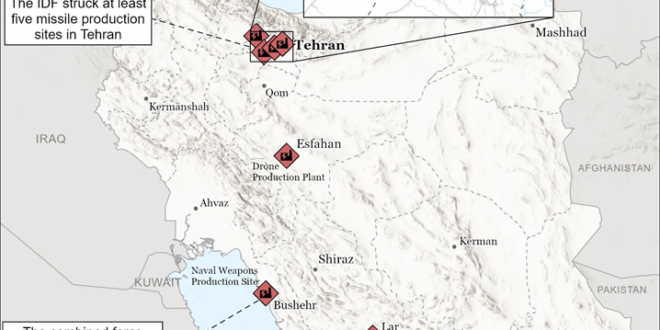
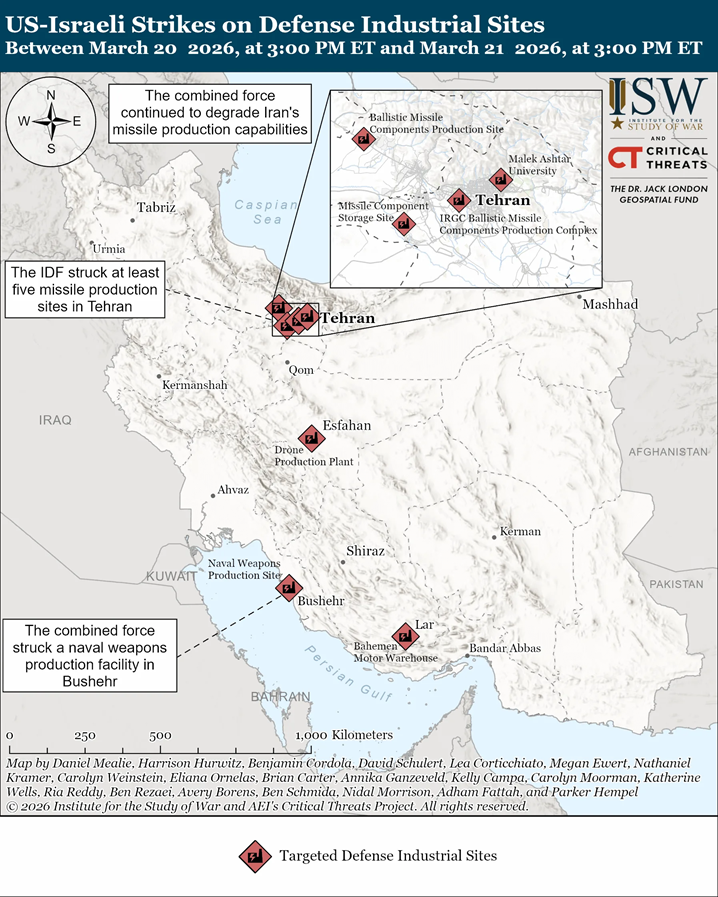
The combined force continued to degrade Iran’s missile production capabilities. The IDF struck at least five missile production sites in Tehran.
Toplines
Iran launched two ballistic missiles targeting the US-UK base at Diego Garcia in the Indian Ocean on March 21, marking the furthest ever attempted Iranian missile strike.[1] The attack demonstrated that Iranian missiles can reach beyond the 2,000-kilometer limit that the regime has long claimed to have self-imposed. One missile failed inflight, and the United States intercepted the other.[2] Diego Garcia is located just over 4,000 kilometers from southern Iran. It is unclear exactly what system Iran used in the attack. It could have been a modified version of one of its longer-range missiles or a previously unknown capability. The attempted attack upends some assumptions about the Iranian missile program, and especially the threat that they may pose to Europe. The nature of that threat depends on the system Iran used and how reliably it can hit targets beyond the 2,000-kilometer range, however.
The Islamic Revolutionary Guards Corps (IRGC) has reportedly expanded its influence over regime decision-making amid a growing power vacuum caused by leadership losses and Supreme Leader Mojtaba Khamenei’s apparent inability to exercise full authority.[3] Two senior Israeli officials told Axios on March 21 that the IRGC has mainly filled the power vacuum that has formed in the regime as a result of Israeli decapitation strikes.[4] Israel has conducted several decapitation strikes since the war began, which have likely disrupted centralized command and control to some extent and created uncertainty around senior decision-making.[5] US and Israeli officials reportedly assess that Mojtaba remains alive, but they have not observed clear evidence that he is personally giving orders, which is consistent with ISW-CTP’s assessment that circumstantial evidence suggests that Mojtaba Khamenei is still badly injured or otherwise incapacitated.[6] The loss of key leadership and Mojtaba’s reported inability to govern at least partially explain the rising role of the IRGC, and specifically hardline IRGC figures close to Mojtaba, such as IRGC Commander Brigadier General Ahmad Vahidi, Parliament Speaker Mohammad Bagher Ghalibaf, and former IRGC Commander Major General Mohammad Ali Jafari. These IRGC officers were reportedly among the individuals who pushed to get Mojtaba selected as the next supreme leader.[1] All three have historically held senior positions across Iran’s military, political, and internal security institutions.[7] They represent a network of influential and highly ideological actors with deep ties to the regime’s coercive apparatus.[8] These individuals are among the most aggressive and repressive elements within the IRGC.
The United States Treasury Department issued a short-term waiver on March 20, permitting the sale of Iranian oil already in transit.[9] The waiver does not allow for new purchases of oil. Treasury Secretary Scott Bessent said that the waiver will inject around 140 million barrels of oil into the global market. Daily oil exports from the Middle East have fallen by at least 60 percent since the war began.[10] Bessent added that the United States will continue to maintain maximum pressure on Iran to limit its access to the international financial system and, therefore, any revenue generated from the oil sales.[11]
US and Israeli Air Campaign
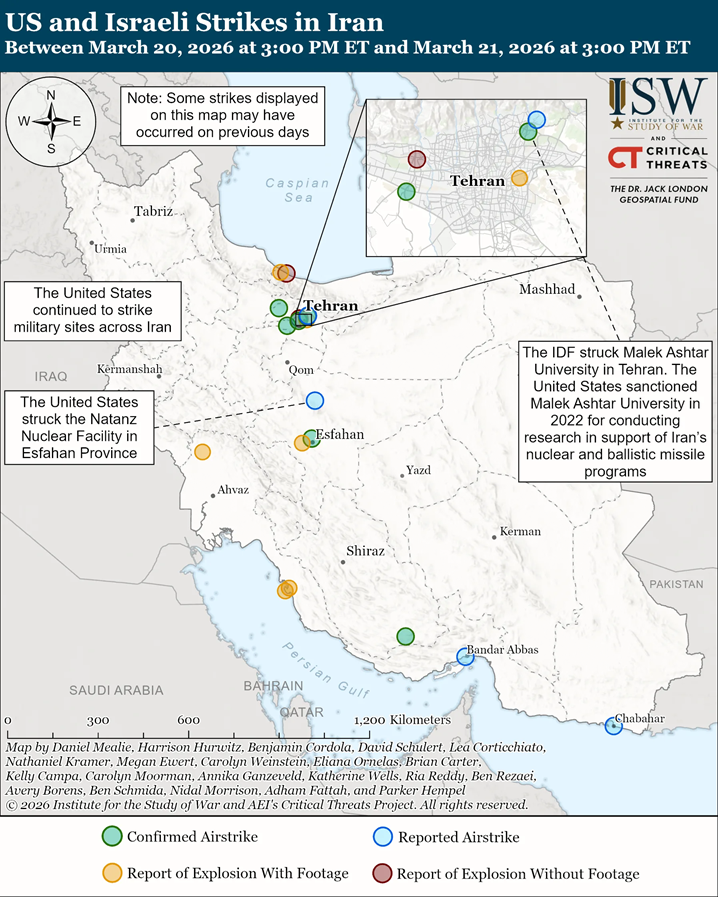
The combined force continued to strike Iranian defense industrial sites. The IDF struck ballistic missile production sites, including an IRGC missile components complex, a missile components storage site, and a Defense Ministry-linked missile fuel production complex, around Tehran on March 21.[12] An OSINT account on X stated on March 21 that the combined force struck an IRGC ammunition depot in Dezful, Khuzestan Province.[13] The IDF separately struck Malek Ashtar University in Tehran on March 21.[14] The United States sanctioned Malek Ashtar University in 2022 for conducting research to develop Iran’s nuclear and ballistic missile programs.[15] An OSINT account on X reported on March 21 that the combined force struck the Research Institute of Petroleum in Tehran, which functions as the National Iranian Oil Company’s research wing.[16]
The United States struck the Natanz Nuclear Facility in Esfahan Province on March 21.[17] Anti-regime media stated that the United States used a bunker buster bomb.[18] Armed Forces General Staff-affiliated media stated on March 21 that no nuclear material had leaked after the strikes.[19] The combined force previously struck the Natanz Nuclear Facility on March 2, and during the 12-day war.[20] The Associated Press, citing an unreleased IAEA report, reported on February 27 that the IAEA had observed activity at Natanz and the Fordow Fuel Enrichment Plant but could not verify the purpose or nature of the activity.[21]
The IDF has reportedly killed IRGC Aerospace Force Drone Unit Commander Brigadier General Saeed Agha Jani on March 21.[22] Agha Jani’s death would remove a key figure responsible for Iran’s drone operations and disrupt the chain of command of the drone force. That disruption will only be temporary, however. Agha Jani directed planning, equipment, and training for IRGC Aerospace Force drone operations and oversaw Iran’s provision of drones to partners, including Russia and other Iranian allies.[23] Agha Jani was also reportedly involved in previous drone attacks, including the attack on MT Mercer Street in 2021 and drone strikes on Saudi energy infrastructure in 2019.[24] The United States sanctioned Agha Jani in October 2021 for his role in Iran’s drone program.[25] The United States identified Agha Jani on March 20 as a key IRGC leader and offered 10 million US dollars for information about him.[26]
The IDF also targeted scientists involved in an “electromagnetic bomb project” and Fars Province Law Enforcement Command (LEC) Special Unit Commander Kavous Darvishi.[27] The LEC Special Unit is an elite riot control force that the regime deploys to suppress protests and maintain internal security, especially in urban areas.[28]
Iranian Retaliation
Iran launched eight missile barrages at Israel between 3:00 PM ET on March 20 and 3:00 PM ET on March 21.[29] The IDF sent recovery and rescue teams to impact sites in northern and southern Israel.[30] One Iranian missile impacted around Dimona in southern Israel and injured at least 47 people.[31] An Israeli journalist reported that an Iranian missile equipped with a cluster munition damaged at least three sites in Rishon Lezion in central Israel.[32] Israeli media reported on March 20 that 70 percent of Iran’s launches against Israel have used cluster munitions and that the percentage is increasing.[33]
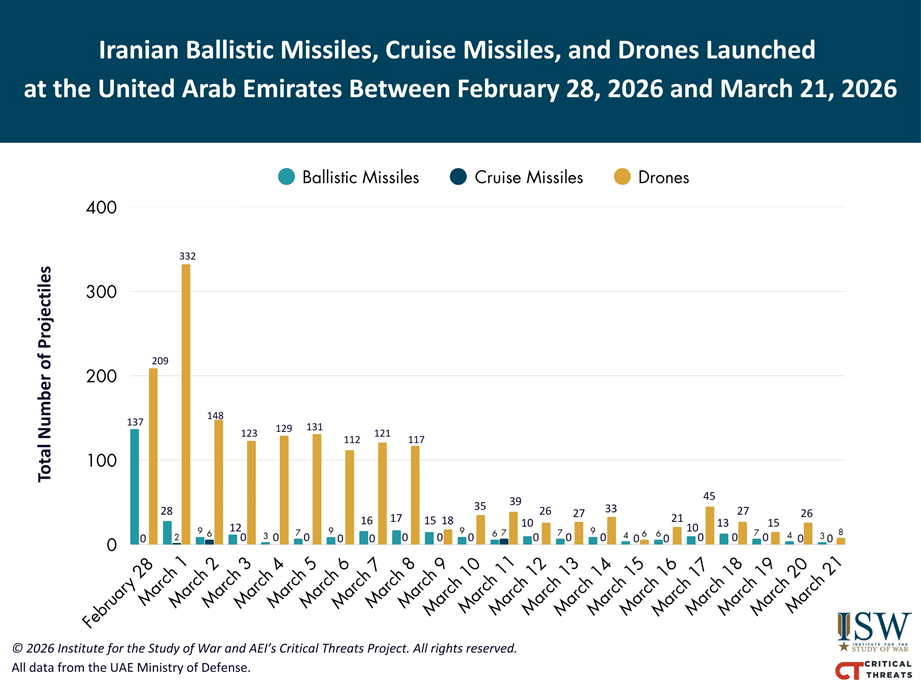
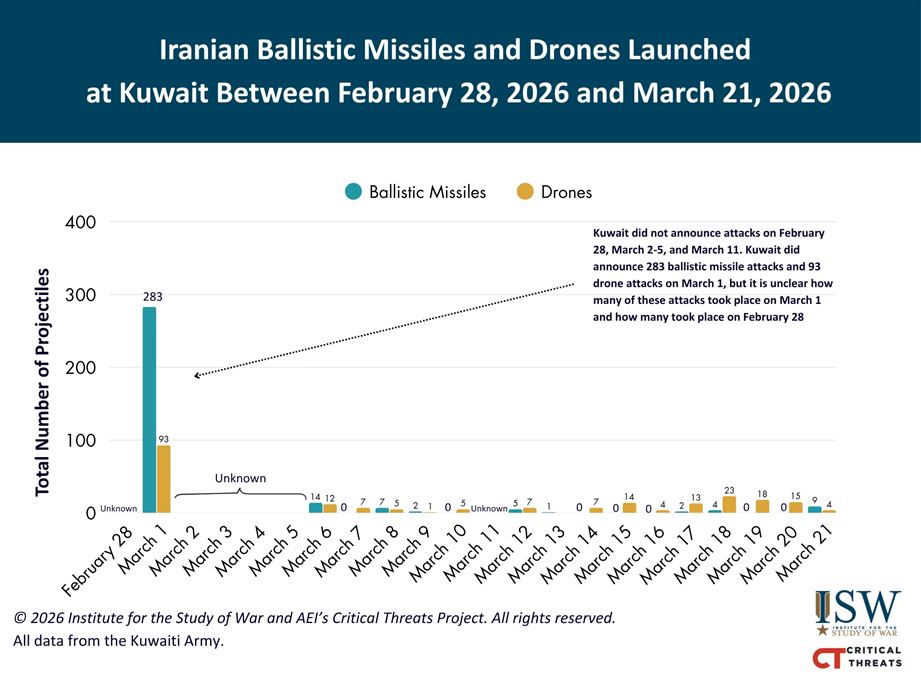
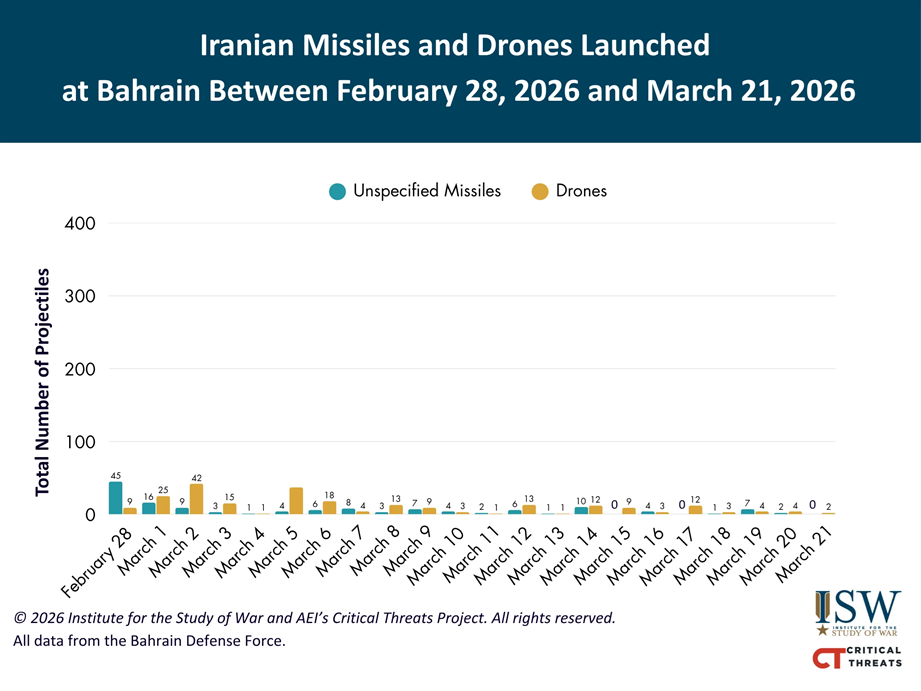
Gulf countries continued to intercept Iranian missile and drone attacks. The Saudi Defense Ministry said that Saudi Arabia intercepted 68 drones from 3:00 PM ET on March 20 to 3:00 PM ET on March 21.[34] The Emirati Defense Ministry said on March 21 that it intercepted three ballistic missiles and eight drones.[35] Kuwait’s Defense Ministry said on March 21 that Kuwait had intercepted nine ballistic missiles and four drones in the past 24 hours.[36] Bahrain intercepted two ballistic missiles between 3:00 PM ET on March 20 and 3:00 PM ET on March 21.[37]
Israeli Campaign Against Hezbollah and Hezbollah Response
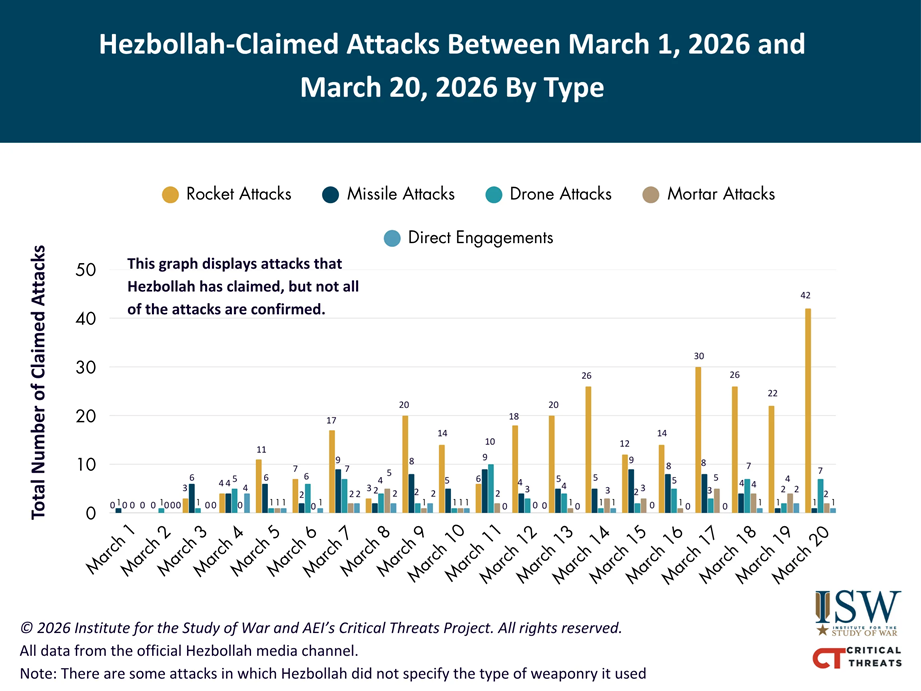
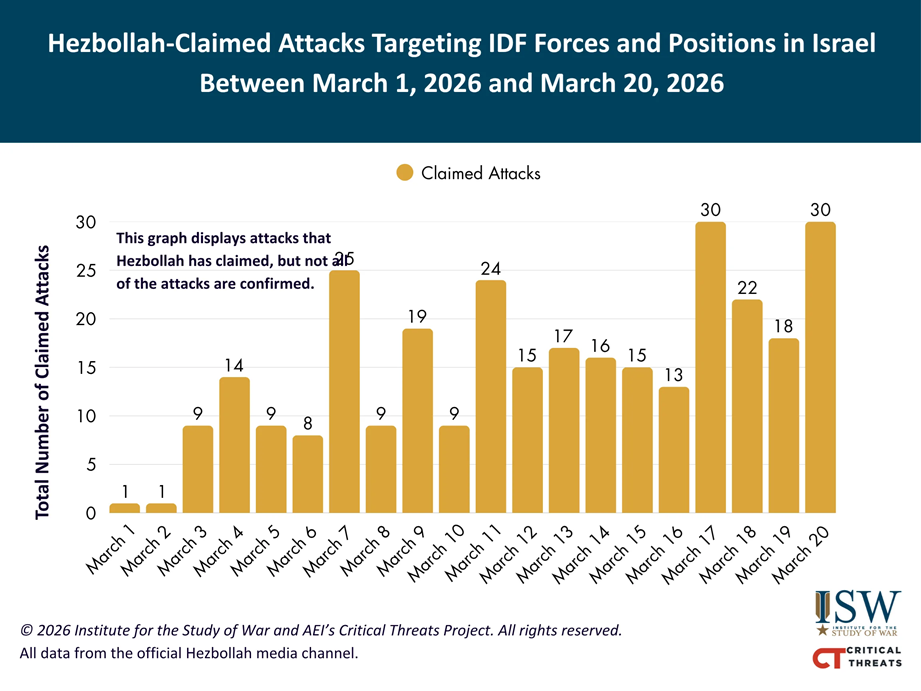
Hezbollah claimed 45 attacks targeting Israeli forces and positions in northern Israel and southern Lebanon, as well as northern Israeli towns, between 3:00 PM ET on March 20 and 3:00 PM ET on March 21.[38] Most of Hezbollah’s claimed attacks targeted Israeli forces and military sites with rockets.[39] Hezbollah claimed two direct engagements with Israeli forces in Marjaayoun District, southern Lebanon.[40] Hezbollah also claimed that it clashed with Israeli soldiers attempting to infiltrate into Naqoura, Tyre District.[41] Hezbollah claimed four drone attacks targeting Israeli forces and positions in northern Israel and southern Lebanon.[42] Hezbollah claimed four rocket attacks targeting northern Israeli communities, including two separate attacks on Kiryat Shmona.[43] Hezbollah is likely continuing to attempt to displace northern Israeli residents from their homes by targeting northern Israeli towns in order to increase political pressure on the Israeli government to halt its war effort against Iran. Hezbollah rockets separately impacted in Safed and Maalot Tarshiha, northern Israel, causing only material damage and minor injuries, respectively.[44] Israeli media reported on March 21 that Hezbollah mortar fire injured two IDF reservists.[45]
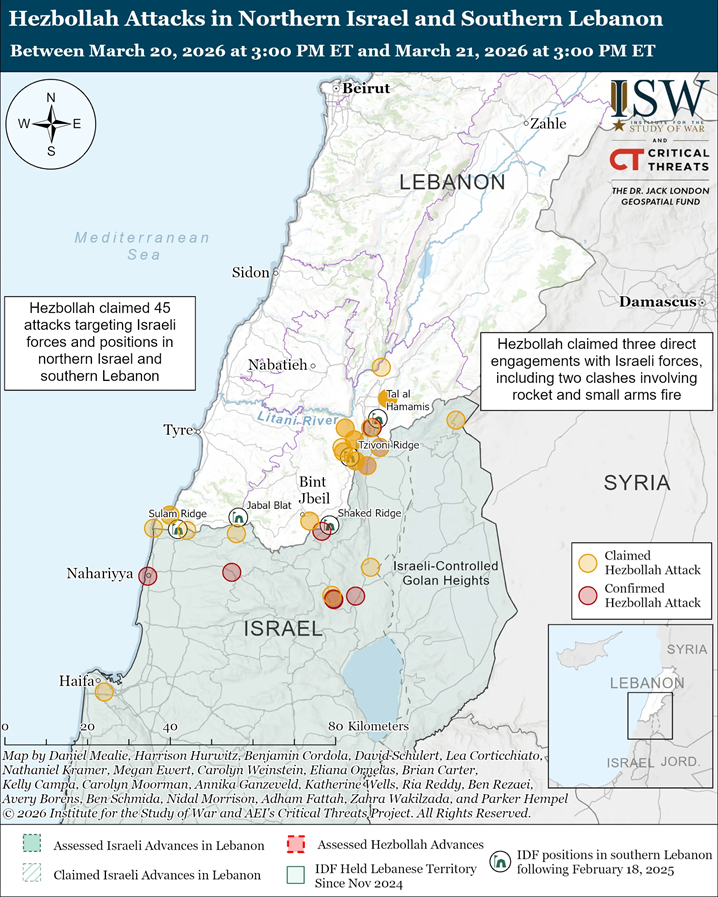
The IDF has continued to conduct airstrikes targeting Hezbollah across Lebanon. The IDF issued evacuation warnings for multiple neighborhoods in Beirut’s southern suburbs, which are a Hezbollah stronghold, before striking Hezbollah command centers in the area overnight.[46] The IDF said on March 21 that it completed two waves of attacks in Beirut and other areas of Lebanon over the weekend and struck central Hezbollah headquarters, which included separate sites that served as the headquarters of Hezbollah’s intelligence unit and air defense system.[47] The IDF also reportedly struck unidentified sites in the Tyre and Bint Jbeil districts since ISW-CTP’s last data cutoff.
The 84th (Givati) Infantry Brigade (162nd Division) killed several Hezbollah members during a clash in southern Lebanon overnight.[48] Israeli soldiers exchanged fire with and killed a Hezbollah fighter and then directed an Israeli drone to strike additional Hezbollah members who had fired on Israeli forces.[49] Israeli tank fire killed three additional Hezbollah fighters.[50]
IDF 36th Division and 91st Division forces also continue ground operations in southeastern Lebanon.[51] The IDF said on March 21 that IDF 36th Division forces located weapons caches and killed several Hezbollah members.[52] The Israeli forces also attacked and destroyed observation points that Hezbollah fighters use to threaten Israeli soldiers.[53] IDF 91st Division forces engaged and killed Hezbollah fighters in southern Lebanon and destroyed Hezbollah infrastructure and weapons.[54] The IDF said on March 21 that the IDF 162 Division has completed its preparations ahead of its deployment to southern Lebanon.[55]
Hezbollah is continuing to attempt to defend against Israeli advances into Khiam, Marjaayoun District. Hezbollah claimed two rocket attacks and one missile attack targeting IDF forces in Khiam between March 20, 2026, at 3:00 PM ET and March 21, 2026, at 3:00 PM ET.[56] Hezbollah also claimed two clashes with Israeli forces, with one instance involving small arms and rockets and the other instance involving small arms, rockets, and light artillery.[57] A geospatial intelligence analyst reported on March 18 that the IDF continues to advance deeper into Khiam and is advancing towards the town’s northernmost neighborhood.[58] Lebanese residents told the New York Times on March 16 that Israeli forces had not completely seized Khiam and noted that Israeli forces have faced resistance from Hezbollah.[59] Khiam is located on high ground from which Hezbollah can fire into northern Israel, and it also grants Hezbollah a vantage point to observe Israeli forces and other targets around the Galilee Panhandle.[60] Hezbollah previously conducted defensive operations against Israeli forces in Khiam during the Fall 2024 Israel-Hezbollah conflict.[61]
Other Axis of Resistance Response
Iranian-backed Iraqi militias’ front groups continued to conduct drone attacks targeting US forces and interests in Iraq and the region. Iranian-backed Iraqi militia front group Saraya Awliya al Dam claimed on March 20 that it conducted six “qualitative operations” against US bases in Iraq.[62] Likely front group Kataib Sarkhat al Quds separately claimed on March 21 that it conducted a drone attack targeting the base.[63] Iranian-backed Iraqi militias have repeatedly claimed attacks targeting the former US Victory base since the start of the war.[64] Likely front group Jaysh al Ghadab also claimed on March 21 that it conducted a drone attack targeting an unspecified US base in Bahrain.[65]
The combined force has continued to strike Iranian-backed Iraqi militia positions. The combined force conducted two strikes targeting a 52nd Popular Mobilization Forces (PMF) Brigade base in Salah al Din Province on March 20 and 21, killing a PMF member.[66] Multiple Iranian-backed Iraqi militias control PMF brigades that answer to Iran instead of the Iraqi prime minister.[67] The Iranian-backed Badr Organization controls the 52nd PMF Brigade.[68] The combined force previously struck this brigade on March 14.[69] The combined force also struck PMF positions in Anbar Province on March 21.[70]
A likely Iranian-backed Iraqi militia conducted a one-way drone attack targeting the Iraqi National Intelligence Service (INIS) headquarters in Baghdad City on March 21, killing an Iraqi intelligence officer.[71] The Shia Coordination Framework and Iranian-backed Iraqi militia Asaib Ahl al Haq’s political wing condemned the attack.[72] Iranian-backed Iraqi militias view the INIS as a US intelligence “cut-out,” according to the Washington Post Baghdad Bureau chief.[73] The United States helped create the INIS in 2004, but Iraqi Prime Minister Mohammad Shia al Sudani has purged several US-trusted INIS officers and replaced them with Iranian-aligned figures since 2022.[74]