 Eurasia Press & News
Bottom Line Up Front
Should the Houthis in Yemen enter the war, they could serve as a force multiplier for Tehran by further depleting U.S. and Israeli air and missile defenses and diverting combat missions from Iran to sites in Yemen.
The Houthis would likely target oil tankers in the Red Sea to help Tehran achieve a tipping point in its battle with the U.S. and Israel, further damaging the global economy.
The Houthis would likely revive their attacks on Saudi Arabia’s energy and infrastructure targets if the Kingdom joins the U.S. and Israeli strike campaign on Iran.
To date, the Houthis have been deterred from joining Tehran’s defense effort by concerns that the U.S. or Israel might destroy the key port of Hodeidah or other major facilities, and by the difficulty of obtaining weapons resupply from Tehran.
After nearly three weeks, the war initiated by the U.S.-Israel military campaign against Iran has expanded well beyond the Islamic Republic, engulfing many of the countries in the region, including most of the Gulf states, as well as Iraq, and Lebanon. Two key members of Iran’s “Axis of Resistance” coalition — Lebanese Hezbollah and Iran-aligned militia forces in Iraq — have joined Tehran’s effort to build pressure on Washington to end the conflict. Experts have put forward multiple explanations for why one key Iranian partner, the Houthis in Yemen (Ansarallah), has not yet joined the fighting.
The Houthi movement is arguably the least damaged Axis member from two years of U.S. and Israeli military action and is seemingly the best positioned among Axis partners to help Tehran. Unlike Hezbollah and Iran-backed Iraqi armed groups, the Houthis face no threat from a central government seeking to exercise a monopoly of armed force on its territory. The Houthis control most of central and northern Yemen, including the capital Sanaa, and face a divided opposition holding southern Yemen. In December, militias backed by the United Arab Emirates (UAE) clashed with those supported by Saudi Arabia. The clashes reflected a widening rift between the two Arab Gulf powers, which headed an Arab coalition fighting the Houthis from 2015 until a 2022 ceasefire. Geographically, the Houthis control a Yemeni coast astride the Red Sea and Bab el-Mandeb Strait — a key chokepoint for global commerce and energy flows in the region, and second only to the Strait of Hormuz in importance.
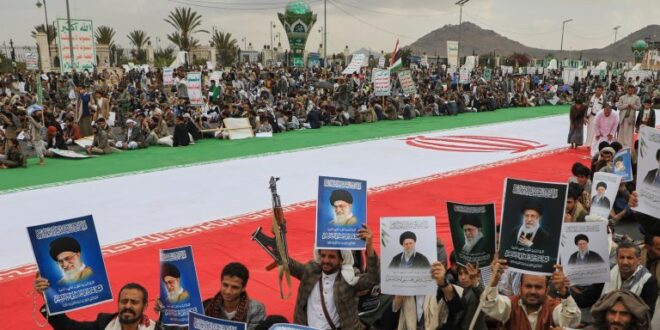
A Houthi entry into the conflict — on ideological grounds as well as based on practical strategic considerations — has long been expected. Five days after the Iran war began, the Houthis’ paramount leader, Abdul Malik al-Houthi, declared that the group was prepared to enter the war, stating: “Regarding military escalation and action, our fingers are on the trigger, ready to respond at any moment should developments warrant it.” While al-Houthi did not stipulate the conditions that might trigger the Houthis to attack, Iran’s new supreme leader, Ayatollah Mojtaba Khamenei, said Thursday in his first written statement (read by an announcer on state television) that Iran may open up “new fronts in the conflict” — a sign, analysts say, that Tehran is prodding the Houthis to get involved soon. Ahmed Nagi, a Yemen analyst at International Crisis Group, told journalists that the Houthis appear to be preparing to take action on Iran’s behalf by building up their forces, including recruiting more fighters, expanding local weapons production, and sending reinforcements to Yemen’s western Red Sea coast.
There is a consensus among regional experts that a Houthi entry into the conflict would amplify the effects of Tehran’s core asymmetric warfare strategy — to upend the global economy by restricting shipping through the Strait of Hormuz and attacking energy facilities in the Arab Gulf states. A Houthi intervention would also support Iran by further depleting Israeli and U.S. air defense supplies and offensive munitions, potentially enabling a higher percentage of Tehran’s remaining missiles and drones to reach their targets. The U.S. and Israel presumably would also have to divert offensive resources, particularly combat aircraft, from strikes on Iran to targeting Houthi missile and drone positions. Assessing that the Houthis could shift the balance toward Iran and the Axis of Resistance in a long war of attrition, Yemen expert Nadwa Al-Dawsari of the Middle East Institute, told journalists “I think the Houthis will intervene at some point. The longer the war continues, the more likely the Houthis will intervene.”
Should the Houthis join the Iran war, their most likely course of action would be to revive their attacks on oil tankers and other commercial vessels transiting the Red Sea. Doing so would materially add to Tehran’s efforts to exert a stranglehold on the global economy by placing upward pressure on oil prices and disrupting regional energy production and supply chains. The Houthis would no doubt build on their experience during the 18 months following the October 7, 2023, Hamas attack on Israel, when the group attacked more than 100 vessels, including oil tankers, transiting the Red Sea. The attacks forced more than 60 percent of commercial shipping to divert to alternate routes. Red Sea commercial traffic has recovered since the May 2025 U.S.-Houthi ceasefire that ended a six-week air campaign against the Houthis (Operation Rough Rider) — but still not to pre-October 7 levels. The U.S. strikes on 1,000 Houthi targets during Rough Rider degraded the Houthis’ arsenal of missiles and armed drones, as Operation Epic Fury has done to Iran. However, both campaigns also demonstrate the limits of using air power alone to end the threat to global commerce posed by the region’s armed actors. In contrast to the Strait of Hormuz, international shipping can use an alternative route by sailing around southern Africa, but doing so lengthens the journey and adds expense.
Attacking shipping in the Red Sea would likely prompt U.S. strikes, using the more extensive U.S. arsenal in the region than was available during Operation Rough Rider. Seeking to limit their risk, Houthi leaders might instead resume attacks on Israel. The vast majority of Houthi missile and drone attacks against Israel during the Gaza war were intercepted or failed to reach their target, but the group demonstrated it can penetrate Israeli airspace and cause casualties and damage. Israeli retaliation would likely target the key port of Hodeidah, which is an essential lifeline for the import-dependent country and a source for illicit Houthi oil revenues. Israel focused its retaliatory attacks on that port at the height of its conflict with the movement during 2024-2025.
Alternatively, the Houthis might restart their missile and drone strikes on Saudi Arabia, arguing it is hosting U.S. forces in combat against Iran. However, most experts assess that the Houthis would exercise this option only if the Kingdom actively retaliated against Iran for its strikes on Saudi energy and other targets. To date, Saudi forces have only defended against Iranian barrages and have not conducted any strikes on Iranian targets.
There are also significant factors compelling Houthi leaders to stay completely out of Tehran’s battle against the U.S. and Israel. Among Iran’s allies, the Houthis have been the least amenable to Iranian control and influence. Although they share in Tehran’s belief of steadfast resistance to Israel and the U.S., Houthi leaders will calculate the interests of their movement in deciding whether to help Iran. One factor causing the Houthis’ leadership to think twice about intervening in the war, according to the Associated Press, quoting Houthis’ media and political officials, is that the group’s weapons stockpile is still running low after its attacks during the Israel-Hamas war. The Houthi officials added that the Iran war has further impeded the flow of weapons, presumably because Iran needs its remaining missile and drone stockpile, already depleted by use and U.S. strikes, for its own war effort. Another Houthi official claimed the group has retained a large stockpile of drones.
Houthi leaders are also deterred by uncertainty about the extent of the U.S. reaction to their entry into the conflict. Houthi officials told the Associated Press the U.S. sent warnings via Omani mediators against participating in the war. Houthi leaders were also reportedly alerted that they were under surveillance by the U.S. and Israel. Fearing potential Israeli decapitation strikes, similar to its attack in August 2025 that killed many of the ministers of the Houthi governing body, Houthi leaders have been instructed not to appear in public. Houthi leaders might also worry that President Trump’s threats of using ground forces against Iran might also be extended to ground action against the Houthis, if they become a combatant.
Some experts speculate that Iran’s Islamic Revolutionary Guard Corps (IRGC) is itself discouraging the Houthis from joining the battle. Dawsari of the Middle East Institute told journalists that the IRGC does not want “to drag the Houthis into a suicidal war” because “if the Iranian regime collapses, and if a new regime emerges, I think the IRGC will regroup in Yemen or Somalia. Yemen is the key ally…The IRGC can’t afford to lose the Houthis. Yemen is so important to them. They need to preserve the Houthis for tomorrow for the IRGC to continue even after the regime.” Yet it is not clear how the IRGC would continue to function as an exile movement, based far from Iran and deprived of the revenues provided by the Iranian state.