 Eurasia Press & News
Toplines
Russian forces have likely begun their anticipated Spring-Summer 2026 offensive against the Ukrainian Fortress Belt, Ukraine’s main defensive line in Donetsk Oblast. Russian forces have begun intensified ground operations in the Lyman direction to advance on Slovyansk, the northern tip of the Fortress Belt, from the northeast, likely to set conditions for an additional push on Slovyansk from the east and southeast at a later date. The Ukrainian 3rd Army Corps (AC) and Joint Forces Task Force reported on March 21 that elements of the Russian 1st Guards Tank Army (GTA, Moscow Military District [MMD]) and 20th Guards Combined Arms Army (CAA, MMD) conducted a roughly battalion-sized mechanized and motorized assault in the Lyman direction on March 19.[1] The Ukrainian 3rd AC and Joint Forces Task Force reported that Russian forces conducted an assault in seven prongs and fielded over 500 Russian infantrymen, dozens of armored vehicles, and more than 100 motorcycles, buggies, and all-terrain vehicles (ATVs). This battalion-sized assault is considerably larger than most Russian mechanized assaults in recent months, and the reinforced company-sized assault Russian forces conducted near Shandryholove (northwest of Lyman) on March 19 was likely a component of this broader battalion-sized assault.[2] The spokesperson of a Ukrainian mechanized brigade operating in the Lyman direction stated on March 21 that Lyman is a key strongpoint on the route to Slovyansk and could serve as a stronghold for Russian efforts to seize both Slovyansk and Kramatorsk – indicating that intensified Russian efforts against Lyman are necessary to set conditions for further assaults against Slovyansk and Kramatorsk.[3] The spokesperson noted that Russian forces are increasing pressure against Ukrainian forces through intensified assaults with large numbers of infantry and equipment. The spokesperson also noted Russian forces are adapting their tactics by switching from attacking in mechanized columns to dispersing vehicles along various prongs of an assault simultaneously, similar to dispersed infantry tactics. Russian forces may be attacking along various prongs to overwhelm and distract Ukraine’s drone-based defenses. The spokesperson added that Russian forces are also conducting more KAB-3000 guided glide bombs, Lancet loitering munitions, and Molniya fixed-wing drone strikes in the Lyman direction. A Russian milblogger claimed on March 20 that Russian forces conducted a FAB guided glide bomb strike on Slovyansk.[4] These air and drone strikes are likely a continuation of the Russian battlefield air interdiction (BAI) campaign in the Lyman direction, which aims to degrade Ukrainian logistics and defensive abilities ahead of ground operations to enable Russian forces to make more rapid, easier territorial advances.[5]
Russian forces are also setting conditions to begin intensified ground operations in the Kramatorsk and Kostyantynivka directions to develop the offensive against the Fortress Belt from the south. Ukrainian 11th AC Spokesperson Lieutenant Colonel Dmytro Zaporozhets reported on March 21 that Russian forces have recently intensified ground assaults in the Slovyansk and Kramatorsk directions in preparation for future offensive operations and to advance to the heights on the approaches to Kostyantynivka, the southern tip of Ukraine’s Fortress Belt.[6] Zaporozhets reported that Russian forces are actively moving personnel on the approaches to Kostyantynivka; intensifying first-person view (FPV) and Molniya drone strikes from Chasiv Yar (northeast of Kostyantynivka); have brought up armored and other vehicles to the direction; and have doubled artillery and tactical aviation strikes in the Kramatorsk direction. Russian forces are intensifying ground assaults and strikes, and the movement of heavy equipment and troops toward the frontline is likely in an effort to set conditions for the Spring-Summer 2026 offensive and to expand ground operations from the south of the Fortress Belt. Russian forces have also been conducting a BAI campaign against the southern tip of the Fortress Belt since at least late February 2026 to prepare for the upcoming campaign, striking main Ukrainian ground lines of communication (GLOCs) in the area and settlements immediately in the vicinity of Kramatorsk.[7]
Russian forces are unlikely to seize the Fortress Belt in 2026 but will likely make some tactical gains at a significant cost. The Ukrainian 3rd AC and Joint Forces Task Force reported on March 21 that Russian forces suffered 405 casualties out of over 500 personnel involved in the March 19 battalion-sized mechanized assault.[8] Such a casualty rate is unsustainable and would likely degrade the Russian ability to wage such large assaults in the mid- to long-term. Zaporozhets reported that Russian forces are attempting to capture key heights east of Slovyansk, including near Kryva Luka, which Ukrainian forces currently use as drone operator positions.[9] Zaporozhets noted that Russian forces will continue ground assaults to secure their flanks because Ukrainian forces maintain positions on favorable terrain. The Ukrainian control of dominant heightseast of Slovyansk will likely complicate Russian advances toward Slovyansk from the comparatively low-lying terrain around Siversk.[10] The exhausted, poorly trained, and overstretched Russian troops in the Slovyansk direction will likely further limit Russian gains in the area. The spokesperson of a Ukrainian mechanized brigade operating in the Lyman direction reported that Russian forces have reduced basic training for personnel conducting ground assaults from one month to one week – likely to accelerate the deployment of new recruits to the frontline to compensate for heavy casualties in costly assaults.[11] Ukrainian military observer Kostyantyn Mashovets assessed on February 2 that elements of the Russian Western Grouping of Forces, including the 20th CAA and 1st GTA, lack the strength to seize Lyman as the grouping may have diverted significant forces to counter the Ukrainian counterattacks that have significantly liberated most of Kupyansk.[12] ISW assessed at the time that Russian forces would likely be unable to launch and maintain an offensive in the Slovyansk direction without receiving additional forces or deprioritizing the Kupyansk offensive, and the Russian efforts to accelerate training are likely part of efforts to generate more forces for the offensive.
Ukrainian forces are taking countermeasures, which will likely further complicate Russian advances, such as more intensively targeting Russian multiple launch rocket systems (MLRS) in the Slovyansk and Kostyantynivka directions to disrupt Russian artillery preparation and expanding their mid-range strike campaign to degrade both Russian offensive and defensive capabilities.[13] Ukrainian forces will likely continue to impose high costs on the Russian spring-summer offensive as they continue conducting a parallel BAI campaign to degrade Russia’s offensive capabilities, particularly in the Slovyansk direction.
The US and Ukrainian delegations held a bilateral meeting in Miami, Florida, on March 21. US Special Envoy to the Middle East Steve Witkoff reported on March 21 that a US delegation, including Witkoff, former Senior Advisor to the US President Jared Kushner, White House Senior Advisor Josh Gruenbaum, and State Department Senior Policy Advisor Chris Curran held “constructive” meetings with the Ukrainian delegation and discussed moving toward a peace agreement.[14] Ukrainian Defense Council Secretary Rustem Umerov reported that the Ukrainian delegation included Ukrainian Presidential Office Head Kyrylo Budanov, Ukrainian Presidential Office First Deputy Head Serhiy Kyslytsya, and Ukrainian Servant of the People Party Head Davyd Arakhamia.[15] Ukrainian President Volodymyr Zelensky and Umerov stated that the US and Ukrainian delegations will continue talks on March 22.[16]
Ukrainian forces downed another Russian military helicopter on March 21, marking the second time that Ukrainian forces have downed a helicopter in two days. A Russian milblogger who frequently reports on the Russian Aerospace Forces (VKS) claimed on March 21 that Russian forces lost another Ka-52 attack helicopter that morning in an unspecified location, and Ukrainian sources and other Russian milbloggers indicated that Ukrainian forces downed the helicopter.[17] The sources did not specify the means Ukrainian forces used to down the helicopter on March 21, but Ukrainian forces downed a Russian Ka-52 using a fiber optic FPV drone in the Pokrovsk direction on March 20.[18] The March 20 helicopter downing prompted milblogger criticism of Russian forces’ use of the helicopters close to the frontlines within range of Ukrainian FPV drones.[19] The milblogger who frequently reports on the Russian VKS claimed on March 21 that Russian MI-8 helicopter crews have been jerry-rigging or needing to purchase their own electronic warfare (EW) systems to protect against Ukrainian drones, but that these methods are insufficient, as infantry EW systems do not work with helicopters.[20] Another Russian milblogger criticized Russian sources who publicize reports of downed Russian aircraft and called for Russia to “end this information frenzy” and crack down on milbloggers who “stage hysterical outbursts” about the situation on the frontline.[21]
Key Takeaways
Russian forces have likely begun their anticipated Spring-Summer 2026 offensive against the Ukrainian Fortress Belt, Ukraine’s main defensive line in Donetsk Oblast.
Russian forces are also setting conditions to begin intensified ground operations in the Kramatorsk and Kostyantynivka directions to develop the offensive against the Fortress Belt from the south.
Russian forces are unlikely to seize the Fortress Belt in 2026 but will likely make some tactical gains at a significant cost.
US and Ukrainian delegations held a bilateral meeting in Miami, Florida, on March 21.
Ukrainian forces downed another Russian military helicopter on March 21, marking the second time that Ukrainian forces have downed a helicopter in two days.
Ukrainian forces recently advanced near Kupyansk and Pokrovsk and in the Kostyantynivka-Druzhkivka tactical area. Russian forces recently advanced near Pokrovsk.
Ukrainian forces struck oil infrastructure and chemical plants in Russia. Russian forces launched 154 drones against Ukraine.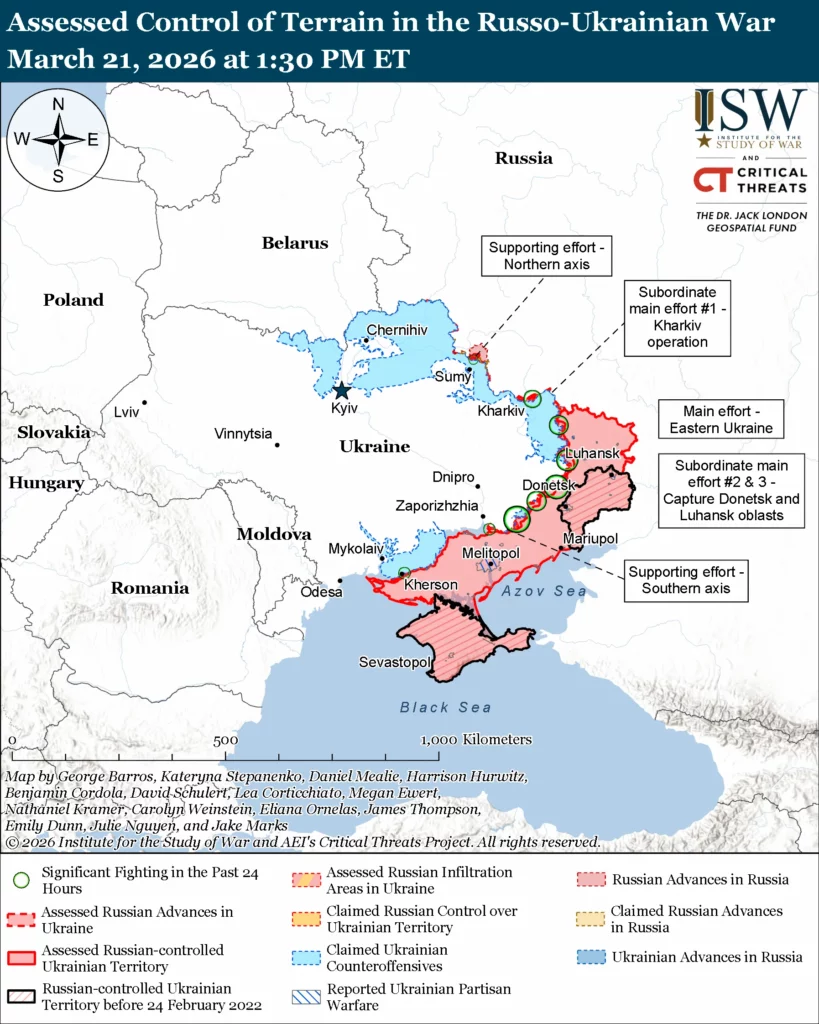
We do not report in detail on Russian war crimes because these activities are well-covered in Western media and do not directly affect the military operations we are assessing and forecasting. We will continue to evaluate and report on the effects of these criminal activities on the Ukrainian military and the Ukrainian population and specifically on combat in Ukrainian urban areas. We utterly condemn Russian violations of the laws of armed conflict and the Geneva Conventions and crimes against humanity even though we do not describe them in these reports.
Ukrainian Operations in the Russian Federation
Ukrainian forces continued their long-range strike campaign against oil infrastructure and chemical plants in Russia overnight on March 20 to 21. The Ukrainian General Staff reported on March 21 that Ukrainian forces struck the Saratov Oil Refinery overnight, damaging a secondary oil processing unit and an RVS-10000 vertical tank.[22] The Ukrainian General Staff reported that the refinery had the processing volume of 4.8 million tons of oil as of 2023. Geolocated footage published on March 21 shows a fire near the refinery.[23] National Aeronautics and Space Administration Fire Information for Resource Management System (NASA FIRMS) data shows heat anomalies at the refinery on March 21.[24] Russian opposition outlet Astra geolocated footage published on March 21 and assessed that the footage shows a fire burning near the Tolyattikauchuk and KuybyshevAzot chemical plants in Tolyatti, Samara Oblast, after reported overnight drone strikes and explosions.[25]
The all-Russian pro-Ukrainian Freedom of Russia Legion (LSR) reported on March 20 that its agents set fire to a coal and military cargo-carrying diesel locomotive at the Prokopyevsky Transport Directorate in Prokopyevsk, Kemerovo Oblast.[26]
Russian Supporting Effort: Northern Axis
Russian objective: Create defensible buffer zones in Sumy Oblast along the international border
Russian forces recently infiltrated in northern Sumy Oblast.
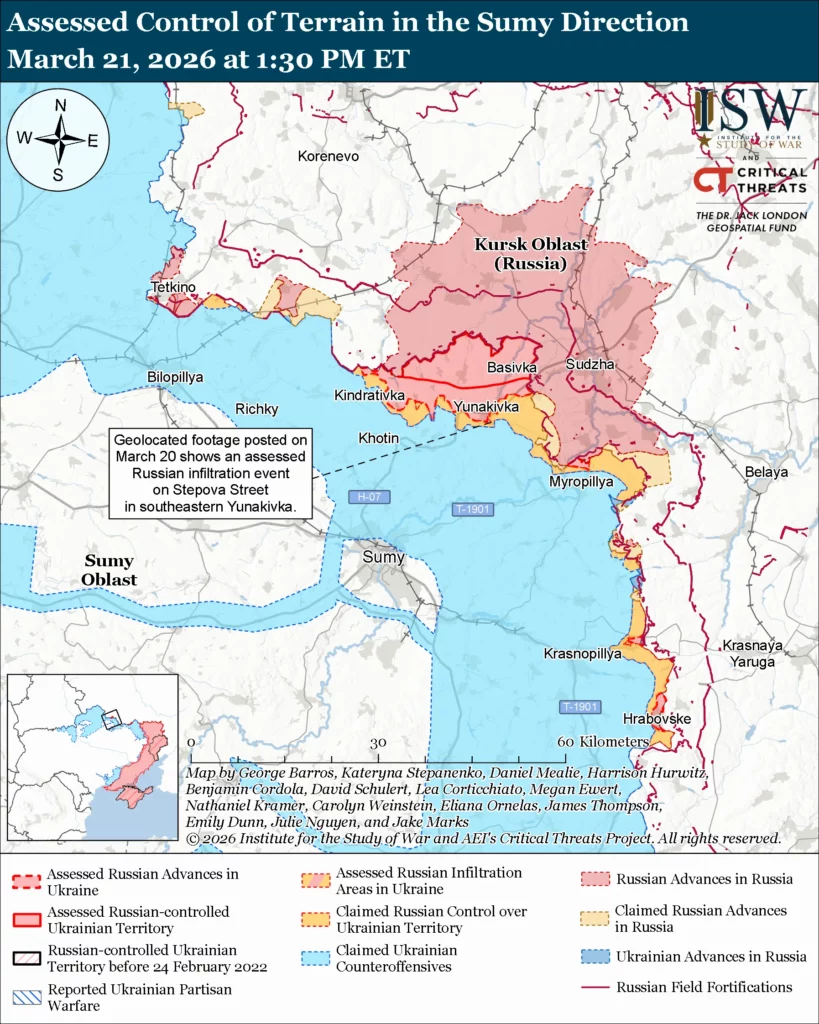
Assessed Russian infiltrations: Geolocated footage published on March 20 shows Ukrainian forces striking a Russian-occupied building in southeastern Yunakivka (northeast of Sumy City) in what ISW assesses was a Russian infiltration mission that did not change the control of terrain or the forward edge of the battle area (FEBA) at this time.[27]
Russian forces attacked north of Sumy City near Oleksiivka, Korchakivka, Kostyantynivka, Novomykolaivka, and Kindrativka and toward Nova Sich, northeast of Sumy City near Yunakivka, Yablunivka, and Khrapovshchyna and toward Myropillya, and southeast of Glushkovo, Kursk Oblast near Kucherov and Ozerki on March 20 and 21.[28]
The Ukrainian 14th Army Corps (AC) published footage on March 21 showing a Ukrainian flag on the Pokrovka (southeast of Sumy City) water tower and reported that Ukrainian forces placed the flag to refute Russian claims of the seizure of the settlement.[29] The Ukrainian 14th AC reported that Ukrainian forces have fire control over the settlement.
Order of Battle: Drone operators of the Russian Rubikon Center for Advanced Unmanned Systems reportedly continue to operate in the Sumy direction.[30]
Russian Main Effort: Eastern Ukraine
Russian Subordinate Main Effort #1 – Kharkiv Oblast
Russian objective: Push Ukrainian forces back from the international border to create a defensible buffer zone with Belgorod Oblast and approach to within tube artillery range of Kharkiv City
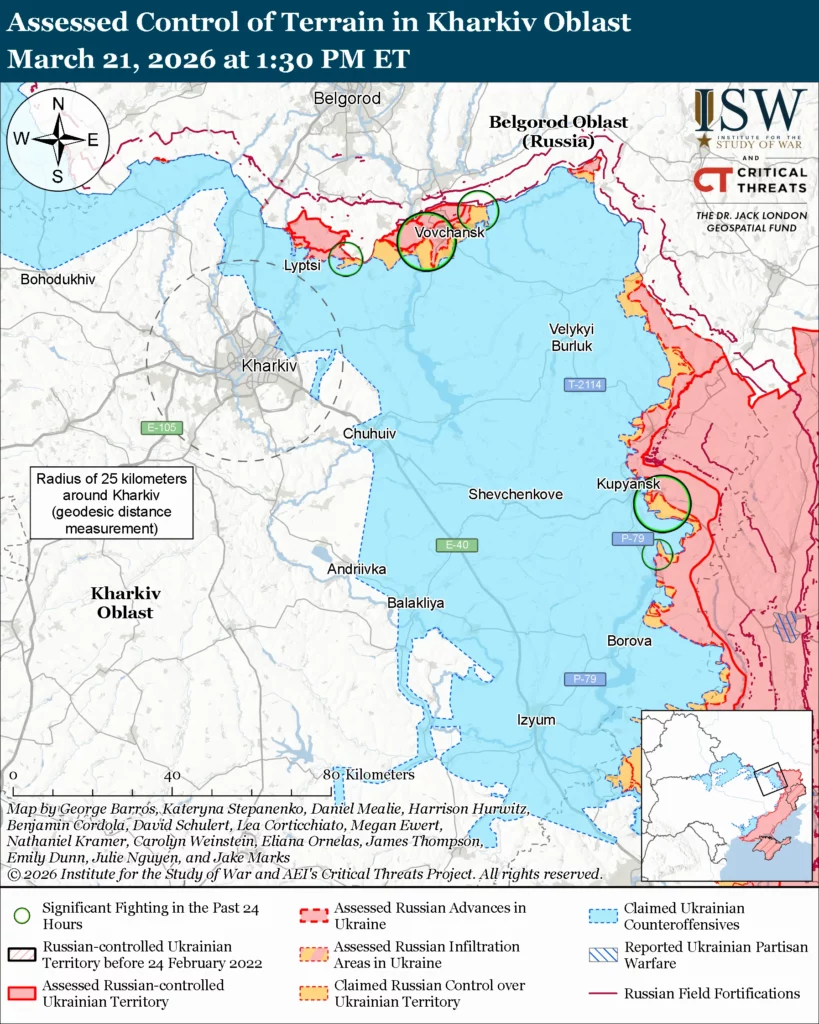
Russian forces continued offensive operations in northern Kharkiv Oblast on March 21 but did not advance.
Russian forces attacked north of Kharkiv City near Zelene and northeast of Kharkiv City near Prylipka, Synelnykove, Starytsya, Vovchansk, and Vovchanski Khutory and toward Okhrimivka and Verkhnya Pysarivka on March 20 and 21.[31]
Neither Ukrainian nor Russian sources reported ground activity in the Velykyi Burluk direction on March 21.
Russian Subordinate Main Effort #2 – Oskil River
Russian objective: Cross the Oskil River in Kharkiv Oblast and push westward into eastern Kharkiv Oblast and northern Donetsk Oblast
Ukrainian forces recently advanced in the Kupyansk direction.
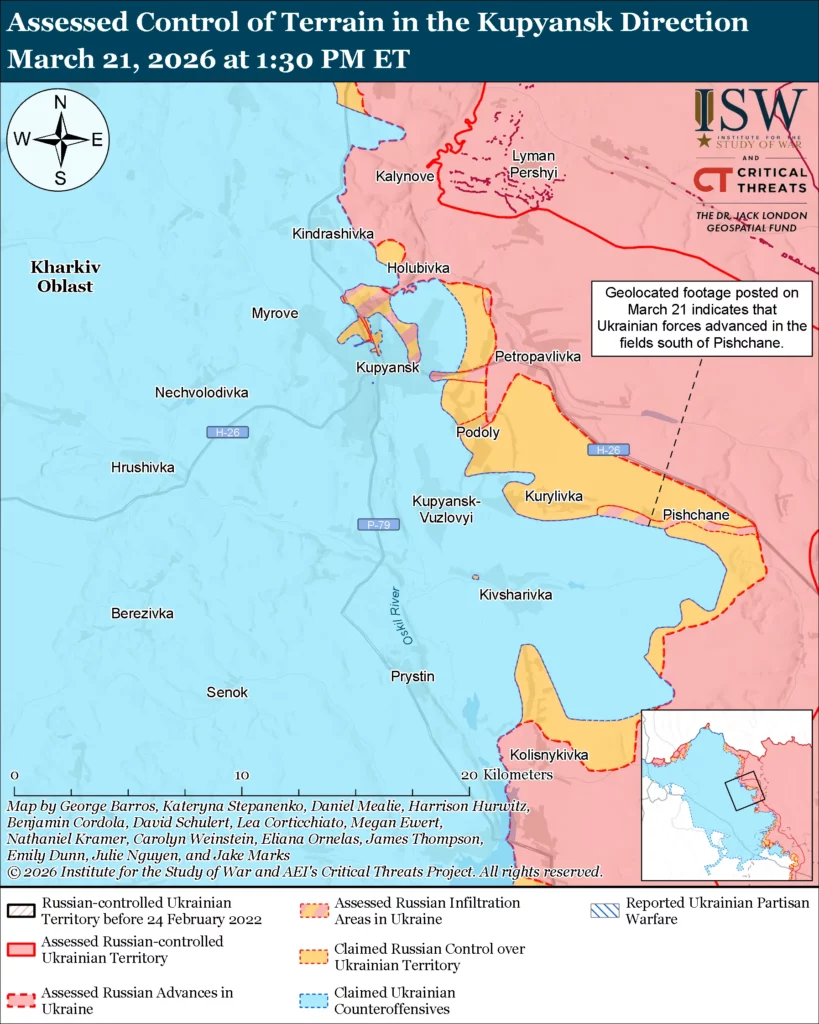
Assessed Ukrainian advances: Geolocated footage published on March 21 indicates that Ukrainian forces recently advanced south of Pishchane (southeast of Kupyansk).[32] The geolocated footage reportedly showed drone operators of the Russian 375th Anti-Tank Artillery Battalion (47th Tank Division, 1st Guards Tank Army [GTA], Moscow Military District [MMD]) striking communications equipment at a Ukrainian position. south of Pishchane.
Unconfirmed claims: Russian milbloggers claimed that Russian forces advanced in central Kurylivka (southeast of Kupyansk).[33]
Russian forces attacked east of Kupyansk near Petropavlivka and southeast of Kupyansk near Kurylivka and Hlushkivka and toward Kupyansk-Vuzlovyi on March 20 and 21.[34]
Russian milbloggers continue to criticize the Russian military command for failures and fabricated claims of success in Kupyansk after Ukrainian forces reportedly cleared an encircled Russian position within Kupyansk. Russian milbloggers criticized the Russian Ministry of Defense (MoD) for falsely claiming that Russian forces had seized Kupyansk and expressed concerns that the Russian MoD is unlikely to honor the Russian soldiers who recently died in central Kupyansk because the MoD does not consider Kupyansk as an active battlefield area.[35] A Russian milblogger and former Storm-Z instructor connected the dire situation in Kupyansk to the incident that prompted the suicide of prominent independent Russian milblogger Andrei “Murz” Morozov in February 2024.[36] Morozov reportedly committed suicide after the Russian military command forced Morozov to censor his reports of the high casualty rates that Russian forces sustained in the effort to seize Avdiivka, Donetsk Oblast, and Morozov’s suicide has been a point of neuralgia in the Russian ultranationalist information space since.[37] A Kremlin-coopted, prominent Russian milblogger even acknowledged the information space discourse about Kupyansk but called on Russians to wait for an official response from the Russian MoD.[38]
Russian forces continued limited offensive operations north of Borova near Novoplatonivka on March 20 and 21 but did not advance.[39]
Geolocated footage published on March 20 shows Russian forces conducting an airstrike against a bridge of the Oskil Hydroelectric Power Plant over the Oskil River east of Oskil, Kharkiv Oblast (southwest of Borova).[40]
Order of Battle: Elements of the Russian 12th Tank Regiment and 423rd Motorized Rifle Regiment (both 4th Tank Division, 1st GTA) and 15th Motorized Rifle Regiment (2nd Motorized Rifle Division, 1st GTA), are reportedly operating in the Borova direction.[41]
Russian Subordinate Main Effort #3 – Donetsk Oblast
Russian objective: Capture the entirety of Donetsk Oblast, the claimed territory of Russia’s proxies in Donbas, and advance into Dnipropetrovsk Oblast
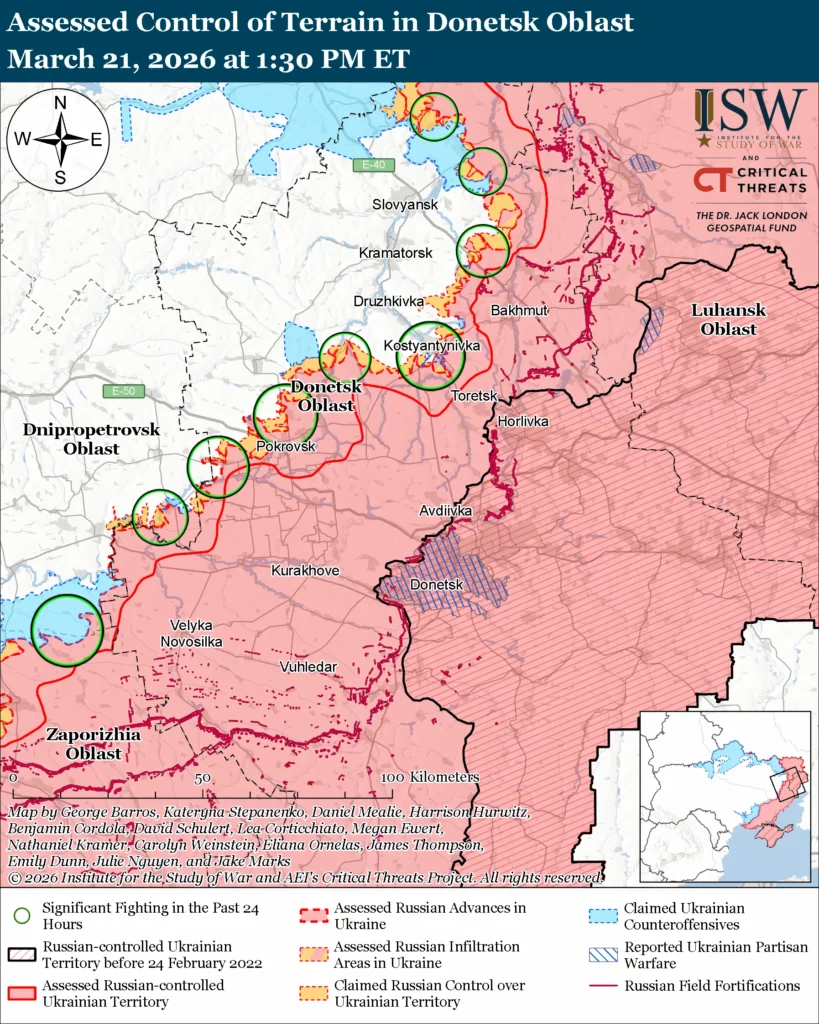
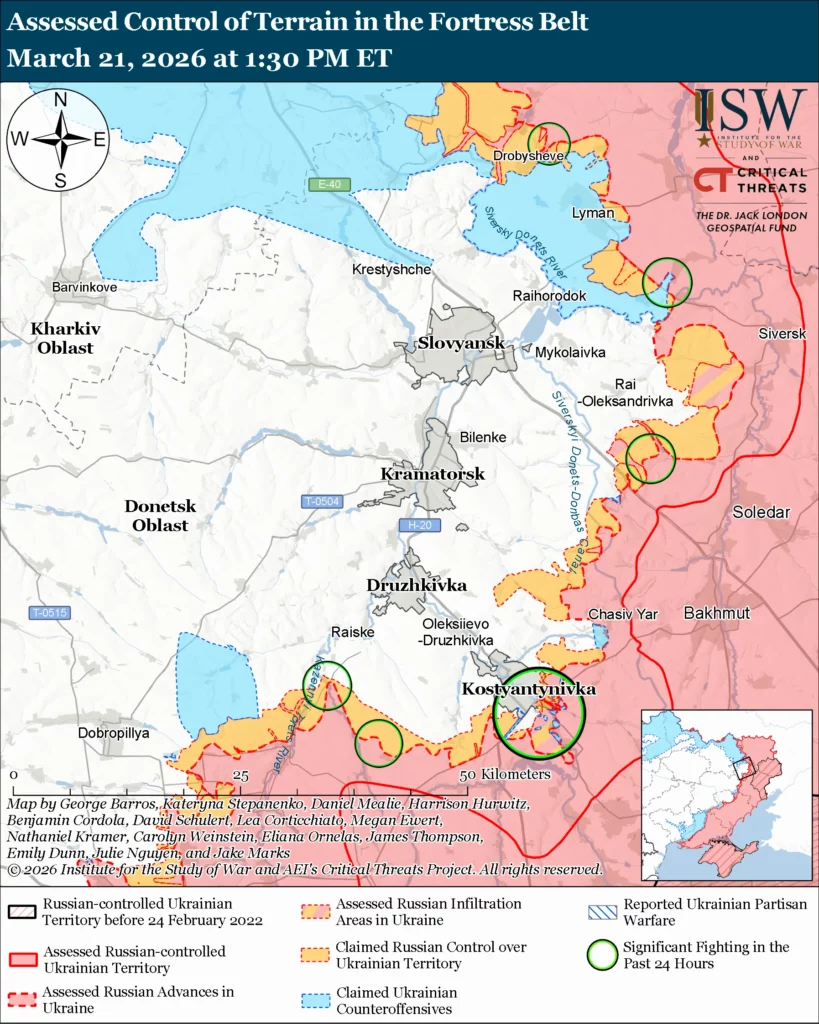
ISW has not observed geolocated footage suggesting that Russian forces advanced in the Slovyansk direction on March 21, despite recently starting ground operations for an offensive against Slovyansk.
See topline text for assessments on the Russian offensive in the Slovyansk direction.
Russian forces attacked northwest of Lyman near Drobysheve; southeast of Lyman near Yampil; northeast of Slovyansk near Platonivka; east of Slovyansk toward Riznykivka and Kryva Luka; and southeast of Slovyansk near Fedorivka Druha, Lypivka, and Dibrova and toward Rai-Oleksandrivka and Pazeno on March 20 and 21.[42]
Order of Battle: Reconnaissance elements of the Russian 85th Motorized Rifle Brigade (3rd Combined Arms Army [CAA], formerly 2nd Luhansk People’s Republic Army Corps [LNR AC], Southern Military District [SMD]) are reportedly operating between Riznykivka and Nykyforivka (southwest of Riznykivka).[43] Drone operators of the Rubikon Center for Advanced Unmanned Technologies reportedly continue to operate in the Lyman direction.[44]
Ukrainian forces likely recaptured limited positions in Chasiv Yar (northeast of Kostyantynivka) following reports of counterattacks in the area.
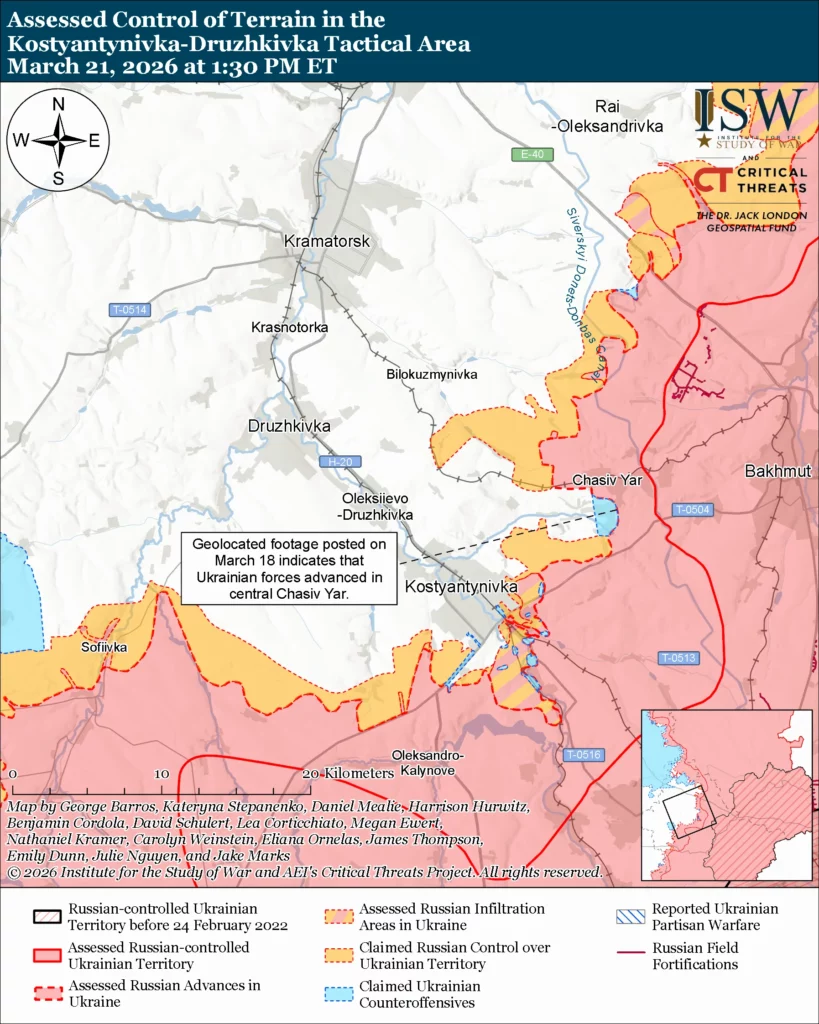
Assessed Ukrainian advances: Geolocated footage published on March 18 and 21 indicates that Ukrainian forces have recently recaptured some positions in central Chasiv Yar.[45] Russian milbloggers claimed that Ukrainian forces have been counterattacking toward Chasiv Yar but that Russian forces repelled the attacks.[46] The current extent of Ukrainian positions within Chasiv Yar remains unclear. Russian forces fought for over 26 months to reach and seize Chasiv Yar since the seizure of Bakhmut in May 2023.
Russian forces attacked near Kostyantynivka itself; east of Kostyantynivka near Chasiv Yar; southeast of Kostyantynivka near Pleshchiivka; south of Kostyantynivka near Illinivka; south of Druzhkivka near Rusyn Yar and Berestok; and southwest of Druzhkivka near Sofiivka and Novopavlivka on March 20 and 21.[47]
Order of Battle: First-person view (FPV) drone operators of the Russian 27th Artillery Regiment (6th Motorized Rifle Division, 3rd AC, under operational control of the Southern Grouping of Forces) are striking Ukrainian forces in Oleksiievo-Druzhkivka (northwest of Kostyantynivka).[48] FPV drone operators of the 150th Motorized Rifle Division (8th CAA, SMD) are reportedly striking Ukrainian forces near Pavlivka, Novopavlivka, and Priyut (all southwest of Druzhkivka).[49] FPV drone operators of the 33rd Motorized Rifle Regiment (20th Motorized Rifle Division, 8th CAA) are reportedly operating in the Druzhkivka direction.[50] Drone operators of the Plemyash detachment of the 238th Artillery Brigade (8th CAA) and of the 255th Motorized Rifle Regiment (20th Motorized Rifle Division) reportedly continue to operate in the Kostyantynivka direction.[51]
Russian forces continued offensive operations in the Dobropillya tactical area on March 21 but did not advance.
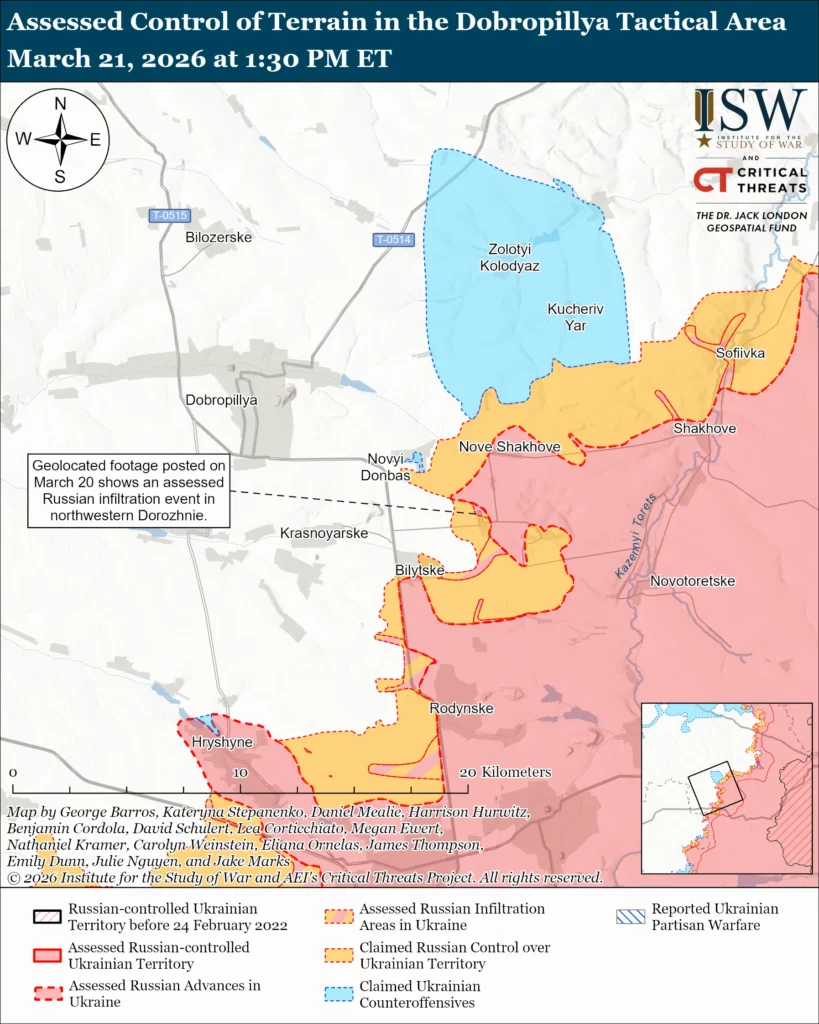
Assessed Russian infiltrations: Geolocated footage published on March 20 shows Ukrainian forces striking Russian positions in northwestern Dorozhnie (southeast of Dobropillya) after what ISW assessed was a Russian infiltration mission that did not change the control of terrain or the forward edge of the battle area (FEBA).[52]
Russian forces attacked east of Dobropillya near Vilne and Novyi Donbas and toward Kucheriv Yar on March 21.[53]
Ukrainian and Russian forces recently advanced in the Pokrovsk direction.
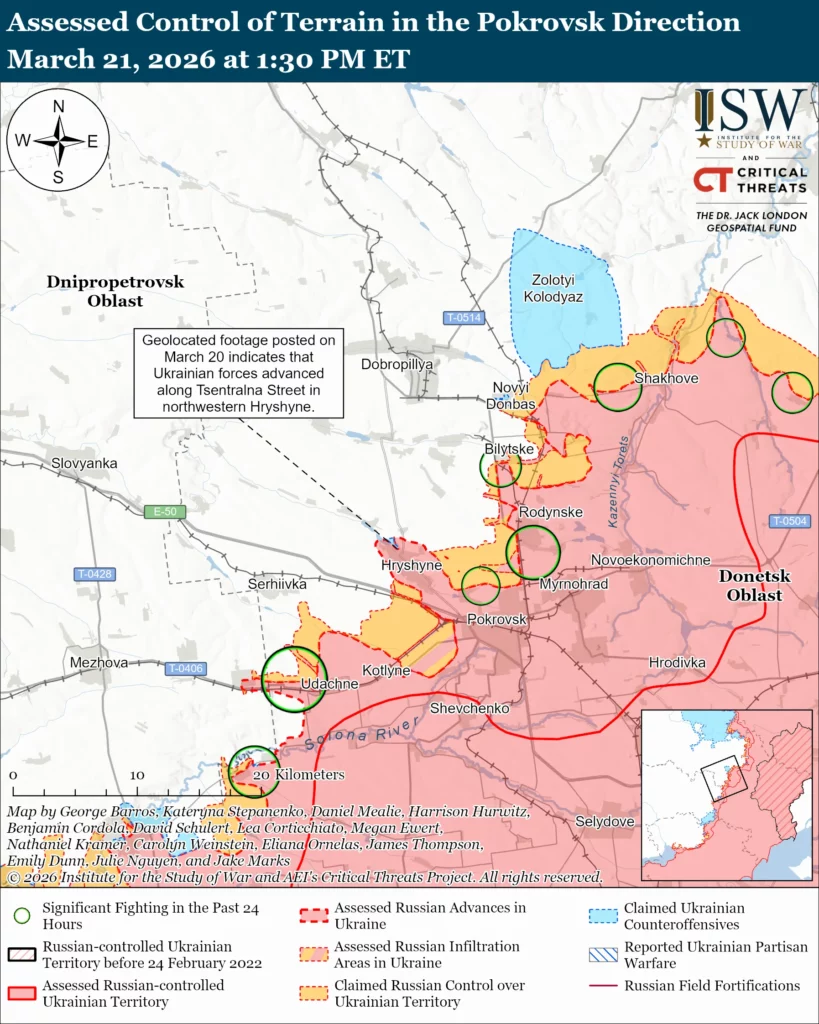
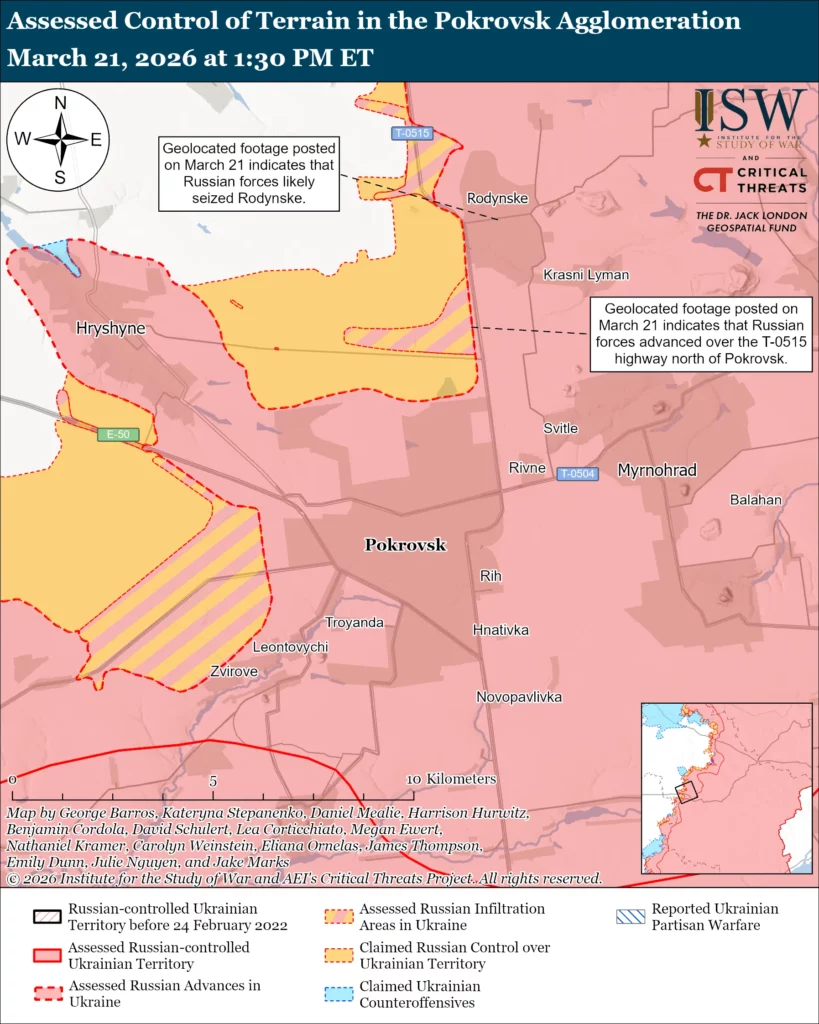
Assessed Ukrainian advances: Geolocated footage published on March 20 indicates that Ukrainian forces recently marginally advanced in northwestern Hryshyne (northwest of Pokrovsk).[54]
Assessed Russian advances: Geolocated footage published on March 21 indicates that Russian forces recently advanced north of Pokrovsk and west of Rodynske (north of Pokrovsk).[55] The presence of Russian forces west of Rodynske indicates that Russian forces likely seized the settlement on a prior date.
Unconfirmed claims: A Russian milblogger claimed that Russian forces advanced in eastern and southern Bilytske (north of Pokrovsk).[56]
Russian forces attacked near Pokrovsk itself; northwest of Pokrovsk toward Serhiivka; north of Pokrovsk near Rodynske and Bilytske; northeast of Pokrovsk near Chervonyi (Krasnyi) Lyman; east of Pokrovsk near Myrnohrad; and southwest of Pokrovsk near Molodetske, Novopidhorodne, and Udachne on March 20 and 21.[57]
A Ukrainian battalion commander in the Pokrovsk direction reported on March 21 that Russian forces are using various routes when conducting motorized assaults to allow small groups to infiltrate while diverting Ukrainian attention and aerial reconnaissance, adapting their tactics based on prior experience.[58]
Order of Battle: Drone operators of the Russian Smuglyanka Detachment and Rubikon Center for Advanced Unmanned Technologies are reportedly coordinating Russian Aerospace Forces (VKS) glide bomb strikes against Ukrainian forces in Chernihivka and Svitle (both north of Pokrovsk) and Novofedorivka, Novooleksandrivka, and Shevchenko (all northwest of Pokrovsk).[59] FPV drone operators of the 9th Motorized Rifle Brigade (51st CAA, formerly 1st Donetsk People’s Republic [DNR] AC, SMD) are reportedly striking Ukrainian vehicles near Shevchenko and Vodyanske (north of Pokrovsk).[60]
Russian forces continued offensive operations near Novopavlivka itself; northeast of Novopavlivka near Novomykolaivka and Bilyakivka; and south of Novopavlivka near Filiya on March 20 and 21.[61]
Russian forces recently infiltrated in the Oleksandrivka direction.
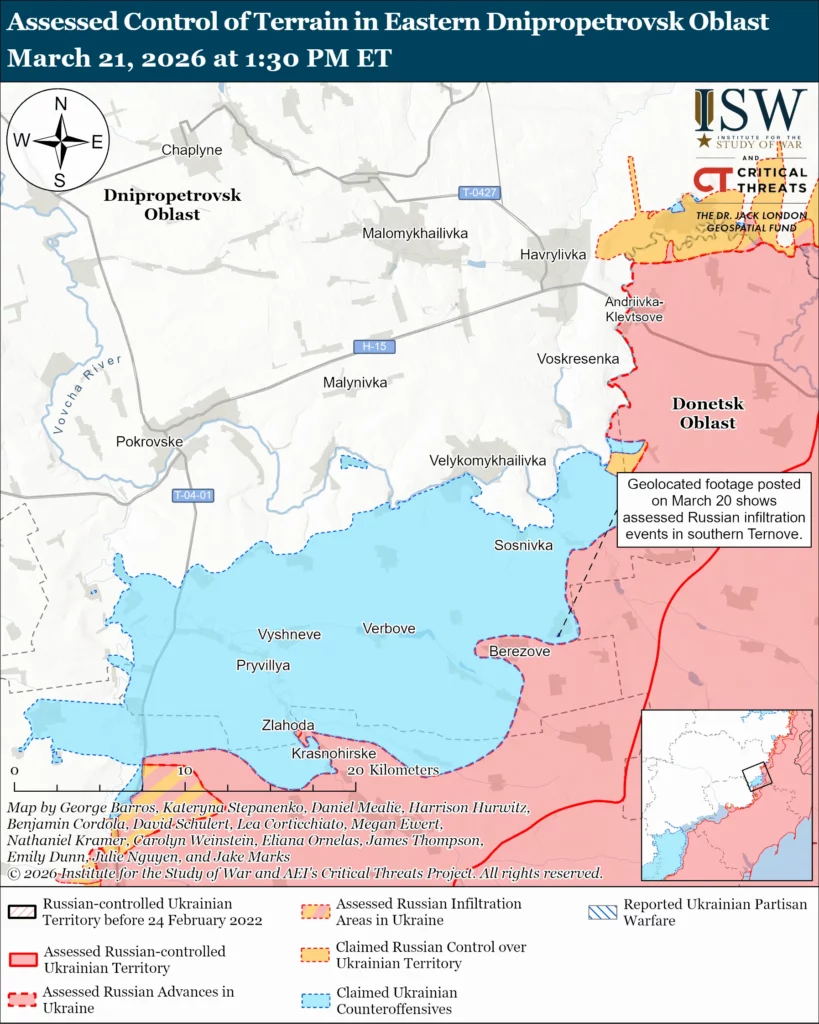
Assessed Russian infiltrations: Geolocated footage published on March 20 shows Russian servicemembers operating in southern Ternove (southeast of Oleksandrivka) during what ISW assesses was a Russian infiltration mission that did not change control of terrain or the forward edge of the battle area (FEBA) at this time.[62]
Russian forces attacked northeast of Oleksandrivka near Ivanivka and southeast of Oleksandrivka near Ternove, Kalynivske, Krasnohirske, and Zlahoda on March 20 and 21.[63] A Russian milblogger claimed that Ukrainian forces counterattacked near Novooleksandrivka (southeast of Oleksandrivka) and Kosivtseve (southwest of Oleksandrivka).[64]
Russian forces continue to struggle to establish a stable defense in the Oleksandrivka direction. An officer of a Ukrainian battalion operating in the Oleksandrivka direction reported on March 20 that Russian forces have been unable to stop Ukrainian advances in the Oleksandrivka direction despite redeploying unspecified Spetsnaz elements, including drone elements, to the direction.[65] The officer noted that Ukrainian advances slowed down due to changing weather conditions, but added that Ukrainian forces continue to advance because Russian forces have not been able to establish stable defensive lines.
Ukrainian forces continued their mid-range strike campaign against Russian military targets in occupied Donetsk Oblast on the night of March 20 to 21. The Ukrainian General Staff reported on March 21 that Ukrainian forces struck a Russian command and observation post in occupied Paraskoviivka (roughly 50 kilometers from the frontline) and the command post of a unit of the Russian Rubikon Center for Advanced Unmanned Technologies in occupied Mariupol (roughly 115 kilometers from the frontline).[66]
Russian Supporting Effort: Southern Axis
Russian objective: Maintain frontline positions, secure rear areas against Ukrainian strikes, and advance within tube artillery range of Zaporizhzhia City
Russian forces continued offensive operations in the Hulyaipole direction on March 21 but did not advance.
Russian forces attacked near Hulyaipole itself; northwest of Hulyaipole near Olenokostyantynivka and toward Verkhnya Tersa and Vozdvyzhivka; north of Hulyaipole near Zelene, Dobropillya, and Varvarivka; west of Hulyaipole near Zaliznychne and Staroukrainka; and southwest of Hulyaipole near Myrne and toward Charivne and Hulyaipilske on March 20 and 21.[67]
Order of Battle: Elements of the Russian 64th Motorized Rifle Brigade (35th Combined Arms Army [CAA], Eastern Military District [EMD]) are operating near Dobropillya.[68] Drone operators of the 14th Spetsnaz Brigade (Russian General Staff’s Main Directorate [GRU]) are reportedly operating near Liubytske (northwest of Hulyaipole).[69] Drone operators of the 38th Motorized Rifle Brigade (35th CAA) are reportedly striking Ukrainian forces in Zaporizhia Oblast.[70]
Ukrainian forces continued their mid-range strike campaign against Russian military targets in occupied Zaporizhia Oblast on the night of March 20 to 21. The Ukrainian General Staff reported on March 21 that Ukrainian forces struck a Russian repair unit in occupied Khliborobne (roughly 30 kilometers from the frontline) overnight.[71]
Russian forces continued offensive operations in western Zaporizhia Oblast on March 21 but did not advance.
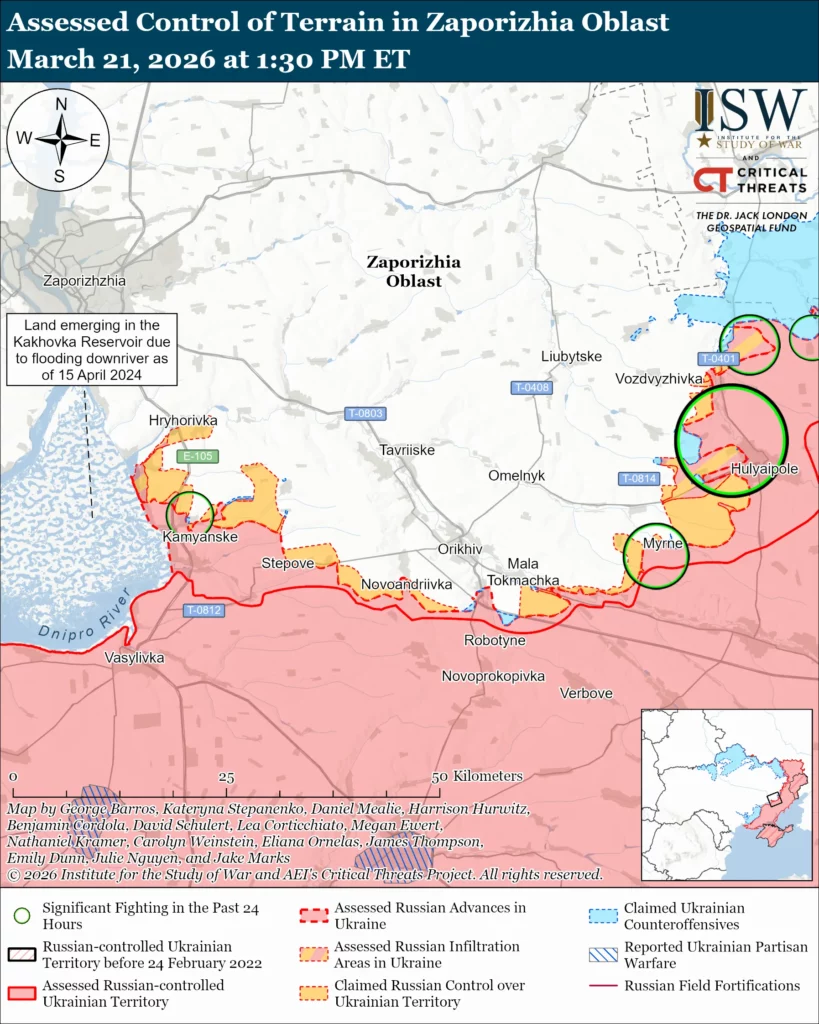
Russian forces attacked southeast of Orikhiv near Luhivske; west of Orikhiv near Stepnohirsk and Prymorske; and northwest of Orikhiv near Richne and Pavlivka and toward Veselyanka, Novoboikivske, Novoyakovlivka, and Mahdalynivka on March 20 and 21.[72]
Russian forces continued limited offensive operations in the Kherson direction, including northeast of Kherson City near the Antonivskyi Bridge, on March 20 and 21 but did not advance.[73]
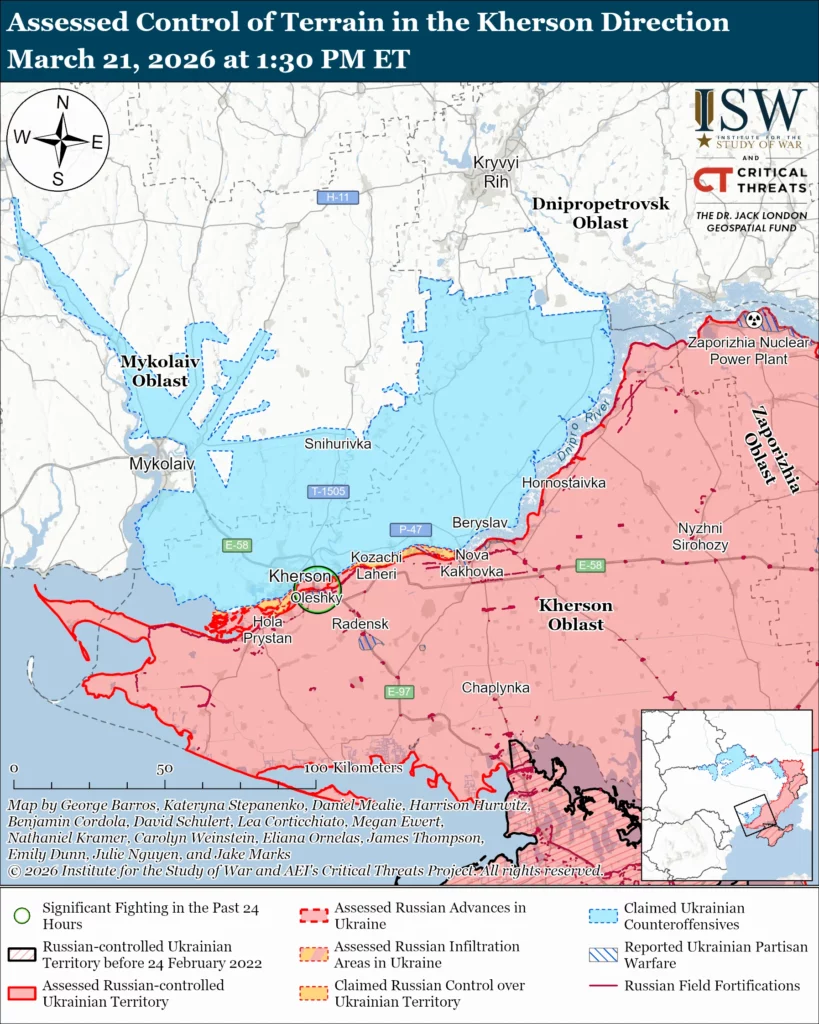
Ukrainian forces likely killed in action (KIA) a Russian Airborne Forces (VDV) battalion commander in the Kherson direction. A source tracking Russian casualties in Ukraine claimed on March 21 that Lieutenant Colonel Alexander Soldatov, commander of the 1st Battalion of the Russian 331st VDV Regiment (98th VDV Division), was KIA near Oleshky (southeast of Kherson City) on February 27.[74]
Russian Air, Missile, and Drone Campaign
Russian Objective: Target Ukrainian military and civilian infrastructure in the rear and on the front line
Russian forces conducted a series of drone strikes against Ukraine on the night of March 20 to 21. The Ukrainian Air Force reported that Russian forces launched 154 Shahed-type, Gerbera-type, Italmas-type, and other drones — of which roughly 90 were Shahed-type drones — from the directions of Oryol and Kursk cities; Millerovo, Rostov Oblast; Primorsko-Akhtarsk, Krasnodar Krai; and occupied Hvardiiske, Crimea.[75] The Ukrainian Air Force reported that Ukrainian forces downed 148 drones, that five drones struck four locations, and that fragments of downed drones fell in seven locations. Ukrainian officials reported that morning and daytime strikes damaged critical and residential infrastructure in Zaporizhzhia City and Kyiv and Chernihiv oblasts.[76] Ukrainian officials reported that the strikes injured six civilians in Zaporizhzhia City, and cut power to 430,000 subscribers in Chernihiv Oblast, almost 21,000 subscribers in Slavutych, Kyiv Oblast, and over 47,000 subscribers in Zaporizhzhia City.[77]
Russian forces are reportedly continuing to use Geran-2 drones with live video guidance to target Ukrainian mobile fire groups. A Russian milblogger published footage on March 21 reportedly showing a Russian Geran-2 drone with live video guidance striking a Ukrainian mobile fire group near Apostolove, Dnipropetrovsk Oblast (roughly 34 kilometers from the frontline).[78]
Significant Activity in Belarus
Russian efforts to increase its military presence in Belarus and further integrate Belarus into Russian-favorable frameworks
Nothing Significant To Report.
Note: ISW does not receive any classified material from any source, uses only publicly available information, and draws extensively on Russian, Ukrainian, and Western reporting and social media as well as commercially available satellite imagery and other geospatial data as the basis for these reports. References to all sources used are provided in the endnotes of each update.