 Eurasia Press & News
Key Takeaways
Iran’s ballistic missile program is a military organization that consists of both combat and support elements. and it is impossible to evaluate the overall degradation of Iran’s ballistic missile program based on one element of the system. The ballistic missile program consists of combat elements such as Iran’s missile stockpile and launchers, but it also includes support elements, such as research facilities, development institutions, and industrial facilities.
The majority of Iranian ballistic missiles are combat ineffective, even if they remain “intact.” A missile launcher that is buried is combat ineffective for the period it is buried. It is also combat ineffective if it cannot move from its underground storage facility.
The combined force has rendered many of Iran’s missile launchers combat ineffective, but it is entirely unclear whether these “launchers” refer to launchers for medium-range or short-range systems or whether any of the launchers are interchangeable between medium-range and short-range systems.
The US-Israeli campaign has solidified the operational success generated by rendering launchers combat ineffective and destroying missile stockpiles by targeting Iran’s defense industrial base extensively. Strikes on these sites will make it more challenging for Iran to reconstitute its missile and drone program over the long-term.
Unspecified US and Israeli officials confirmed that Iran shot down a US Air Force F-15E over Iran on April 3. This incident is the first known US combat aircraft lost over Iranian territory since the beginning of the war.
The IDF announced that it has prepared a plan to establish a “security zone” along the Israel-Lebanon border, which includes the destruction of Lebanese villages within the defined zone. Hezbollah would likely use the expanded Israeli presence in southern Lebanon and the displacement of southern Lebanese Shia to justify its position as the “defender” of Lebanon.
Toplines
Iran’s ballistic missile program is a military organization that consists of both combat and support elements, and it is impossible to evaluate the overall degradation of Iran’s ballistic missile program based on one element of the system. The ballistic missile program consists of combat elements—Iran’s missile stockpile and launchers—but it also includes support elements, such as research facilities, development institutions, and industrial facilities. Any evaluation of the degradation that discounts the status of the support elements of the program is therefore incomplete. The US–Israeli campaign has targeted nearly every element of Iran’s ballistic program (see below).
The majority of Iranian ballistic missiles are combat ineffective, even if they remain “intact.”[1] About 50 percent of Iranian missile launchers are still “intact,” according to recent US intelligence assessments.[2] This figure, however, appears to include launchers that have been damaged or rendered inaccessible. A unit is considered combat ineffective when it cannot accomplish its assigned mission. A unit does not necessarily need to be destroyed to be considered combat ineffective. A missile launcher that is buried is combat ineffective for the period it is buried. It is also combat ineffective if it cannot move from its underground storage facility.[3]
Assessing Iran’s missile threat accurately requires distinguishing between different missile types. Iran possesses short-, medium-, and long-range ballistic missiles in its arsenal. Iran relies on medium-range ballistic missiles to target Israel. Iran fires its short-range missiles to target Gulf states and US assets in these countries. Estimates on the status of Iran’s missile program do not distinguish between the two, which limits the ability to use these estimates to completely understand the status of Iran’s missile program.
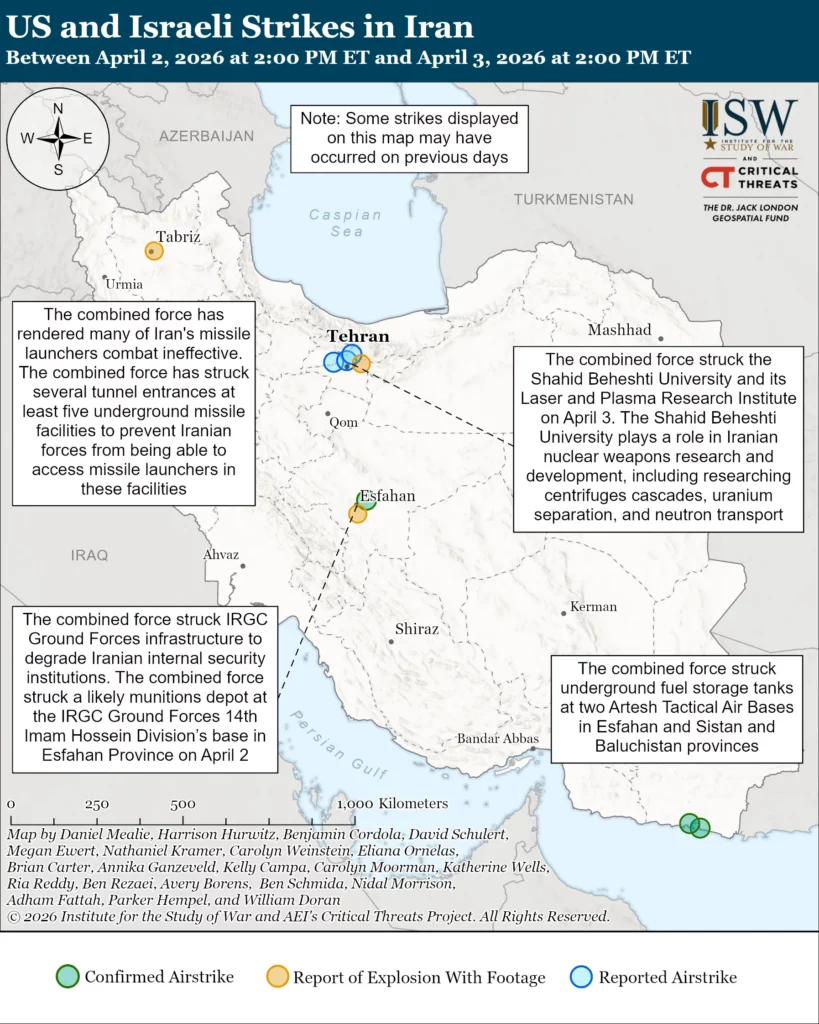
The combined force has rendered many of Iran’s missile launchers combat ineffective, but it is entirely unclear whether these “launchers” refer to launchers for medium-range or short-range systems or whether any of the launchers are interchangeable between medium-range and short-range systems. The combined force has struck several tunnel entrances and at least five underground missile facilities to prevent Iranian forces from being able to access missile launchers in these facilities.[4] CNN analyzed 107 Iranian tunnel entrances on March 21 and found that the combined force had struck 77 percent of the tunnel entrances.[5] The status of the launchers in these underground facilities is unclear, but striking these tunnel entrances has at least temporarily rendered these launchers combat ineffective. The combined force has also targeted Iran’s efforts to clear rubble from collapsed tunnel entrances.[6] Western media also reported that Iran retains 50 percent of its drone capabilities.[7] Combat ineffectiveness is a temporary state, but other combined force strikes have worked to make it more difficult for Iran to make its ballistic missile forces combat effective again (see below for information on defense industrial strikes).
The rate of Iranian missile fire suggests that Iran’s medium-range ballistic missile force has been significantly degraded. The US military assessed that Iranian missile fire has reduced by around 90 percent since the start of the war.[8] ISW-CTP previously observed that Iran has been firing only a few missiles per salvo, and sometimes just one, at Israel in recent weeks.[9] Smaller salvoes are relatively easier for the IDF to intercept, as demonstrated by their performance against small Houthi salvoes between 2023 and 2025.
The short-range ballistic missile force has continued to conduct attacks at a steady rate, but the status of the short-range missile force remains unclear. Iranian missile fire targeting the Gulf states has remained relatively steady since the start of the war, excluding Iran’s large missile launches targeting the UAE on the first day of the war. Iran’s relatively consistent rate of missile fire at the Gulf states in the weeks since may reflect constraints in specific types of missiles compared to others. The status of Iranian short-range missile capabilities, which target the Gulf states, is difficult to assess using open-source information at this time. Missile fire at the Gulf states has remained relatively steady in recent weeks, but there is limited clarity about how large the remaining stockpiles are and what tactical limitations the Iranian short-range missile units are facing.
The combined force has also targeted Iran’s drone program, including drone launchers, but the status of the program is unclear.[10] Western media estimated that Iran retains 50 percent of its drone capabilities.[11] Neither the United States nor Israel has released information about the total number of drone targets struck, but reports suggest drone launches have decreased since the start of the war.[12]
US-Israeli strikes, particularly decapitation strikes, have also created a pervasive fear that may be cause Iranian forces to prioritize their survival and impede their ability to execute their assigned mission. US and Israeli strikes have severely degraded Iran’s medium-range missile capabilities. Iranian missile fire targeting Israel has steadily declined since the beginning of the war. Iran has, on average, fired only a few missiles per salvo at Israel since March 20. This impact is less clear within the short-range missile force. US Secretary of Defense Pete Hegseth stated on March 31 that combined force airstrikes have degraded the Iranian military’s morale and even led to “widespread desertions, key personnel shortages, and caused frustrations amongst senior leaders.[13] The IDF stated on March 24 that ballistic missile units have refused to go to launch sites due to fear of IDF strikes.[14] Iranian forces also appear to be struggling with recruitment and retention.[15] Some reserve forces have reportedly failed to show up at military centers, for example.[16] These factors can render missile systems combat ineffective because they lack available or willing forces to operate them.
The US-Israeli campaign has solidified the operational success generated by rendering launchers combat ineffective and destroying missile stockpiles by targeting Iran’s defense industrial base extensively. Strikes on these sites will make it more challenging for Iran to reconstitute its missile and drone program over the long-term. Iran retains an unclear number of missiles and drones in its stockpiles, but ongoing strikes on Iranian defense industrial sites degrade Iran’s ability to rebuild these stockpiles. Iran has also used a sizable portion of its weapons stockpiles in attacks on Israel and the Gulf since the war began. The force has conducted extensive strikes targeting Iran’s missile and drone production capabilities. The IDF announced on March 31 that it estimates that it has targeted nearly 70 percent of Iran’s defense industry.[17] Combined force strikes have severely damaged Iran’s four major missile production sites, including the Khojir, Shahroud, Parchin, and Hakimiyeh facilities, for example.[18] Strikes on defense industrial targets have degraded several components of the missile program, including research, fuel production, components, and testing facilities. The combined force has targeted Iran’s steel production capabilities, which are critical for Iran’s ballistic missile production capabilities.[19] Iran has ceased operations at its main steel production facility in Esfahan Province, due to damage from repeated airstrikes.[20] The IDF announced on April 3 that it had destroyed 70 percent of Iran’s steel production capacity.[21]
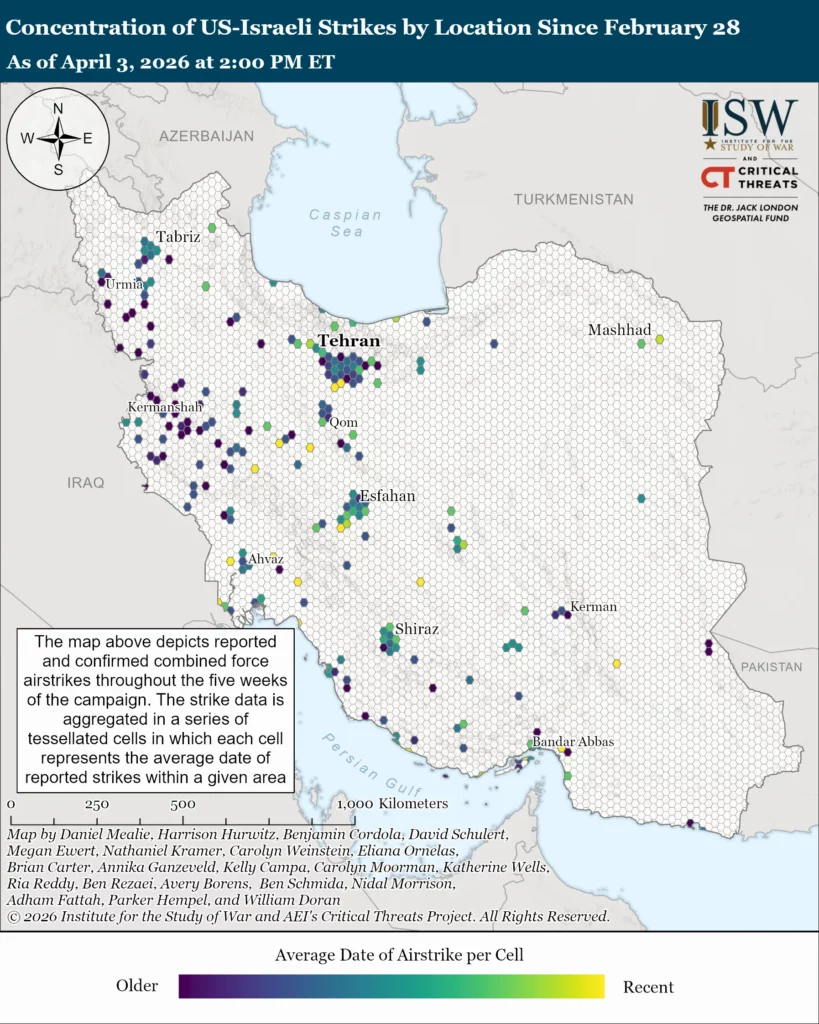
The pattern of recorded US-Israeli strikes shows a gradual shift towards targets in central and eastern Iran in more recent weeks of the campaign, but this effect could be the result of existing data limitations. The map above depicts reported and confirmed combined force airstrikes throughout the five weeks of the campaign. The strike data is aggregated in a series of tessellated cells in which each cell represents the average date of reported strikes within a given area. The combined force concentrated airstrikes targeting West Azerbaijan, East Azerbaijan, Kurdistan, Kermanshah, and Sistan and Baluchistan provinces at the beginning of the campaign, for example. The combined force gradually began to target Gilan, Yazd, Markazi, and Mazandaran provinces in central Iran at a greater scale during the later weeks of the campaign. The combined force has consistently struck Iranian targets in Tehran and Esfahan provinces throughout the campaign, likely given both regions relative importance to the Iranian military and defense industrial apparatus.
This map only depicts a small sample of the combined force’s overall strike pattern and reflects the data limitations created by several conditions, including the Iranian regime’s internet shutdown. Unverified textual reporting on strikes was excluded from the assessment. Restrictions upon commercially available satellite imagery limit ISW-CTP’s ability to visually confirm strikes. ISW-CTP defines confirmed airstrikes as kinetic activity that Israel or the United States confirmed through official channels or that were geolocated by visual means. ISW-CTP defines reported airstrikes as kinetic activity reported by authoritative sources with or without footage, but has not been confirmed with collaborative evidence.
Unspecified US and Israeli officials confirmed that Iran shot down a US Air Force F-15E over Iran on April 3.[22] This incident is the first known US combat aircraft lost over Iranian territory since the beginning of the war.[23] An unspecified Israeli official and a second source with knowledge of the situation told Axios on April 3 that the two crew members ejected safely after the aircraft was hit.[24] Unspecified US and Israeli sources told the New York Times on April 3 that US forces rescued one crew member and are searching for a second crew member.[25] An unspecified senior Israeli official told Axios on April 3 that Israel canceled planned strikes in Iran to avoid disrupting the rescue effort.[26] Unspecified US officials told CBS News on April 3 that two helicopters participated in the search-and-rescue mission and recovered the F-15E pilot after ejection.[27] The officials added that small arms fire hit the helicopter carrying the recovered pilot, wounding crew members on board, but that the helicopter landed safely.[28] A US A-10 Warthog involved in the search and rescue mission crashed near the Strait of Hormuz.[29] Unspecified US officials said that the aircraft came under Iranian fire and was damaged.[30] The pilot was safely recovered.[31]
Iran has reportedly informed mediators that Iran is unwilling to meet US demands for a ceasefire and will not meet US officials in Islamabad for talks in the coming talks.[32] Pakistan has mediated indirect talks between the United States and Iran over the past week.[33] Unspecified mediators told the Wall Street Journal on April 3 that the talks have reached a “dead end.”[34] Turkey and Egypt are reportedly considering new proposals and venues for the talks.[35]
The IDF announced that it has prepared a plan to establish a “security zone” along the Israel-Lebanon border, which includes the destruction of Lebanese villages within the defined zone.[36] The IDF told Israeli media on April 3 that the IDF’s “security zone” will expand between two and four kilometers north of the Israel-Lebanon border, depending on terrain.[37] The IDF stated that the plan would include the destruction of ”first line” Lebanese towns between Kfar Kila, Marjaayoun District, and Naqoura, Tyre District, except for a ”small number” of Lebanese Christian villages.[38] The IDF said that the plan is an adaptation of the October 2025 “Yellow Line” demarcation plan in Gaza.[39] A senior IDF officer said that the plan will avoid complications encountered in the 1982-2000 Israeli occupation of southern Lebanon by depopulating the buffer zone entirely.[40] The IDF would also establish a line of outposts to establish control over the zone.[41] The IDF plan would reportedly not seek to completely dismantle Hezbollah as a part of its campaign objectives in Lebanon but rather ”weaken” the group.[42] A senior IDF officer told an Israeli Army Radio correspondent that a smaller security zone along the border will be easier for the IDF to control and defend.[43]
Hezbollah would likely use the expanded Israeli presence in southern Lebanon and the displacement of southern Lebanese Shia to justify its position as the “defender” of Lebanon. Hezbollah has consistently argued that the group must continue to retain its weaponry to “defend” Lebanon against Israeli invasion and “liberate” Lebanese territory from Israeli control.[44] The destruction of southern Lebanese villages along the Lebanon-Israel border and the displacement of the predominantly Shia southern Lebanese population could result in Hezbollah garnering more support from its Shia support base and strengthening Hezbollah’s narrative that the group remains a viable “defender” of Lebanon.
US and Israeli Air Campaign
The combined force strikes killed an IRGC Aerospace officer on April 1 as part of the decapitation campaign against Iranian military officials. Iranian media reported on April 3 that the combined force killed IRGC officer Mohammad Hossein Sufi in Khorramabad, Lorestan Province, on April 1.[45] Lorestan Province’s IRGC Public Relations Department reported that Sufi had deployed alongside IRGC Aerospace Forces personnel during the current conflict.[46] IRGC-affiliated media reported that Sufi spent six years in Syria, which suggests that Sufi participated in Iran’s expeditionary operations in support of the Assad regime during the Syrian civil war.[47]
The combined force struck a likely IRGC Ground Forces munitions depot in Esfahan Province as part of its effort to degrade Iranian internal security institutions. The combined force struck a likely munitions depot at the IRGC Ground Forces 14th Imam Hossein Division’s base in Esfahan Province on April 2.[48] The combined force previously struck buildings in the central and northern parts of the division’s complex on March 8 and possibly again on March 22.[49] The Imam Hossein Division deployed to Syria to fight for the Assad regime during the Syrian civil war.[50] The regime has also historically deployed IRGC Ground Forces units to suppress internal unrest.[51]
The combined force struck the Laser and Plasma Research Institute (LAPRI) on April 3, which is a specialized research center at Shahid Beheshti University in Tehran Province.[52] The Shahid Beheshti University plays a role in Iranian nuclear weapons research and development, including researching centrifuge cascades, uranium separation, and neutron transport.[53] The university also cooperates with the Atomic Energy Organization of Iran.[54] The European Union listed Shahid Beheshti University in 2011 as an entity owned or controlled by the Ministry of Defense and Armed Forces Logistics (MODAFL) that carries out scientific research related to nuclear weapons.[55] The LAPRI, a subordinate research institute at Shahid Beheshti University, contributes to research on lasers, photonics, and plasma for defense industries and sciences.[56] Israel killed five senior nuclear scientists from the university during the opening days of the June 2025 Israel-Iran War, including Mohammad Mehdi Tehranchi.[57] Tehranchi served as a supervisor in Iran’s pre-2004 Amad Plan and previously served as vice chancellor for research at the LAPRI and as head of Shahid Beheshti University.[58]
The combined force struck underground fuel storage tanks at two Artesh Tactical Air Bases (TAB), including the 8th TAB in Esfahan Province and the 10th TAB in Sistan and Baluchistan Province.[59] The combined force previously struck Iranian F-14 Tomcat fighter aircraft at the 8th TAB.[60] The base hosts F-14s.[61] The combined force also struck the underground fuel complex at the 10th TAB in Konarak, Sistan and Baluchistan Province.[62] The combined force previously struck buildings where Iranian air force planes were parked at the 10th TAB.[63] The combined force has also targeted refineries.[64] The combined force has targeted Iran’s fuel stockpile as well as refineries to hinder Iran’s ability to replace the stockpiles.
Iranian Response
Iran has launched at least nine missiles targeting Israel since ISW-CTP’s last data cut off on April 2.[65] This figure is estimated from IDF and Israeli media reports about IDF-issued missile detections and interceptions. Iran launched the missiles in eight waves of attacks, which suggests that most of the launches only contained one or two missiles.[66] This rate is consistent with recent Iranian launch rates targeting Israel over the past few weeks, but Iran has fired slightly fewer barrages targeting Israel in the past three days.[67] The IDF intercepted several of the missiles, while at least two missiles likely failed mid-flight over Israel.[68] At least two missiles contained cluster munitions, which dispersed over the Haifa and Krayot areas.[69]
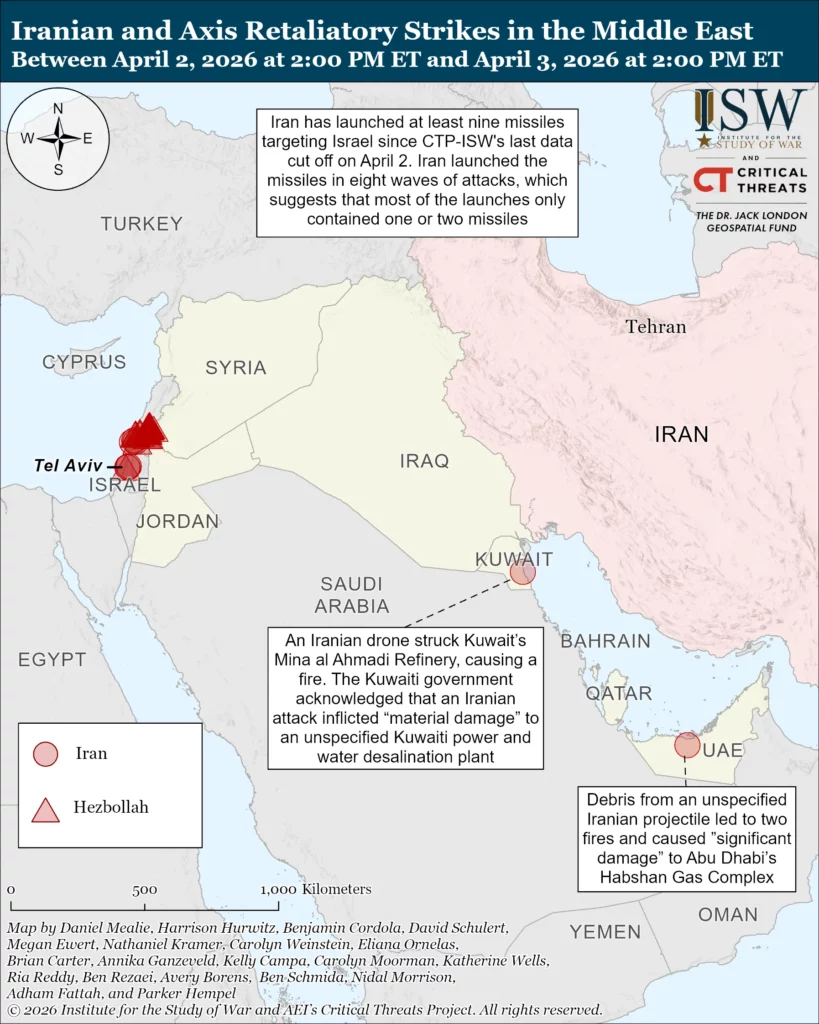
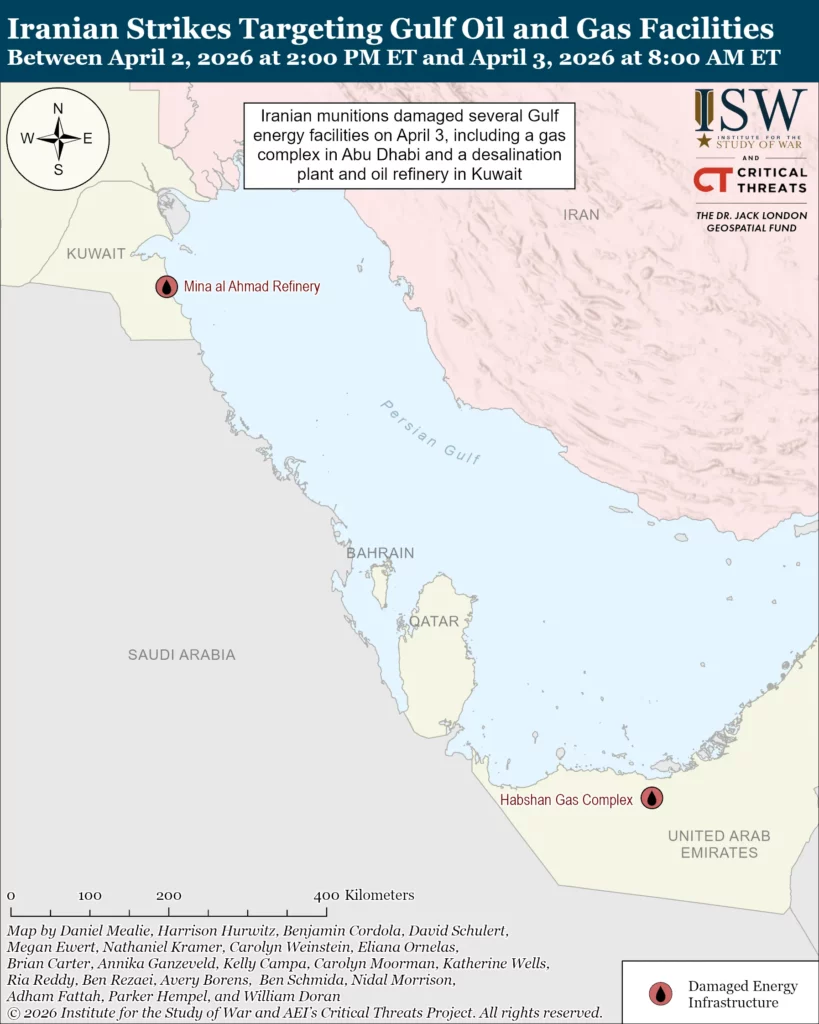
Iranian strikes and intercepted fragments damaged several Gulf energy facilities on April 3. Iran continues to target Gulf energy infrastructure, which is part of the Iranian effort to drive up global energy prices and coerce the Gulf states into pressuring the United States and Israel to end their campaign. An Iranian drone struck Kuwait’s Mina al Ahmadi Refinery, causing a fire.[70] The Kuwaiti government also acknowledged that an Iranian attack inflicted “material damage” to an unspecified Kuwaiti power and water desalination plant.[71] Iran previously attacked a Kuwaiti desalination plant on March 29.[72] Debris from an unspecified Iranian projectile led to two fires and caused ”significant damage” to Abu Dhabi’s Habshan Gas Complex.[73] At least one person was killed.[74]
Iran fired slightly more projectiles targeting the UAE on April 3 than on any day within the last week. Iran fired 47 drones, 18 ballistic missiles, and four cruise missiles targeting the UAE and killed at least one person (as noted above).[75] The volume of Iranian missile and drone fire targeting the UAE this week is about less than half of the volumes that Iran fired during the first week of the war, however (see graph below). The drop in volume after the first week of the war is likely the result of combined force strikes targeting Iranian missile and drone assets.
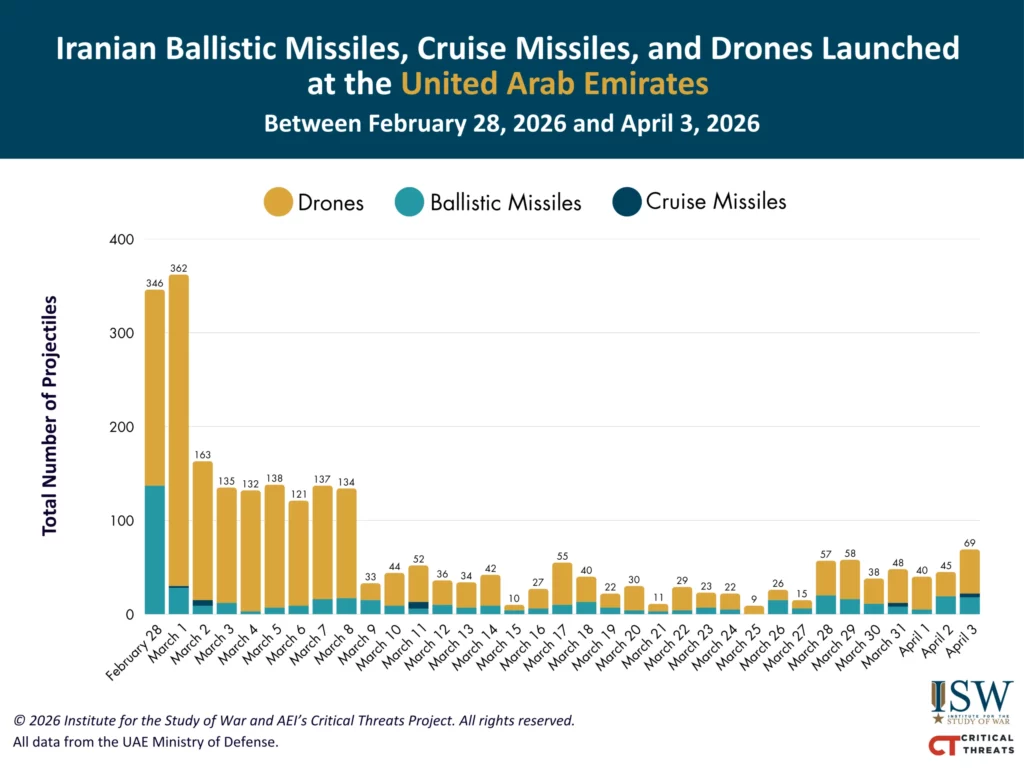
Iran continues to launch cruise missiles targeting Gulf states. Iran launched four cruise missiles targeting the UAE and two cruise missiles targeting Kuwait on April 3.[76] Iran has launched at least 45 cruise missiles targeting Kuwait, Qatar, Saudi Arabia, and the UAE since the beginning of the war.[77] Iran has used cruise missiles to target civilian ships in the Persian Gulf and also the Gulf states’ territory.
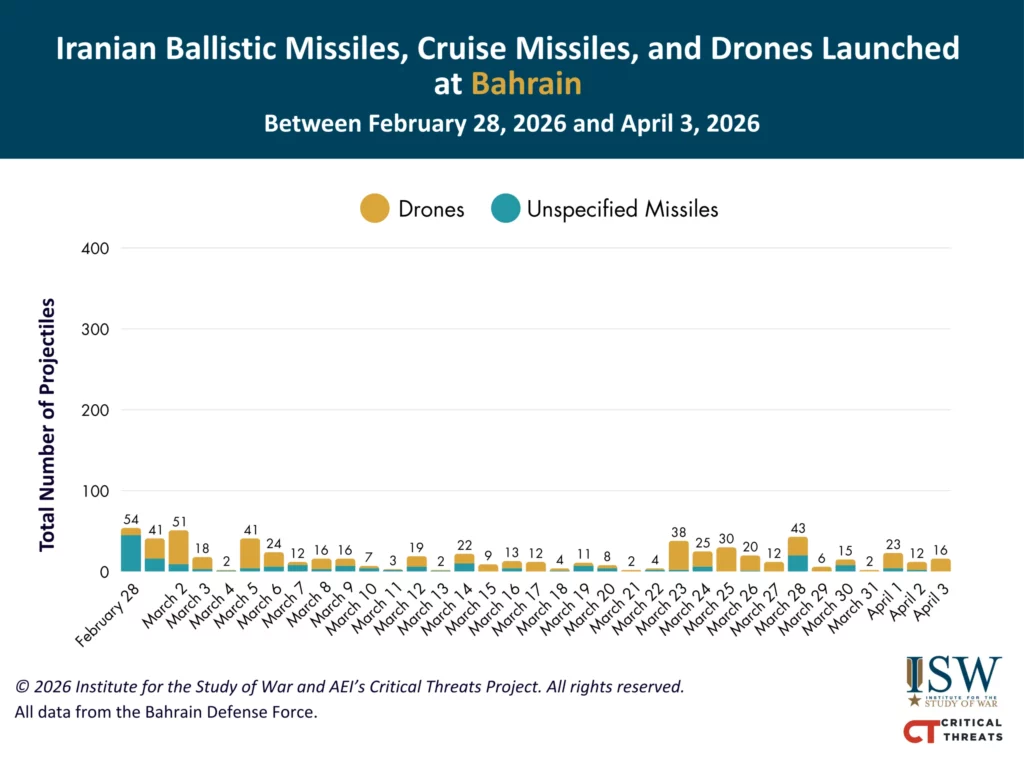
Iran fired 16 drones targeting Bahrain on April 3.[78] Bahrain intercepted all of the drones.[79]
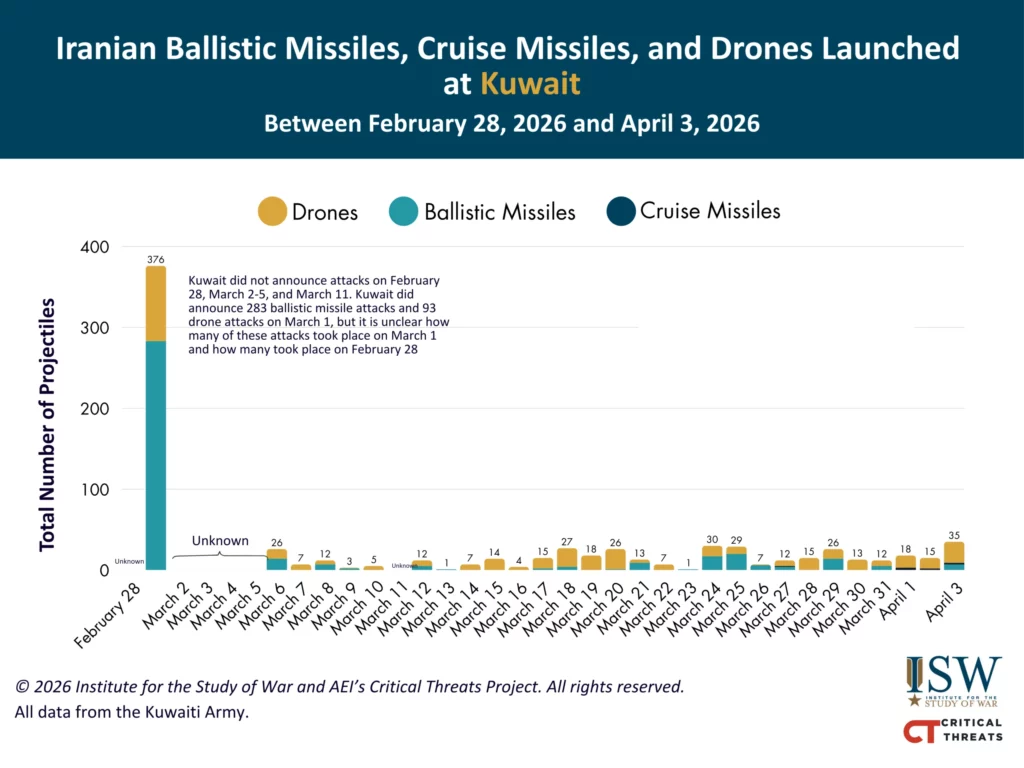
Iran fired 26 drones, seven ballistic missiles, and two cruise missiles targeting Kuwait on April 3.[80] A drone and an unspecified munition inflicted damage to a Kuwaiti oil refinery and desalination plant, respectively, as noted above.[81]
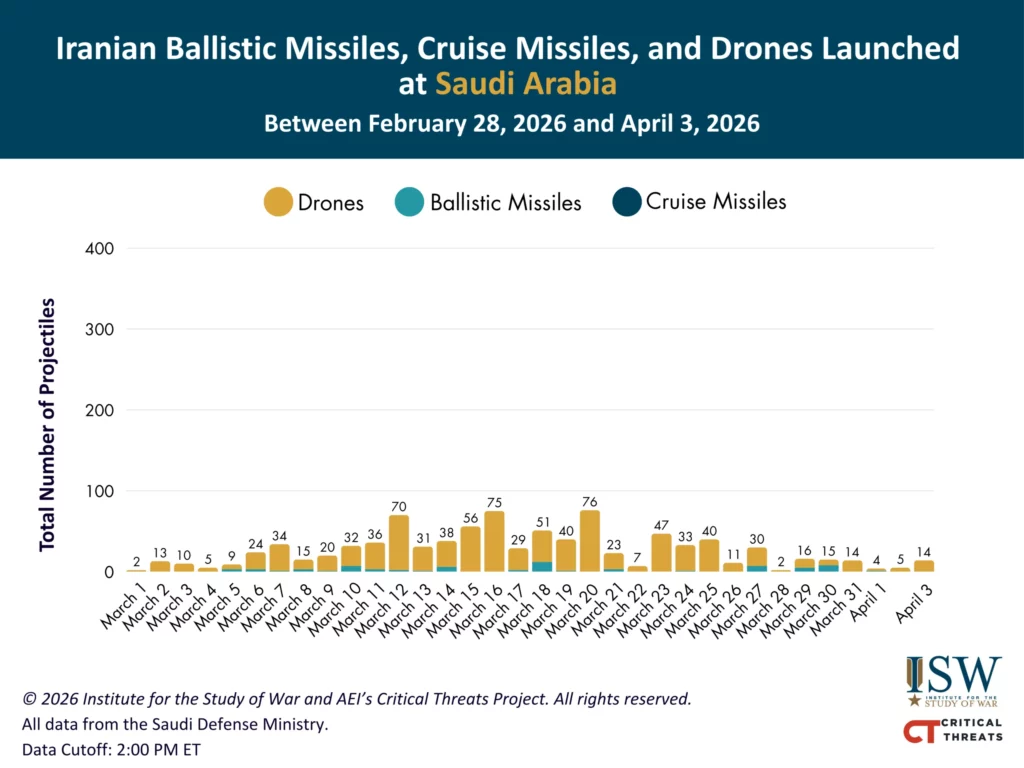
Iran fired 14 drones targeting Saudi Arabia on April 3.[82] Saudi air defenses intercepted all of the drones.[83]
Israeli Campaign Against Hezbollah and Hezbollah Response
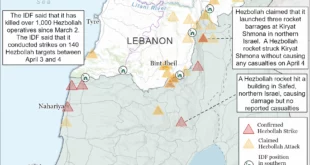
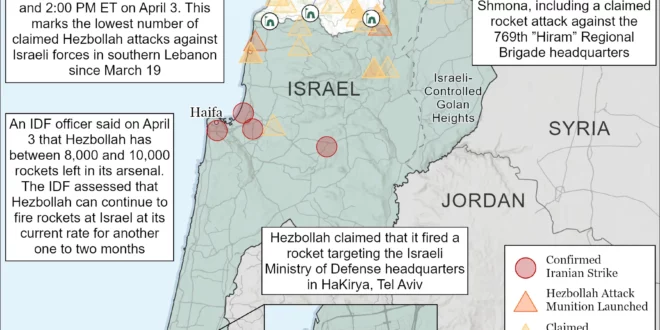
Hezbollah claimed that it conducted 15 attacks targeting Israeli forces in southern Lebanon between 2:00 PM ET on April 2 and 2:00 PM ET on April 3.[84] This marks the lowest number of claimed Hezbollah attacks against Israeli forces in southern Lebanon since March 19. Hezbollah claimed it detonated an improvised explosive device targeting Israeli forces near al Biyyadah, Tyre District.[85] Hezbollah also claimed that it conducted four rocket and mortar attacks on IDF forces near Ainata, Bint Jebeil District.[86]
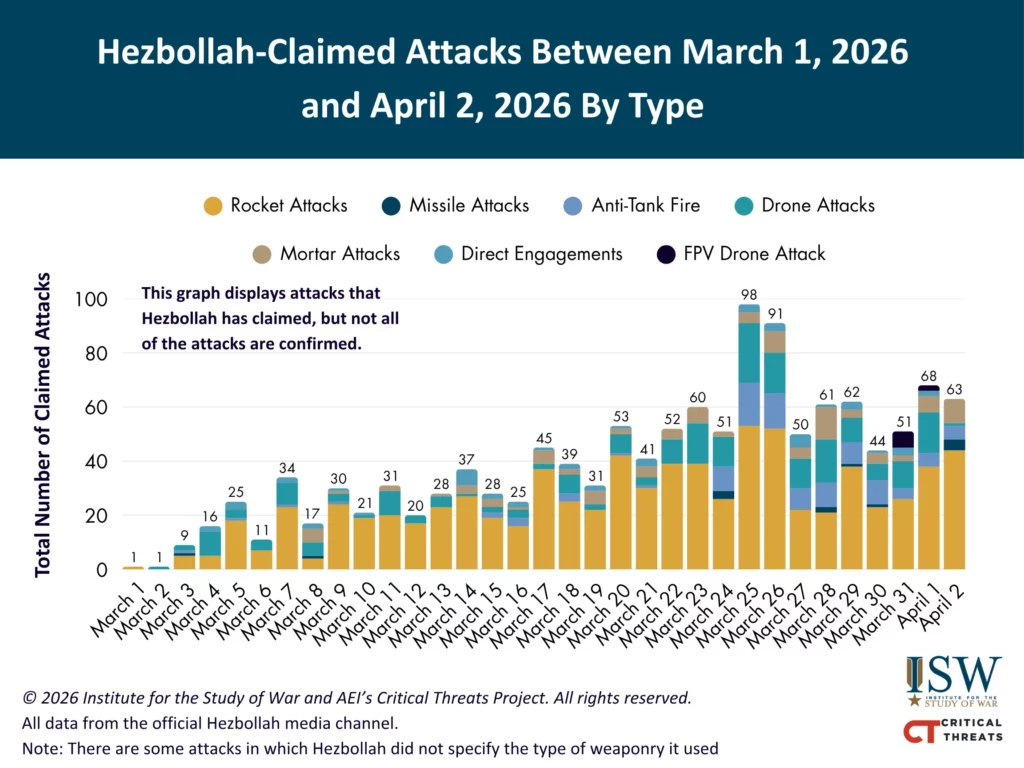
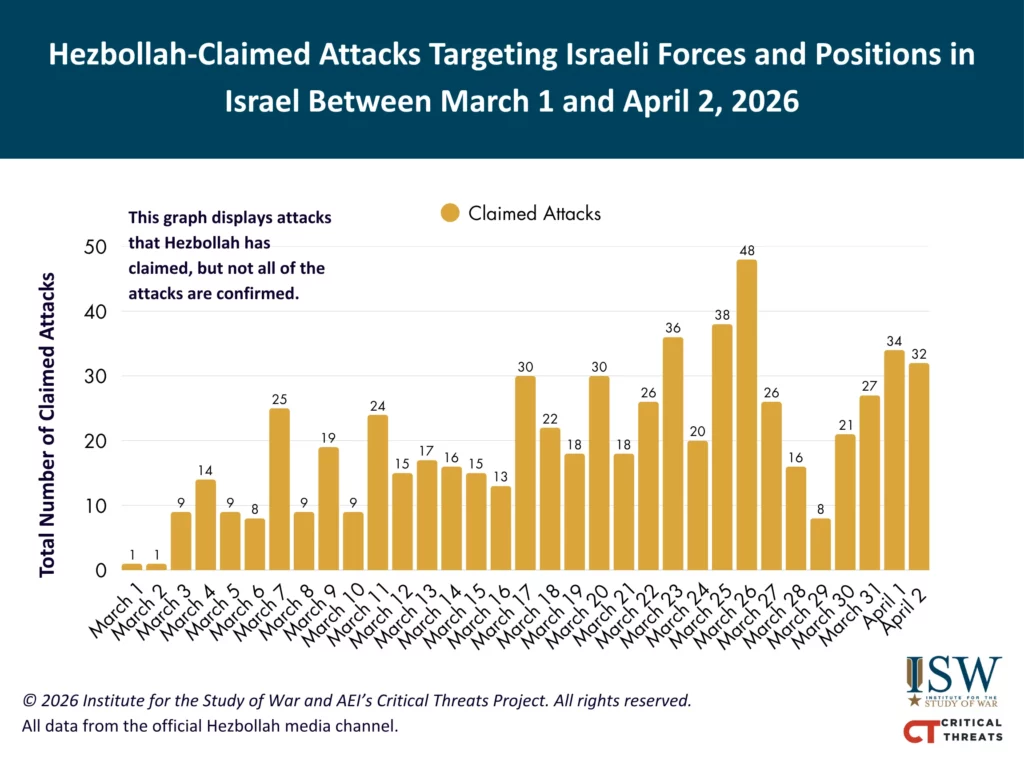
Hezbollah claimed that it conducted 29 attacks targeting IDF infrastructure and Israeli communities in northern Israel between 2:00 PM ET on April 2 and 2:00 PM ET on April 3.[87] Hezbollah published a video in which it claimed that it launched a rocket targeting the Israeli Ministry of Defense headquarters in HaKirya, Tel Aviv.[88] An independent missile analyst assessed that the projectile in the Hezbollah video was a Zelzal rocket that had been retrofitted with a precision guidance system.[89] Hezbollah also claimed it fired a rocket at the 769th (Hiram) Regional Brigade headquarters in Kiryat Shmona.[90] Hezbollah claimed it fired seven additional rockets and drone attacks targeting Kiryat Shmona.[91] Israel issued multiple ”Red Alerts” warnings for Kiryat Shmona on April 2 and 3.[92] An unnamed lieutenant colonel from IDF Northern Command said on April 3 that Hezbollah has between 8,000 and 10,000 rockets left in its arsenal compared with 40,000 before October 2023.[93] The officer said that Hezbollah still maintains between 300 and 400 operable launchers.[94] The officer also said that Hezbollah has launched roughly 70 percent of its rocket attacks on Northern Israel since the start of the war from positions north of the Litani River.[95] ISW-CTP previously assessed on February 28 that Hezbollah would likely use its long-range weapons to conduct attacks against Israel from central and northern Lebanon.[96]
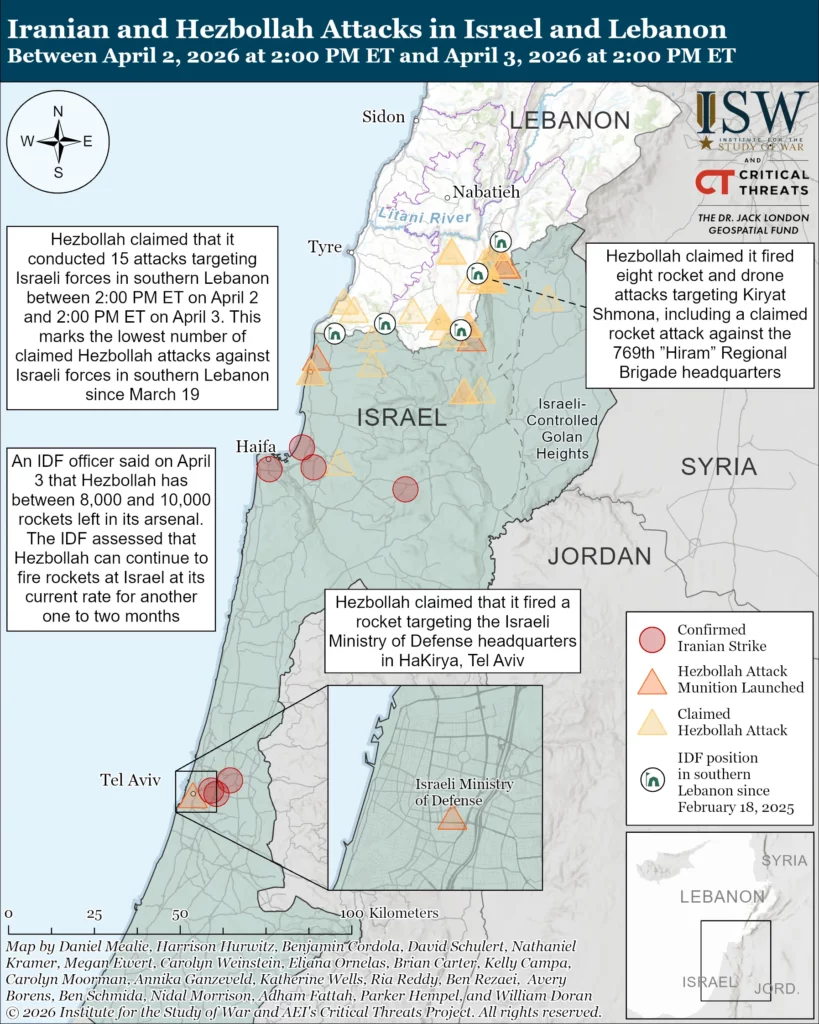
The IDF has continued to strike Hezbollah sites and personnel throughout Lebanon. The IDF said that it has attacked more than 3,500 targets since the start of Israeli operations in Lebanon on March 2.[97] The IDF issued evacuation warnings for Lebanese citizens near two bridges that the Litani River connects Sohmor and Machghara, both in the Western Bekaa District.[98] The IDF reported that Hezbollah used these bridges to move weapons and personnel from northern Lebanon to southern Lebanon.[99] The IDF has previously struck five bridges on the Litani River since the start of the Israeli campaign in Lebanon on March 2.[100]
The IDF continued to conduct ground operations in southern Lebanon on April 2:
Southeastern Lebanon: The Multidimensional (Refaim) Unit (36th Armored Division) has killed more than 40 Hezbollah fighters and carried out around 75 strikes against Hezbollah infrastructure since March 2.[101] The IDF announced that the Multidimensional Unit killed three Hezbollah operatives who were planning to launch rockets at Israel from southern Lebanon on April 2.[102]
Central Southern Lebanon: An Israeli military correspondent reported on April 3 that soldiers from the 50th Battalion, 933rd (Nahal) Infantry Brigade (162nd Division) seized a Hezbollah weapons cache in southern Lebanon.[103] The cache included several first-person view (FPV) drones, a sniper rifle, rocket-propelled grenades (RPGs), small arms, and ammunition.[104] ISW-CTP’s analysis of the imagery indicates that the FPV drones have been fitted with large batteries, and the manufacturers fitted the drones with rocket-propelled grenades that the drones could drop on Israeli forces.[105] Hezbollah previously claimed six FPV drone attacks against IDF armored vehicles between March 31 and April 3.[106] A geospatial analyst reported that the 933rd Infantry Brigade has advanced toward the center of Beit Lif, Bint Jbeil District.[107] The 933rd Infantry Brigade’s reported location suggests that the 933rd Infantry Brigade may have uncovered the Hezbollah weapons cache in the general vicinity of Beit Lif.
Southwestern Lebanon: The IDF reported on April 3 that the 213th Artillery Brigade (Res.) and 226th Paratroopers Brigade (Res.) (both 146th Armored Division (Res.)) directed airstrikes targeting Hezbollah operatives in southwestern Lebanon.[108] The 213th Artillery Brigade directed a separate airstrike that targeted and killed a Hezbollah anti-tank guided missile (ATGM) crew.[109] The 213th also found and seized rifles, flak jackets, and frag grenades at the ATGM crew’s position.[110]
Other Axis of Resistance Response
Iranian-backed Iraqi militias and militia front groups continue to claim attacks against US targets in Iraq and the Middle East. The Islamic Resistance in Iraq, which is a coalition of Iranian-backed Iraqi militias, claimed on April 2 that it carried out 23 drone and rocket attacks against US bases in Iraq and the region.[111] Likely front group Saraya Awliya al Dam claimed on April 2 that it conducted five attacks against US bases in Iraq and the region.[112] Likely front group Jaysh al Ghadab claimed it launched an unspecified number of drone attacks against “Zionist-American” interests in northern Iraq and Bahrain on April 2.[113]
Iranian-backed Iraqi militias continued to target Baghdad International Airport on April 2 and 3. Likely Iranian-backed Iraqi militia front group Saraya Awliya al Dam released undated FPV drone footage on April 2 showing an attack targeting fuel tanks at Camp Victory, a former US military base located at the Baghdad International Airport.[114] An Iraq analyst reported on March 17 that Saraya Awliya al Dam is a front group for Kataib Sayyid al Shuhada.[115] A security source told Iraqi media on April 2 that two likely Iranian-backed Iraqi militia drones struck the diplomatic support center at the Baghdad International Airport, causing unspecified damage.[116] A separate Iraqi security source told Iraqi media on April 2 that two additional Iranian-backed Iraqi militia drones targeted the diplomatic support center, but neither drone hit the facility.[117] Another Iraqi security source told Iraqi media on April 3 that a likely Iranian-backed Iraqi militia drone targeted the diplomatic support center but again failed to hit the facility.[118] Iranian-backed Iraqi militia have continuously targeted the Baghdad International Airport and its co-located facilities, including the former US military base Camp Victory and the Iraqi Mohammad Alaa Airbase, since the war began.[119] Iranian-backed Iraqi militia Kataib Hezbollah similarly conducted a FPV drone attack on the Victory Base on March 15.[120]
Iranian-backed Iraqi militias targeted the Trebil border crossing on the Iraq-Jordan border on April 2. A security source told Iraqi media on April 2 that a likely Iranian-backed Iraqi militia drone “crashed” near the Iraq-Jordan Trebil border crossing in western Anbar Province.[121] The source said that the drone did not cause any damage or casualties.[122] It is unclear which militia or actor conducted the attack. A front group for Harakat Hezbollah al Nujaba claimed to fire drones targeting US and Israeli interests in Jordan on March 24.[123]
The US-Israeli combined force continued to strike Iranian-backed Iraqi militia targets to prevent Iranian-backed militia attacks against US interests and Israel. An Iraqi security source told Iraqi media on April 2 that an airstrike hit the 30th Popular Mobilization Forces (PMF) Brigade in Bartella, Ninawa Province, causing no casualties.[124] The 30th PMF Brigade is affiliated with the Badr Organization.[125]