 Eurasia Press & News
Key Takeaways:
The article argues that high-endurance extra-large uncrewed underwater vehicles (XLUUVs) can disperse risk and perform persistent ISR, mine countermeasures, anti-submarine warfare, and other missions at lower cost than crewed submarines, while acting as force multipliers alongside traditional undersea platforms.
Technological advances in endurance, quieting, and autonomy are enabling concepts such as drone motherships and torpedo-armed XLUUVs, but the piece notes that doctrine on human authorization, attribution, and escalation has lagged behind these capabilities.
For India, whose submarine numbers are projected to decline, the authors recommend co-development partnerships, dedicated funding for indigenous programs such as Jalkapi, and modular architectures to integrate XLUUVs into a hybrid undersea force structure.
The recent seizure of a US military underwater drone (Anduril Dive-LD) by Iran near the Strait of Hormuz has brought into focus uncrewed underwater vehicles (UUVs) and their role in contemporary naval operations. This episode, albeit different, comes nearly 10 years after an American UUV was seized by Chinese naval forces in the South China Sea and then promptly returned after Washington lodged a formal diplomatic protest.
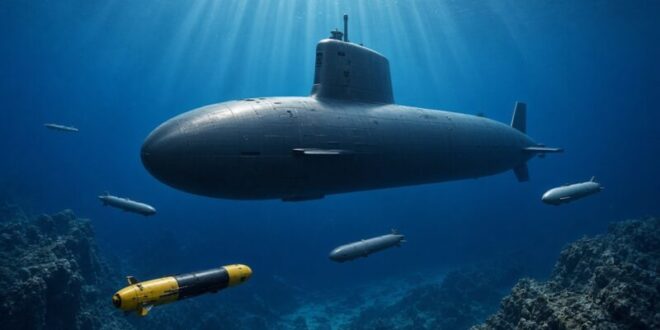
In the intervening time, UUVs have evolved from rudimentary, low-cost reconnaissance tools to sophisticated, multi-purpose systems that can support traditional undersea missions and sometimes even substitute for conventional assets during low-intensity maritime operations. Among them, the development of high-endurance extra-large uncrewed underwater vehicles (XLUUVs) is particularly significant, as naval forces envision these platforms eventually augmenting, and possibly replicating, a submarine’s tactical and strategic role in their undersea force structure. The succeeding analysis examines these uncrewed submersible platforms, tracks their latest technological developments, and assesses their viability for contemporary undersea warfighting.
The Strategic and Tactical Imperatives of XLUUVs in Undersea Warfare
For decades, submarines have been regarded as the principal underwater platform capable of translating a navy’s undersea strategic posture, whether it be sea-denial or sea control, into real-time operational resilience. They provide a decisive advantage because they can be deployed for a wide range of missions, from broad-area maritime surveillance to long-range targeting. As the Commander of Submarine Forces, United States Navy, recently stated, “these missions do not simply create tactical advantages; they influence adversary calculations at the strategic level.” However, recent advances in undersea sensing, assisted by machine-learning software, are diminishing the refuge of dark oceans that submarines currently benefit from. In this context, developing a fleet of uncrewed submersible platforms such as XLUUVs disperses that risk. This is not because the role of a submarine is becoming obsolete, but because the economics and operational logic of undersea warfare are gradually changing.
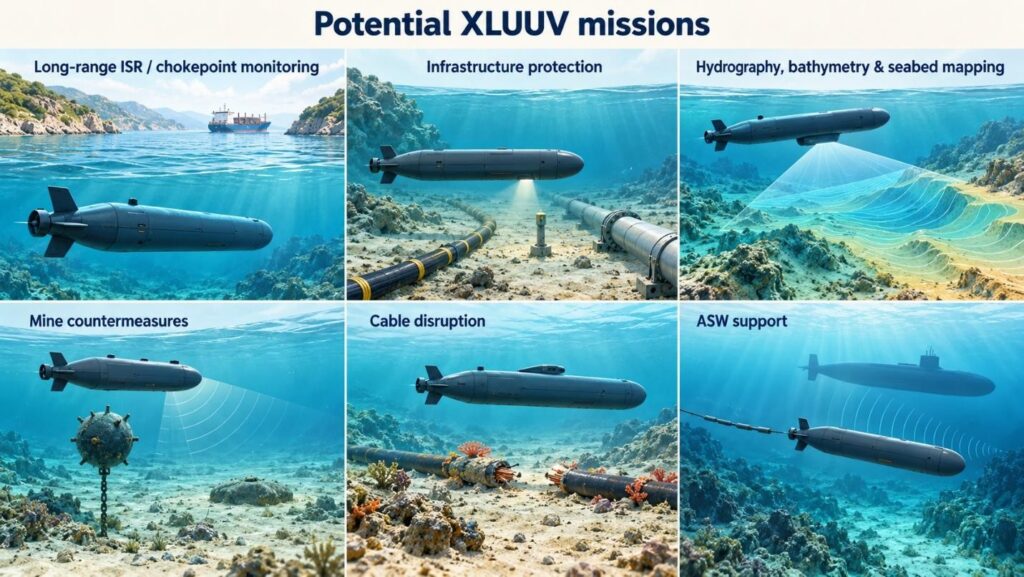
High-endurance XLUUVs currently under research and development worldwide can operate at greater depths, with larger operational range, and carry multiple mission-configurable payloads than other UUVs. Moreover, such platforms are also being endowed with increasing degrees of autonomy, allowing their deployment for dual-use undertakings such as long-range Intelligence, Surveillance, and Reconnaissance (ISR), protection of critical underwater infrastructure (CUI), mine countermeasures (MCM), hydrographic surveys, bathymetry, and seabed mapping. Moreover, these platforms can also be tasked with specialised offensive missions such as cutting undersea cables, monitoring contested chokepoints, and conducting anti-submarine warfare (ASW).
Figure 1: A Visual Overview of the Missions an XLUUV can Undertake
Operational Trends in XLUUV Development
Ideally, such platforms should be deployed alongside crewed submarines, handling the “dull, dirty and dangerous” missions that require attritability and persistence more than human judgment or firepower. Their advantage is persisting inside severely denied battlespaces and acting as force multipliers by extending sensing, increasing coverage, and complicating adversary defences. This lets submarines conserve stealth and endurance for deterrence and focus on sea denial, precision strike, and high-end combat. Moreover, technological advances in fuel-cell endurance, acoustic quieting, and AI-enabled navigation are enabling novel operational concepts for XLUUVs.
China and Russia’s development of ‘motherships’ for uncrewed vehicles demonstrates one such concept, in which larger ‘drone motherships’ can carry and deploy underwater payloads. This can possibly extend the existing operational endurance and range of XLUUVs. Meanwhile, US and allied naval forces such as the UK are testing the ability to launch armed torpedoes from XLUUVs, envisioning a resilient undersea kill-web in which XLUUVs not only support submarines through sensing but, if required, will complete the kill-chain themselves. Traditionally, submarines have functioned as self-contained combat platforms, carrying out the undersea kill chain by themselves. Such lethally capable XLUUVs would challenge this linear, platform-centric model by redistributing these targeting functions across a layered undersea architecture, while possibly also compressing the decision-action cycle for naval commanders.
The Economics of Hybrid Force Design
Economically, the cost of a high-endurance XLUUV capable of operating at deeper sea levels and equipped with specialised payloads, while significant, is comparatively much lower than the capital outlay required for a modern diesel-electric submarine. However, this cost claim does not include the steep research and development expenses incurred to transform an initial XLUUV prototype into a fully functioning deep-sea platform. The US Navy’s Orca programme is one such example, where the cost escalation since the initial award of contract demonstrates the cost variance between designing such a platform and then actually deploying it.
In this regard, TJ Milledge’s techno-economic approach to undersea domain awareness argues that naval force planning should optimise the combination of capabilities within finite budgets rather than over-relying on any single platform. Essentially, navies need to balance resources allocated to the research and development of uncrewed submersible programmes with their spending on the development, acquisition and sustainment of next-generation crewed submarines. Bryan Clark makes a similar proposition, stating that undersea superiority will not depend on expanding homogeneous fleets, whether crewed or uncrewed. Instead, he argues that by integrating specialised autonomous systems with legacy submersible platforms in a complementary way, navies can achieve greater operational flexibility and resilience at lower cost.
The Doctrinal Question
Global XLUUV development is currently centred on the level of autonomy these submersible platforms can achieve. The desire for an extra-large, highly autonomous undersea vehicle (XLAUV) with a lethal payload currently drives global research and development, as it can be tasked with most missions currently performed by a submarine. However, this growing sophistication exposes the fact that technology is advancing faster than the doctrine needed to command, trust, and regulate such submersible platforms. The dilemma remains whether navies can trust them with decisions that carry operational and strategic consequences. As programmes advance towards carrying kinetic payloads, the focus shifts from technology to authority. Where should the boundary between autonomous execution and human authorisation be drawn, and how do attribution and escalation work in an opaque arena such as the undersea domain?
At the same time, the harsh operational realities of the underwater environment, including communication constraints, naturally force greater reliance on autonomous decision-making. Therefore, unless such issues are addressed and doctrine advances in parallel with technology, autonomous system-of-systems cooperation risks becoming an operational liability rather than a strategic advantage. To navigate and manage this impending evolution in undersea warfighting, nations need a clear-eyed assessment of where the rules for action and the lines of sub-conventional escalation will be drawn. Otherwise, a situation in which autonomous XLUUVs from opposite sides meet and engage, escalating the encounter into conventional hostilities, is no longer implausible.
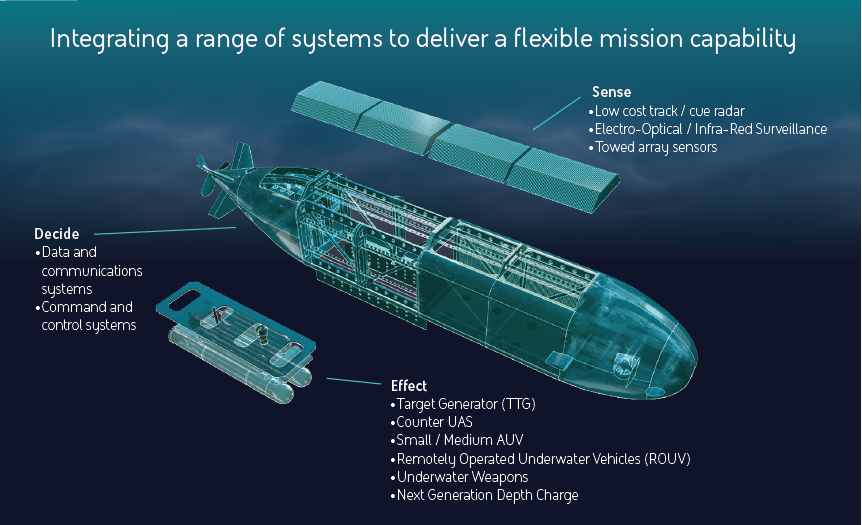
Figure 2: The Various Modular Payloads Possible for an XLAUV
Counter-XLUUV Technology
The corollary of XLUUV proliferation is the need for navies to simultaneously invest in ways to counter such submersible platforms. Low-cost uncrewed systems have already demonstrated their asymmetric value in the aerial domain. Similarly, navies need to innovate cost-effective ways to detect, classify, track, and neutralise adversary UUVs. Otherwise, navies will face a significantly high cost-to-kill ratio. Given the opacity of the underwater domain, navies may benefit from adopting a distributed undersea architecture rather than competing platform-for-platform.
Recent exercises have shown that combining multi-static acoustic sensing with AI-enabled software and a reliable acoustic library can reliably detect underwater drones. Technologies like compact quantum magnetic sensors are also being developed to better pinpoint submersible platforms at sea. Likewise, navies are developing soft-kill measures, including acoustic deception, acoustic jamming, and inertial spoofing. As XLUUV operations evolve, navies will likely invest in specialised hard-kill measures, such as anti-XLUUV torpedoes and interceptors.
Consequences for India
Inducting XLUUVs into India’s undersea force structure carries logic given its many strategic and tactical demands in the undersea domain. Moreover, given the vast geography the Indian Navy must monitor to pursue its ASW mission, an Indian XLUUV fleet will also ensure its limited submarines remain available for complex missions, especially protecting its nuclear submarine fleet. This becomes especially significant because the Indian Navy’s submarine fleet is expected to decline over the next five years. Reports indicate that indigenously manufactured Indian XLUUVs, such as the Jalkapi programme, are being tested and entering production; however, such systems have not yet been deployed or tested at scale.
To accelerate capability development, New Delhi’s best option is to co-develop a fleet of large uncrewed submersibles with a partner country such as the UK, US, Australia or Russia. While this strategy runs counter to the country’s current streak of complete indigenisation in defence procurement, inaction risks eroding New Delhi’s deterrence in the undersea domain. These co-development partnerships could help advance progress in advanced underwater payloads for sensing, navigation, and communications, without compromising India’s indigenisation objectives.
As part of its long-term vision, the Indian Navy has already outlined plans to induct an uncrewed underwater fleet into its force structure. However, the research and development costs of an indigenous XLUUV programme are beyond what private industry can currently bear alone. Defence policymakers need to earmark a special capital outlay to incubate XLUUV research, develop competing prototype models, and rapidly integrate them into operational testing. Additionally, the Indian Navy must prioritise modular architectures, interoperable communications, and common mission-data standards, backed by joint testing between naval operators, research laboratories, and industry. Furthermore, it should adopt technical specifications that have proven successful worldwide, rather than impose unique specifications. With focused investment, a clear call to action, and well-defined operational concepts, India can formulate for this new era of hybrid undersea warfare.
Conclusion
Crucially, the lessons that apply to India also apply to a number of countries planning to induct conventional- or nuclear-powered submarines into their fleets. With the Indo-Pacific currently witnessing a boom in submarine proliferation, adding large uncrewed submersibles to that equation means an increasingly congested and contested undersea domain. Regional actors, including India, need to address this brewing security dilemma and build a cohesive undersea deterrence architecture. Crewed submarines will continue to underpin this architecture, but solving the dark ocean equation will require technology and doctrine to advance together, with an expansion to autonomous uncrewed fleets requiring clear rules of action.