 Eurasia Press & News
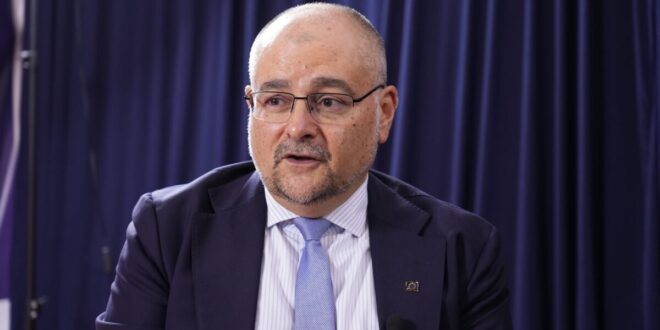
Gilles Bertrand, the European Union’s special envoy for Afghanistan, in an exclusive interview with Amu described Russia’s recognition of the Taliban as an “unhelpful” move, warning it could undermine international consensus and embolden unilateral actions.
Bertrand said that engagement with the Taliban should be conditional on respect for Afghanistan’s international obligations — including human rights and political inclusivity.
“I do not think this was a helpful move,” Bertrand said of Russia’s recognition. “There is a consensus in the international community that we should progress on these issues as long as there is respect for the international commitments of the country — the very conventions that were signed by Afghanistan, including the Rome Statute.”
Moscow officially recognized the Taliban government on July 2, 2025 — becoming the first country to do so. The decision followed years of gradual rapprochement after the Taliban’s return to power in 2021. Russia had previously designated the Taliban a terrorist organization, a status that was suspended by its Supreme Court earlier this year.
Bertrand said the EU remains committed to maintaining international unity on Afghanistan policy. “It is important to maintain that consensus,” he added.
Taliban-Pakistan tensions
Amid heightened tensions and intermittent clashes between Taliban and Pakistani border forces, Bertrand urged both sides to return to dialogue.
“We should not open a new page of violence,” he said, cautioning that territorial and security concerns on both sides must be addressed diplomatically. “We believe Turkey and Qatar have been making a very positive effort in hosting talks. There is no military solution to this situation.”
The Taliban and Pakistan were engaged in their worst border clashes in years last month, resulting in days-long fighting, dozens of casualties, and the closure of key trade crossings. While a temporary ceasefire was reached during talks in Doha, two subsequent rounds in Istanbul failed to produce an agreement. A recent skirmish in Spin Boldak reignited tensions, with both sides accusing each other of violating the truce.
Human rights
Bertrand expressed strong concern over the Taliban’s systematic exclusion of women and ethnic groups from governance, calling it a central obstacle to any sustainable political settlement.
“Without substantial progress on human rights, particularly on women’s rights, there will be no durable solution,” he said. “When you ask people in Europe what comes to mind when they hear ‘Afghanistan,’ sadly, the answer is often women’s oppression.”
Bertrand argued that the current Taliban leadership lacks the political will seen in earlier post-conflict years. “In 2002–2004, Afghans had hope — hope for peace, for rebuilding. That hope is now gone.”
Terror threats
Despite a reported reduction in Islamic State Khorasan Province (ISKP) activity, Bertrand warned that the group remains a threat — as do other regional terrorist networks.
“ISKP might be down, but it’s not out,” he said. “The presence of armed terrorist groups on Afghan soil remains a serious concern. We know from experience how quickly these groups can morph and become a threat to the host country and the broader region.”
Bertrand added that while the Taliban have made some progress in fighting ISKP, their approach to other terrorist groups operating in Afghanistan has been less convincing.
Dialogue and regional cooperation
The envoy said his mandate involves working with regional powers to chart a path forward. In his first six weeks, he has visited Qatar, the UAE, and Turkey, and will meet Central Asian envoys in Brussels next week to discuss shared security concerns.
“Some of these contacts have been discreet, but they are focused on mutual respect for territorial integrity and security concerns,” he said.
Bertrand also reaffirmed the EU’s commitment to Afghan women and girls. “We have not abandoned them. We continue to raise their rights in every engagement with the de facto authorities.”
The Doha Process
Bertrand underscored the EU’s support for the Doha Process — a UN-led multilateral framework for coordinated international engagement on Afghanistan.
“There is an international consensus around the core principles of the Doha Process: respecting human rights, honoring international commitments, and promoting political inclusivity. It remains the only game in town.”
The process has recently shifted to working groups on counter-narcotics and private sector development, but Bertrand insisted it remains a critical platform for dialogue.