 Eurasia Press & News
An Israeli attack on Sunday killed one of Hezbollah’s top leaders, threatening to unravel a November 2024 ceasefire that has kept most of the Lebanese population out of the crossfire.
Hezbollah has been rebuilding its missile and drone arsenal, but its capacity to retaliate is limited by continued military weakness and pressure from Beirut to avoid embroiling Lebanon in another war against Israel.
The attack will further aggravate tensions between Beirut and Washington over the slow pace and modest scale of the Lebanese government’s efforts to disarm the group.
The Trump administration’s cancellations last week of a high-profile visit from the Lebanese Armed Forces (LAF) commander will set back U.S. efforts to assist and empower the LAF to demobilize Hezbollah.
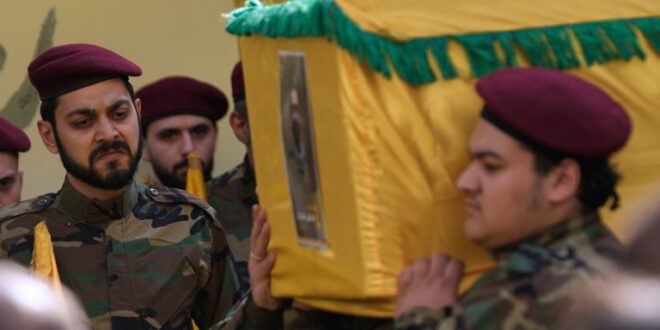
Israel’s escalation against the leaders and military infrastructure of Lebanese Hezbollah is clouding the November 2024 ceasefire between the two combatants. The truce has, to date, spared the vast bulk of Lebanon’s population from renewed conflict. On Sunday, the potential for the agreement to break down increased substantially after Israel resumed its earlier pattern of targeting the group’s top leadership. An Israeli strike on the Hezbollah stronghold in the southern suburbs of Beirut killed Haytham Ali Tabatabai, known as “Abu Ali,” the chief of staff of Hezbollah’s military wing. Lebanon’s state-run news agency said the strike targeted an apartment in Dahiyeh, a densely populated cluster of neighborhoods on the outskirts of Beirut, where Hezbollah has long held sway. At least five people were killed in the airstrike, and more than 25 were injured, according to the Lebanese health ministry. The strike came one week before Pope Leo begins a visit to Lebanon on Sunday, diluting what is expected to be a message of peace from the Pontiff.
Israel’s strike on Tabatabai reflects its belief that decapitating the group would prevent it from rebuilding its military strength and deterrent capability. Some regional sources described Tabatabai as the de facto leader of the group, with more influence over the group’s policies than nominal leader Secretary-General Naim Qassem, even if Tabatabai’s formal role was confined to militia affairs. He previously led Hezbollah’s elite Radwan unit, which Israel, in ceasefire negotiations last year, insisted be moved off Israel’s borders. He also reportedly led Hezbollah’s special forces in Syria — operatives that were forced to leave Syria after the Assad regime collapsed at the hands of Sunni Islamists last December.
Israel made clear the strike was intentional and calculated. The office of Israeli Prime Minister Benjamin Netanyahu issued a statement acknowledging the deliberate targeting, claiming Tabatabai had been leading Hezbollah’s efforts to regroup. According to the Netanyahu statement: “My policy is clear: Under my leadership, Israel will not allow Hezbollah to build its power anew and again constitute a threat.” The attack represented a further escalation after a period of near-daily strikes on southern Lebanon, including some on Beirut, suggesting Israeli intelligence has corroborated a wide range of reporting that Iran has found routes and methods to resupply Hezbollah. Iran and Hezbollah reportedly want the group to rearm not only to defend against Israel, but also to stiffen the group’s ability to resist U.S. pressure on Beirut to disarm it.
The Israeli escalation, which appears to violate the understandings of the November 2024 ceasefire, immediately threw the truce into question. In a televised speech Monday, Hezbollah Secretary-General Naim Qassem accused Israel of violating the truce, saying: “The [Israeli] aggression is the problem…not the resistance, not the Lebanese state’s institutions, nor the army.” He warned that those who portray Hezbollah as the problem “because it is not surrendering,” (i.e., agreeing to disarm completely) are effectively accepting that Lebanon should be surrendered to Israel.” On Sunday, a subordinate leader, Mahmoud Qomati, deputy head of the Political Council of Hezbollah, accused the Trump team of complicity, saying: “There is no choice but to adhere to resistance, and it is impossible to accept the continuation of this violation…Today’s aggression on Dahiyeh crosses a new red line and an American green light for escalation.”
However, the Hezbollah leadership’s statements did not threaten that the group itself would retaliate. Instead, reflecting Hezbollah’s reduced political influence within Lebanon, Qassem and his associates called on the Lebanese government to respond to Israeli violations. But Beirut, which in September acquiesced to U.S. insistence that the LAF disarm Hezbollah nationwide, gave no indication it would risk conflict with Israel by retaliating militarily on Hezbollah’s behalf. Representing the Lebanese state, President Joseph Aoun rhetorically condemned the attack. He accused Israel of rejecting “all the efforts and initiatives put forward to end the escalation.”
Iran’s Islamic Revolutionary Guard Corps (IRGC), which has armed and advised Hezbollah in large part to deter the U.S. and Israel, assumed a more assertive posture by threatening an armed response to the Israeli strike. The IRGC posted on its social media accounts that “revenge” for the targeted killing “will be at its scheduled time” and that the response to Israel “will be crushing.” However, experts judge it unlikely either Hezbollah or Tehran would take any concrete kinetic action, assessing that doing so would likely restart all-out Israel-Hezbollah conflict as well as the Twelve Day War between Iran and Israel. Some hardliners in Hezbollah and the IRGC nonetheless argued that a failure to respond militarily would indicate Hezbollah had lost its deterrence capabilities. This perception could embolden Netanyahu to continue escalating against the group.
The Israeli targeted killing is sure to aggravate the tensions between Washington and Beirut on the pace and scope of the LAF’s efforts to disarm Hezbollah. Trump’s team has adopted Israel’s interpretation of the ceasefire as requiring Hezbollah’s disarmament countrywide. Trump officials have been visiting Beirut continuously during the past several months to pressure the government to accelerate implementation of its September executive order — issued at Washington’s insistence — to fully disarm Hezbollah. Despite the Trump team’s pressure, Beirut has calibrated its disarmament efforts to avoid sparking armed confrontation with Hezbollah, which would surely trigger broader civil conflict with the Shia community that constitutes the group’s political base. The Lebanese government also fears that confronting Hezbollah directly could fracture the LAF.
Implementing its cautious approach, the Beirut government has focused on dismantling Hezbollah positions south of the Litani River, consistent with the emphasis of the ceasefire and of UN Security Council Resolution 1701 on the areas of Lebanon that border Israel. To date, the LAF has dismantled hundreds of Hezbollah sites and weapons depots in southern Lebanon. According to U.S. Central Command (CENTCOM), the military has removed nearly 10,000 rockets, almost 400 missiles, and more than 205,000 pieces of unexploded ordnance from the south over the past year. The United Nations Interim Force in Lebanon (UNIFIL), which was mandated by Resolution 1701 to help the LAF keep the border areas free of both Hezbollah and Israeli forces, says it has helped the LAF redeploy to more than 120 positions in southern Lebanon and supported its efforts to clear roads and unexploded munitions.
Hezbollah leaders, backed by their IRGC patrons, oppose relinquishing the group’s weapons, with the exception of south of the Litani. The organization argues it is not required by the November ceasefire to disarm entirely, and claims the LAF is too weak to defend Lebanon against Israel. Hezbollah has used Israel’s continued occupation of several points of high ground in south Lebanon, as well as its continued air strikes, to support its resistance to full disarmament. Secretary-General Qassem recently stated: “The Lebanese army deployment south of the Litani River, despite the continued [Israeli] aggression, is a concession,” adding that Israel has not implemented any obligations under the ceasefire and that the United States has offered “no guarantees.”
Fueling tensions with Beirut, Trump’s team has been ratcheting up its criticism of what the team says is “foot-dragging” by Beirut to dismantle the group’s military infrastructure. Last week, Trump officials cancelled a visit to Washington by the LAF Commander, General Rodolphe Haykal, over the LAF’s statement that blamed Israel for the escalation in Lebanon without referencing any Hezbollah provocations. The LAF statement in question, issued after UNIFIL came under Israeli fire in south Lebanon, said: “The Israeli enemy persists in its violations of Lebanese sovereignty, causing instability in Lebanon and hindering the completion of the army’s deployment in the south.” The announcement prompted significant criticism of Beirut from several members of the U.S. Congress, putting pressure on Trump to cancel Haykal’s trip.
Experts argue that cancelling the visit was counterproductive. Haykal’s visit was intended to advance the Washington-Beirut dialogue on how the U.S. can help the LAF perform the Hezbollah disarmament mission, as well as persuade Israel to fully abide by the ceasefire terms, including withdrawal from all Lebanese territory. Specifically, Haykal sought to discuss a new U.S. assistance program for the LAF, which would presumably help empower the force to demobilize Hezbollah more thoroughly. The U.S. has been one of the LAF’s main supporters, providing more than $3 billion in assistance to bolster Lebanon’s internal security and border patrol over the past 18 years, according to the State Department. Last month, the U.S. delivered $190 million in military aid as part of a broader $230 million package for Lebanon’s security forces. The assistance includes direct financial support, equipment, and training programs. In March, the Trump administration approved a $95 million military assistance package for the Lebanese military — despite a 90-day freeze on foreign aid — a move analysts saw as support for Lebanon’s military and government amid tensions with Hezbollah.