 Eurasia Press & News
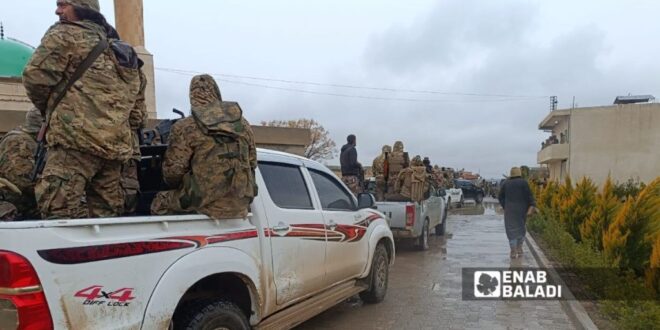
Syrian government forces and the Syrian Democratic Forces (SDF) are massing at the entrances to al-Hasakah city (northeastern Syria) after a meeting between Syrian President Ahmed al-Sharaa and SDF commander Mazloum Abdi failed on Monday, 19 January.
Enab Baladi obtained information from sources familiar with the negotiations between the two sides indicating that the meeting lasted about four consecutive hours. During it, al-Sharaa offered Abdi a government post, and proposed nominating a name for al-Hasakah governor, on the condition that the SDF break away from the Kurdistan Workers’ Party (PKK).
Abdi asked that al-Hasakah remain under the SDF’s civil and military leadership, but the Syrian president rejected this, stipulating that personnel from the Ministries of Interior and Defense enter the area to finalize the agreement.
Abdi also asked al-Sharaa for a five-day deadline to consult SDF leaders, but al-Sharaa refused as well.
Fawza Youssef, a member of the co-presidency body of the Democratic Union Party (PYD) and a negotiator representing the SDF, said the meeting between Mazloum Abdi and al-Sharaa “was not positive.”
Speaking to Rudaw (based in the Kurdistan Region of Iraq), she said Damascus wants the Kurds to hand over everything, and wants “Rojava” (Syrian Kurdistan) to return to what it was before 2011.
She said surrender is unacceptable for the SDF, and that the government wants to dismantle its institutions and does not want Kurds to obtain their rights.
Youssef also accused Islamic State members of participating alongside the government in its assault on the SDF.
The agreement signed by the two sides yesterday, under US sponsorship, stipulates that the Syrian government take over all border crossings and oil and gas fields in the region, and that regular forces secure them to ensure state revenues return to the Syrian state.
It also provides for integrating all SDF military and security personnel into the structures of Syria’s Ministries of Defense and Interior on an “individual” basis after the necessary security vetting, granting them military ranks and financial and logistical entitlements in line with regulations, while protecting the privacy of Kurdish areas.
Its option is “resistance”
For his part, SDF spokesperson Farhad Shami called on Kurdish-populated areas, meaning eastern Syria, the Kurdistan Region of Iraq, and southern Turkey, as well as Kurdish youth in Europe, to resist.
In a post on X, Shami said he would turn Derik (al-Malikiyah), (northeastern al-Hasakah countryside, near the Iraqi border), al-Hasakah, and Kobani/Ain al-Arab (northern Aleppo Governorate, near the Turkish border) into “a graveyard for a new generation influenced by (Islamic State), led by the Turkish state,” as he put it.
The Autonomous Administration, the governing arm of the SDF, had previously called for arming and general mobilization to confront the government offensive, which seized large areas that the SDF had controlled in eastern Syria.
Enab Baladi’s correspondent in al-Hasakah reported the start of arming efforts and the mobilization of anyone able to carry weapons in neighborhoods across al-Hasakah city.
The army mobilizes toward al-Hasakah
On the other side, the Syrian army is mobilizing its forces toward al-Hasakah city after the agreement’s failure, according to a military source who spoke to Enab Baladi.
The source said the army shelled SDF positions in preparation for a broad military operation aimed at taking control of the entire region.
As of the time of publishing, the government had not issued any statement regarding today’s meeting between al-Sharaa and Abdi, or the opposing deployments.
A 14-point agreement
Syrian President al-Sharaa met Abdi in Damascus today to complete the agreement signed by the two sides yesterday, Sunday.
The agreement included 14 points:
An immediate, comprehensive ceasefire on all fronts and front lines between government forces and the SDF, and the withdrawal of all SDF military formations to east of the Euphrates as a preliminary step toward redeployment.
The immediate handover of Deir Ezzor (eastern Syria) and Raqqa (northern Syria) governorates, administratively and militarily, fully to the Syrian government, including all civil institutions and facilities.
Immediate decisions to confirm current employees within the relevant state ministries, and a government commitment not to target SDF personnel and employees of the civil administration in the two governorates.
The integration of all civilian institutions in al-Hasakah Governorate (northeastern Syria) into Syrian state institutions and administrative structures.
The Syrian government taking full control of border crossings and oil and gas fields in the region, and securing them through regular forces to ensure resources return to the Syrian state.
The integration of all SDF military and security personnel into the structure of Syria’s Ministries of Defense and Interior on an individual basis after the required security vetting, granting them ranks and financial and logistical entitlements in accordance with regulations, while protecting the specific character of Kurdish areas.
The SDF leadership’s commitment not to incorporate remnants of the former regime into its ranks, and to provide lists of former regime officers present in northeast Syria.
A presidential decree appointing a nominee to serve as governor of al-Hasakah, as a guarantee of political participation and local representation.
The removal of heavy military presence from the city of Ayn al-Arab/Kobani (northeastern Aleppo countryside), forming a security force from local residents, and maintaining a local police force that is administratively affiliated with Syria’s Ministry of Interior.
Integrating the administration responsible for the Islamic State detainees and camp file, along with the forces guarding these facilities, with the Syrian government, so the government assumes full legal and security responsibility.
Adopting a list of nominated leaders submitted by the SDF leadership to fill senior military, security, and civilian posts within the central state structure to ensure national partnership.
Welcoming Presidential Decree No. 13 of 2026, which recognizes Kurdish cultural and linguistic rights and addresses the legal and civil issues of unregistered persons (maktoumei al-qayd), as well as restoring accumulated property rights from previous decades.
The SDF’s commitment to remove all non-Syrian Kurdistan Workers’ Party (PKK) leaders and members from Syrian territory to ensure sovereignty and regional stability.
The Syrian state’s commitment to continue combating terrorism (ISIS) as an active member of the International Coalition, with joint coordination with the United States in this framework to ensure security and stability in the region.
Working toward understandings related to the safe and dignified return of residents of Afrin (northwestern Aleppo countryside) and al-Sheikh Maqsoud neighborhood (Aleppo city) to their areas.
Developments accelerated following an agreement between the government and the SDF that provided for the SDF’s withdrawal from Deir Hafer (eastern Aleppo countryside) to west of the Euphrates. The area then saw widespread clashes that ended with the government taking control of all of Deir Ezzor Governorate and Raqqa city, after tribal movements against the SDF.