 Eurasia Press & News
The National’s interviews with residents, local officials and commanders reveal a complex picture of a scarred city
Entering Sweida, the southern heartland of Syria’s Druze community, feels like crossing into another country.
Visitors to the city must pass through a series of checkpoints. The first is run by Damascus-controlled forces, followed by several operated by local groups, who closely check visitors’ documents against an approved list of names.
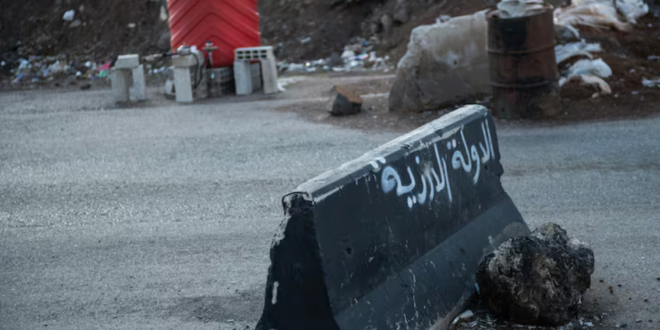
At the final barrier, signs welcome visitors with slogans referring to the “Druze nation”.
Sweida and parts of its surrounding countryside barricaded themselves off amid growing animosity towards Damascus, after hundreds of Druze civilians were killed in July, as clashes between Bedouin fighters aligned with the government and Druze militiamen spiralled into sectarian bloodletting. Human rights groups and residents have accused Syrian security forces of taking part in the killing.
Israel, which also has a significant Druze community, bombed government forces during the clashes. It positioned itself as a champion of the religious minority, who make up about 3 per cent of Syria’s population. The show of force was widely welcomed by Sweida’s Druze and emboldened their dream of autonomy.
“We demand the right to self-determination because we can no longer live with them,” Shadi Murshid, a former judge recently appointed commander of Sweida’s de facto internal security forces, told The National. “Our wounds are deep. They won’t heal, we will not forgive.”
Despite a ceasefire signed in July, the situation remains tense. Gunfire erupted in Sweida on Saturday after a member of the state internal security forces allegedly shot Druze olive pickers in the village of Al Matana, killing four, residents said. Syrian authorities said on Sunday they had detained the suspect and referred him for investigation.
The incident has further strained relations between residents and security forces, amid fears that the truce could unravel.
The National’s interviews with residents, local officials and a moderate Druze cleric in Sweida reveal a complex picture of a scarred city where radicalised stances born of bloodshed have been exploited by both Israel and local armed factions.
Though marginalised, pragmatic voices have also emerged among residents and local leaders. They told The National they remained attached to Syria’s national identity, while distrusting foreign influence and militias, who are accused of hijacking fear for their own interests.
The Druze in Sweida will be the next test for President Ahmad Al Shara after Syria’s Kurds, who controlled a quarter of the country before clashes with government troops significantly reduced their territorial authority. Mr Al Shara’s government is seeking to assert control across all Syrian territory without provoking the wrath of Israel or losing the international community’s support.
‘Federalism as well’
As government forces withdrew after the July truce, local Druze leaders established a “supreme legal committee”. The de facto autonomous administration set out to oversee public affairs under the leadership of Sheikh Hikmat Al Hijri, an outspoken Druze cleric with close ties to Israel.
Damascus does not recognise the administration as legitimate.
The National Guard, a coalition of around 40 local factions loyal to Mr Al Hijri, serves as the administration’s military wing. One of its leaders, Brig Gen Jihad Ghoutani, told The National during a visit to the city that the force sees Israel as its closest ally. Analysts, however, say that Israel, under the guise of defending the Druze, has sought to undermine Syria’s Islamist leadership and secure its border region.
Most of the Druze militias in Sweida, including those that were initially open to working with Damascus, have gathered under the umbrella of the National Guard.
Sheikh Al Hijri has consolidated control over the area since the July killings, sidelining the two other Druze spiritual leaders, Sheikh Yousef Jarbou and Sheikh Hammoud Al Hannawi, who are more open to dialogue with the government.
His portrait is now plastered across Sweida squares and local offices, and displayed on the National Guard’s newly issued uniforms, which also feature a Star of David.
Brig Gen Ghoutani, speaking in his office, which is also decorated with a huge portrait of Mr Al Hijri, said the local force had prepared for a possible government attack. The National Guard, equipped with light and medium weapons, has a “fully integrated defensive plan in all directions”, he told The National.
He said that, as the Kurdish-led forces had done before signing an integration deal last month, Sweida’s military wing was ready to resist. “We have the same goal: federalism as well.”
The July killings marked a turning point for Sweida’s Druze, and its leadership, breaking their trust in the new government and its armed forces, which are made up of former rebel factions, some with radical backgrounds.
Mr Murshid, the head of Sweida’s general security, said his father was killed at the start of the offensive led by pro-government forces and allied tribal militias, showing an image of a bullet-riddled body of an elderly man. His son was wounded, and a 14-year-old relative was shot in the head when their car came under fire, he said.
He accused the government of being behind the attacks on his relatives. “If they want to come back and wage a new battle on us and a new extermination, we will be ready with our weapons,” he warned.
Israel as an ally
Mr Al Hijri’s takeover has also empowered figures from the old Bashar Al Assad regime, including Brig Gen Ghoutani, who was a member of the infamous Fourth Division led by the former president’s brother, Maher Al Assad.
The Assad-era officer, who presents himself as a champion of minority rights, now praises Israel, while calling for “confederation and then independence”.
He said Israel, which has been accused by UN bodies of committing genocide in Gaza, “protects human rights and respects humanity”.
“We say: Israel is our ally. We are proud of it. They will not abandon us,” he claimed.
Brig Gen Ghoutani denied that Israel was funding the local security, as reported by The Washington Post, saying its support was limited to humanitarian aid delivered through the Red Crescent. It remains unclear how Sweida residents fund his force, which he said comprises about 3,280 volunteers under contract who receive a stipend of $150 to $250 a month.
Israel’s intervention in July was widely welcomed in Sweida, breaking a long-standing taboo in a country where it has long been seen as the enemy. Israeli flags are now everywhere in the city, mounted on cars, painted on walls, and even available for sale in shops. “God bring victory to Israel,” reads graffiti in the city’s main square.
Many analysts, however, say that Israel has sought erode the country’s national cohesion, because it views President Al Shara, who led an armed group once affiliated to Al Qaeda, with deep suspicion.
Since December 2024, when the Assad regime was ousted, Israel has seized swathes of land in the south, destroyed the country’s military capabilities with air strikes and demanded a demilitarised zone south of Damascus.
Yet, Mr Al Shara, who has been welcomed internationally since taking power, has repeatedly said he does not seek war with neighbouring countries and has promised to protect Syria’s minorities. The Syrian government has held several rounds of US-mediated talks with Israel, but like the Assad regime, does not officially recognise Israel.
Last year, Syria agreed to a US and Jordan-sponsored road map to defuse tensions in Sweida and reach a security agreement with Israel. The plan called for establishing a local police force representing all communities in Sweida, reactivating civil institutions, and a joint Syrian-Jordanian-American monitoring mechanism to oversee the implementation of the road map.
The absence of any reference to Sweida’s autonomy in the deal suggests that the demand has gained little international traction beyond Druze-friendly circles in Israel. Israeli officials have not publicly called for independence for Sweida, which has no shared border with Israel.
Druze spiritual leaders in Israel, who have lobbied for US guarantees to protect the community, have opposed separatist initiatives pushed by Mr Al Hijri.
Even influential Israeli Druze leader Sheikh Mowafaq Tarif, who initially called for Israeli military intervention in Sweida, is now urging self-governance akin to German or Swiss federalism, rather than secession.
Scarred city
The stench of blood has left Sweida since The National’s last visit in July. In the city’s central Tishreen Square, memorial portraits of the Saraya family stand where bullet casings, shattered glass and blood trails once marked the ground where they had been killed by gunmen who filmed their deaths selfie-style.
Shops have reopened, and the streets are busy with cars and pedestrians. There is a deceptive calm in a city that still bears scars from the violence, visible in soot-stained facades and broken windows.
Human rights groups have reported grave abuses committed by tribal fighters and government-aligned forces, as well as by Druze militiamen. Casualty tolls vary, but the Syrian Observatory for Human Rights, a UK-based war monitor, said the clashes killed more than 2,000 people.
Mr Al Shara vowed to hold those responsible to account. But Human Rights Watch said last month that nothing had been done so far.
“We will never trust the government again,” said a woman in the square, sitting on a bench as she ate a shawarma with her friend under the weak winter sun. She said that Sweida’s separatist aspirations were new. When the Assad regime collapsed, the people of Sweida, who had been holding regular protests against the regime for more than a year, rejoiced. “We were hopeful at first,” she said.
Sweida has been in complete isolation since the massacre. Refusing to let the state enter, it has relied on Red Crescent convoys for basic necessities. Residents and monitors say access to humanitarian aid remains tightly controlled, denouncing siege-like conditions.
Despite the hardships, the woman said she had not left Sweida because she did not feel safe in areas under Damascus’s control.
As the local economy spirals, pragmatic voices have grown louder. A former Sweida resident who had returned to visit friends, said he did not trust Israel. “I think it’s wrong,” he stated, pointing to the Israeli flags and shaking his head in disapproval.
The man, who asked for his identity to be concealed, took up arms in the wake of the killings but left for Damascus shortly afterwards because of the lack of jobs in Sweida.
“We can’t live like this. We need to find a solution,” he said.
One of Sweida’s influential Druze religious figures, who asked to remain anonymous because of the sensitivity of the topic, said demands for secession were unrealistic.
“We are a small, geographically enclosed society. We lack the economic foundations, the geographic depth, and the political conditions for an independent entity. We are surrounded by states that pursue their own interests,” he told The National.
The violence in Sweida “created a deep lack of trust in the legitimacy of the state and the current authorities”, he added. But “despite everything we’ve been through – the killing, the destruction – we cannot abandon our roots and say we are not Syrians”.
“We are Syrian citizens. This is our homeland. Governments come and go, but the homeland does not change.”