 Eurasia Press & News
Straddling the narrow land bridge between West Asia, the Caucasus, and Central Asia, Armenia has long functioned as more than a small, landlocked state. The southern province of Syunik forms the only direct connection between Iran and the north, while also sitting on the fault line between Turkish, Azerbaijani, Russian, and Western interests. The newly announced Trump Route for International Peace and Prosperity (TRIPP), presented as a commercial transport corridor linking Azerbaijan to its Nakhchivan exclave and onward to Turkey, would pass through this sensitive strip of territory. In doing so, it promises to reshape both Armenia’s internal balance and the wider regional map — altering trade routes, security buffers, and political leverage across West Asia and the South Caucasus.
The corridor running through southern Armenia has become a strategic prize in its own right. It offers Turkey a direct land link to Central Asia, provides the European Union with an alternative trade route that bypasses Russia, and reshapes access along Iran’s northern frontier in ways closely aligned with US and Israeli security interests. Following Azerbaijan’s 2023 military takeover of Nagorno-Karabakh and its continued deployment inside Armenian territory, no settlement addressed occupation, political captives, ethnic cleansing, or displacement. Instead, momentum coalesced around control of this route — who would oversee it, secure it, and integrate it into broader regional networks. Armenia, whose territory the corridor crosses, enters this equation without leverage, bearing the political and security costs of a project driven by interests that lie elsewhere.
Administered sovereignty
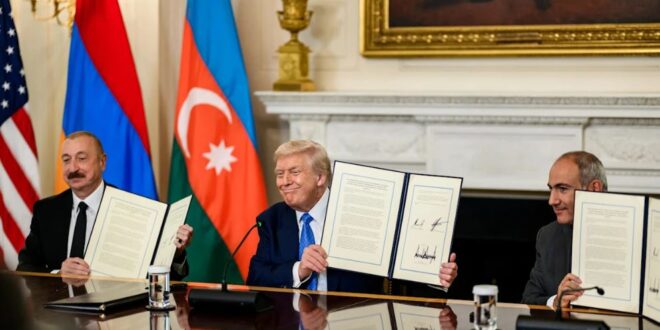
The Trump Route for International Peace and Prosperity (TRIPP) entered the public domain in January 2026, when Armenia and the US published three implementation frameworks outlining the structure, governance, and legal mechanisms of a new transit route through southern Armenia, following the August 2025 Agreement on the Establishment of Peace and Inter-State Relations between the two Republics.
Presented as a technical 43-kilometer route arrangement regulating access between Azerbaijan and its Nakhchivan exclave (part of the peace agreement between the two countries) and onward to Turkey, the frameworks formalized a model based on indirect administration, joint ownership, and long-term infrastructure development.
However, the frameworks codified a long-debated outcome that had gained urgency after the collapse of negotiations following Azerbaijan’s 2023 military takeover of Nagorno-Karabakh and its subsequent advances into Armenian territory.
For Benyamin Boghosyan, senior research fellow at the Applied Policy Research Institute of Armenia (APRI), TRIPP reflects a post-war reality rather than a choice. After the destruction of Nagorno-Karabakh in September 2020, the dissolution of the self-declared republic and the takeover by Azerbaijani forces in 2023, the imprisonment of some of it’s Armenian leaders and intelectuals, “it was clear that Azerbaijan would come after the so-called Zangezur corridor to be connected with Nagorno-Karabakh and Armenia,” Boghosian explained, adding that “the question was whether to provide the access via negotiations or simply allowing Azerbaijan to occupy part of Syunik.”
However, Boghosian sees that the Armenian state can have some control over decisions taken within the corridor, such as “in some cases simply to prevent or not to allow an Azerbaijani citizen or cargo to pass via Armenia,” through a front office-back office operating model.
The TRIPP development company will be registered in Armenia according to the joint statement, meaning it will be part of the “Armenian legislation system,” and will be owned by both the US and Armenian states; 74% of the company shares will be owned by the US, and 26% only by Armenia. For Boghosian, this means that “the US will have a much more influential role in any decision this company will make,” adding that, “The Armenian government will give exclusive rights to this company for the development of infrastructure projects in the TRIPP area,” while the territories of the so-called TRIPP area are not yet “fully clear.”
The company that hasn’t been registered yet will be in charge of developing infrastructure such as railroads, highways, electricity lines, gas pipelines, etc. However, it’s a very “complicated legal issue as well,” according to Boghosian, given that Armenian and US legal systems are different and that Armenia is a member of the Eurasian Economic Union.
Furthermore, after 2025 August peace agreement, Boghosian explaines that, “the European Union also may be involved in the TRIPP through funding some infrastructure projects, the main road highway, and very recently, Azerbaijan and the EU reached an agreement that EU will potentially provide money for the modernization of Nakhchivan International Airport (Nakhchivan Autonomous Republic, a landlocked exclave of Azerbaijan), but as of now, there are no concrete agreements.”
Everyone else’s corridor
The corridor has major regional and international significance due to its location connecting Turkey to Central Asia, and Central Asia to Europe, while blocking Iran’s long-standing “safe” border to the north.
Initially, in November 2020, Russia was in charge of the Trilateral Peace Agreement between Armenia and Azerbaijan, which highlighted that the Border Guard Service of the Russian Federal Security Service shall be responsible for overseeing the transport connections. However, following the Russian invasion of Ukrainian territory, “Russian involvement and influence in the South Caucasus started to decline (…) Now it will be the US through this American-Armenian trip company,” said Boghosian, adding, “US and Russia will agree broadly about the future of Caucasus, about their roles, and then I don’t exclude that some agreement may be reached also on TRIPP between the two parties.”
When it comes to Iran, Armenia served as the last standing safe northern border with a sole Armenian presence. If TRIPP is implemented, it would cause “a headache for Iran,” as Boghosian describes, due to the potential US presence or involvement. Boghosian highlighted that “It was clear for 10 years or even for more that Israel is freehanding Azerbaijan, to use Azerbaijani territories for anti-Iranian activities.”
Meanwhile, this agreement extends beyond strategic and economic interests. For Boghosian, the route was inevitable and could have a positive impact on Armenia. However, Vahram Emiyan, Chairperson of the Armenian National Committee of Lebanon, considers this agreement a “reward for the victors,” calling it a “Pan-Turkic corridor.”
In principle, open borders can benefit trade between countries, but they require stable relations and effective border management. Emiyan draws parallels with Turkey’s economic practices in places like Lebanon and Syria, where markets have been flooded with Turkish goods. He argues that a similar dynamic would have severe consequences for Armenia, particularly its agricultural sector: “The agricultural products of Turkey will flood the market and the rural areas, which are already facing problems, will be in a much worse situation.”
In a broader context, the project is designed, according to Emiyan, to link Europe with Central Asia through what is often referred to as the “Middle Corridor.” The route bypasses Russia and reduces Iran’s access to Europe, given that Armenia has traditionally served as Iran’s overland gateway northward, while aiming to shorten transit distances between Europe and Central Asia, allowing goods, oil, and other materials to reach European markets more quickly and at lower cost.
Emiyan fails to see any positive outcomes and considers the deal a “surrender,” which puts the South Caucasus under “Turkish hegemony,” and describes the US’s peace through force policy as “a very dangerous concept.”
Power dictates the law
Armenia’s core compromise has been accepting regional connectivity and normalization under conditions of military defeat and pressure, without resolving occupation, security, or political rights, effectively trading leverage for short-term stability while absorbing the long-term risks.
Emiyan explains, “You may have peace now, but over the long run, it will always be under constant threat of aggression, your economy will be under their control, and they will keep bullying you and taking concessions from you.”
He further situates his rejection of the agreement primarily within the framework of international law, arguing that the deal itself “lacks legal validity” because it was concluded under coercive conditions, pointing to the 1969 UN Vienna Convention on the Law of Treaties and the 1975 Helsinki Final Act.
From this legal standpoint, Emiyan argues that the agreement not only overlooks aggression but actively legitimizes it. He links the deal directly to the outcome of Azerbaijan’s 2023 military aggression: “Under the 1948 Genocide Convention, what happened in Nagorno-Karabakh constitutes genocide, according to Article II of the convention,” adding that, “this sends a very dangerous message to the international community, to dictators around the world, that one can get away with murder, get away with genocide, and even be rewarded for it.”
While the documents invoke normalization and “neighborly relations,” Emiyan argues that such language is incompatible with continued military occupation of Armenian land, such as in the Jermuk region, where Azerbaijani forces have “advanced up to 8.5 kilometers into Armenian land,” questioning, “how can there be neighborly relations when one party is occupying around 200 square kilometers of another country’s territory?”
Emiyan further highlights that the agreements mention further steps that must be taken to finalize the deal: “In theory, these further steps could include the issues I mentioned. But in practice, we do not see that. Usually, when ‘further steps’ are discussed, they imply steps to be taken by Armenia. Yet the text does not say only Armenia. Azerbaijan also has steps to take.” Concluding with a proverb: “You can’t stop an alligator from attacking you by feeding it. You only make it hungrier.”
While Boghosian believes that the absence of reciprocity and guarantees is real, he argues that this does not invalidate the arrangement in the short term. In his view, uncertainty has become a structural condition of the current international order. “No one can speak about any guarantees in 2026 in this turmoil. And no one can speak about 100% guarantees,” he said, pointing out that even NATO member states cannot rely on absolute security assurances, referring to Trump’s ambition of taking over Greenland.
From this perspective, Boghosian shifts the discussion away from permanence and toward time-bound risk reduction. He argues that US involvement in the project — and President Donald Trump’s personal investment in it — creates a temporary deterrent effect. He estimates that this window of relative stability could last “at least for the next three years,” corresponding to the remainder of Trump’s term in office.
Ultimately, TRIPP reveals how power is currently exercised in the region, in which the aggressor ultimately gets what it wants. When a military force achieves its objectives, those results are consolidated through economic arrangements and political pressure. The method changes, the outcome does not. Azerbaijan secures access, Turkey secures connectivity, the US and its partners secure strategic positioning, and the European Union secures an alternative route, all while occupation, captives, and displacement remain unresolved.
What is clear is that the corridor embeds Armenia more deeply into a regional order shaped elsewhere, where access moves faster than accountability and where sovereignty is preserved formally while its margins are steadily narrowed.