 Eurasia Press & News
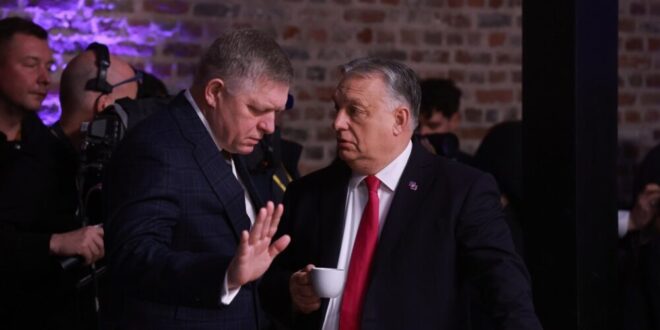
The EU’s ‘awkward squad’ – namely, Hungary and Slovakia – were both targets for criticism this week by European institutions angry at how those two governments are subverting the rule of law and stymieing anticorruption efforts. On Thursday, a senior legal adviser to Europe’s top court, the ECJ, said that the court should annul the December 2023 decision by the European Commission to unblock 10 billion euros in funds that had been withheld from Hungary over rule-of-law concerns. The EU Commission’s decision was widely seen as caving in to Hungarian PM Viktor Orban’s threat to veto aid to Ukraine, essentially buying Budapest off. The European Parliament then lodged a claim that the EU Commission breached its own rules when it unfroze this funding for Hungary. Thursday’s legal opinion by Advocate-General Tamara Capeta is not binding in any way for the ECJ’s final ruling on the matter, which will be delivered in a few months, but judges often take their cue from advocates-general who help the court in such complicated or unprecedented cases. Orban called the advocate-general‘s opinion “absurd“ and Minister for European Affairs Janos Boka described it as just another attempt to threaten Hungary because its government is not willing to support Ukraine financially.
In a separate case, another ECJ advocate-general, Juliane Kokott, argued that Hungary infringed EU law by adopting the “Law on the protection of national sovereignty” in December 2023. The law established the Sovereignty Protection Office (SPO), which the government is using to identify organisations or people that allegedly carry out activities in the interests of other states and foreign actors, and so harm or jeopardise Hungary’s sovereignty. Inevitably, it’s arguably being used to silence critics of the regime. The EU Commission took Hungary to court arguing that the law breaches fundamental EU freedoms. Kokott sided with the EU Commission, saying that in her opinion the law and the measures that may be adopted under it are capable of affecting the application of EU law. Moreover, the investigative powers of the SPO are legally binding and liable to affect cross-border economic activities falling within the scope of the fundamental freedoms. According to her, the powers of the office are discriminatory and not proportionate to the legitimate aim of protecting domestic democratic discourse.
Meanwhile, the other half of the awkward duo, Slovakia, faced sharp criticism on Wednesday as the EU Commission warned that the country had made “no progress” on corruption and the rule of law, prompting a heated exchange among MEPs in the European Parliament. Opening the debate in Strasbourg, the EU justice commissioner, Michael McGrath, cited the EU Commission’s “2025 Rule of Law Report” and delivered a stark verdict on Slovakia’s direction. “No progress has been made,” he said repeatedly, pointing to concerns over judicial independence, anticorruption efforts and the protection of whistleblowers. The EU Commission has launched infringement proceedings over recent constitutional amendments and is pursuing a separate case over changes to whistleblower protections that it says could weaken safeguards and undermine institutional independence. Slovakia has until March 2 to respond. The debate exposed deep divisions among MEPs. Daniel Freund, a German Green, described recent legal changes as a “regression”, warning that they posed a risk to democratic standards. Hungary’s Klara Dobrev said Slovakia risked following a path towards “absolute power”, while Slovenia’s Irena Joveva accused PM Robert Fico of dismantling justice to shield a “corrupt inner circle”. Inevitably, Slovak and far-right representatives rejected the criticism. Lubos Blaha, an MEP from Fico’s ruling Smer party, insisted there were “no problems with corruption and the rule of law”, while nationalist voices dismissed the debate as politically motivated and directed their attacks at Brussels. The EU Commission will conduct a “virtual visit” to Slovakia this month as part of preparations for its “2026 Rule of Law Report”. The scrutiny in Brussels came as Slovakia’s parliament refused to open a special session on corruption prosecutions proposed by the opposition.
Slovakia’s top court takes issue with Criminal Code amendment
Slovakia’s Constitutional Court this week suspended part of a fast-tracked amendment to the Criminal Code, which critics say could have influenced the prosecution of a senior ruling coalition figure. The judges halted provisions governing the use of testimony from cooperating defendants two months after the change was approved by parliament. The measure had raised concerns because it directly affected ongoing criminal proceedings, including the case of former police chief Tibor Gaspar, now deputy speaker of parliament and a senior member of the ruling Smer party. In a statement, the court said suspending the measure was “legally safer”. It warned the provision represented a significant conceptual shift whose consequences were difficult to predict and could affect live cases in irreversible ways. Under the contested amendment, courts would have been barred from considering testimony from cooperating defendants who had previously failed to give truthful statements, a broadly worded rule that judges and prosecutors argued risked creating a shortage of evidence in serious criminal cases. The court accepted challenges to other parts of the reform, including new criminal offences covering people questioning the post-World War II settlement under the Benes Decrees and interference in election campaigns by foreign powers – but it did not suspend their application. A final ruling on their constitutionality is still pending. The legislation was pushed through parliament under an accelerated procedure in December and signed into law by President Peter Pellegrini despite criticism from legal experts and prosecutors, who warned it could undermine efforts to tackle organised crime and corruption. Gaspar himself faces charges of participation in an organised crime group and corruption. In recent days, Robert Fico’s government has received bad news on several fronts. The economy continues to struggle, while the prosecutor general has criticised the administration for failing to tackle corruption. A prosecutor also halted proceedings in a case concerning the donation of military equipment to Ukraine, an issue Fico’s coalition continues to question. Elsewhere, a court rejected an indictment against anticorruption investigators who handled cases linked to Fico’s previous governments. Despite the setbacks, a recent poll suggests Fico could still form a new ruling coalition, though he would need the support of a far-right movement.
Rubio to visit Hungary in boost for Orban’s campaign; Samsung battery factory in the spotlight
US Secretary of State Marco Rubio is expected to arrive in Budapest on Monday, following the Munich Security Conference over the weekend and a flying visit to Slovakia on the Sunday. According to the US State Department, Rubio’s visit is expected to focus primarily on energy issues. “During his visit to Budapest, the Secretary will meet with key Hungarian officials to bolster our shared bilateral and regional interests, including our commitment to peace processes to resolve global conflicts and to the U.S.-Hungary energy partnership,” the State Department said in a press release. However, Hungary’s pro-government media have been framing the visit as a possible preparatory meeting ahead of a presidential visit during the election campaign. Earlier, PM Viktor Orban said President Donald Trump “owes” him a visit to Hungary and he continues to float the idea that a Ukrainian-Russian peace summit could be hosted in Budapest before the election on April 12. However, political scientist Peter Kreko questioned the value of a Trump visit during the campaign and dismissed the likelihood it could significantly tilt the race in Orban’s favour. According to recent polls, Orban’s Fidesz trails the opposition Tisza party by 8-10 points. Opposition leader Peter Magyar said his party has over 3 million voters and wouldn’t rule out a two-thirds parliamentary majority, though he is bracing for a smear campaign by Orban’s Fidesz involving a video of him with an ex-girlfriend. Meanwhile, Hungarian Foreign Minister Peter Szijjarto hosted China’s foreign minister. “We are having good days in Hungary – we have the Chinese foreign minister, and next week the US secretary of state. This is what isolation looks like,” he said ironically, referring to criticism that Hungary’s foreign policy has made the country a “pariah”. Magyar announced that he and his designated foreign minister, former energy envoy Anita Orban (unrelated to the PM), will attend the Munich Security Conference to hold bilateral meetings. The Orban government has stayed away from the conference for years.
Attention turned this week to Hungary’s battery industry after independent news site Telex published an in-depth investigation alleging that the government has long neglected environmental and labour safety violations at Samsung SDI’s gigafactory in God. The company has faced criticism for years, with investigative site Atlatszo regularly reporting on water and soil contamination, as well as repeated breaches of labour safety regulations, including instances where toxic gas levels exceeded hazardous limits multiple times. Although Samsung has been fined several times by environmental authorities, the penalties were minor and did not force the company to substantially alter its battery operations. Telex revealed that some ministers – including Orban’s influential spin doctor Antal Rogan, who also oversees the intelligence services – have warned that the case is an “unacceptable political risk” and the intelligence services even conducted secret operations at the factory. Ultimately, however, the government refrained from exerting serious pressure – let alone suspending operations – prioritising economic benefits and fearing that stricter regulation might drive away other Asian investors. The main advocate of Samsung was, according to Telex, Foreign Minister Szijjarto, who immediately went on the offensive and threatened to sue over the claims in the article. The case has been seized on by Magyar, who demanded Szijjarto’s immediate resignation and an urgent meeting with Samsung management. This means that Orban’s two appointed “brothers in arms” to lead Fidesz’s election campaign are both embroiled in recent controversies. Szijjarto faces criticism over the Samsung case and Minister of Construction and Transport Janos Lazar sparked outrage after suggesting that Roma workers should be tasked with cleaning filthy toilets on Hungary’s trains.
Babis in favour of social media ban for kids; too many cooks spoil Czech foreign policy
Czech PM Andrej Babis said he’s inclined to back a ban on social media for children under 15 as the issue continues to be discussed in an increasing number of countries. “I am in favour because the experts I know say that it is extremely harmful for children. We must protect our children,” the PM said – as coincidence would have it – in a video published on social media, one of Babis’s favourite channels of communication where he posts on a near-daily basis. While there are not yet clear or detailed plans on what such a measure would look like, Deputy PM Karel Havlicek said they were now consulting with experts and big tech representatives and may put forward a draft bill later this year. Since Australia banned social media use for children under 16 at the end of last year, several countries around Europe – including France, the UK, Spain, Greece and Denmark – have been debating similar measures, citing the toxic and addictive impact of social media platforms for children and young teenagers. Opposing voices have criticised such blanket bans as paternalistic measures that could undermine people’s right to privacy while pointing, for instance, to the positive influence of social media for isolated or marginalised children, and logistical difficulties in implementing it. Experts, too, are divided over the issue, arguing that while a ban might be the “simplest” solution, it should also be accompanied by other measures aimed at regulating how social media platforms operate and how algorithms work, with the goal of creating a safer digital space for all. “It is necessary to ensure that age verification does not become a system for the mass collection of sensitive data,” argued Kamil Kopecky of Palacky University in Olomouc.
Czech officials are heading to Munich for a highly anticipated – and possibly dreaded – 62nd edition of the security conference held annually in the Bavarian capital. President Petr Pavel will represent the Czechia, but will also be joined by Foreign Minister Petr Macinka, chairman of junior coalition partner the Motorists, and Defence Minister Jaromir Zuna, a non-partisan nominee of the far-right SPD. Seen from Prague, the event will be an important test to determine how and if Czechia’s foreign policy and international stance can remain clear and consistent when there are fundamental disagreements between the president, the government and within the ruling coalition itself. President Pavel and Foreign Minister Macinka have notoriously bad relations and have been locked in a months-long dispute over Pavel’s refusal to nominate Motorist honorary chairman Filip Turek to a ministerial post. Ahead of the Munich Security Conference, Macinka told journalists he would not seek out or try to meet with the president at the event. Dozens of heads of state and government will attend the conference regarded – a year after US Vice President JD Vance’s acrimonious speech – as a crucial challenge for transatlantic relations amid worsening relations between the US and EU.
Poland makes its Peace Board position clear; historic NATO post awaits 4-star general
Poland will not join Donald Trump’s so-called Board of Peace, PM Donald Tusk declared ahead of Wednesday’s cabinet meeting. His remarks were a response to an invitation Poland received to attend the body’s inaugural session, scheduled for February 19 in the US. Tusk said the decision was driven by concerns over the new organisation’s operating rules, legal status and concrete objectives, which observers say could make it a direct rival to the UN. At the same time, he stressed the government would continue to monitor developments closely, and remain flexible and open to reassessing its position. The statement marks the clearest position yet from Poland’s leadership. Until now, both Tusk and President Karol Nawrocki had relied on diplomatic ambiguity, seeking to preserve strong ties with the US administration while avoiding steps that could undermine Poland’s alliance with Ukraine – something that, in Warsaw’s view, would inevitably follow from sitting at the same table as Russian President Vladimir Putin, Belarusian President Aleksandr Lukashenko and other authoritarian leaders among the roughly 60 invited to join the organisation. From the outset, the invitation hads been a source of visible discomfort for Polish officials, who adopted an unwritten strategy of delaying a decision, citing constitutional procedures – a tactic that had “produced good results”, Tusk told reporters on Thursday, before leaving for Brussels to attend an informal summit of EU leaders. “Poland is not, and will not be, anyone’s vassal,” he said. “We will remain a loyal, reliable ally – but not a vassal in relations with any country in the world.”
Meanwhile, a Polish four-star general is set to take the helm of NATO’s Joint Force Command (JFC) Brunssum in the Netherlands, Warsaw’s military leadership announced on Tuesday. The headquarters is one of NATO’s three permanent joint force commands in Europe – alongside Naples in Italy and Norfolk in the United Kingdom – and plays a central role in shaping the alliance’s eastern-flank posture, including deterrence and reinforcement planning for Central and Eastern Europe. For the past two decades, JFC Brunssum has been led exclusively by German and Italian officers; a Polish general assuming the role represents “a significant sign of trust in the Polish Armed Forces and in our defence efforts,” Chief of the General Staff Gen. Wieslaw Kukula said on Tuesday. The specific nominee has yet to be announced. Poland currently has only two active four-star generals – Kukula himself and Gen. Slawomir Wojciechowski, Warsaw’s military representative to the NATO and EU Military Committees – one of whom is expected to replace Germany’s Gen. Ingo Hertz, who currently holds the post. The move comes as part of a broader reshuffle aimed at strengthening the role of European allies within NATO’s military leadership. On February 6, allies approved a new distribution of senior officer responsibility across the NATO Command Structure, with the UK set to lead JFC Norfolk and Italy JFC Naples. Responsibility for JFC Brunssum will rotate between Poland and Germany.