 Eurasia Press & News
Toplines
Russian officials are unlikely to deviate from their original war demands during the upcoming February 17 to 18 trilateral US-Ukrainian-Russian talks in Geneva, Switzerland. Kremlin Spokesperson Dmitry Peskov stated on February 16 that Russian Presidential Aide Vladimir Medinsky will head the Russian delegation at the upcoming trilateral meetings.[1] Peskov noted that the Russian delegation will also include Russian Deputy Foreign Minister Mikhail Galuzin and Russian General Staff’s Main Intelligence Directorate (GRU) First Deputy Head Lieutenant General Vladimir Kostyukov.[2] Peskov stated that Russian Direct Investment Fund (RDIF) CEO Kirill Dmitriev will be in Geneva but will be attending a working group on economic cooperation, likely referring to the US-Russian bilateral economic group.[3]
Peskov stated that the Geneva talks would discuss a “broader” range of issues than previous talks in Abu Dhabi and would particularly discuss territorial issues.[4] Russian Deputy Foreign Minister Sergei Ryabkov stated that the Kremlin has instructed the Russian delegation to act within the framework that Russian President Vladimir Putin and US President Donald Trump allegedly agreed to during the August 2025 Alaska Summit.[5] Kremlin officials have previously claimed that the Alaska Summit agreed to principles based on Putin’s June 2024 speech to the Russian Ministry of Foreign Affairs (MFA), in which Putin insisted on capitulation to Russia’s demands of both Ukraine and the North Atlantic Treaty Organization (NATO).[6] The Kremlin has repeatedly demonstrated its full commitment to achieving its original war aims, including those not related to territory in eastern Ukraine.[7]
Russia may try to exploit another temporary moratorium on strikes against energy infrastructure to falsely claim that Russia is making a concession. Ukrainian Defense Council Secretary Rustem Umerov stated on February 14 that Ukraine will raise the issue of another temporary energy strikes ceasefire in the Geneva meetings.[8] Russia has previously used temporary moratoriums on energy strikes in March-April 2025 and in January-February 2026 to stockpile drones and missiles for subsequent devastating strikes.[9] The Kremlin agreed to the January-February 2026 moratorium on strikes against some Ukrainian energy infrastructure only after inflicting severe damage to Ukraine’s national energy grid. The Kremlin will likely again try to portray its adherence to any future short-term moratorium as a significant concession, even though the Kremlin will likely use those days to stockpile weapons for larger strike packages. Russian forces have also already degraded Ukraine’s energy grid such that Ukraine faces major power issues even when Russia temporarily stops its strikes. Ukraine’s energy grid suffered significant shutdowns during the January-February 2025 strikes moratorium due to the months and years worth of damage the grid had already sustained.[10] Ukrainian President Volodymyr Zelensky reported on February 14 that Russian strikes have damaged every power plant in Ukraine, and Ukraine may again face major power issues during a future moratorium.[11]
Russia appears to be investing in centralized incubators for drone technology and is setting up bespoke roles and units to support specific drone capability development efforts. These drone capability development efforts include supporting drone units’ ability to conduct tactical tasks that support Russia’s battlefield air interdiction (BAI) campaign, as well as drone-based air defense. Former Russian space agency Roscosmos head and Zaporizhia Oblast occupation senator Dmitry Rogozin stated on February 16 that the BARS-Sarmat Unmanned Systems Special Purpose Center (formerly BARS-Sarmat Detachment), which Rogozin oversees, is expanding its roster of specialized roles, expanding combat units, and conducting additional recruitment.[12] The BARS-Sarmat Center is a key research and development (R&D) organization for Russian drone capabilities and develops and tests hardware and operational concepts before proliferating new technologies and drone tactics more broadly across Russian drone units.[13] The official Telegram channel of the BARS-Sarmat Unmanned Systems Special Purpose Center stated that the center is not just a group of drone operators but a comprehensive structure that integrates reconnaissance, strike capabilities, electronic warfare (EW), engineering development, production, and training under one organization.[14] The BARS-Sarmat Center stated that it also includes two specialized detachments — the ”Dnepr” and ”Stalingrad” detachments — which specialize in operating drones at operational depths of up to 30 to 35 kilometers and a separate “Bagration” air defense detachment, which specializes in intercepting Ukrainian drones using unmanned systems. The BARS-Sarmat Center stated that it is developing a “new” military specialty role called the “soldier technologist” — a role likely designed to facilitate the development and integration of drone capabilities across Russian combat forces writ large. The BARS-Sarmat Center also includes a specialized detachment — the Ustinov Scientific and Technical Detachment — which manufactures and modernizes equipment considering combat experience from the front. Each of these new units notably focuses on different elements of Russia’s BAI campaign, including enabling mid-range strikes, interceptor drones, and technological adaptations. Russia’s BAI campaigns have been largely responsible for facilitating Russian advances on the battlefield in Fall and Winter 2025. Russia’s investment in specialized units meant to develop, refine, and proliferate Russian drone capabilities is noteworthy. ISW previously observed reports that Russian plans to reorganize the BARS-Sarmat Center and at least five separate Russian Unmanned Systems Forces (USF) regiments into six USF brigades, and the further development and expansion of the center may allow Russia to more quickly disseminate successful drone developments across the Russian military.[15]
The Kremlin appears to be adapting its tactics to conduct sabotage attacks in Europe. Western intelligence officials stated to the Financial Times (FT) on February 15 that former Wagner Group recruiters, who previously recruited Russians to fight in Ukraine, are now organizing Kremlin-sponsored sabotage attacks in Europe.[16] Sources told FT that the Russian General Staff Main Intelligence Directorate (GRU) is leveraging Wagner’s recruitment network in Europe while attempting to maintain at least two degrees of separation from the agents to maintain plausible deniability. The Wagner Group recruiters are reportedly trying to attract Europeans, particularly those who are “economically vulnerable” or lack purpose or direction in their lives, to conduct arson attacks or to pose as putative Nazi propagandists in Europe. FT‘s February 15 report follows earlier reports that Russia’s sabotage campaign deintensified in 2025, likely as the Kremlin reassessed its tactics.[17] US and European officials told Bloomberg in August 2025 that the decline may have been due to Kremlin efforts to regain control over the unreliable local criminals it often used for these attacks.[18] The officials noted at the time that many potential recruits were likely less willing to participate in Russia’s attacks, given that several agents were arrested and prosecuted. The GRU also reportedly was redirecting resources away from the European sabotage campaign and towards the war in Ukraine. The Kremlin began a campaign to reassert control over the Wagner Group and other irregular forces and integrate them into Russian state services starting in late 2022 and intensified this campaign following the Wagner Group’s mutiny in June 2023.[19] The GRU appears to be leveraging former Wagner Group elements to fulfill the GRU’s needs in Europe, potentially allowing the GRU to focus more of its organic resources on Ukraine. Russia may reintensify its sabotage campaign in 2026 by shifting from using unreliable organized crime networks to financially motivated individual agents.
At least one Ukrainian FP-5 Flamingo cruise missile did not cause damage to Russia’s Kapustin Yar launch site in Astrakhan Oblast in January 2025. A Ukrainian open-source intelligence (OSINT) outlet published on February 16 satellite imagery collected on an unspecified date showing a six-meter crater near the fence of a preparation area at Kapustin Yar.[20] The Ukrainian General Staff reported that Ukrainian forces conducted a strike series that included Flamingo missiles against Kapustin Yar in January 2025 and later stated that the strikes damaged a technical facility that serviced missiles, an assembly building, and a logistics warehouse.[21] This recent satellite imagery suggests that at least one of the Flamingo missiles reached Kapustin Yar but that it either missed its intended target or that Russian forces intercepted the missile. The available satellite imagery is limited in scope, and other Ukrainian missiles may have struck other areas of Kapustin Yar. A Russian milblogger claimed on February 16 that Ukrainian forces launched four total Flamingo missiles in the strike package.[22]
Key Takeaways
Russian officials are unlikely to deviate from their original war demands during the upcoming February 17 to 18 trilateral US-Ukrainian-Russian talks in Geneva, Switzerland.
Russia may try to exploit another temporary moratorium on strikes against energy infrastructure to falsely claim that Russia is making a concession.
Russia appears to be investing in centralized incubators for drone technology and is setting up bespoke roles and units to support specific drone capability development efforts. These drone capability development efforts include supporting drone units’ ability to conduct tactical tasks that support Russia’s battlefield air interdiction (BAI) campaign, as well as drone-based air defense.
The Kremlin appears to be adapting its tactics to conduct sabotage attacks in Europe.
At least one Ukrainian FP-5 Flamingo cruise missile did not cause damage to Russia’s Kapustin Yar launch site in Astrakhan Oblast in January 2025.
Ukrainian forces recently advanced in the Kostyantynivka-Druzhkivka tactical area. Russian forces recently advanced in the Kostyantynivka-Druzhkivka tactical area and near Pokrovsk.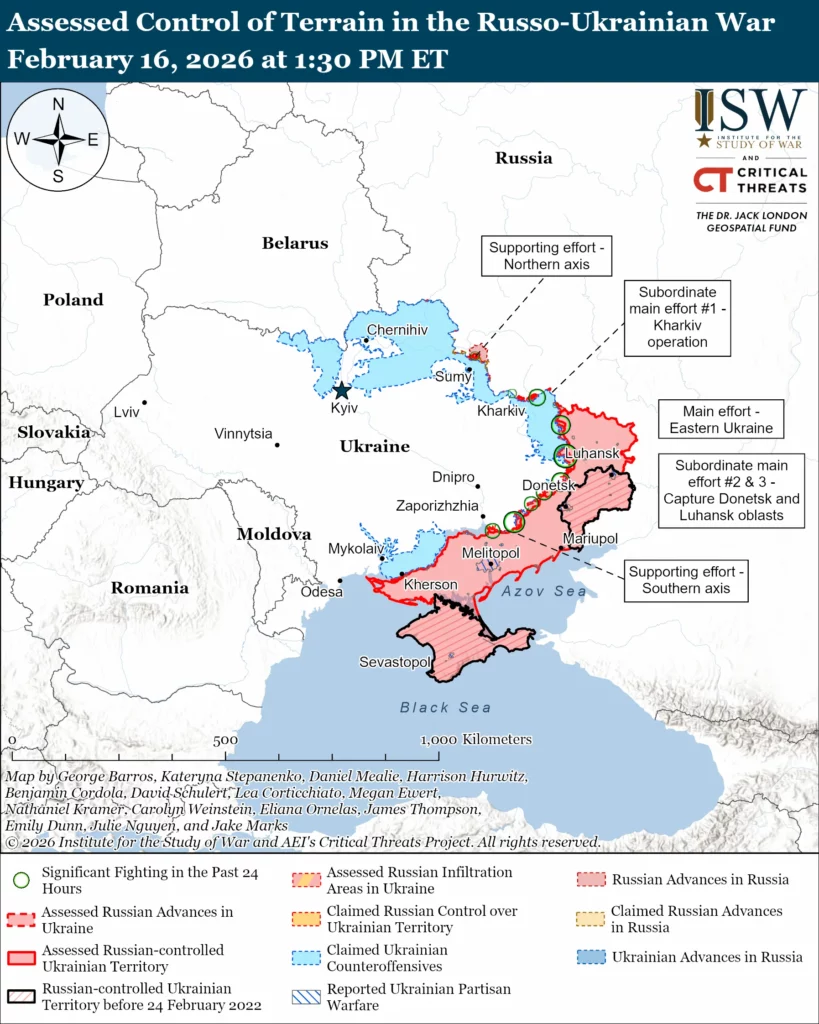
We do not report in detail on Russian war crimes because these activities are well-covered in Western media and do not directly affect the military operations we are assessing and forecasting. We will continue to evaluate and report on the effects of these criminal activities on the Ukrainian military and the Ukrainian population and specifically on combat in Ukrainian urban areas. We utterly condemn Russian violations of the laws of armed conflict and the Geneva Conventions and crimes against humanity even though we do not describe them in these reports.
Ukrainian Operations in the Russian Federation
Ukrainian forces likely struck Russian energy infrastructure in Belgorod and Bryansk oblasts on the night of February 15 to 16. Ukrainian Center for Countering Disinformation Head Lieutenant Andriy Kovalenko, who often reports on successful Ukrainian drone strikes, posted images on February 15 of fires near the Belgorod Combined Heat and Power Plant in Belgorod Oblast, implying that Ukrainian forces struck the plant.[23] Belgorod Oblast Governor Vyacheslav Gladkov acknowledged that the Ukrainian forces’ strike on Belgorod Oblast significantly damaged energy facilities.[24] Kovalenko also posted footage of smoke plumes on February 15 in Bryansk Oblast, implying that Ukrainian forces struck unspecified targets in Bryansk Oblast.[25] Footage published on February 15 shows a burning electrical substation near Vygonichi, Bryansk Oblast.[26] Bryansk Oblast Governor Alexander Bogomaz acknowledged that the strike caused power and heating outages in five municipalities and part of Bryansk City.[27]
Russian Supporting Effort: Northern Axis
Russian objective: Create defensible buffer zones in Sumy Oblast along the international border
Russian forces continued offensive operations in northern Sumy Oblast on February 15 and 16 but did not make confirmed advances.
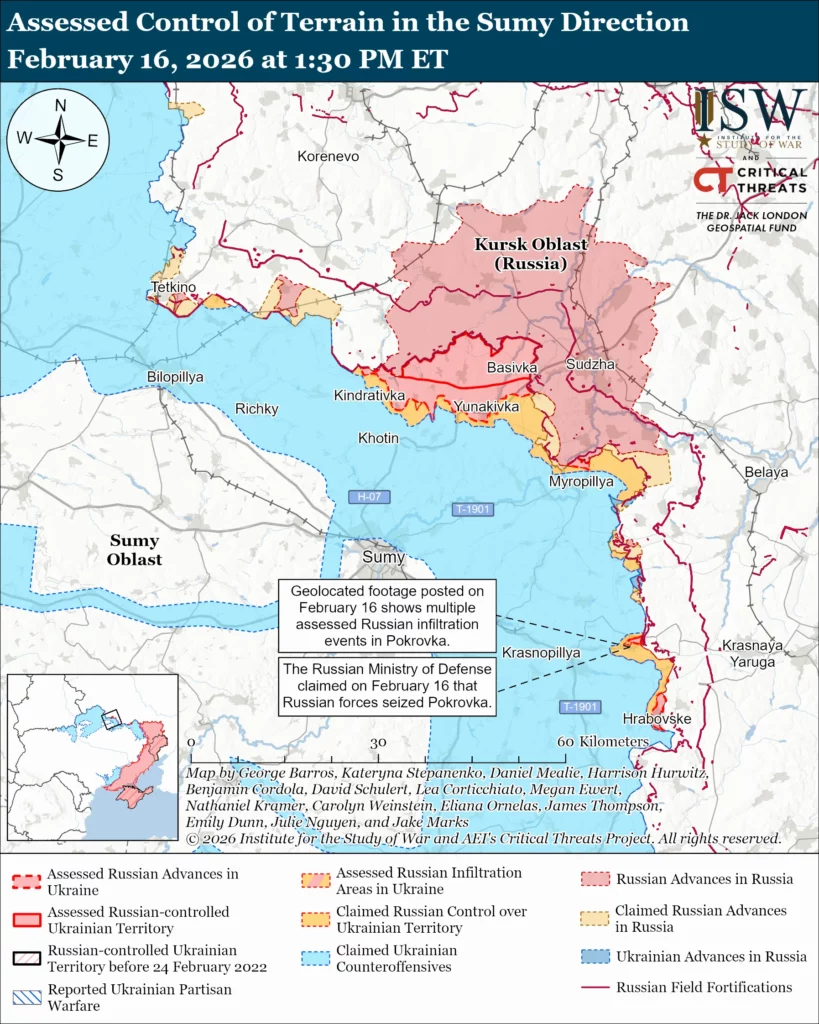
Assessed Russian infiltrations: Geolocated footage published on February 16 shows Russian servicemembers operating in eastern and central Pokrovka (southeast of Sumy City) during what ISW assesses was a Russian infiltration mission that did not change control of terrain or the forward edge of the battle area (FEBA) at this time.[28]
Unconfirmed claims: The Russian Ministry of Defense (MoD) claimed that elements of the Russian 34th Separate Motorized Rifle Brigade (49th Combined Arms Army [CAA], Southern Military District [SMD]) seized Pokrovka.[29] A Russian milblogger claimed that Russian forces advanced west of Popivka (southeast of Sumy City) and south of Pokrovka.[30]
Russian forces attacked in Sumy and Kursk oblasts, including north of Sumy City near Varachyne, Kindrativka, and Oleksiivka and toward Nova Sich and Mala Korchakivka, and northeast of Sumy City near Yablunivka, Yunakivka, and Loknya and toward Khrapivshchyna, on February 14 and 15.[31] Russian milbloggers claimed that Ukrainian forces counterattacked near Popivka, Vysoke, and in Krasnopillya Raion (all southeast of Sumy City).[32]
Order of Battle: Artillery and other elements of the Russian 108th and 56th airborne (VDV) regiments (both of the 7th VDV Division) are reportedly operating in the Sumy direction.[33] Elements of the 145th Naval Infantry Regiment (810th Naval Infantry Brigade, Black Sea Fleet) are reportedly operating in Kindrativka.[34]
Russian Main Effort: Eastern Ukraine
Russian Subordinate Main Effort #1 – Kharkiv Oblast
Russian objective: Push Ukrainian forces back from the international border to create a defensible buffer zone with Belgorod Oblast and approach to within tube artillery range of Kharkiv City
Russian forces continued offensive operations in northern Kharkiv Oblast on February 16 but did not advance.
Russian forces attacked north of Kharkiv City toward Veterynarne and northeast of Kharkiv City near Vovchansk, Vovchanski Khutory, Starytsya, Symynivka, and Hrafske and toward Okhrimivka on February 15 and 16.[35] A Russian milblogger reportedly affiliated with the Russian Northern Grouping of Forces claimed that Ukrainian forces counterattacked near Vilcha (northeast of Kharkiv City).[36]
An officer of a Ukrainian brigade operating in northern Kharkiv Oblast reported on February 16 that Russian forces are accumulating personnel for further assaults, but that Ukrainian forces have fire control over Russian ground lines of communication (GLOCs) and are preventing Russian forces from concentrating or using armored vehicles.[37] The officer reported that Russian forces are primarily assaulting in small groups and use light transport vehicles. The officer noted that poor weather conditions are complicating drone reconnaissance and logistics for both sides.
A Russian milblogger reportedly affiliated with the Russian Northern Grouping of Forces claimed on February 16 that the regimental command of the Russian 127th Motorized Rifle Regiment (71st Guards Motorized Rifle Division) depleted its assault forces near Zybyne (northeast of Kharkiv City) and that the regiment’s manning level is around 40 percent as of early February 2026.[38]
Order of Battle: Drone operators of the Russian 245th Motorized Rifle Regiment (47th Tank Division, 1st Guards Tank Army [GTA], Moscow Military District [MMD]) are striking Ukrainian equipment south of Odnorobivka (northwest of Kharkiv City).[39] Drone operators of the Chechen Okhotnik [Hunter] Akhmat Spetsnaz Detachment (204th Akhmat Spetsnaz Regiment) are striking Ukrainian forces northwest of Mali Prokhody (north of Kharkiv City).[40] Drone operators of the 71st Guards Motorized Rifle Division (14th Army Corps [AC], Leningrad Military District [LMD]) are striking Ukrainian equipment northeast of Zakharivka (northeast of Kharkiv City).[41] Elements of the Chechen Zapad-Akhmat Battalion are reportedly operating near Vovchansk.[42] Drone operators of the Russian 83rd Motorized Rifle Regiment (69th Motorized Rifle Division, 6th Combined Arms Army [CAA], LMD) are reportedly striking Ukrainian positions in the Kharkiv direction.[43]
Neither Russian nor Ukrainian sources reported ground activity in the Velykyi Burluk direction on February 16.
Russian Subordinate Main Effort #2 – Oskil River
Russian objective: Cross the Oskil River in Kharkiv Oblast and push westward into eastern Kharkiv Oblast and northern Donetsk Oblast
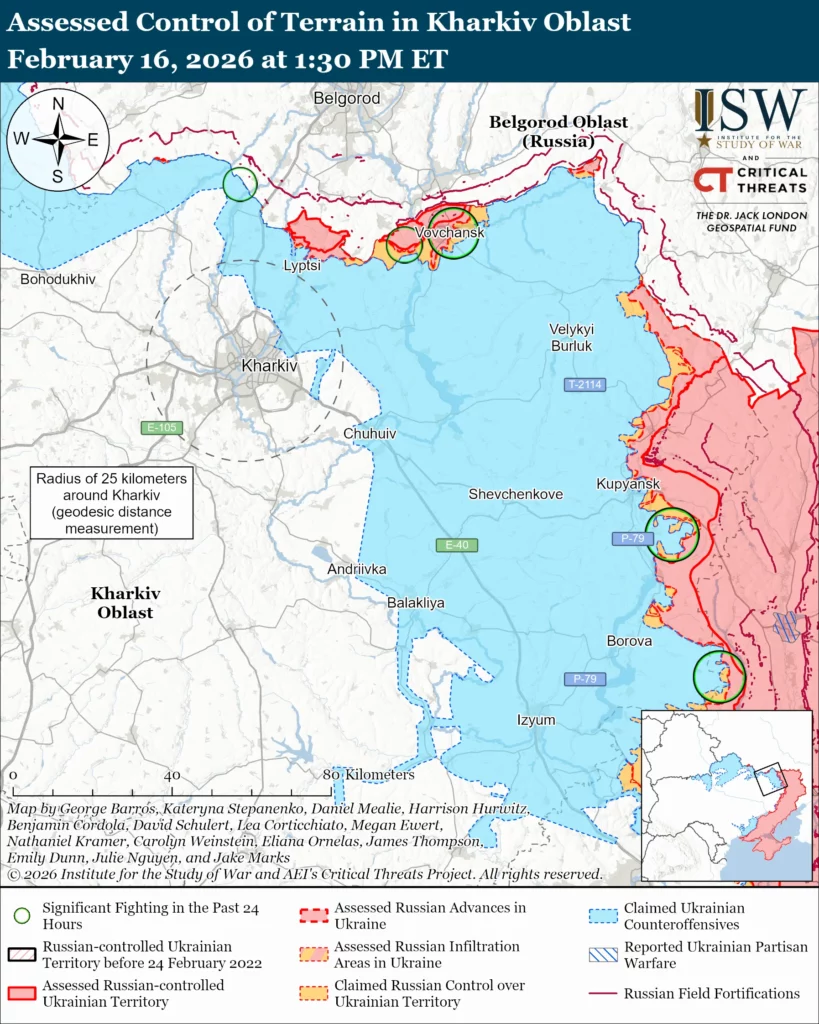
Russian forces continued offensive operations in the Kupyansk direction on February 16 but did not advance.
Russian forces attacked near Kupyansk itself, south of Kupyansk near Kupyansk-Vuzlovyi, and southeast of Kupyansk near Kurylivka and Pishchane on February 15 and 16.[44]
Ukrainian Joint Forces Task Force Spokesperson Colonel Viktor Trehubov reported on February 16 that Ukrainian forces have only recorded 22 radio frequencies in Kupyansk itself and that these radio signals are isolated to a small block of high-rise buildings in the center of Kupyansk.[45] Trehubov stated that Russian forces can only supply the surrounded units by drone drops.
A Russian milblogger claimed that warming weather, fog, and sleet have created conditions that negatively impact the movement of personnel and equipment.[46]
Russian forces continued offensive operations southeast of Borova near Druzhelyubivka and Tverdokhlibove and south of Borova near Oleksandrivka on February 15 and 16 but did not advance.[47]
Russian Subordinate Main Effort #3 – Donetsk Oblast
Russian objective: Capture the entirety of Donetsk Oblast, the claimed territory of Russia’s proxies in Donbas, and advance into Dnipropetrovsk Oblast
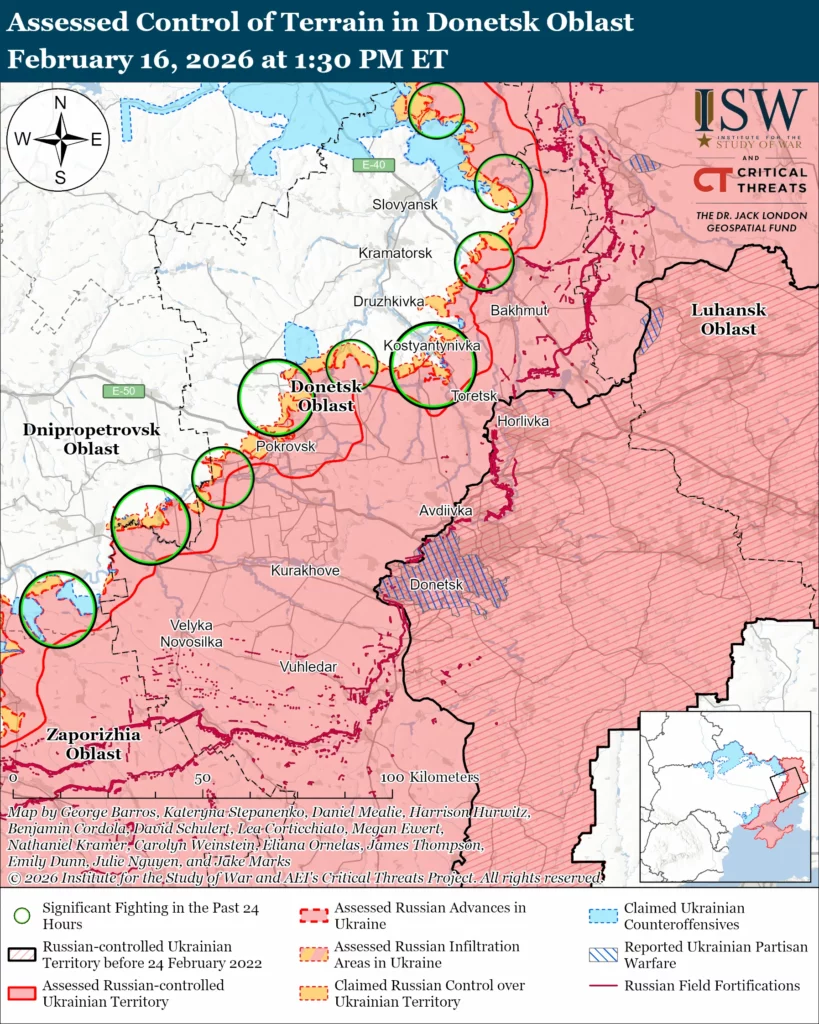
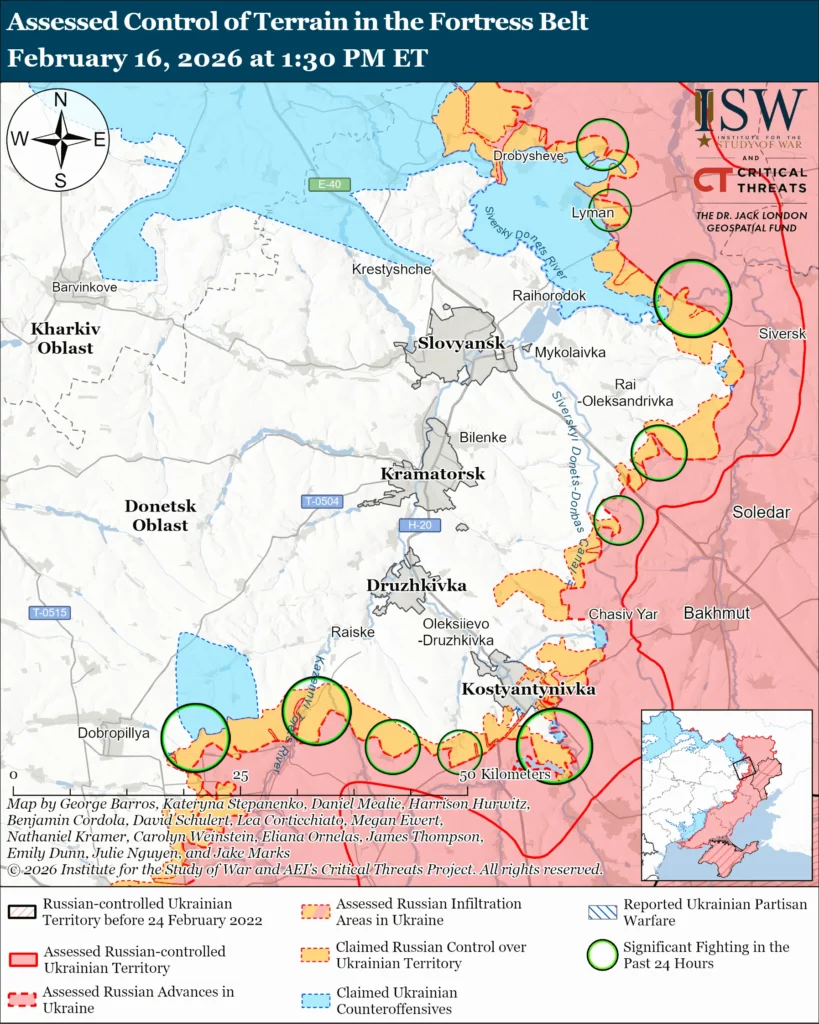
Russian forces recently infiltrated in the Slovyansk direction.
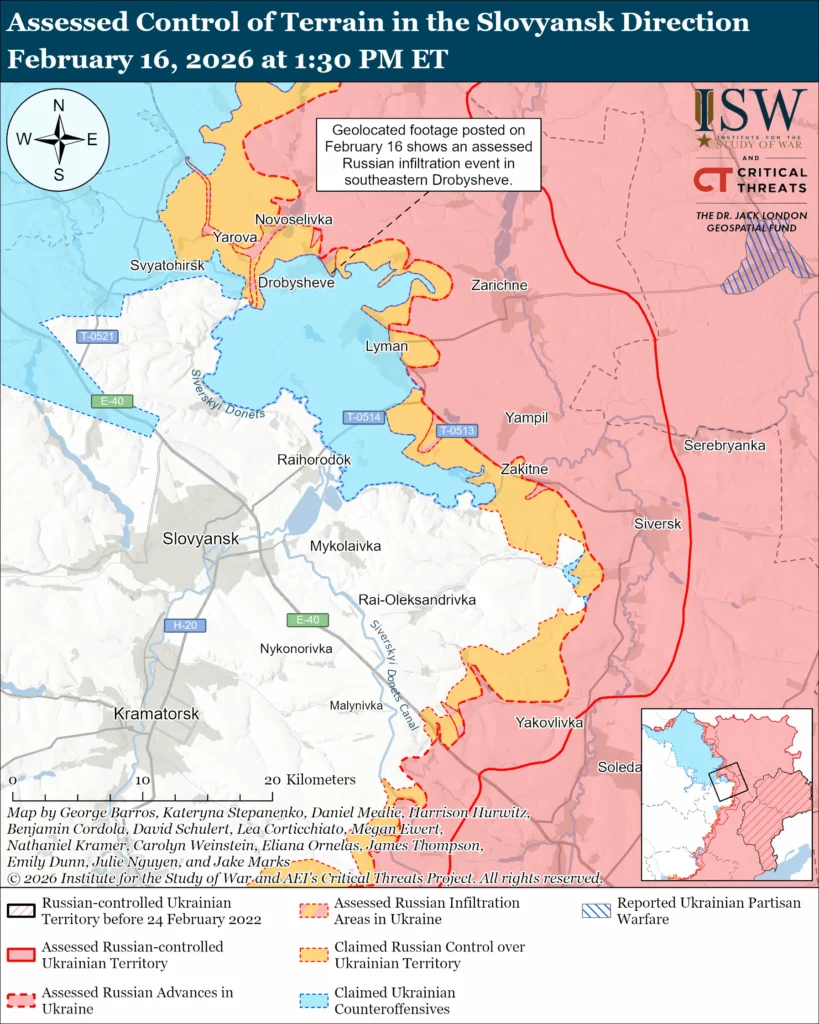
Assessed Russian infiltrations: Geolocated footage published on February 16 shows Ukrainian forces striking a Russian position in southern Drobysheve (northwest of Lyman) after what ISW assesses was a Russian infiltration mission that did not change control of terrain or the forward edge of battle area (FEBA) at this time.[48]
Unconfirmed claims: Russian milbloggers claimed that Russian forces advanced in northern Lyman and northern Riznykivka (east of Slovyansk).[49]
Russian forces attacked near and within Lyman itself; northwest of Lyman near Drobysheve and Svyatohirsk; north of Lyman near Stavky; east of Lyman near Maslyakivka; southeast of Lyman near Yampil and Dibrova; northeast of Slovyansk near Dronivka; east of Slovyansk near Zakitne, Riznykivka, and Kryva Luka and toward Rai-Oleksandrivka; and southeast of Slovyansk near Bondarne and Nykyforivka and toward Fedorivka Druha on February 15 and 16.[50]
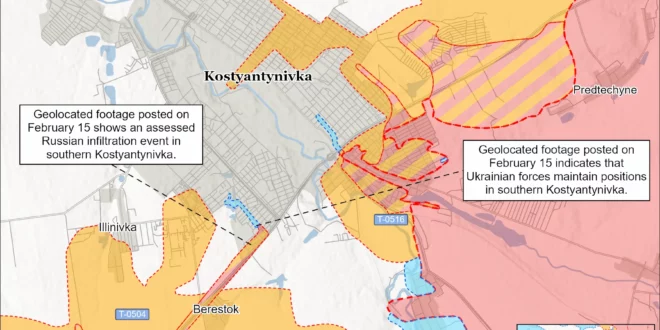
Ukrainian and Russian forces recently advanced in the Kostyantynivka-Druzhkivka tactical area.
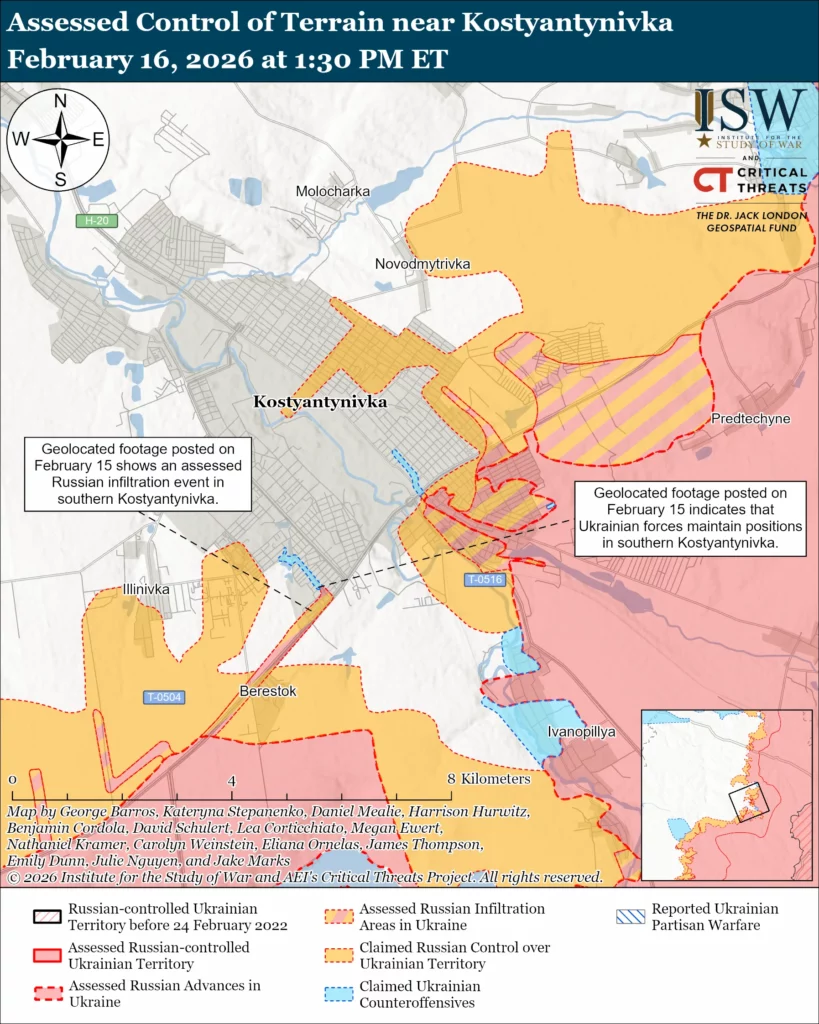
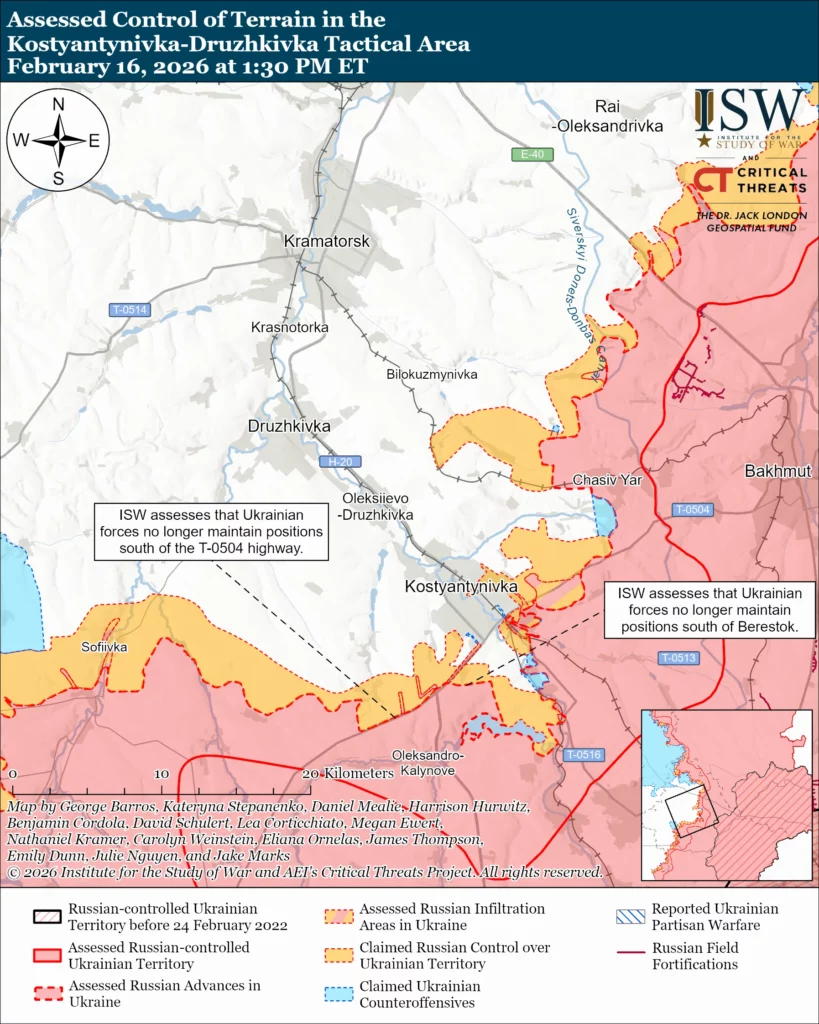
Assessed Ukrainian advances: Geolocated footage published on February 15 indicates that Ukrainian forces recently advanced in southern Kostyantynivka.[51]
Assessed Russian advances: ISW assesses that Russian forces likely advanced north of Yablunivka (southwest of Kostyantynivka) and south of Berestok (south of Kostyantynivka) on a prior date, given that ISW has observed Russian servicemembers operating in these areas and has not observed evidence in the past few weeks that would indicate that Ukrainian forces continue to maintain defensive positions in the area.
Assessed Russian infiltrations: Geolocated footage published on February 15 shows Ukrainian forces striking Russian positions in southwestern and southern Kostyantynivka after what ISW assesses was a Russian infiltration mission that did not change the control of terrain or FEBA at this time.[52]
Unconfirmed claims: A Russian milblogger claimed that Russian forces advanced in southwestern Kostyantynivka.[53]
Refinement of areas under Russian claims: Geolocated footage published on February 15 shows elements of the Russian 4th Motorized Rifle Brigade (3rd Combined Arms Army [CAA], formerly 2nd Luhansk People’s Republic Army Corps [LNR AC], Southern Military District [SMD]) striking Ukrainian positions west of Ivanopillya (south of Kostyantynivka) — an area in which Russian sources previously claimed Russian forces maintained positions.[54]
Russian forces attacked near and within Kostyantynivka itself; northeast of Kostyantynivka near Orikhovo-Vasylivka and Holubivka; south of Kostyantynivka near Kleban-Byk, Pleshchiivka, Shcherbynivka, and Ivanopillya; southwest of Kostyantynivka near Illinivka and Stepanivka; south of Druzhkivka near Rusyn Yar and toward Mykolaipillya; and southwest of Druzhkivka near Sofiivka, Novopavlivka, and Toretske on February 15 and 16.[55]
The Russian Ministry of Defense (MoD) claimed on February 16 that Russian forces seized Minkivka (northeast of Kostyantynivka), which Ukrainian military observer Kostyantyn Mashovets had reported that Russian forces had seized as of February 4.[56]
Order of Battle: Drone operators of the Russian 72nd Motorized Rifle Brigade (3rd AC, under operational control of the Southern Grouping of Forces) are striking Ukrainian tanks in northwestern Kostyantynivka.[57] Drone operators of the 13th Rusichi Assault Detachment of the 1194th Motorized Rifle Regiment (4th Motorized Rifle Brigade, 3rd CAA) are striking Ukrainian positions in southwestern Kostyantynivka.[58] First-person view (FPV) drone operators of the 150th Motorized Rifle Division (8th CAA, SMD) are reportedly intercepting Ukrainian drones and striking the Ukrainian drone control center near Toretske.[59] Loitering munitions operators of the 238th Artillery Brigade (8th CAA) are reportedly striking Ukrainian forces in the Kostyantynivka direction.[60] Elements of the Grachi Detachment of the 346th Spetsnaz Brigade (Russian General Staff’s Main Directorate [GRU]) are reportedly operating in the Kostyantynivka direction.[61]
Russian forces recently infiltrated the Dobropillya tactical area.
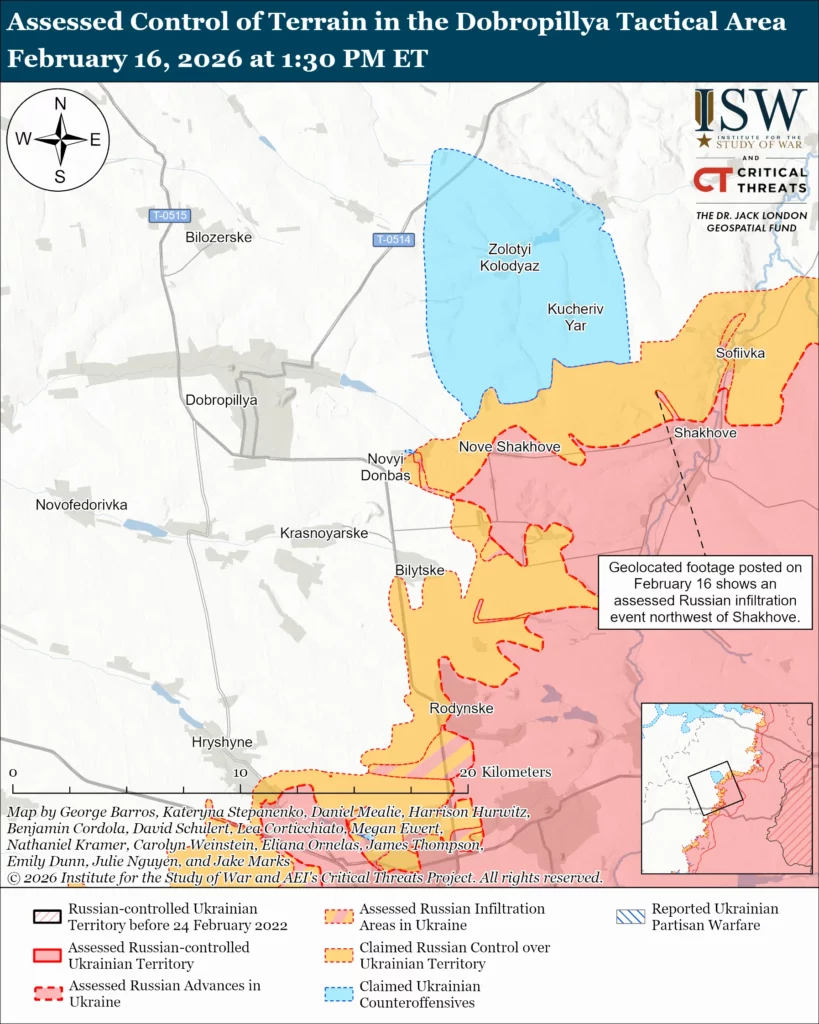
Assessed Russian infiltrations: Geolocated footage published on February 16 shows Ukrainian forces striking a Russian servicemember northwest of Shakhove (east of Dobropillya) after what ISW assesses was a Russian infiltration mission that did not change control of terrain or the FEBA at this time.[62]
Russian forces attacked northeast of Dobropillya toward Kucheriv Yar and east of Dobropillya near Novyi Donbas and Vilne on February 15 and 16.[63]
Order of Battle: FPV drone operators of the Russian Rubikon Center for Advanced Unmanned Technologies are reportedly striking Ukrainian armored vehicles near Dobropillya.[64]
Russian forces recently advanced in the Pokrovsk direction.
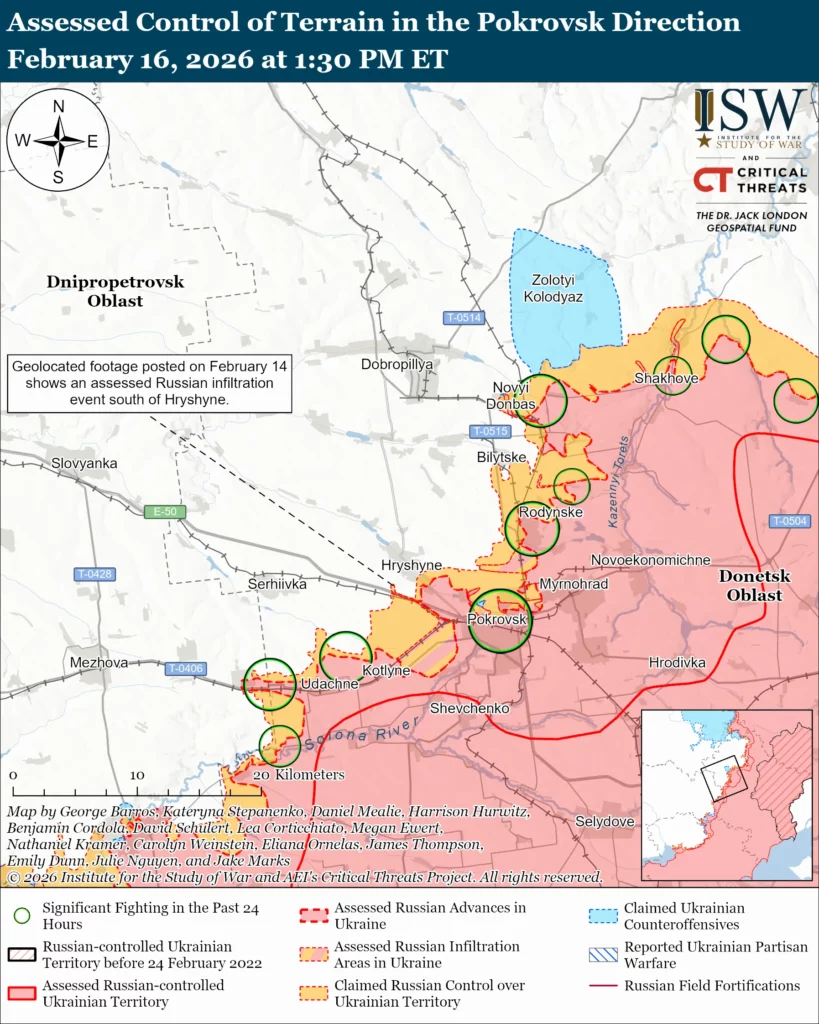
Assessed Russian advances: Geolocated footage published on February 14 indicates that Russian forces recently advanced south of Hryshyne (northwest of Pokrovsk).[65]
Russian forces attacked near Pokrovsk itself; northwest of Pokrovsk near Hryshyne and toward Shevchenko and Novooleksandrivka; north of Pokrovsk near Rodynske and Bilytske; northeast of Pokrovsk near Zatyshok and Chervonyi (Krasnyi) Lyman; southwest of Pokrovsk near Kotlyne, Udachne, Molodetske, and Novopidhorodne; and west of Pokrovsk toward Serhiivka on February 15 and 16.[66]
The Ukrainian 7th Rapid Reaction Corps of the Air Assault Forces reported on February 16 that Russian forces have increased pressure from Kotlyne and Rodynske on the northern and southern flanks of the Pokrovsk-Myrnohrad agglomeration as part of Russian attempts to close the pocket.[67] The 7th Corps reported that Russian small assault groups continue to infiltrate from northwestern Pokrovsk toward Hryshyne.
Order of Battle: Artillery elements of the Russian 35th Motorized Rifle Brigade (41st CAA, Central Military District [CMD]) are reportedly striking Ukrainian forces in the Pokrovsk direction.[68]
Ukrainian forces continued their frontline strike campaign against Russian military assets on the night of February 15 to 16. The Ukrainian General Staff reported that Ukrainian forces struck a Russian drone control point near Zatyshok and a Russian communications hub near Novopavlivka (south of Pokrovsk and roughly seven kilometers from the frontline).[69]
Russian forces continued offensive operations near Novopavlivka itself, northeast of Novopavlivka near Novomykolaivka, and south of Novopavlivka near Filiya and Dachne on February 15 and 16 but did not advance.[70]
Russian forces continued offensive operations in the Oleksandrivka direction on February 16 but did not make confirmed advances.
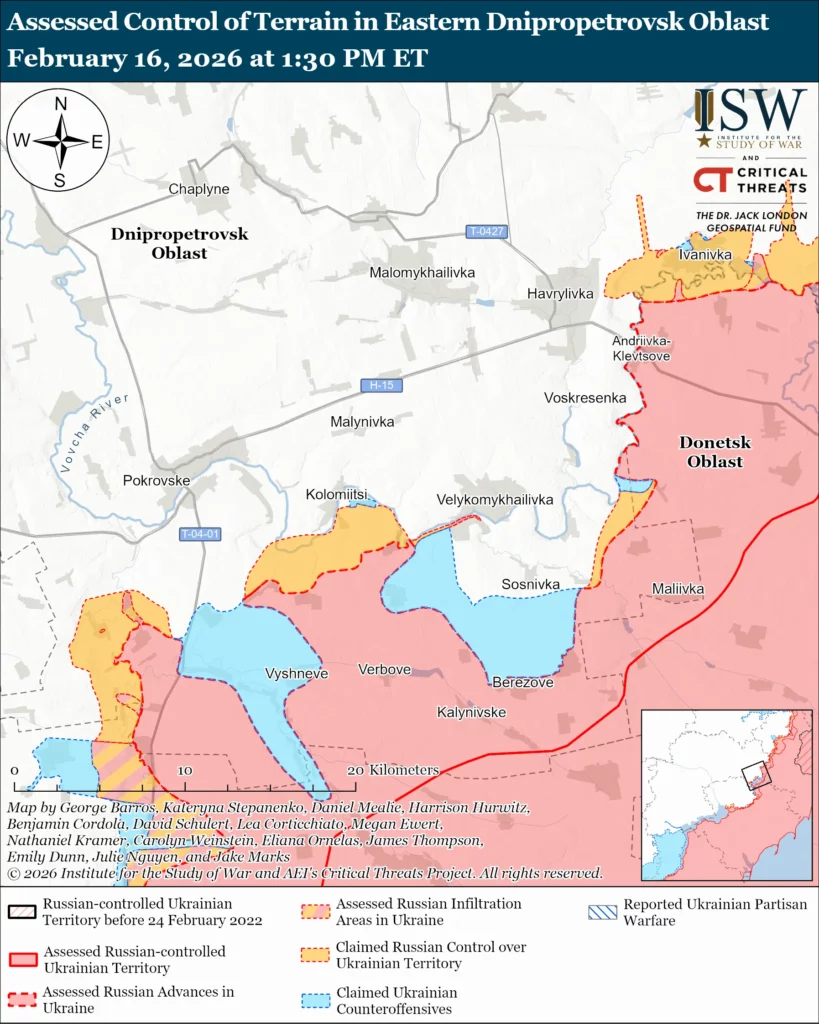
Unconfirmed claims: A Russian milblogger claimed that Russian forces marginally advanced in northern Ivanivka (northeast of Oleksandrivka).[71]
Russian forces attacked toward Oleksandrivka itself; northeast of Oleksandrivka near Zelenyi Hai and Ivanivka and toward Havrylivka; and southeast of Oleksandrivka near Verbove, Oleksiivka, Orestopil, Stepove, and Vyshneve on February 15 and 16.[72] Russian milbloggers claimed that Ukrainian forces counterattacked near Orestopil, Hai, and Sosnivka (all southeast of Oleksandrivka).[73]
The spokesperson of a Ukrainian brigade operating in the Oleksandrivka direction reported on February 16 that Russian forces have changed tactics over time from conducting mechanized assaults to high-speed motorized assaults to now conducting infiltration missions but that interceptor drones have allowed Ukrainian forces to better counter Russian infiltration tactics.[74]
The Ukrainian General Staff reported on February 16 that Ukrainian forces struck a Russian manpower concentration near Berezove (southeast of Oleksandrivka) overnight.[75]
Order of Battle: Drone operators of the Russian 14th Spetsnaz Brigade (GRU) are striking Ukrainian forces east of Pokrovske (north of Oleksandrivka).[76]
Russian Supporting Effort: Southern Axis
Russian objective: Maintain frontline positions, secure rear areas against Ukrainian strikes, and advance within tube artillery range of Zaporizhzhia City
Russian forces continued offensive operations in the Hulyaipole direction on February 16 but did not advance.
Russian forces attacked near Hulyaipole itself; northwest of Hulyaipole near Pryluky and Svyatopetrivka and toward Verkhnya Tersa; north of Hulyaipole near Danylivka, Nove Zaporizhzhia, Dobropillya, Yehorivka, Varvarivka, and Zelene; northeast of Hulyaipole near Uspenivka, Rybne, and Zlahoda; and west of Hulyaipole toward Staroukrainka, Zaliznychne, and Krynychne on February 15 and 16.[77] A Russian milblogger claimed that Ukrainian forces counterattacked near Boikove, and Rizdvyanka (all northwest of Hulyaipole).[78]
Order of Battle: Elements of the Russian 14th Spetsnaz Brigade (Russian General Staff’s Main Directorate [GRU]) are reportedly striking Ukrainian forces near Verkhnya Tersa, Rizdvyanka, and Vozdvyzhivka (northwest of Hulyaipole).[79] Elements of the 218th Tank Regiment (127th Motorized Rifle Division, 5th Combined Arms Army [CAA], Eastern Military District [EMD]) are reportedly operating in the Zaporizhia direction.[80]
Russian forces continued offensive operations in western Zaporizhia Oblast on February 16 but did not advance.
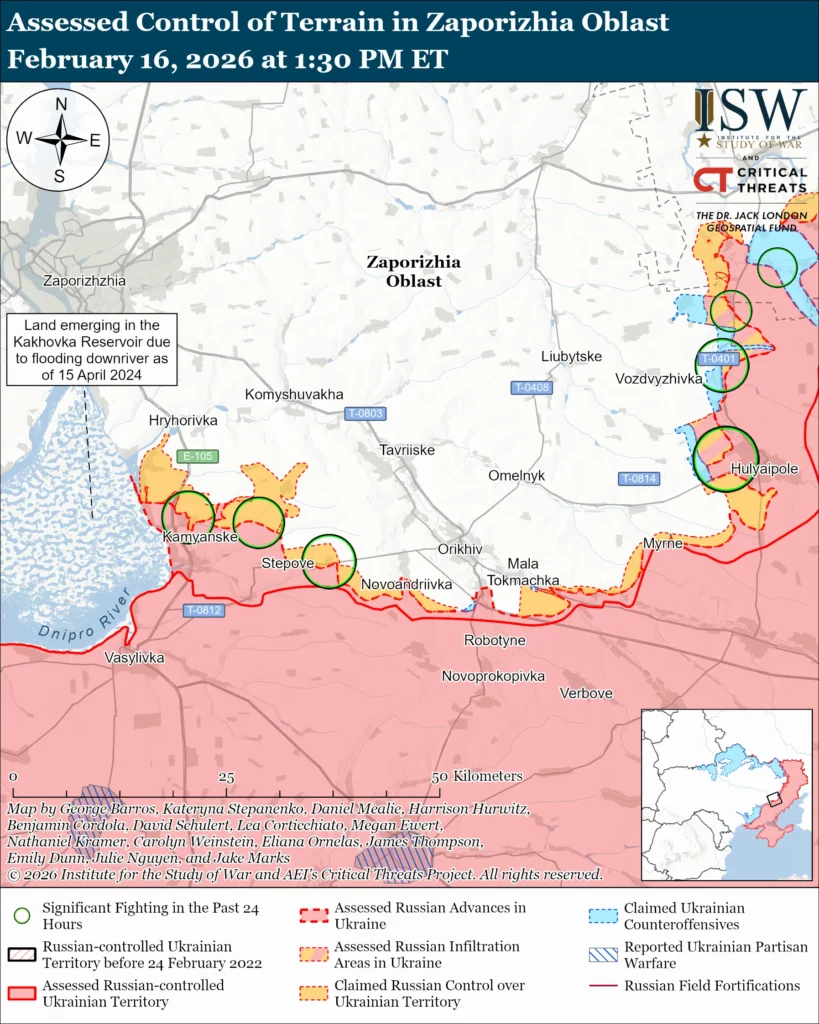
Russian forces attacked west of Orikhiv near Mali Shcherbaky and northwest of Orikhiv near Stepnohirsk, Lukyanivske, Novoboikivske, Richne, and Pavlivka on February 15 and 16.[81] Russian milbloggers claimed that Ukrainian forces counterattacked in Richne, Mali Shcherbaky, Pavlivka, Stepnohirsk, Novodanylivka (south of Orikhiv), Novoyakolivka (northwest of Orikhiv), Lukyanivske, Novoandriivka, and Mala Tokmachka (both west of Orikhiv).[82]
A Russian milblogger claimed that Russian forces do not maintain enduring positions in Richne (northwest of Orikhiv), contrary to what other Russian sources have previously claimed.[83]
Order of battle: Drone operators of the Russian Nemets group of the 3rd Assault Company of the 291st Motorized Rifle Regiment (42nd Motorized Rifle Division, 58th Combined Arms Army [CAA], Southern Military District [SMD]) are reportedly striking Ukrainian forces near Orikhiv.[84] Elements of the 7th Airborne (VDV) Division reportedly continue to operate in the Zaporizhia direction.[85]
Ukrainian forces continue their mid-range strikes against Russian military assets in occupied Zaporizhia Oblast on the night of February 15 to 16. The Ukrainian General Staff reported that Ukrainian forces struck a Russian manpower concentration near occupied Kalynivka (roughly 53 kilometers from the frontline).[86]
Neither Ukrainian nor Russian forces reported ground activity in the Kherson direction on February 16.
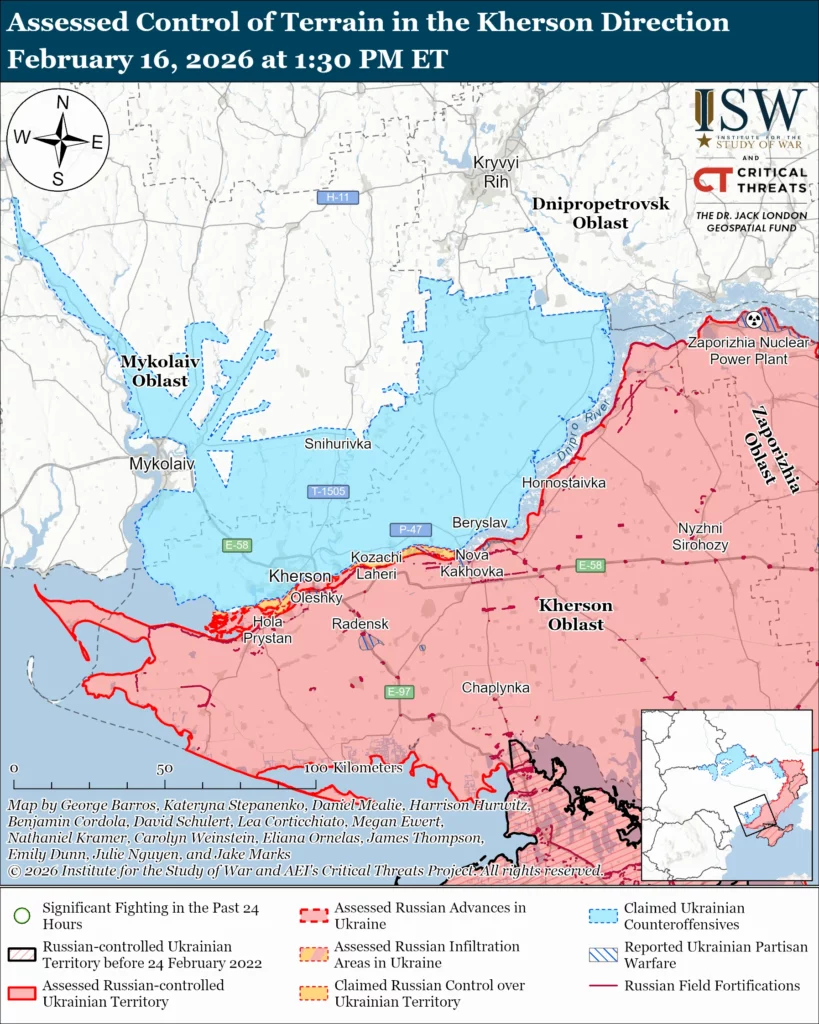
Order of Battle: Drone operators of the 215th Separate Reconnaissance Battalion and the 331st VDV Regiment (both 98th VDV Division) are reportedly striking Ukrainian forces in Kherson City.[87]
Russian Air, Missile, and Drone Campaign
Russian Objective: Target Ukrainian military and civilian infrastructure in the rear and on the front line
Russian forces conducted a series of missile and drone strikes against Ukraine on the night of February 15 to 16. The Ukrainian Air Force reported that Russian forces launched four Zircon hypersonic cruise missiles from occupied Crimea, one Iskander-M ballistic missile from Bryansk Oblast, and one Kh-31P anti-radiation missile from occupied Zaporizhia Oblast.[88] The Ukrainian Air Force reported that Russian forces also launched 62 Shahed-type, Gerbera-type, Italmas-type, and other drones – of which about 40 were Shaheds – from the directions of Kursk and Bryansk cities; Millerovo, Rostov Oblast; Shatalovo, Smolensk Oblast; Primorsko-Akhtarsk, Krasnodar Krai; and occupied Hvardiiske, Crimea. The Ukrainian Air Force reported that Ukrainian forces downed two Zircon missiles and 52 drones, that one missile and nine drones hit eight locations, and that downed debris fell on two locations. Ukrainian officials reported that Russian forces struck residential, energy, medical, and railway infrastructure in Kharkiv and Sumy oblasts.[89]
Significant Activity in Belarus
Russian efforts to increase its military presence in Belarus and further integrate Belarus into Russian-favorable frameworks
Nothing Significant To Report.
Note: ISW does not receive any classified material from any source, uses only publicly available information, and draws extensively on Russian, Ukrainian, and Western reporting and social media as well as commercially available satellite imagery and other geospatial data as the basis for these reports. References to all sources used are provided in the endnotes of each update.