 Eurasia Press & News
Toplines
Ukrainian, US, and Russian representatives concluded trilateral and multilateral negotiations in Geneva, Switzerland, on February 18.[1] Ukrainian President Volodymyr Zelensky and Ukrainian Defense Council Secretary Rustem Umerov stated that Ukrainian, US, and Russian representatives met in two groups focusing on military and political issues, respectively, on February 17 and 18.[2] Zelensky and Umerov noted that Ukrainian and US representatives also met with British, French, German, Italian, and Swiss representatives on February 17. Zelensky and Umerov stated that meetings on February 18 concerned security parameters and implementation mechanisms as well as humanitarian steps, such as prisoner-of-war (POW) exchanges and the release of imprisoned civilians. Zelensky stated that the US representatives called on Russia and Ukraine to refrain from strikes, likely referring to long-range strikes against energy infrastructure, and reiterated Ukraine’s willingness to do so.[3] Reuters reported on February 18 that the talks lasted two hours.[4] Russian Presidential Aide Vladimir Medinsky, who led the Russian delegation to the February 17 to February 18 Geneva talks, stated that the negotiations were difficult but “businesslike.”[5]
Medinsky leading the Russian delegation to Geneva is notable as the Kremlin is likely using him to stall negotiations. Russian General Staff’s Main Directorate (GRU) Head Admiral Igor Kostyukov led the Russian delegation to the first two rounds of trilateral talks in Abu Dhabi, United Arab Emirates (UAE) in late January and early February 2026, but Zelensky expressed concern on February 17 that the change in the delegation’s leadership suggests that Russia would use the Geneva talks to buy more time for its war effort.[6] Zelensky noted that Medinsky tends to discuss the so-called “historical roots” of the war, which Ukrainian and US officials have previously noted that Kremlin officials bring up during negotiations to stall discussions of a serious peace deal.[7]
Ukraine continues to offer significant concessions to advance the peace negotiations process, including compromising on territorial concessions. Zelensky told Axios on February 17 that Ukraine is prepared to discuss a troop withdrawal in Donbas but called on Russia to pull back Russian troops an equivalent distance.[8] Zelensky stated that Ukraine and the United States agree that the Ukrainian people would have to vote on any agreement to end the war, but noted that the Ukrainian people would reject a peace deal that involved Ukraine unilaterally withdrawing from eastern Donbas. Zelensky reiterated Ukraine’s willingness to hold elections in line with Russia’s demands but noted that Ukraine needs a ceasefire to safely hold the elections. Zelensky reiterated the need for a bilateral meeting with Putin to negotiate territorial issues directly — a meeting that Putin has repeatedly refused.[9] US President Donald Trump notably stated after the August 2025 Alaska summit that Putin had agreed to meet with Zelensky, but Putin has not yet done so.[10]
Russian officials signaled that Russia would not be satisfied with just territorial concessions and reiterated commitment to Russia’s original war goals, which include dismantling the NATO alliance. The Russian Embassy in Belgium told Russian state Izvestia newspaper on February 17 that Russia will demand that NATO legally enshrine a non-expansion clause in accordance with a “draft treaty” that Russia created in December 2021 — referring to Russia’s December 2021 pre-war ultimatums of the United States and NATO.[11] These ultimatums amounted to the destruction of the current NATO alliance by calling for NATO to halt deployment of forces or weapons systems to member states that joined NATO after 1997.[12] These ultimatums also aimed to force the West to reverse its “open door” policy, rule out eastward enlargement, and abandon partnerships on NATO’s eastern flank, including Ukraine.[13] These demands of Ukraine and NATO are part of Russia’s original war demands, and a Russian embassy reiterating these demands amid ongoing negotiations continues to signal that Russia would not be satisfied with a deal that does not concede to all these demands of Ukraine, NATO, and the United States — even if the deal meets some of Russia’s territorial demands. through its demands of NATO[14]
Russian officials, including Russian Ministry of Foreign Affairs (MFA) Spokesperson Maria Zakharova, invoked on February 17 and 18 the so-called “spirit” or “understandings” that the US and Russian delegations allegedly reached during the August 2025 Alaska summit.[15] Kremlin officials often attempt to exploit the lack of clarity about the outcome of the Alaska summit to claim that the summit achieved a joint US-Russian understanding and agreement to end the war in Ukraine, and present the agreement in ways that benefit Russia — including by obfuscating Russia’s own efforts to impede the peace process.[16] This “understanding” remains ambiguous as there have been no formal agreements as a result of the meeting, with Trump noting after the summit that the US and Russian delegations reached “no deal.”[17] Kremlin officials have consistently reiterated their commitment to achieving their original war aims militarily or diplomatically and have demonstrated no willingness to compromise from these aims to achieve a peace in Ukraine.[18]
Russian President Vladimir Putin is likely setting informational conditions to restart limited, rolling involuntary reserve call-ups as Russia appears to be struggling to replace its losses in Ukraine with existing force generation mechanisms. The Russian State Duma adopted a bill in its first reading on February 18 that would strengthen preventative measures against the “distortion of historical truth” and “evasion of the duty to defend the Fatherland.”[19] The bill likely aims to provide Russia with a legal justification to prosecute Russians who criticize involuntary reserve call-ups. Russian State Duma Committee on Security and Anti-Corruption Deputy Chairperson Anatoly Vyborny stated that the bill’s primary objective is to shape the Russian public consciousness to think of evading service to the Russian “Motherland” as “socially unacceptable.”[20] The Kremlin has also throttled Telegram in recent days, likely in an attempt to consolidate control over the information space and limit criticisms of the Russian government or war effort.[21] Putin likely seeks to normalize limited, rolling call-ups in an effort to sustain the size of the Russian force grouping in Ukraine, rather than conduct another partial call-up as in September 2022 or declare general mobilization. Putin likely aims to use these limited call-ups to maintain Russia’s loss rates and the current tempo of offensive operations — not to significantly build up the Russian force grouping fighting in Ukraine and flood the front with more forces.
The Kremlin has been setting conditions to allow it to conduct a rolling, involuntary reserve call-up since at least October 2025.[22] The Russian Cabinet of Ministers approved a bill in October 2025 that would allow Russia to deploy reservists from its active reserve in expeditionary deployments outside of Russia without an official Kremlin declaration of mobilization or a state of war.[23] The bill also allows the Kremlin to mobilize active reservists to perform special tasks in armed conflicts and counterterrorism operations. Russian President Vladimir Putin signed a decree on November 4, 2025, allowing the Russian military to conduct conscription processes year-round rather than only twice a year, which may improve Russia’s military registration and enlistment offices’ administrative capacity to process the rolling involuntary reserve call-ups amidst the semi-annual conscription cycles.[24] Putin signed another decree on December 8, 2025, authorizing the compulsory call-up of an unspecified number of Russian inactive reservists who will undergo compulsory “military assemblies” in the Russian Armed Forces, National Guard (Rosgvardia), Federal Security Service (FSB), Ministry of Emergency Situations military rescue units, and other state security agencies in 2026.[25] ISW assessed that that decree would likely allow the Kremlin to covertly call up members of its strategic inactive reserve.[26]
Putin is resorting to preparations for further involuntary reserve call-ups from a place of weakness, as Russia is likely preparing to attempt to offset Russia’s near exhaustion of its expensive voluntary recruitment system in 2026. Putin has long been trying to balance “butter and guns” – the need to prevent societal discontent about another large-scale partial involuntary reserve call-up, the need to maintain the tempo of Russian offensive operations on the battlefield, and the need to maintain the workforce in both the civilian and defense industrial sectors of the already strained Russian economy. The September 2022 partial call-up of 300,000 reservists led to widescale domestic backlash and the exodus of an estimated 700,000 to 900,000 economically mobile Russians from the country.[27] Putin must balance the workforce needs of the Russian economy, which Russian officials have stated will require at least 2.4 million additional workers by 2030.[28] Russia is already suffering from labor shortages, and the Kremlin has claimed that Russian manufacturing industries have a shortage of about 800,000 workers, while trade, construction, and service industries have a shortage of about 1.5 million workers — all due to Russia’s war effort.[29] A large-scale call-up would potentially take thousands of workers away from not only the civilian sectors of the economy, but the Russian defense industrial base (DIB), affecting Russia’s ability to produce enough materiel to maintain its battlefield tempo.
The Russian military must simultaneously maintain its force generation mechanisms to, at a minimum, replace Russia’s battlefield losses. Russian officials have indicated that Russia’s recruitment rate has been barely able to replace its monthly loss rates for much of the war, but Russia’s ability to recruit volunteers to fight in Ukraine appears to be slowing.[30] Bloomberg reported on February 11, citing Western officials, that Russia sustained about 9,000 more battlefield casualties than it was able to replace in January 2026 after years of Russia’s recruitment rate meeting its replacement rate.[31] The Russian military’s ability to replace its losses is crucial for Putin’s theory of victory, which rests on the assumption that the Russian military can maintain its current advances, albeit slow and grinding, long enough to outlast Ukraine’s ability to defend itself and the West’s willingness to support Ukraine.[32]
Putin has refused to conduct another partial involuntary reserve call-up since September 2022, despite the slowing tempo of Russian advances in recent years and the Russian military’s consistent inability to achieve Putin’s strategic objectives on the battlefield. Putin likely fears more domestic backlash like that the Kremlin experienced in the aftermath of the September 2022 call-up, and Kremlin officials have repeatedly attempted to quell any fears of another call-up in recent years by claiming that Russia’s ongoing force generation recruitment mechanisms are sufficient and Russia does not need another call-up.[33] The Kremlin is also facing social pressure to conduct rotations and relieve mobilized servicemen who had fought in Ukraine since Fall 2022. Russian society, including ultranationalist milbloggers, has consistently complained about Russia’s poor conduct of the September 2022 partial involuntary reserve call-up and the need for Russia to provide some relief to mobilized personnel still fighting on the frontline.[34] A Russian source suggested that about 78,000 Russian personnel mobilized in September 2022 were fighting against Ukraine as of May 2025.[35]
ISW assessed in February 2025 that the high personnel, economic, and societal costs of Russia’s war would force the Kremlin to make difficult choices about.[36] The Kremlin’s efforts to prepare Russian society for more partial reserve callups suggest that Putin is now grappling with these difficult choices in February 2026, four years into the war, as ISW previously forecasted. The Kremlin is likely pushing for Ukraine to capitulate to Russia’s long-held demands in ongoing peace negotiations imminently to secure its war aims without having to make uncomfortable sacrifices to do so.
Russian officials’ messaging about the recent throttling of Telegram remains disjointed as the Kremlin attempts to navigate the repeated backlash the restrictions have generated among Russian milbloggers. Kremlin officials, including Kremlin Spokesperson Dmitry Peskov and Russian State Duma Defense Committee Chairperson Andrei Kartapolov, recently denied that Russian forces were significantly using Telegram on the frontline or even using the platform at all.[37] Peskov’s and Kartapolov’s claims sparked significant milblogger backlash, and Kremlin officials appear now to be backtracking on these previous claims. Russian Minister of Digital Development, Communications, and Mass Media Maksut Shadayev acknowledged on February 18 that Russian forces began using Telegram at the start of the full-scale invasion, but claimed that Russian authorities have not made a decision to restrict Telegram in the war zone in Ukraine at this time.[38] Shadayev stated that he hopes Russian forces will adapt and switch to using Russian platforms “within some time.” Chief of the Main Communications Directorate of the Russian Armed Forces Lieutenant General Valery Tishkov also acknowledged on February 17 that Russian forces were using Starlink terminals on the frontline but claimed that only “individual” Russian units were using the terminals and “primarily to mislead Ukrainian forces.”[39] Russian propagandist Vladimir Solovyov claimed on February 18 that Russian troops at command posts use chats on both Telegram and Russian state messaging platform Max and that “everything is functioning properly.”[40] Solovyov claimed that Russian authorities are not slowing down or blocking Telegram, so any Russian units experiencing communications issues with Telegram should submit a request to their superiors directly to resolve the problem.
Kremlin officials’ and affiliates’ February 17 and 18 statements acknowledged that Russian forces have been using Telegram but still attempted to downplay the consequences of the recent SpaceX block on Russian forces’ usage of Starlinks, likely to address the continued backlash within the information space about the Telegram restrictions. Some Russian milbloggers, however, continued on February 18 to criticize Kremlin officials, particularly Shadayev, for dismissing the negative effects of the latest Telegram restrictions.[41] The varying Kremlin claims about whether or not Russian forces use Telegram on the battlefield continue to demonstrate that the Kremlin is sensitive to Russian milblogger complaints, a key pro-war community that the Kremlin has long sought to coopt and control.[42]
The Kremlin is looking for new excuses to justify its intensified Telegram censorship campaign. Shadayev also attempted on February 18 to justify the decision to throttle Telegram, claiming that foreign intelligence agencies are now “systematically” accessing Russian troops’ Telegram correspondence in order to gain information to use against Russian forces.[43] Russian federal censor Roskomnadzor initially stated on February 10 that it throttled Telegram in order to force it to comply with Russian laws and called for Telegram to protect Russian citizens from fraud and to combat extremism and terrorism.[44] The Kremlin appears to be trying to find new ways to justify the decision to significantly restrict Telegram, likely in response to the widespread backlash. The Kremlin may hope that claims that foreign intelligence services were exploiting Telegram to harm Russian forces on the battlefield will appeal to the pro-war, ultranationalist milblogger community.
Key Takeaways
Ukrainian, US, and Russian representatives concluded trilateral and multilateral negotiations in Geneva, Switzerland, on February 18.
Ukraine continues to offer significant concessions to advance the peace negotiations process, including compromising on territorial concessions.
Russian officials signaled that Russia would not be satisfied with just territorial concessions and reiterated commitment to Russia’s original war goals, which include dismantling the NATO alliance.
Russian President Vladimir Putin is likely setting informational conditions to restart limited, rolling involuntary reserve call-ups as Russia appears to be struggling to replace its losses in Ukraine with existing force generation mechanisms.
Putin likely aims to use these limited call-ups to maintain Russia’s loss rates and the current tempo of offensive operations — not to significantly build up the Russian force grouping fighting in Ukraine and flood the front with more forces.
The Kremlin has been setting conditions to allow it to conduct a rolling, involuntary reserve call-up since at least October 2025.
Putin is resorting to preparations for further involuntary reserve call-ups from a place of weakness, as Russia is likely preparing to attempt to offset Russia’s near exhaustion of its expensive voluntary recruitment system in 2026.
The Kremlin is likely pushing for Ukraine to capitulate to Russia’s long-held demands in ongoing peace negotiations imminently to secure its war aims without having to make uncomfortable sacrifices to do so.
Russian officials’ messaging about the recent throttling of Telegram remains disjointed as the Kremlin attempts to navigate the repeated backlash the restrictions have generated among Russian milbloggers.
The Kremlin is looking for new excuses to justify its intensified Telegram censorship campaign.
Ukrainian forces recently advanced near Pokrovsk. Russian forces recently advanced in northern Sumy Oblast, in the Kostyantynivka-Druzhkivka tactical area, and near Velykyi Burluk.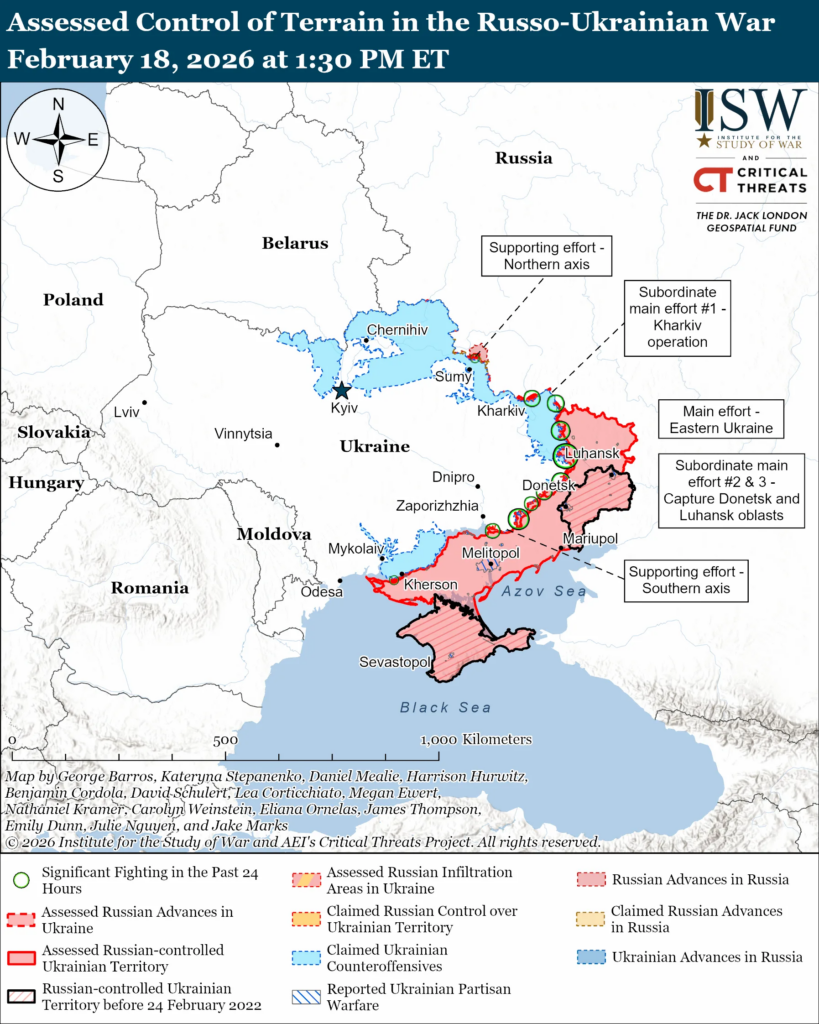
We do not report in detail on Russian war crimes because these activities are well-covered in Western media and do not directly affect the military operations we are assessing and forecasting. We will continue to evaluate and report on the effects of these criminal activities on the Ukrainian military and the Ukrainian population and specifically on combat in Ukrainian urban areas. We utterly condemn Russian violations of the laws of armed conflict and the Geneva Conventions and crimes against humanity even though we do not describe them in these reports.
Ukrainian Operations in the Russian Federation
Ukrainian forces likely conducted another long-range strike campaign against Russian military and industrial infrastructure on the night of February 17 and 18. Russian opposition media outlet Astra published footage [February 18 reportedly showing explosions at the VNIIR-Progress enterprise in Cheboksary, Republic of Chuvashia and damage to the Michurinskaya Combined Heat and Power Plant (CHPP) in Belgorod City, likely due to Ukrainian strikes.[45] Astra reported that VNIIR-Progress enterprise manufactures Kometa antennas used in Shahed-type drones, Iskander-M ballistic missiles, and unified gliding and correction modules (UMPCs) for guided aerial bombs, as well as satellite GNSS receivers and antennas for GLONASS, GPS, and Galileo satellite navigation systems. Geolocated footage published on February 18 shows damage to the Belgorod City CHPP.[46]
Russian Supporting Effort: Northern Axis
Russian objective: Create defensible buffer zones in Sumy Oblast along the international border
Russian forces recently advanced in Sumy Oblast.
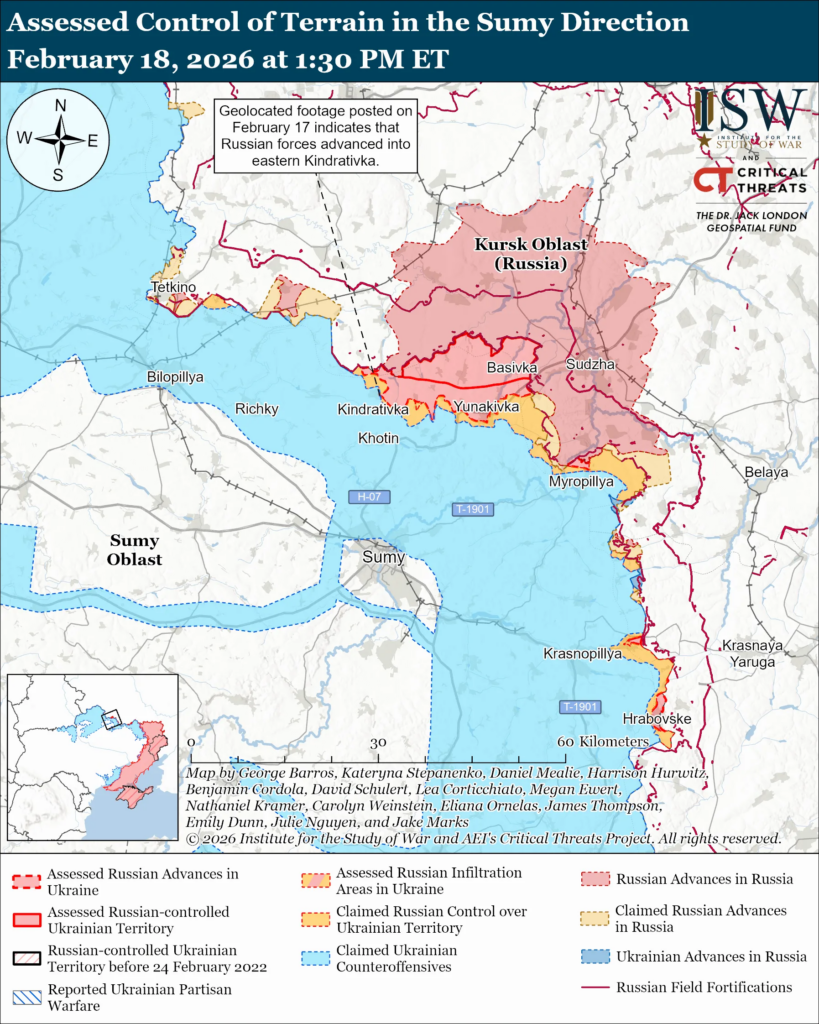
Assessed Russian advances: Geolocated footage published on February 17 indicates that Russian forces advanced into eastern Kindrativka (north of Sumy City).[47]
Assessed Russian infiltrations: Geolocated footage published on February 18 shows Russian forces operating in northwestern Kharkivka (northwest of Sumy City) during what ISW assesses was a Russian infiltration mission that did not change control of terrain of the forward edge of the battle area (FEBA) at this time.[48]
Unconfirmed claims: The Russian Ministry of Defense (MoD) claimed that elements of the Russian 80th Separate Arctic Motorized Rifle Brigade (14th Army Corps [AC], Leningrad Military District [LMD]) seized Kharkivka.[49] A Russian milblogger claimed that Russian forces advanced northwest of Bila Bereza and northwest of Komarivka (both northwest of Sumy City).[50]
A Russian milblogger claimed that Russian forces attacked southeast of Sumy City near Hrabovske on February 18.[51]
Ukrainian forces continued their mid-range strike campaign against Russian military assets in Kursk Oblast. The Ukrainian General Staff reported on February 18 that Ukrainian forces struck a Russian drone control point near Salnoye, Kursk Oblast (roughly 19 kilometers from the international border).[52]
Russian Main Effort: Eastern Ukraine
Russian Subordinate Main Effort #1 – Kharkiv Oblast
Russian objective: Push Ukrainian forces back from the international border to create a defensible buffer zone with Belgorod Oblast and approach to within tube artillery range of Kharkiv City
Russian forces continued offensive operations in northern Kharkiv Oblast on February 18 but did not advance.
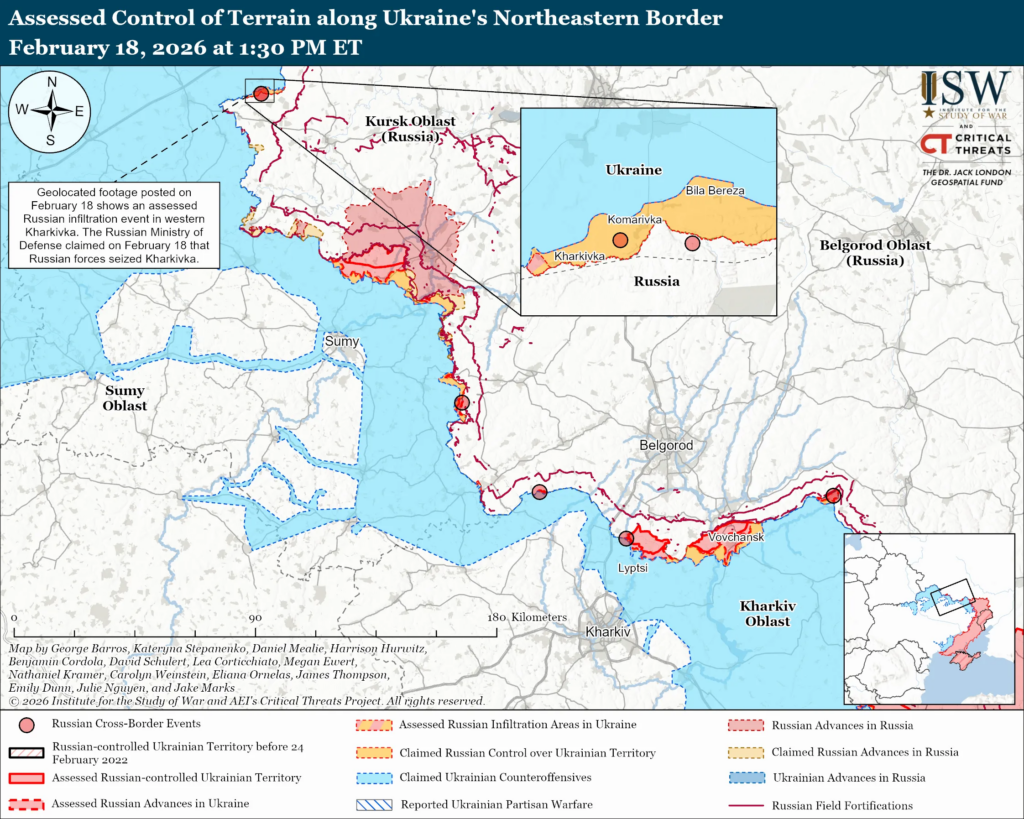
Russian forces attacked northeast of Kharkiv City near Vovchansk, Prylipka, Starytsya, Symynivka, Vilcha, Vovchanski Khutory, and Hrafske and toward Okhrimivka on February 17 and 18.[53] A Russian milblogger claimed that Ukrainian forces counterattacked near Vovchanski Khutory.[54]
The spokesperson of a Ukrainian brigade operating in northern Kharkiv Oblast reported on February 18 that Russian forces are increasingly employing mothership drones and striking bridges with guided aerial bombs.[55] The spokesperson stated that Russian forces continue attacking in small groups of two to three people and do not use heavy military equipment.
Order of the Battle: Drone operators of the Russian Cherny Voron (Black Raven) drone detachment (reportedly of the 3rd Motorized Rifle Division, 20th Combined Arms Army [CAA], Moscow Military District [MMD]) are reportedly striking Ukrainian forces near Ivashky, Petrovske, and Odnorobivka (all northwest of Kharkiv City).[56]
Russian forces recently advanced in the Velykyi Burluk direction.
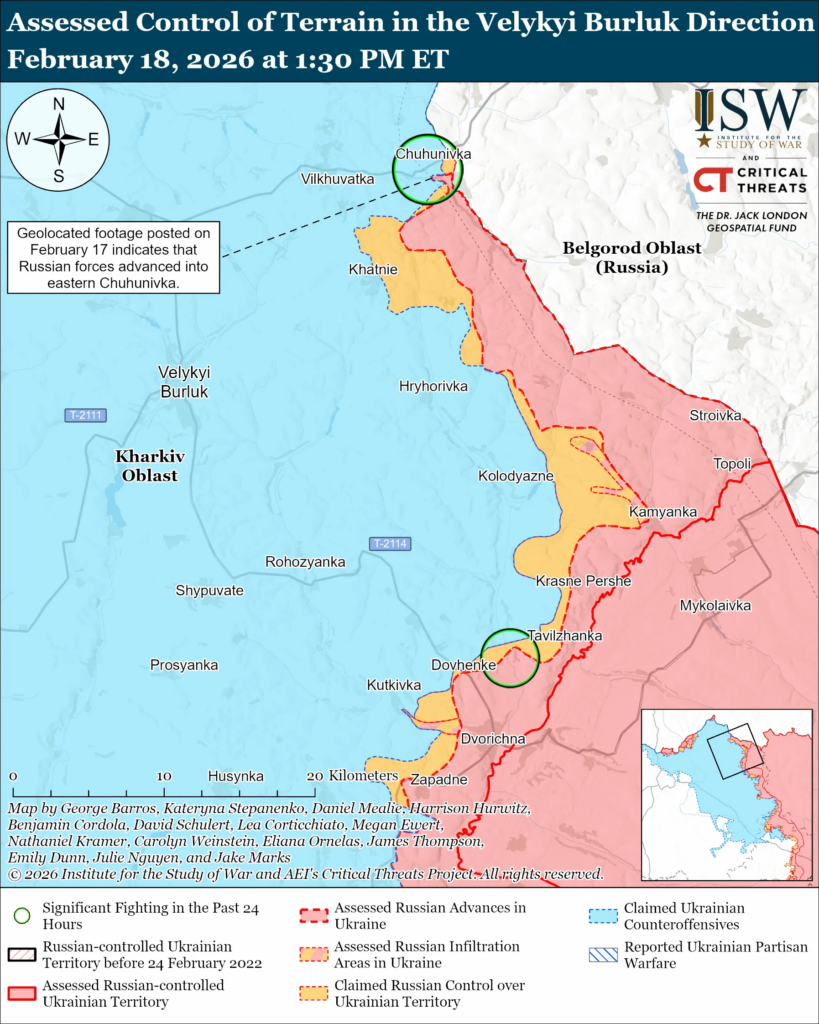
Assessed Russian advances: Geolocated footage published on February 17 indicates that Russian forces in eastern Chuhunivka (southeast of Velykyi Burluk).[57]
Russian forces attacked southeast of Velykyi Burluk near Chuhunivka and toward Kolodyazne on February 17 and 18.[58]
Order of Battle: Drone operators of the Russian Grom-Kaskad Drone Brigade (reportedly of the 4th Air Force and Air Defense Army, Russian Aerospace Forces [VKS]) are striking Ukrainian artillery systems west of Serednii Burluk (southwest of Velykyi Burluk).[59]
Russian Subordinate Main Effort #2 – Oskil River
Russian objective: Cross the Oskil River in Kharkiv Oblast and push westward into eastern Kharkiv Oblast and northern Donetsk Oblast
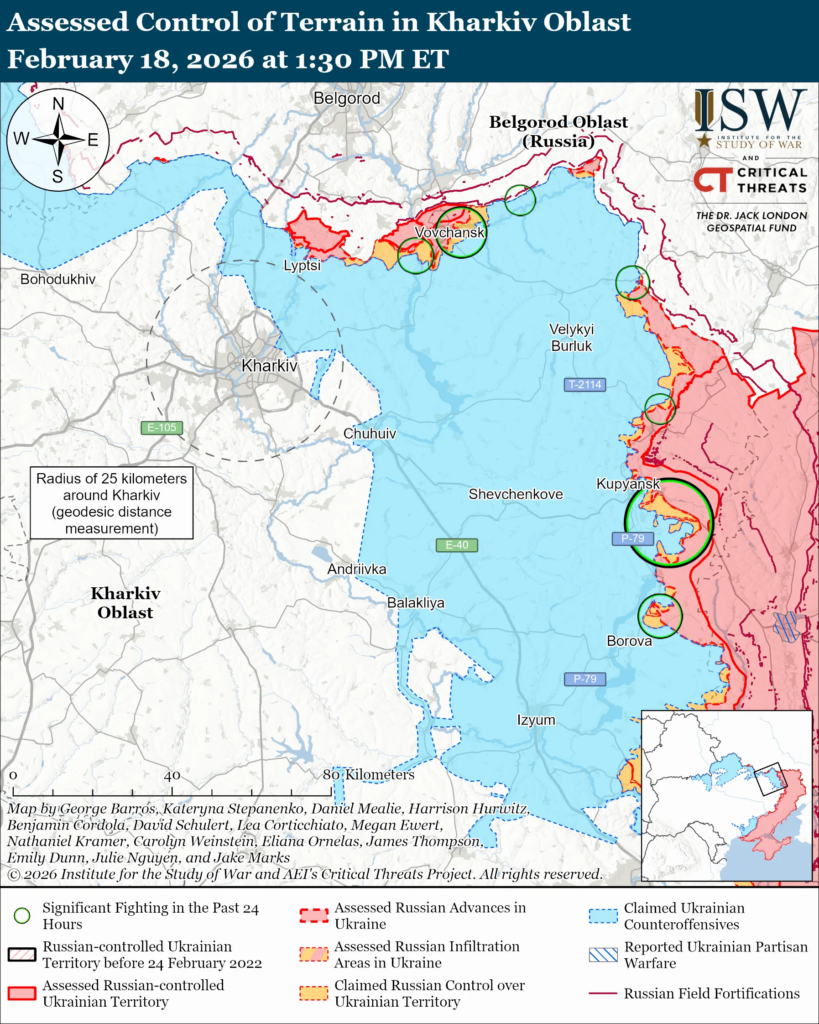
Russian forces continued offensive operations near Kupyansk itself, northeast of Kupyansk near Fyholivka, and southeast of Kupyansk near Kurylivka and Novoosynove on February 17 and 18.[60]
Russian forces continued offensive operations southeast of Borova near Tverdokhlibove and Ridkodub on February 18 but did not advance.[61]
Russian Subordinate Main Effort #3 – Donetsk Oblast
Russian objective: Capture the entirety of Donetsk Oblast, the claimed territory of Russia’s proxies in Donbas, and advance into Dnipropetrovsk Oblast
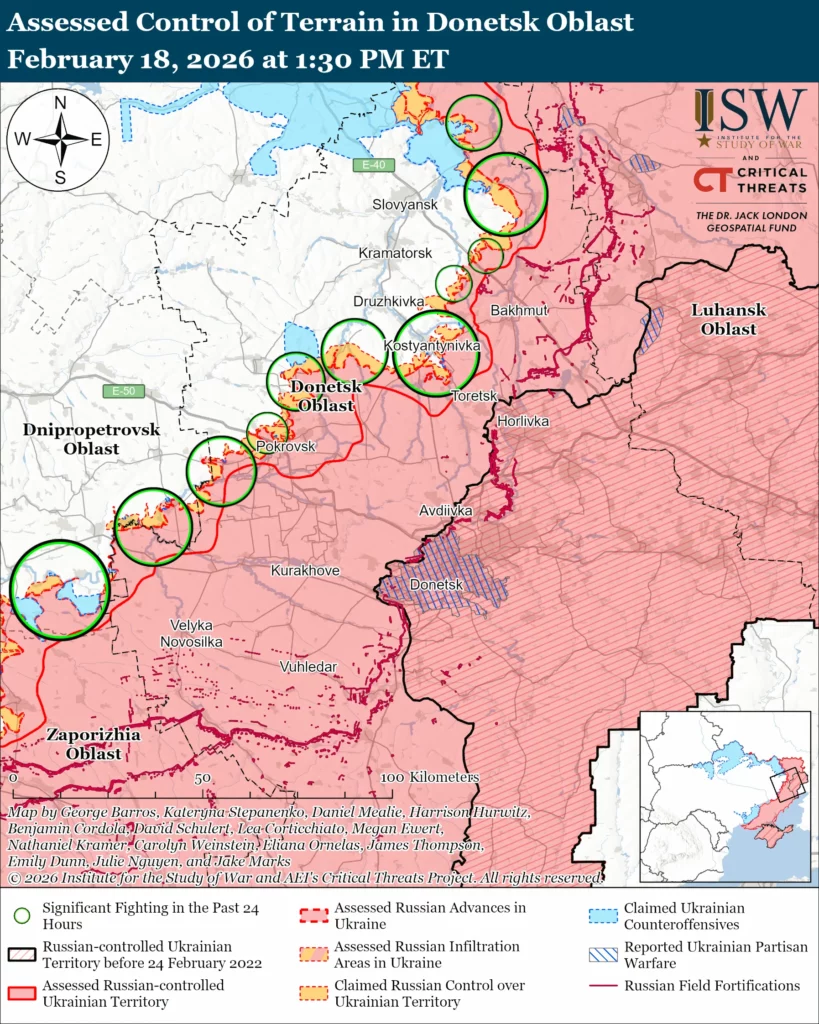
Russian forces continued offensive operations in the Slovyansk direction but did not advance.
Russian forces attacked near and within Lyman itself; northwest of Lyman near Novoselivka, Drobysheve, Sosnove, Svyatohirsk, and Yarova; northeast of Lyman near Zarichne and toward Stavky; southeast of Lyman near Yampil and Ozerne; south of Lyman near Dibrova and toward Staryi Karavan and Brusivka; northeast of Slovyansk near Dronivka; east of Slovyansk near Svyato-Pokrovske, Zakitne, Platonivka, Kryva Luka, Riznykivka and toward Rai-Oleksandrivka; and southeast of Slovyansk near Nykyforivka and Bondarne on February 17 and 18.[62]
A spokesperson for a Ukrainian brigade operating in the Lyman direction reported on February 18 that Russian forces continue to rely on small group infiltration tactics and that Russian forces have increased glide bomb strikes in the brigade’s area of responsibility (AoR).[63] The spokesperson reported that Russian forces are using a significant number of drones, including first-person-view (FPV) drones launched from Molniya mothership drones. The spokesperson added that the recent loss of Starlink is affecting Russian operations for now, but warned that Russian forces will likely eventually adapt and find alternative solutions.
Order of battle: FPV drone operators of the Russian 88th Motorized Rifle Brigade (3rd Combined Arms Army [CAA], formerly 2nd Luhansk People’s Republic Army Corps [LNR AC], Southern Military District [SMD]) are striking Ukrainian forces in western Kalenyky (east of Slovyansk).[64] FPV drone operators of the 1194th Motorized Rifle Regiment (4th Motorized Rifle Brigade, 3rd CAA, SMD) are reportedly striking Ukrainian equipment near Novoselivka.[65]
Russian forces recently advanced in the Kostyantynivka-Druzhkivka tactical area.
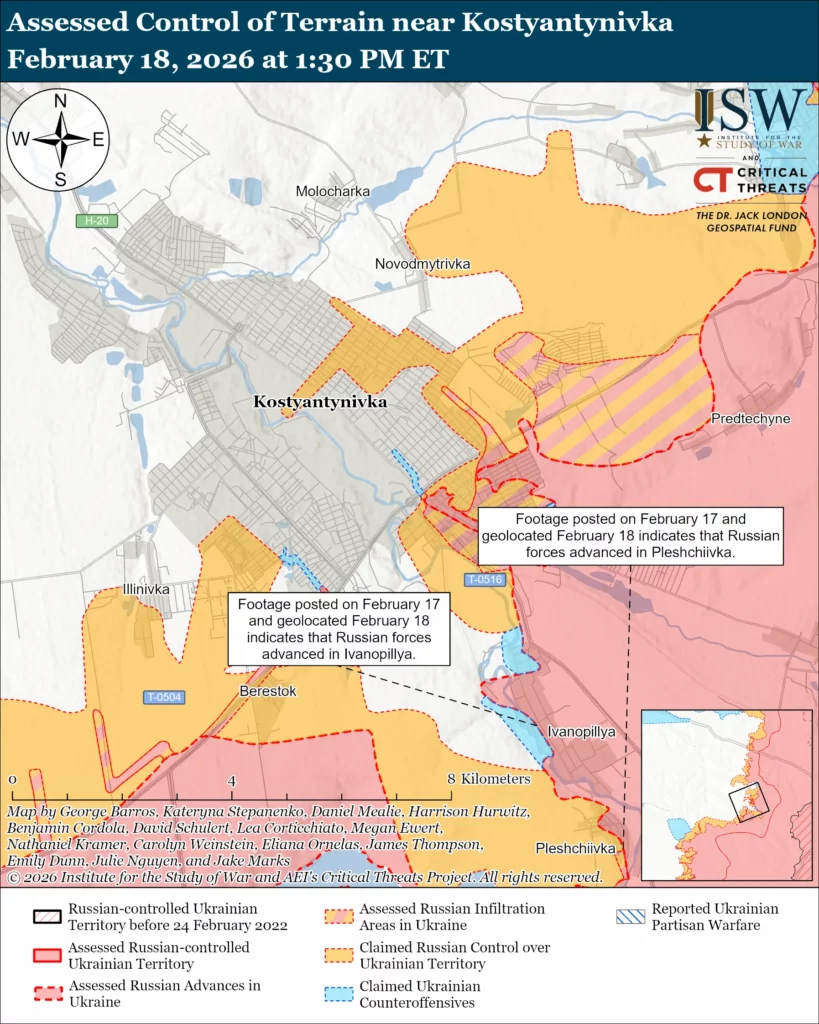
Assessed Russian advances: Geolocated footage published on February 17 indicates that Russian forces recently advanced in central Ivanopillya and southeastern Pleshchiivka (both south of Kostyantynivka) and likely seized Nelipivka at a prior date (just east of Pleshchiivka).[66]
Russian forces attacked near Kostyantynivka itself; north of Kostyantynivka near Novodmytrivka and toward Fedorivka; northeast of Kostyantynivka near Chasiv Yar; east of Kostyantynivka near Stupochky; south of Kostyantynivka near Pleshchiivka, Illinivka, Berestok, Ivanopillya, and Shcherbynivka; south of Druzhkivka near Rusyn Yar; and southwest of Druzhkivka near Novopavlivka and Sofiivka on February 17 and 18.[67]
Order of Battle: Drone operators of the Russian 150th Motorized Rifle Division (8th CAA, SMD), including its 103rd Motorized Rifle Regiment, are reportedly striking Ukrainian forces in the Kostyantynivka direction, including near Sofiivka and Krasnyi Kut (southwest of Druzhkivka).[68]
Neither Ukrainian nor Russian sources reported ground activity in the Dobropillya direction on February 17 and 18.
Order of Battle: Drone operators and other elements of the Russian 33rd Motorized Rifle Regiment (20th Motorized Rifle Division, 8th CAA, SMD) and of the 177th Separate Naval Infantry Regiment (Caspian Flotilla) are reportedly operating in the Dobropillya direction.[69]
Ukrainian forces recently advanced in the Pokrovsk direction.
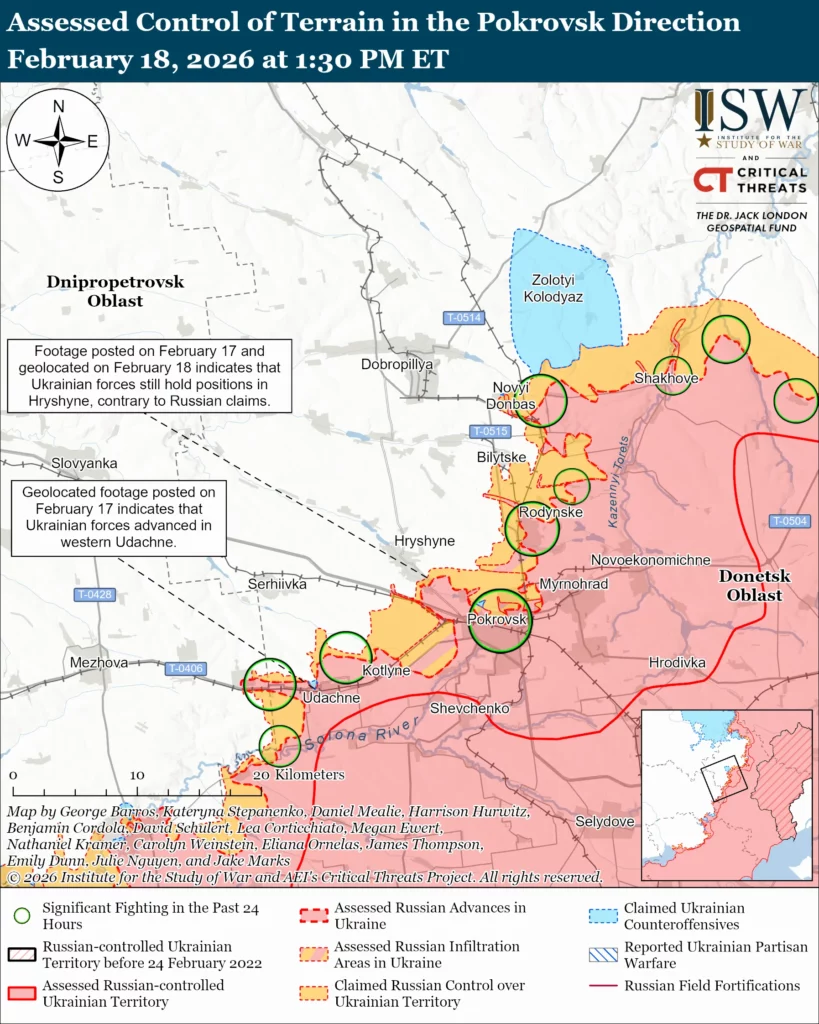
Assessed Ukrainian advances: Geolocated footage published on February 17 shows Russian forces striking a Ukrainian position in northwestern Udachne (southwest of Pokrovsk).[70]
Unconfirmed claims: A Russian milblogger claimed that Russian forces advanced northwest of Rodynske (north of Pokrovsk)[71]
Refinement of areas under Russian claims: Geolocated footage published on February 17 shows Ukrainian forces operating in southeastern Hryshyne — an area where Russian sources previously claimed Ukrainian forces did not maintain positions.[72]
Russian forces attacked near Pokrovsk itself; northwest of Pokrovsk near Hryshyne and toward Novooleksandrivka and Shevchenko; north of Pokrovsk near Rodynske and Bilytske; northeast of Pokrovsk near Zatyshok; and southwest of Pokrovsk near Molodetske, Kotlyne, Udachne, and Novopidhorodne on February 17 and 18.[73]
The Ukrainian 7th Rapid Reaction Corps of the Air Assault Forces reported on February 18 that Ukrainian forces cleared eastern Hryshyne following Russian small group infiltrations into the settlement.[74]
Order of Battle: Drone operators of the Russian 15th Motorized Rifle Brigade (2nd CAA, Central Military District [CMD]) are striking Ukrainian positions in western Udachne.[75]
Ukrainian forces continued their frontline strike campaign against Russian military assets on the night of February 17 to 18. The Ukrainian General Staff reported that Ukrainian forces struck a Russian drone control point near Rodynske.[76]
Russian forces continued offensive operations toward Novopavlivka itself and south of Novopavlivka near Filiya on February 17 and 18, but did not advance.[77]
Russian forces continued offensive operations in the Oleksandrivka direction but did not advance.
Russian forces attacked northeast of Oleksandrivka near Ivanivka; southeast of Oleksandrivka near Ternove, Orestopil, Novooleksandrivka, Oleksiivka and toward Vyshneve and Sosnivka; and south of Oleksandrivka near Vidradne on February 17 and 18.[78] A Russian milblogger claimed Ukrainian forces counterattacked near Oleksandrivka itself and toward Hai (southeast of Oleksandrivka).[79]
Order of Battle: Drone operators of the Russian 14th Spetsnaz Brigade (Russian General Staff’s Main Directorate [GRU]) are reportedly striking Ukrainian forces near Malynivka (northeast of Oleksandrivka).[80]
Ukrainian forces continued their mid-range strike campaign against Russian military assets in occupied Donetsk Oblast. The Ukrainian General Staff reported that Ukrainian forces struck a Russian drone communications hub near occupied Staromlynivka (roughly 30 kilometers from the frontline).[81] The Ukrainian General Staff reported that Ukrainian forces also struck a Russian S-300VM anti-aircraft missile system launcher near occupied Mariupol (roughly 110 kilometers from the frontline)
Russian Supporting Effort: Southern Axis
Russian objective: Maintain frontline positions, secure rear areas against Ukrainian strikes, and advance within tube artillery range of Zaporizhzhia City
Russian forces continued offensive operations in the Hulyaipole direction on February 18 but did not make confirmed advances.
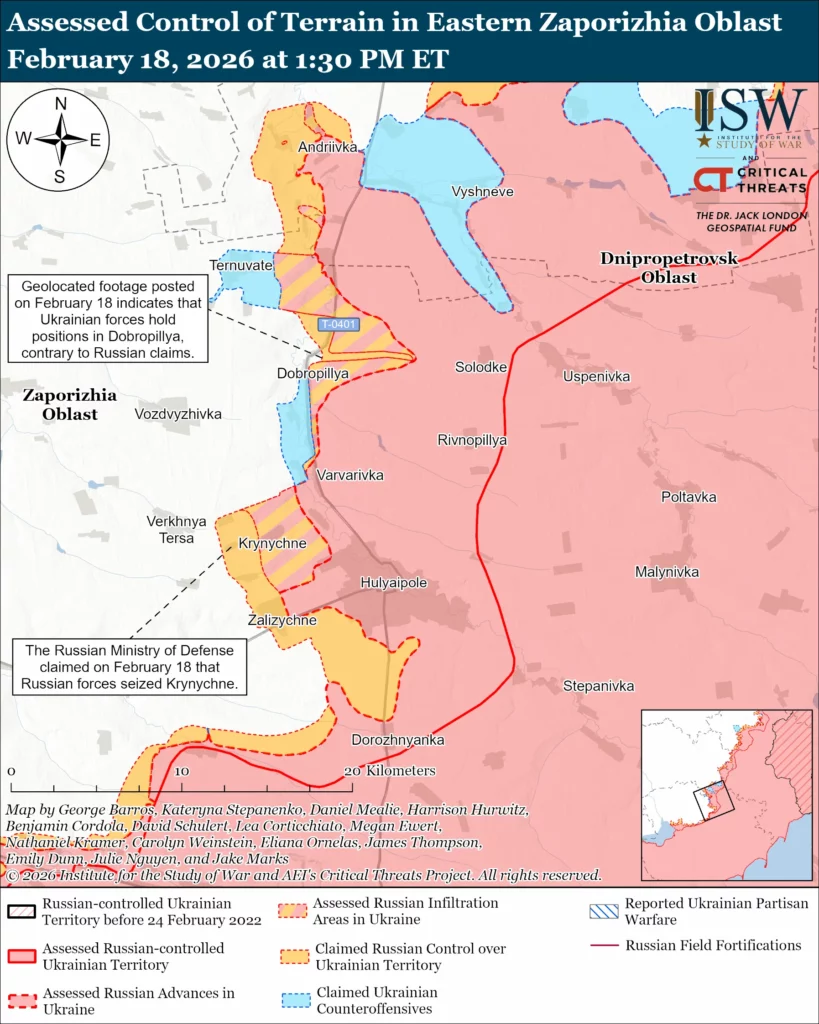
Unconfirmed claims: The Russian Ministry of Defense (MoD) claimed that Russian forces seized Krynychne (west of Hulyaipole).[82] A Russian milblogger claimed that Russian forces seized Staroukrainka and advanced northwest of Zaliznychne (both west of Hulyaipole).[83]
Refinement of areas under Russian claims: Geolocated footage published on February 18 shows Ukrainian forces operating in northern Dobropillya (north of Hulyaipole) — an area where Russian sources previously claimed that Russian forces maintained positions.[84]
Russian forces attacked near Hulyaipole itself; northwest of Hulyaipole near Pryluky, Tsvitkove, Svyatopetrivka and toward Verkhnya Tersa; north of Hulyaipole near Dobropillya, Danylivka, Nove Zaporizhzhia, and Varvarivka; northeast of Hulyaipole near Solodke, Rybne, and Zelene; and west of Hulyaipole near Zaliznychne, Krynychne, and Staroukrainka and toward Hirke on February 17 and 18.[85] Russian milbloggers claimed that Ukrainian forces counterattacked near Vozdvyzhivka, Rizdvyanka, and Ternuvate (all northwest of Hulyaipole), Zelenyi Hai (east of Hulyaipole), Staroukrainka and Zaliznychne.[86]
Order of Battle: Russian milbloggers credited elements of the Russian 218th Tank Regiment (127th Motorized Rifle Division, 5th Combined Arms Army [CAA], Eastern Military District [EMD]) with the claimed seizure of Krynychne.[87] Drone operators of the 1198th Motorized Rifle Regiment (35th CAA, EMD) are reportedly striking Ukrainian positions near Hulyaipole.[88] Drone operators of the 14th Spetsnaz Brigade (Russian General Staff’s Main Directorate [GRU]) are reportedly striking Ukrainian forces near Lyubytske (northwest of Hulyaipole).[89]
Russian forces continued offensive operations in western Zaporizhia Oblast on February 18 but did not advance.
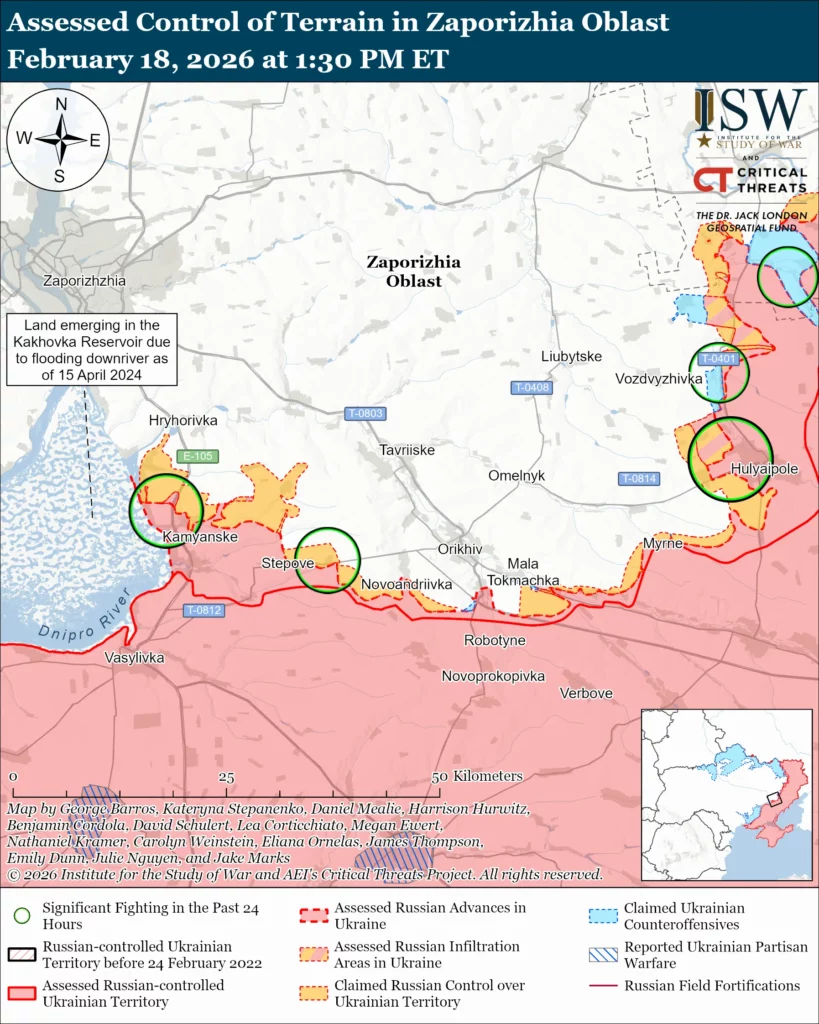
Russian forces attacked southeast of Orikhiv near Mala Tokmachka; west of Orikhiv near Stepove, Mali Shcherbaky, Stepnohirsk, and Prymorske and toward Shcherbaky; and northwest of Orikhiv near Mahdalynivka and Lukyanivske on February 17 and 18.[90] Russian milbloggers claimed Ukrainian forces counterattacked near Orikhiv itself and near Stepnohirsk, Prymorske, and Mahdalynivka.[91]
A spokesperson for a Ukrainian brigade operating in the western Zaporizhia direction reported on February 18 that Russian forces have more than doubled the number of drone strikes against Ukrainian forces near Orikhiv.[92] The spokesperson reported that Russian troops are increasingly attempting to advance from the flanks, as they have been unable to achieve successes following frontal assaults.
Order of Battle: Drone operators of the Russian 7th Airborne (VDV) Division are reportedly striking Ukrainian personnel and providing refueling services in the Zaporizhia direction.[93]
Ukrainian forces continued their mid-range strike campaign against Russian military assets in occupied Zaporizhia Oblast on February 18. The Ukrainian General Staff reported that Ukrainian forces struck a Russian drone detachment concentration area near occupied Trudove (roughly 26 kilometers from the frontline) and a Russian drone workshop in occupied Tokmak (approximately 27 kilometers from the frontline).[94]
Russian forces continued limited offensive operations in the Kherson direction on February 18 but did not advance.[95]
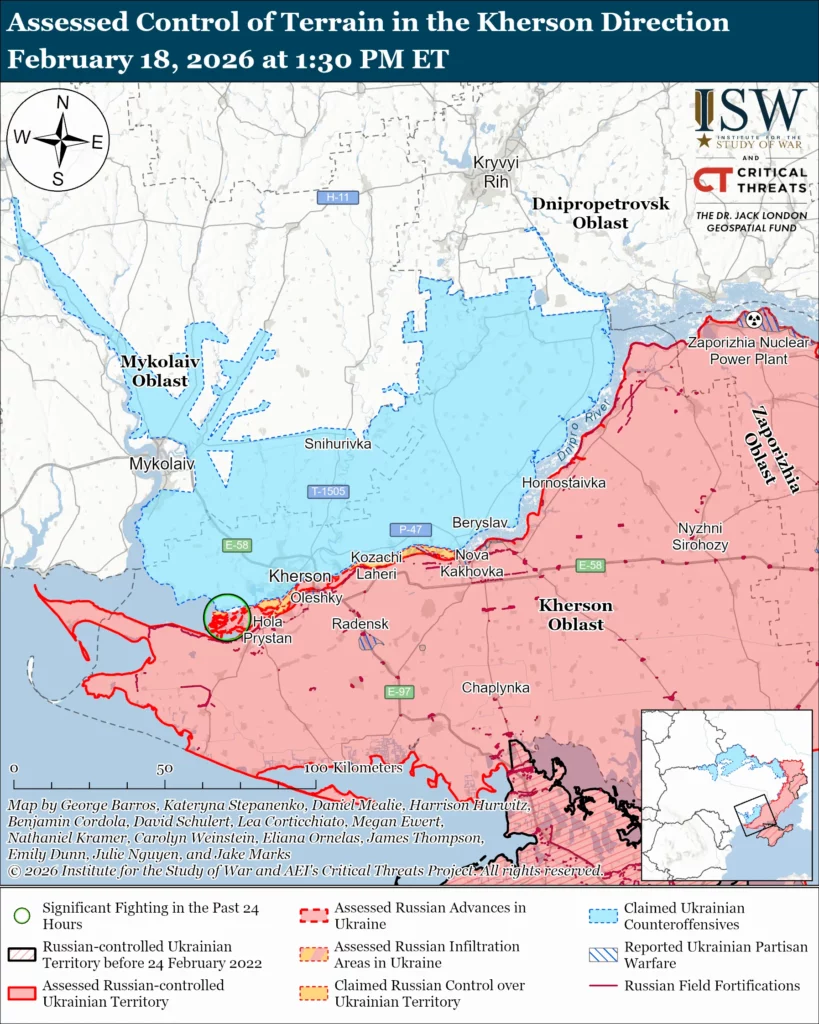
Order of Battle: Drone operators of the Russian 98th VDV Division are reportedly striking Ukrainian positions on the west (right) bank of the Dnipro River in Kherson Oblast.[96]
Russian Air, Missile, and Drone Campaign
Russian Objective: Target Ukrainian military and civilian infrastructure in the rear and on the front line
Russian forces conducted a series of missile and drone strikes against Ukraine on the night of February 17 to 18. The Ukrainian Air Force reported that Russian forces launched one Iskander-M missile from occupied Crimea and 126 Shahed-type, Gerbera-type, Italmas-type, and other drones, of which roughly 80 were Shahed-type drones, from the directions of Bryansk, Kursk, and Oryol cities; Shatalovo, Smolensk Oblast; Primorsko-Akhtarsk, Krasnodar Krai; and occupied Hvardiiske, Crimea.[97] The Ukrainian Air Force reported that Ukrainian forces downed 100 drones as of 0830 local time, that one Iskander-M missile and 23 drones struck 14 locations, and that drone debris impacted three locations. Ukrainian officials reported that Russian forces struck transport and residential infrastructure in Chernihiv and Kharkiv oblasts.[98]
Significant Activity in Belarus
Russian efforts to increase its military presence in Belarus and further integrate Belarus into Russian-favorable frameworks
Nothing Significant To Report.
Note: ISW does not receive any classified material from any source, uses only publicly available information, and draws extensively on Russian, Ukrainian, and Western reporting and social media as well as commercially available satellite imagery and other geospatial data as the basis for these reports. References to all sources used are provided in the endnotes of each update.