 Eurasia Press & News
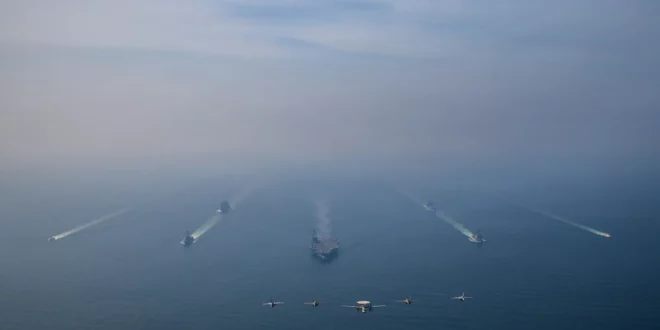
There’s been no slowdown to the U.S. military buildup around Iran despite both sides engaging in nuclear talks this week.
President Donald Trump has threatened the Islamic Republic with direct action if diplomacy doesn’t produce the desired results.
And with a second aircraft carrier group headed to the Gulf, Trump’s warnings that an attack on Iran would go beyond last summer’s bombings on nuclear facilities leave a range of options open to the president.
There could be new rounds of targeted strikes, assassinations of top leaders or a more sustained military campaign that could resemble something closer to a Third Gulf War.
Here’s What Trump Has Deployed To Middle EastTrump has throughout the escalation voiced his preference for a diplomatic solution. He wants a nuclear deal that would go beyond the 2015 agreement that limited Iran’s nuclear program in exchange for sanctions relief.
But distance persists in the negotiating positions between Washington and Tehran. Despite some progress in Tuesday’s talks in Geneva, the White House said Washington and Tehran were still “very far apart” on key issues.
If Diplomacy Fails
“Iran would be very wise to make a deal with President Trump,” Press Secretary Karoline Leavitt said on Wednesday, referencing the U.S.’s strikes last June.
She told reporters at the White House there were “many reasons and arguments that one could make for a strike against Iran”.
After the talks this week, Iran said they had reached a “general agreement” with the US on “guiding principles” that would frame efforts to resolve the dispute over its nuclear programme.
Leavitt said the US expects Iran to “come back to us with some more detail in the next couple of weeks, and so the president will continue to watch how this plays out.”
So what would keep Trump happy and away from military options?
“I do believe the White House wants to see an agreement reached, but that agreement would have to be more restrictive than the [2015 deal] Joint Comprehensive Plan of Action that the first Trump administration pulled out of, and would likely have to include some restrictions on Iran’s ballistic missile program,” said Mick Mulroy, who served as deputy assistant secretary of defense for the Middle East during the U.S. exit from the JCPOA in 2018.
He told Newsweek: “The question will be will Iran compromise and agree to these terms. To date, they have not indicated that they are willing.”
“If they reject these terms, I believe the U.S. is not only ready to take significant military action against nuclear facilities and ballistic missile production and launch sites. I believe we are postured to do it in a sustainable manner to include responding to any escalatory actions by Iran,” said Mulroy, now president of the Fogbow advisory firm and co-founder of the Lobo Institute.
“It may be that the administration has decided to continuously degrade Iran’s nuclear and ballistic missile program militarily until there is nothing to preserve by not signing on to a new agreement.”
Strikes on Military and Strategic Sites
While Iran is not currently assessed to hold any nuclear weapons and regularly denies any plan to conduct such an endeavor, the Islamic Republic possesses the largest missile and drone arsenal in the Middle East.
These capabilities continue to pose a major threat in the event of a conflict, even after Iran expanded vast quantities of both during the 12-Day War with Israel in the summer.
The farthest reach of these weapons is believed to extend at least 2,000 kilometers, or 1,240 miles, putting the entire Middle East and parts of Southeastern Europe well within range. Adjustments to known platforms could also significantly extend this scope, while hypersonic maneuverability may serve to thwart even advanced defense systems.
Much of Trump’s talk surrounding a deal with Iran has dealt specifically with its nuclear program, though the U.S. leader and other top officials, particularly Secretary of State Marco Rubio, have said that Iran’s missile capabilities, among other areas, would also need to be subject to limits under a new agreement.
This position is also being pressed by Israeli Prime Minister Benjamin Netanyahu, who visited Trump last week at the White House, between the first and second rounds of U.S.-Iran negotiations.
Thus far, Iranian diplomats have resisted any talk of including the nation’s missile arsenal in an initial deal and have also argued it was their nation’s right to enrich uranium at lower levels. And while, like their U.S. counterparts, they have called for a diplomatic solution, Iranian officials have repeatedly warned even a limited U.S. strike would spark an all-out war, with Supreme Leader Ayatollah Ali Khamenei threatening directly to sink U.S. warships.
Iran’s air defenses have proved largely ineffective against state-of-the-art U.S. and Israeli aircraft, though the Islamic Republic has long invested in heavily fortified subterranean complexes sometimes referred to as “missile cities” to house its missile and drone stockpiles. Here too, however, the U.S. has demonstrated the ability to overcome the challenge by penetrating deep underground with the use of bunker buster-style munitions, like the 30,000-pound GBU-57 Massive Ordnance Penetrators used to hit the nuclear sites at Fordow, Isfahan and Natanz.
Richard Goldberg, former director for countering Iranian weapons of mass destruction for the White House National Security Council under the first Trump administration and senior counselor to the National Energy Dominance Council under the second, recently told Newsweek that missile capabilities would likely factor high on Trump’s list of targets should he choose to take military action.
“What are they threatening with us today? They say, ‘We’ll launch missiles around the region. We’ll launch missiles at U.S. bases. We’ll launch missiles at oil infrastructure,’ and we know that they’re building missiles, not just to hit Saudi Arabia or Iraq. They have missiles already that can reach Europe, and they’re building missiles to reach the United States of America,” said Goldberg, now senior adviser at the Foundation for Defense of Democracies. “So, the missile threat of Iran emerges after its nuclear program as the greatest threat we face already.”
“And therefore, it would make sense, even if you had a target set that was broader than that, command and control, decapitation strike of Khamenei, whatever else you want to do, punishment for killing tens of thousands of people and violating the president’s red line, the fact that they are threatening to retaliate with their missile program would mean that their missile program would likely be one of the first on the list to get hit, and it would make perfect sense for that to happen.”
Decapitation of Political Leadership
While Israel has long targeted top commanders among Iran’s Axis of Resistance coalition allies and even widely believed to be behind the assassination of nuclear scientists in Iran, Trump fired the first open shot against the Islamic Republic back in January 2020, ordering the strike that killed Islamic Revolutionary Guard Corps Quds Force commander Major General Qassem Soleimani at Baghdad International Airport in Iraq.
The regional turmoil surrounding the war in Gaza, sparked by an attack led by the Palestinian Hamas movement against Israel in October 2023, has further shattered the norms of what was once a shadowy conflict fought across the region. Israel’s targeting of Hamas leadership in Tehran and Iranian commanders in Syria spurred the first two waves of direct Iranian strikes in Israel in June and October 2024.
Then, in June 2025, as the U.S. and Iran engaged in previous rounds of nuclear diplomacy, Israel launched an unprecedented series of strikes across Iran, killing scores of senior military officials and nuclear scientists, and devastating air defenses and other military sites over the course of 12 days. Before U.S. intervention, Trump openly hinted at the potential to assassinate Khamenei, teasing knowledge of his whereabouts.
While Trump ultimately opted for a more limited bombing of Iran’s most heavily shielded nuclear sites, the U.S. leader has more recently demonstrated his willingness to target leadership in the U.S. Delta Force raid that seized Venezuelan President Nicolás Maduro and his wife from their home in Caracas. As with Iran, Venezuela was subject at the time to a U.S. pressure campaign involving a massive military buildup off its shores, including the USS Gerald R. Ford carrier strike group, which is now set to join the USS Abraham Lincoln carrier strike group in the Middle East.
Trump first began ramping up military pressure on Iran in the days following the operation in Venezuela, when the Islamic Republic was in the throes of nationwide protests and clashes, with the U.S. leader blaming Iranian security forces for the historic bloodshed that killed thousands of people, most of them civilians. Analysts at the time told Newsweek that the White House may ultimately be seeking to apply a “Venezuela model.”
This strategy contains substantial risks, however, not only due to retaliation, but over uncertainty over who may step in to take the reins. Unlike Maduro, or even Iranian President Masoud Pezeshkian, who won a snap election after the death of his predecessor in a May 2024 helicopter crash, Khamenei’s position has both ideological and religious roots, and the 86-year-old’s succession is a matter of utmost sensitivity assigned to the elite Assembly of Experts.
With speculation already swirling over who may lead in the event of Khamenei’s demise, including potential takeovers from members of Iran’s political and military echelons, even Rubio acknowledged to lawmakers late last month that “no one knows who would take over.”
Kenneth Pollack, a former White House National Security Council official and CIA analyst specializing on the Persian Gulf, argued that, at this stage, the regime change option is effectively “off the table.”
“The protests have died down. They’re occasional. They’re sporadic. But the moment has passed, and the administration’s rhetoric has shifted completely,” Pollack, who is today vice president for policy at the Middle East Institute, told Newsweek. “It’s really no longer about regime change at all. It’s now all about the deal.”
Echoing Goldberg, Pollack felt nuclear and military targets were the most likely choice for Trump.
“I do think that we are likely to bomb these ballistic missile fabrication facilities that the Israelis are up in arms about,” Pollack said. “Obviously, there are some nuclear sites that weren’t fully struck back in June. We might very well hit some of those. We could very well hit Revolutionary Guard and Basij headquarters, less to try to bring about regime change, and more as a way of saying, ‘We know this is valuable to the regime because they do help the regime keep control and so we’re simply trying to inflict pain on you.'”
“I could also imagine the U.S. going after Iranian military targets,” he added. “The Iranians have some very expensive pieces of military equipment. I’ve been pointing out for 30 years that the Iranian Navy is both expensive and very vulnerable. We might do something like that.”
Another potential set of targets whose loss could prove deeply damaging to Iran include the nation’s so-called “ghost fleet” of tankers engaged in sanctions-evading trade, though Pollack pointed out that final option may require a more comprehensive campaign involving multiple maritime theaters across the globe.
The Longer War
At the moment, none of the many signs indicating looming U.S. military action against Iran suggest any form of large-scale invasion, as was witnessed during the Iraq War, also referred to sometimes as the Second Gulf War. That conflict was preceded by a substantial amassing of forces and equipment, including in neighboring countries like Kuwait, to sustain the insertion of nearly half a million U.S. personnel into Iraq in the opening phase of the war.
While nothing near this figure has been mobilized in the vicinity of Iran today, the presence of two aircraft carrier strike groups, combat and refueling aircraft and other equipment is likely sufficient to support a prolonged period of aerial operations, the kinds of which the U.S. has ample experience conducting.
Following the First Gulf War, also called Operation Desert Storm, the U.S. enforced a no-fly zone over Iraq and frequently targeted air defenses and other sites after pushing Iraqi units out of Kuwait. The U.S. also established an autonomous Kurdish-led region across much of the country’s north, further weakening then-Iraqi President Saddam Hussein’s government until the 2003 invasion that ousted him.
The U.S. also contributed to a NATO aerial campaign in support of the insurgency that toppled Libyan leader Muammar el-Qaddafi in 2011. Yet Iran presents a number of distinct challenges that separate it from Hussein’s Iraq and Qaddafi’s Libya.
For one, while the government’s survival has been tested by the recent demonstrations and unrest, its security forces, including the IRGC and its Basij paramilitary wing, maintain a deeply entrenched network of intelligence and home defense, with no signs of high-profile defections among top officials to date, even under the harshest-yet manifestation of Trump’s “maximum pressure.”
Insurgent groups, including those organized along ethnic and Islamist lines, are present in Iran and some claimed operations during the height of the protests, though their activity has yet to pose any major internal challenge to the Islamic Republic. Meanwhile, Arab partners with which Trump has enjoyed close ties, including Saudi Arabia, have called for restraint in dealing with Iran, a departure from past U.S. interventions in the region.
“It seems clear that our Gulf Arab partners do not want to see a military confrontation between the U.S. and Iran,” Mulroy said. “It could significantly de-stabilize the region and impact the free flow of energy as Iran has threatened and does have the ability to sea mine the Strait of Hormuz, an action that would also negatively impact Iran, but they may be willing to do it anyway.”
Meanwhile, Mulroy noted, Trump’s Board of Peace that includes a number of these Arab partners deemed crucial for securing a lasting peace in Gaza, “is already under considerable strain,” as “Hamas not disarming will likely impact the deployment of the International Stabilization Force” and “Israel refusing to entertain a two state solution and continuing to annex parts of the West Bank is only going to add to those challenges.”
A long-term, sustained military intervention in the Middle East also runs contrary to Trump’s track record, save for the first-term campaign he inherited from former President Barack Obama against the Islamic State militant group (ISIS), an entirely different kind of foe whose defeat was championed by all in the region, including Iran.
When Trump did embark in March of last year on a lengthier air offensive against Yemen’s Iran-aligned Ansar Allah, also known as the Houthi movement, he ultimately struck a bilateral ceasefire with the group less than two months later, with both sides proclaiming victory.
After all, argued Pollack, what “[Trump] likes are foreign adventures that are easy, cheap and quick.”
“He doesn’t want anything expensive, doesn’t want anything that’s going to be protracted, doesn’t want anything that’s hard,” Pollack said. “So, we shut down Iran’s air defenses, and he’s bringing a lot of stealth assets, so you don’t even worry about Iranian air defense in those cases, but we’ll shut down what’s left of Iran’s air defenses. We go in, we bomb these facilities, we inflict a lot of pain on the Iranian regime.”
But that does not mean U.S. escalation would necessarily be limited to a single round.
Pollack described Trump’s core messaging to Tehran as boiling down to: “The beatings will continue until your offer improves. I can come back and I can do this to you again whenever I want to. 202-456-1414, give me a call whenever you’re ready to make the deal that I want.”