 Eurasia Press & News
A judicial rebuke in Washington altered the legal landscape, but not Europe’s political calculus, where security dependence on the US outweighs economic self-interest
The US Supreme Court’s ruling on Friday that most of Donald Trump’s tariffs were unlawful marked a humiliating defeat for the president. But the EU’s response was arguably just as embarrassing.
In a statement released just 25 minutes after the court’s announcement, the European Commission reaffirmed its commitment to slashing levies on US exports, as called for by July’s EU-US trade deal – even though America’s top court had effectively just nullified the agreement.
“We… continue to advocate for low tariffs and to work towards reducing them,” said Olof Gill, Commission spokesperson for trade. Apparently unsure that Washington had got the message, the EU executive reiterated its promise almost word-for-word on Sunday.
The reason for Europe’s total – and predictable – abasement can be summarised in one word: Ukraine. Desperate to ensure continued US support for Kyiv’s war effort against Russia, Brussels has repeatedly capitulated to Washington since Trump’s return to the White House last year.
This political dynamic has been openly acknowledged by EU officials, including Trade Commissioner Maroš Šefčovič and, most explicitly, Directorate-General for Trade chief Sabine Weyand.
“The decision was that we needed to hold the US close to us in security terms and to preserve their commitment to Ukraine,” Weyand said last August, a month after the notoriously lopsided Turnberry Deal was agreed.
This policy of appeasement was always likely to fail: Trump, as many have pointed out, respects strength, not weakness. Moreover, he has made clear that ending the war in Ukraine on terms favourable to Moscow is, in his view, a necessary step towards a broader – if arguably misguided – strategic aim: to “un-unite” Russia and China and thereby contain Beijing’s economic and military rise.
But recent events, particularly Hungary’s growing confidence in torpedoing the EU’s Ukraine policy, underscore just how much the bloc’s strategy has faltered.
Marcomentum
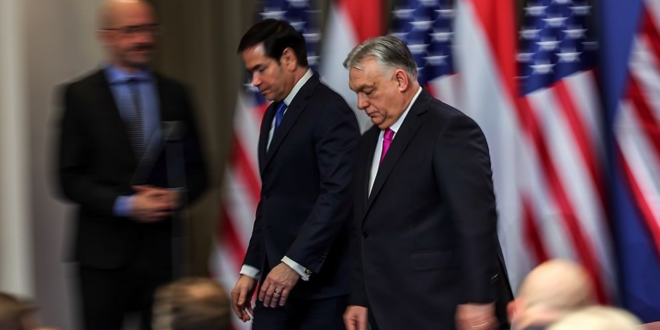
After delivering a pro-imperialist speech in Munich earlier this month that mentioned Ukraine just once, US Secretary of State Marco Rubio flew to Budapest to meet Hungary’s pro-Moscow leader, Viktor Orbán – without setting foot in Brussels.
Standing alongside the Hungarian autocrat, Rubio hailed the Central European country as “essential and vital for our national interests” – and failed to mention Ukraine at all.
This unwavering support from Washington likely explains why, just hours after Friday’s Supreme Court decision, Hungarian Foreign Minister Péter Szijjártó felt emboldened enough to announce the political and economic equivalent of a nuclear bomb.
Hungary, Szijjártó said, would veto a €90 billion EU loan to Ukraine that the bloc’s leaders, including Orbán himself, had agreed to last December, unless Kyiv resumes transporting oil through the Druzhba pipeline – which, in a painful irony, Russia itself had recently damaged.
On Sunday, Szijjártó announced that Hungary would also block the EU’s 20th sanctions package on Russia, which Brussels had been racing to finalise ahead of the fourth anniversary of Russia’s full-scale invasion on Tuesday.
The moves mark an unprecedented escalation of the long-simmering diplomatic spat between Kyiv and Budapest. Orbán, whose Fidesz party is trailing by roughly 10 percentage points ahead of parliamentary elections on 12 April, has repeatedly accused Ukraine – without evidence – of supporting the opposition Tisza Party, led by Péter Magyar.
Orbán has always backed down from previous threats to block sanction packages. But he has never vetoed EU policy after explicitly promising not to do so – suggesting that, this time, he may not be bluffing.
Budapest’s threat to withhold financial support for Ukraine also comes at an critical moment. The war-torn country is set to run out of money in April and has been pounded by fierce Russian attacks on its civilian infrastructure this winter, leaving many Ukrainians without heating in freezing conditions.
Tellingly, Robert Fico, Slovakia’s Moscow-friendly leader, also pledged to slash emergency electricity supplies to Ukraine for similar reasons on Saturday – less than a week after Rubio, in a visit to Bratislava squeezed between his trips to Munich and Budapest, hailed the “extraordinary opportunity for cooperation and partnership” between Slovakia and the US.
Groundhog day
Some EU policymakers, however, have expressed frustration with Brussels’ strategy vis-à-vis Washington in recent days.
The European Parliament, for instance, said on Sunday it would suspend the EU-US trade deal until there is “clarity and legal certainty” over how the US’s 15% blanket levy on EU goods will ultimately be applied. France, America’s perennial European frenemy, has even threatened to fire the bloc’s much-vaunted “trade bazooka” at Washington.
Recent history, however, suggests that this tough talk is unlikely to translate into action.
After Trump dropped his threat to invade Greenland last month, many MEPs similarly refused to ratify the deal until there was “clarity” on the Arctic island’s future. Days later, they backed down – and no clarity was ever offered.
Meanwhile, France’s call to fire the bazooka – officially known as the “Anti-Coercion Instrument,” which would theoretically allow the EU to sanction US tech giants – in response to Trump’s annexation threats last month was met with fierce resistance by many capitals and, crucially, from the Commission, which oversees EU trade policy.
Indeed, it is likely that the EU’s policy toward the US, and its trade deal, will simply revert to the status quo in the coming weeks.
Trump has already hiked global tariffs to 15%, the same duty faced by most EU exports under the Turnberry Deal, which he is allowed to impose for 150 days under Section 122 of the US Trade Act.
At a press conference on Friday, Trump also pledged to introduce further duties through alternative legal mechanisms, including Section 232 (on national security grounds) and Section 301 (to combat “unfair” trade practices).
“In the end, the outcome probably won’t be any better for the EU,” said Varg Folkman, an analyst at the European Policy Centre.
Nor, for that matter, is it likely to be better for Ukraine.