 Eurasia Press & News
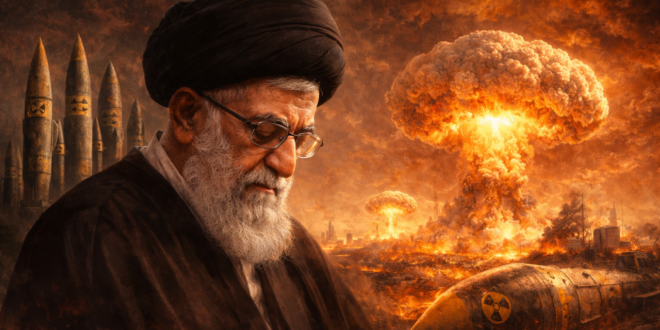
The death of Iran’s Supreme Leader Ayatollah Ali Khamenei on February 28, 2026, may significantly impact the country’s stance on weapons of mass destruction (WMDs).
Iran’s Supreme Leader Ayatollah Ali Khamenei was killed on February 28, 2026, in a joint US -Israeli airstrike targeting his compound in Tehran. Iranian state media confirmed the death early on March 1, announcing 40 days of national mourning. US President Donald Trump declared the strikes part of a broader operation to eliminate threats from Iran’s nuclear and missile programs, with bombing set to continue as needed.
Khamenei, who ruled since 1989, issued a religious fatwa in the mid-1990s—publicly reaffirmed around 2003—declaring the production, stockpiling, and use of nuclear weapons (and weapons of mass destruction more broadly) as haram, or forbidden under Islamic law. This edict served as a key public justification for Iran’s insistence that its nuclear activities were peaceful, even as uranium enrichment advanced to levels raising international alarms.
The fatwa was a personal religious ruling from the Supreme Leader, not an unchangeable tenet of Shia Islam. Fatwas can be reinterpreted or set aside by successors, especially in existential crises. Historical examples include shifts under Ayatollah Khomeini. In recent years, IRGC commanders reportedly pressed Khamenei to rescind it amid escalating threats. With his death amid active military strikes, the fatwa’s practical authority has effectively ended—no living issuer enforces it, and hardline elements may now push to discard it entirely.
Succession remains unclear. Power struggles could favor IRGC hardliners who have long viewed nuclear capability as essential for regime survival, drawing parallels to North Korea’s deterrent model.
Credible Reports on Iran’s WMD Holdings
Iran denies possessing weapons of mass destruction, but assessments from intelligence agencies, think tanks, and international bodies indicate serious capabilities or near-capabilities across nuclear, chemical, and related domains.
Nuclear Program
Iran has no confirmed operational nuclear weapons, but its enriched uranium stockpile has long been a concern. Before the June 2025 Israeli-US strikes damaged key sites like Natanz and Fordow, the IAEA reported Iran holding uranium enriched to 60% purity—enough material, if further processed to 90%, for multiple weapons. A February 2026 IAEA report noted about 440 kg of 60% enriched uranium, stored underground at Isfahan and unaccounted for post-strikes. Experts assess Iran could produce weapons-grade material quickly in covert facilities, though full weaponization would take longer. Recent attacks targeted reconstitution efforts, but underground rebuilding and lost IAEA monitoring raise breakout risks. US intelligence in 2025 estimated years away from long-range delivery systems like ICBMs (potentially by 2035), but medium-range missiles remain viable for regional threats.
Chemical Weapons
Multiple sources accuse Iran of maintaining a covert chemical weapons program despite joining the 1997 Chemical Weapons Convention. A February 2025 Foundation for Defense of Democracies report detailed evolution from Iran-Iraq War-era agents to modern pharmaceutical-based agents (like weaponized fentanyl derivatives) affecting the central nervous system. Israel claimed strikes in June 2025 destroyed the Shahid Meisami Research Complex, linked to this work. Allegations include possible use of chemical-laced agents against protesters during the December 2025–January 2026 uprising, causing severe symptoms inconsistent with standard tear gas. The US , Israel, and OPCW have called for probes into these claims and Iran’s alleged transfers to proxies in Syria and elsewhere. US Treasury actions in 2026 targeted networks supplying precursors for ballistic missiles and advanced conventional weapons, overlapping with chemical concerns.
Biological Weapons
Evidence is thinner, with no confirmed active stockpiles. Dual-use facilities and research opacity fuel suspicions of potential capability, but public reports focus more on nuclear and chemical threats.
Iran Resort to WMD Use?
Khamenei’s death removes the primary ideological restraint against WMD pursuit or use. Iran’s missile forces, though degraded (hundreds destroyed in 2025–2026 strikes), retain regional delivery options against Israel or US bases. Proxies like Hezbollah could complicate escalation.
According to live coverage by BBC News, Iran’s Islamic Revolutionary Guard Corps (IRGC) issued a sharply worded statement following the confirmed killing of Supreme Leader Ayatollah Ali Khamenei in recent US-Israeli airstrikes, warning that “the most devastating offensive operation in the history of the Islamic Republic of Iran’s armed forces” would begin “in just moments,” targeting what it called the “occupied territories” (Israel) and American bases in the region.
The Times of Israel similarly reported that the IRGC vowed the “most ferocious offensive operation in history” against Israel and US installations, noting slight variations in translation from the original Persian but confirming the core threat. Both outlets described the declaration as part of rapidly escalating rhetoric, while also noting that, as of their latest updates, there had been no independent confirmation of a full-scale offensive being launched immediately beyond ongoing retaliatory strikes.
Regime survival remains paramount—WMD deployment would likely trigger overwhelming retaliation. Yet chaos from leadership vacuum, domestic unrest (tens of thousands killed in recent crackdowns), and economic strain could push desperate measures. Hardliners may see nuclear breakout or chemical options as deterrents against further regime-change efforts.
The strikes aimed to forestall threats but may accelerate radicalization. Without diplomacy or restored monitoring, the path to WMD use grows more plausible in this volatile moment. The region—and world—now faces heightened uncertainty as Iran’s future leadership decides its course.