 Eurasia Press & News
The joint Israeli-American military operation against Iranian targets is in its early stages, but it comes in a context related to the developments of the war in the Gaza Strip, in light of the unprecedented escalation of tension between Israel and Iran since they exchanged direct attacks in April 2024 after the targeting of the Iranian consulate building in Syria, and then the scene worsened in October of the same year after the assassination of Hassan Nasrallah. In June 2025, Israel expanded its operations by launching a military operation targeting Iranian capabilities, followed by the United States carrying out Operation Midnight Hammer on June 22, 2025, which targeted three major nuclear facilities: Fordow, Natanz, and Isfahan.
On مسارها الثالثthe morning of February 28, 2026, the two countries launched a joint military campaign against a number of Iranian military and leadership targets, in an attack expected to constitute the start of a large-scale air campaign aimed mainly at weakening the Iranian regime and undermining its capabilities, and perhaps changing its approach and its strict political and religious reference. The attacks come after the two countries held two rounds of “semi-direct” talks, the first in Oman on February 6, and the second on February 26 and held in Switzerland with Omani participation. In fact, the launch of joint military operations against Iran raises several questions about its duration, duration, final objectives and the day after its cessation, which puts the Middle East and the world in front of a set of open and unpredictable scenarios that are clearly and accurately unpredictable, as US President Donald Trump’s policy indicates the element of surprise and uncertainty.
Indicators of joint and simultaneous operations
Iran is facing joint and simultaneous US and Israeli attacks; military, cyber and intelligence complex levels and strategic depth, targeting, according to officials from the two countries, a number of targets in various Iranian cities, including the capital Tehran, Isfahan and Qom, and affected in its first waves military bases, air defense systems and prominent figures in the political and military fields, in addition to the headquarters of the Iranian leader Ali Khamenei. On the other hand, Tehran has launched revenge strikes with ballistic missiles and drones, targeting Israel and what it claims are American interests in many Gulf countries.
In practice, the joint military operation is still in its infancy, yet this operation comes in an integrated manner with the context of post-war developments in the Gaza Strip, since both Israel and Iran exchanged the first direct attacks in April 2024, and then in October of the same year, and its expansion on June 13, 2025, with Israel launching a military operation against Iranian capabilities, which ended with the United States carrying out Operation Midnight Hammer, which targeted on June 22, 2025, three central Iranian nuclear facilities, Fordow, Natanz, and Isfahan.
In fact, the joint military operation comes after the United States has strengthened five key levels in recent weeks, according to the following indicators:
المؤشر الأولOver the past few weeks, the United States has strengthened its extensive military presence for defensive and offensive purposes, the largest since the 2003 Iraq War, through the deployment of air defense systems, refueling aircraft, and military aircraft in a number of its bases in the region, as well as the deployment of two groups of aircraft carriers, namely: USS Abraham Lincoln, USS Theodore Roosevelt, and USS Gerald R. Ford) in the Eastern Mediterranean.
The second indicator: Obtaining the “legitimacy of implementation”, from the American point of view, the failure of the second negotiating framework, which began in 2026. Through which it wanted Iran to make substantial concessions in its nuclear program and its ballistic and missile programs, based on the operational and field results following the developments of the war in the Gaza Strip, Iran stuck to negotiate according to the pattern of mutual proposals and convergence of the views of the parties, a long-term approach confirmed by the United States categorical rejection of it.
The third indicator: The existence of a broad internal American consensus on the Iranian regime, especially with the US discourse in recent days to link the Iranian threat to American interests in the region, and even to the American territory, where it was estimated that Iran is close to acquiring missiles capable of reaching America.
It is assumed that the United States did not start the ongoing operations, without a clear knowledge of the next day, which is likely in part to create the rise of one current at the expense of another, and several indications have emerged during the past few days, including the management of negotiations with the United States with two references, the first is (Bizikshian-Araqchi) and who followed the strategy of moderate and warning of the repercussions of the continuation of the existing situation, and the second reference represented by (Khamenei-Larijani), who sought to adhere to the speech and narrative of Iranian power, and this is reinforced by the report of the newspaper “Le Figaro”, which referred to the attempt of former Iranian President Hassan Rouhani and former Foreign Minister Mohammad Javad Zarif in early January 2026, to move to remove Supreme Leader Ali Khamenei, with reference to the strong relationship between the current Foreign Minister Abbas Araqchi with both Rouhani and Zarif, where he gave the latter a direct role in giving the latter a direct role in the 2015 nuclear agreement, where he gave the latter a direct role in the 2015 nuclear agreement, where he gave a direct role to both the latter.
Contrary to this assumption, it is unclear how Trump and Netanyahu’s speeches, calling for the overthrow of the regime, can be translated without entering into a long-term ground battle for field control of the country’s main military, security, social, and economic joints, or perhaps by relying on the reaction of the street and the bet on its move by simply weakening the regime, an uncertain bet, in the absence of clear indications that opponents of the regime and demonstrators on the street are originally allies or supporters of the United States and Israel. This requires a close scrutiny before embarking on this military campaign, which the parties – Washington and Tel Aviv – can stop at any moment, but its repercussions will remain the next day.
Indicator 5: Decision-making, which was clearly agreed upon and determined during Israeli Prime Minister Benjamin Netanyahu’s visit to Washington on February 12.
Iranian readiness, response and escalation frameworks
For Iran, which certainly expected this attack and worked to strengthen its internal system as much as possible, and this time Tehran may see that the ongoing process poses an existential threat to the religious regime and the Shiite reference state, and in a way that requires a higher reaction in terms of pace and cost compared to what it was in previous combat cycles, and therefore developed a set of different plans for the scenarios of the US-Israeli attack and the strategy of response that it will adopt; where it bets on a coherent and interrelated set of the following factors:
The first factor: Iran sought to make the most of the experience of the 12-day war in June 2025, by working to prevent a leading vacuum or military and political vacancies, as it worked simultaneously and consistently to establish a chained leadership structure that would reach the MP and the fourth or fifth alternative to any potential leader who was assassinated.
The second factor: that Iran seeks as much as possible to preserve the life and centrality of the role of Supreme Leader Ali Khamenei, in the worst case, the protection of the guide can ensure the leadership of the post-war country in a manner similar to his role after the revolution in 1979, in addition to the fact that the survival of the guide closes the way for any internal political or military coup attempt, and takes away its legitimacy, even if it comes from within the existing political system and linked to the reformist currents. On the other hand, the United States and Israel appear to be trying to separate the guide from the operational context, create security difficulties and challenges over his direct oversight of the operations, and may seek to assassinate him as a key option to provide a more suitable environment for the substitutes.
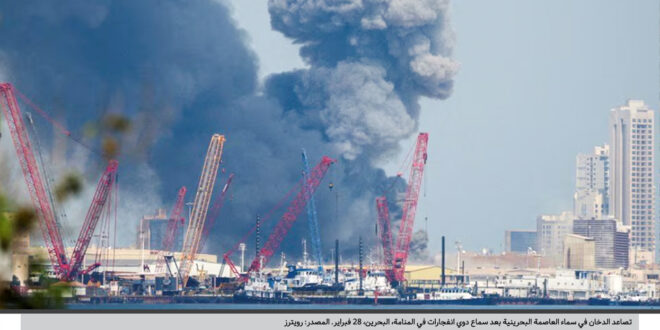
العامل الثالثThird factor: Iran is trying through its initial response to pressure on Washington from the gate of contradictory interests of its allies – Israel and the Gulf countries – especially as it moved from targeting infrastructure to civilian structures, as happened in the incident of the drone that was shot down over Kuwait airport, and reports of the fall of missiles in Manama and Doha capitals and other Gulf cities. In addition, the military operation cost both the United States and Israel, by targeting Israel’s population centers of gravity, and the vital economic interests of the United States across the region.
In addition, Iran is betting on flooding the entire region with missile and drone attacks, with the aim of exhausting the US air defenses deployed in more than one base, especially in light of reports that US air defense systems suffer from a lack of strategic stockpiles, which have been depleted in the war since the seventh of October, and before in Ukraine. Iran has already announced the targeting of 14 U.S. military bases in the region, indicating intensity of the launch on the first day of the war.
On the other hand, the United States and Israel are likely to work to achieve superiority and operational freedom in Iranian airspace, specifically Washington, where it has the ability to keep its aircraft over Iran based on the large reinforcements of refueling aircraft, which leads to attacking Iranian missile sources and platforms before launching them, in addition to expecting Iran’s rapid stockpile of missiles, especially hypersonic, to decrease in the pace of their launch in the coming days. On the other hand, Iran is currently moving within pre-prepared plans, and with the continuous change in the operational environment and increasing its complexity over time, and in light of the constant targeting of Iranian leaders, this may complicate the Iranian response and move it from the category of thoughtful action to randomness.
Moreover, Iran’s targeting of the Gulf countries and Jordan, and even placing civilian structures in those countries on its list of targets with drone and missile attacks, may lead to a change in the position of the Arab and regional countries, which previously opposed any US and Israeli military operation against Iran, and the refusal of most of them to use their territory as a starting point for any attacks on them, by becoming part of the media and diplomatic campaign demanding the undermining of the Iranian regime’s capabilities as it has become a direct threat to its security and safety, and this in turn may deprive Iran of multilateral regional pressure to stop the war.
العامل الرابعIran is aware of the sensitivity and fragility of its surroundings in countries such as Pakistan and Afghanistan, which have been engaged in continuous clashes for days, in addition to the economic and political burdens in Iraq. The prolonged war is likely to lead to waves of migration and displacement to neighboring countries, which are already suffering from problems and challenges that may be exacerbated in light of the chaos or unrest in Iran, which increases the repercussions of US and Israeli military operations, and raises their cost in one of the most sensitive regions around the world.
The operation from an American and Israeli point of view
U.S. and Israeli officials see Iran as an already organized country, designed to systematically change its leaders. However, replacing a boss who was killed in a helicopter crash is in no way like the exclusion of most senior officials, and certainly not like the removal of the supreme leader during the war. No conclusions should be drawn according to the incident of former Iranian President Ibrahim Raisi; everything depends on the Iranian people and their behavior.
On the issue of missiles, they believe that their number, impact and strength are lower than what Iran describes. It is true that, in the context of a regional war, it is launched on every American point in the region and on Israel, but the technical capacity to object is stronger. They are unable to cause serious damage.
The negotiating track between the United States and Iran. He was stalled from the start because U.S. demands for coordination with Israel were far from what the Iranians agreed to offer. Israeli Prime Minister Benjamin Netanyahu convinced U.S. President Donald Trump that war alone would narrow the gaps and possibly change the regime. So the big gaps were thought out, not what Iran was offering. The technical meeting next Wednesday is even misleading, and on the other hand, an opportunity to resume talks under intense pressure, as they did with Hamas in Gaza.
But it cannot be ignored that this war is regional; it is far from all-out war. Iran’s capabilities are not at the level of U.S. and Israeli capabilities, except that it has the capability to launch missiles as a concept.
There are those who believe that the main issue will be reflected in two central questions, and the answer to them will affect the question that worries the US president and the leaders of the region the most, which is: We have made a good start, but how will things end? The two issues are:
The impact of the war on oil prices and on the global economy in general.
- The behavior of the street in Iran and the chances of possible regime change, as there is a perception that the Iranian regime will not fall easily despite the killing of its leaders.
The continuation of the joint process will harm Western economies, especially the United States. Under these circumstances, a favorite scenario is expected for Washington to end this process within a week, perhaps a little longer, and until then, fears in Israel of further involvement in the process will not stop.
Contexts and objectives of the joint military operation
It cannot be said that the context of the objectives of the joint military operation is unclear or announced; this operation comes in two contexts of high interdependence and overlap, namely:
The first context: The process is a conceptual continuation of the war against the strategy of “unity of the squares”, which Israel began to implement after Hamas attacks against the bases and settlements of the Gaza Strip on October 7, 2023. That means that the course of military operations against Iran since June 2025 is aimed at fundamentally changing the risks and threats associated with Iran, both those related to the regime itself, and its ability to continue to support and regroup its proxies in the region. This sets out the objectives of the ongoing operation in the same manner as the objectives of the military operations in both the Gaza Strip and Lebanon, where it continues to carry out its strikes with the aim of ending any capabilities of Hamas and Lebanese Hezbollah, including strikes against their military assets and senior leaders of the two organizations.
On the other hand, it seems clear that there is an American and Israeli awareness that a complete end to the proxy Iranian parties in the Gaza Strip, Lebanon, Yemen and Iraq is not possible without a decisive blow to the Iranian regime supporting those parties. This not only means cutting off the military and ideological supply of agents, but also giving them space to assess their situation and make their concessions without Iranian pressure that has prevented them from doing so until the moment. The indications of this are the link between the current targeting of Iran and the unity of the squares, and the simultaneous attacks on both the Lebanese Hezbollah and the Popular Mobilization Forces in Iraq, where the strikes targeted its main leadership in the Iraqi capital Baghdad.
The second context: The operation, in operational terms, is a continuation of the military tracks initiated by Israel in June 2025, Operation Rising Assad, which targeted Iranian military commanders, nuclear scientists, and Iranian defensive and offensive capabilities. Which stopped after 13 days, with the United States striking and possibly ending, as the U.S. statements indicate, Iran’s nuclear program. This path indicates that the current attacks may not only set limited targets against certain capabilities, but also come in the context of the complete and systematic destruction of Iran’s military capabilities, whether offensive or defensive, especially missile, ballistic and naval, and this means weakening the regime and creating a strategic vacuum by assassinating its senior leaders and theorists, which may in the future undermine the regime’s ability to withstand, especially in light of the protest movement in the street and continuing since late 2025.
Scenarios of the joint military operation
Joint military operations enter their first day amid questions and a state of uncertainty and ambiguity about their fate, objectives and duration, which puts them in a set of scenarios as follows:
The first scenario: a military operation with a limited time limit
It is possible that the ongoing operation will last for a few days and perhaps a few weeks, and in light of this scenario, military operations of limited duration, means that they are narrow targets, and their objectives may revolve around one of the following points:
أولاًFirst: Undermining the capabilities of the Iranian regime, especially the long-range missile, and preventing it from practicing any deterrent or implementation of any response. Although Iran has been active during the first day in carrying out counter-strikes targeting various countries in the region, it is expected that its capabilities and extensive activity in directing missiles and drones will begin to decline gradually in the coming days, and direct them to nearby targets in the Gulf Cooperation Council countries. This increases pressure on Washington because of the damage to its allies.
ثانياًSecond: A gradual military operation, so that each round will be over a day to two days, with pauses to re-evaluate and determine the damage of the battle, according to a US official to CNN, therefore, may witness periods of escalation and another of calm, and the purpose of this is to synchronize military action with the negotiating track, especially since the Omani Foreign Minister, Badr Al-Busaidi, pre-empted the process with his statements indicating the possibilities and acceptable possibilities to reach an agreement, trying to inform the world and the Gulf Cooperation Council countries of the course of negotiations, and to emphasize that any military action is not incompatible with the course of the ongoing negotiations. Today, in a post on the “X” website, he said: “I am disappointed (shocked), negotiations have been once again undermined,” recalling the previous Israeli attack on Iran while negotiations between Tehran and Washington were underway in the Omani capital Muscat, adding that this does not serve the interests of the United States or the cause of world peace.
Scenario II: Open-ended and targeted military operation
The entry of the United States and Israel into a large-scale, targeted, military operation could mean that those objectives would be expanded beyond undermining certain military capabilities such as missile capabilities, and going towards a long-term process of overthrowing the regime and creating a strategic political and security vacuum in the regime’s system of governance led by the Supreme Leader and the Iranian Revolutionary Guards. This suggests that the military intervention may be consecutive or intermittent, and may be comprehensive or selective. However, the occurrence of a vacuum in the system of governance is unclear, especially since the Constitution defines measures that prevent a sovereign vacuum and the country has taken proactive measures by choosing the fifth and fourth deputy for each official, which indicates the difficulty of vacancy of any position without an alternative, which in practice means excluding this vacuum without an internal coup or a revolution that overthrows the entire system constitutionally and institutionally.
Scenario III: A specific, large-scale, multi-target military operation
It is highly likely that the ongoing military operation, multi-stage, multi-level and target, will undermine Iran’s capabilities and move to successive military operations to end the influence and capabilities of its proxies, both Iraqi armed factions, the Lebanese Hezbollah and perhaps the Houthis in Yemen. The statement by Democratic Majority Leader Chuck Schumer, after a briefing by the White House to congressional leaders and a House of Representatives, on the seriousness of the matter and the need to open up to the American people, may indicate that the ongoing military operations may be long-term and of high potential cost.
Scenario Four: Operational Stalemate and the Entry of War in the Sum Zero Phase
There is a possibility that the operations will not lead to any fundamental change in Iran, whether at the level of regime change or its approach, or push it to make negotiated concessions. In this case, both the United States and Israel risk producing a reality in which Iran is weak and threatened, but at the same time dangerous, where escalation or countering any act that it is estimated to pose an internal or external threat to become a recurring event in the Iranian approach, and may backfire the strength of the militants who will be quick to portray the situation as a victory in the war.