 Eurasia Press & News
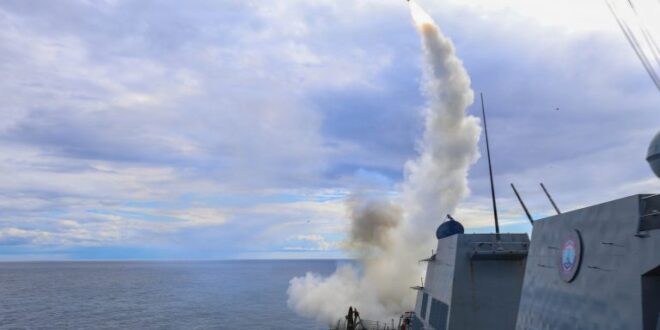
U.S. Central Command (CENTCOM) confirmed the first American fatalities in the conflict with Iran, reporting that three U.S. service members were killed and five others wounded in attacks on regional bases.
Despite the death of Supreme Leader Ayatollah Ali Khamenei, Iran’s rapid and coordinated escalation demonstrates that regime command and control remain firm.
Iran appears to be pursuing an asymmetric war of attrition focused on exhausting U.S., Israeli, and allied defensive resources.
Iran’s attack near the Strait of Hormuz adds an economic dimension to the conflict by threatening maritime traffic and energy supply chains, effectively bringing oil markets, shipping insurance, and global trade routes into the conflict.
A day after the death of Iran’s Supreme Leader, Ayatollah Ali Khamenei, Tehran appears to have substantially escalated its response, demonstrating the continued ability to maintain operational command and control across its military assets. Despite the leadership shock, Iran seems to be expanding its military operations, reportedly deploying for the first time the advanced hypersonic missile Fattah-2 while continuing strikes on U.S. military bases in the region. Iran also launched another barrage of missiles toward targets in Israel. In addition, Iranian forces attacked the Skylight, an oil carrier sailing near the Strait of Hormuz. The commercial vessel sustained severe damage and is reportedly beginning to sink. This marks a notable development with significant consequences for maritime security and global energy markets.
Contrary to expectations that the Supreme Leader’s death might trigger immediate paralysis, the Iranian regime appears to still remain in control. Compared to previous responses, the scale and coordination of recent retaliatory attacks suggest the system and institutions remain firm rather than disrupted. Iran’s president declared retaliation for the killing of its Supreme Leader is not only a legitimate right, but a sacred national duty. Iranian leaders have described the assassination of Khamenei as a “declaration of war” against the nation and Muslims at large. Iran’s foreign minister stated that the Supreme Leader was a spiritual symbol for millions of Muslims worldwide — framing his death as an event also with civilizational and ideological implications. Since Khamenei’s death, anti-American protestors gathered outside the U.S. Consulate of Karachi, Pakistan, where clashes with police left at least 22 people dead and more than 120 injured. At the same time, Iraqi police targeted pro-Iranian protestors outside the Green Zone in the capital Baghdad, where the U.S. Embassy is located.
U.S.-Israeli strikes have continued to hit a range of Iranian military and defense-industrial targets, including missile production and storage facilities. The U.S. military announced on Sunday it had “cut off the head of the snake,” with the destruction of the Revolutionary Guard’s headquarters. However, the focus of the continued military operation appeared to have shifted today with a more deliberate targeting of police stations and infrastructure linked to the Basij — the paramilitary force operating under the Islamic Revolutionary Guard Corps (IRGC). The Basij is responsible for internal security, and its mandate is primarily domestic. Unlike conventional military assets, the Basij represents the regime’s domestic enforcement arm through which it manages protests, suppresses dissent, and maintains social control. Striking Basij-linked facilities suggests an effort not solely aimed at degrading Iran’s external military capabilities but also diminish the regime’s ability to exert domestic control. This aligns with a broader “regime-change” goal, as stated yesterday by President Trump and Prime Minister Netanyahu. At the same time, U.S. Central Command (CENTCOM) announced the first confirmed American fatalities of the conflict: three U.S. service members killed and five wounded in an attack on the U.S. military base in Kuwait.
Iran, however, appears to be employing a different strategy. Tehran understands that it cannot defeat Israel or the United States in a conventional, high-intensity war. Instead, the regime seems to be deploying an asymmetric and attritional response designed not for decisive battlefield victory, but rather endurance and survival. Analyzing the pattern of Iranian counterattacks suggests a layered operational approach designed to generate pressure on Gulf states, create regional disruption on land, sea, and air, while simultaneously attempting to exhaust U.S. and allied defensive resources. By targeting airports, ports, and infrastructure across the Gulf region, Tehran appears intent on achieving several objectives simultaneously.
First, by striking Gulf states, Iran is attempting to force the governments in the region to bear the costs of hosting U.S. personnel and military bases, signaling that any form of alignment with Washington carries real security and economic consequences for countries in the region. Despite several Gulf states opposing the U.S. and Israeli strikes and refusing to allow their territories and airspace to be used as launch platforms, Iran’s actions suggest it is willing to test, and potentially strain, those relationships. With this, Tehran may hope to deter deeper Gulf involvement in the military conflict, even if it carries the risk of alienating nations that have so far opted to not directly participate and have been active mediators.
Second, the sustained use of drones and lower-cost munitions is likely a tactical attempt by Tehran to deplete interceptor stockpiles and force the U.S. and allied countries to utilize expensive defensive munition in response to relatively inexpensive Iranian offensive weapons.
A war of attrition that exhausts missile defense inventories is the most beneficial outcome for Tehran. Iran knows this is a war it cannot “win” militarily, but the regime in Tehran may believe they can survive it. Survival would mean halting U.S. and Israeli sustained strikes. To achieve that, Iran likely believes it must raise the economic, operational, and political costs for Israel and the United States, and importantly, its regional Gulf allies. Operationally, there are questions about munition and interceptor stockpiles.
Reports suggest U.S. and Israeli munitions inventories are not unlimited and during the previous confrontation, Israel reportedly pressed Washington for a ceasefire amid concerns about ammunition sustainability. Whether current stockpiles can sustain prolonged high-tempo defense operations is a critical variable for how the conflict will develop.
Israel is already experiencing the cost of conflict with airport closures, suspended commercial flights, and broader disruption to civilian life. Iran-launched ballistic missiles struck near a shelter in the Beit Shemesh area in central Israel today, reportedly penetrating through a local protected shelter rather than exploding outside. Israeli authorities said the impact killed nine people and wounded at least 20, including children. If Iran’s objective is to inflict sustained psychological and economic pressure on Israel, this type of strike fits within the asymmetrical framework.
Third, targeting transport hubs, including airports and seaports, has significant implications. By disrupting hubs that are perceived by Tehran as part of a support network for U.S. logistics — whether through direct strikes or heightened risk perceptions — the movement of American assets, personnel, and materiel across the theater could become more complicated. Even temporary closures or insurance spikes can slow U.S. operational tempo. In addition, the reported targeting of major commercial ports such as Duqm in Oman and Jebel Ali in the UAE, both located near the Strait of Hormuz, adds an economic dimension to Iran’s approach. In fact, striking Duqm represents a notable escalation, especially as Oman played a mediating role for the negotiations and was initially spared during the first wave of retaliation. Expanding the battlespace to include these types of locations signals that Tehran may now be broadening its pressure campaign beyond immediate military targets to reshape the wider regional economic, energy, and supply-chain environment.
Tehran appears to be fighting a war of endurance: prolong the conflict, expand the economic battlefield, make the costs increasingly prohibitive, ration advanced capabilities, and impose steady human and financial costs on its adversaries. All with the hope that political tolerance erodes faster in Jerusalem and Washington than in Tehran.