 Eurasia Press & News
No reports of injuries or damage in Israel; terror group says attacks are ‘revenge’ for Khamenei’s killing; Lebanese PM condemns ‘irresponsible act’; IDF says Hezbollah ‘destroying Lebanon’
Rockets and drones launched from Lebanon set sirens blaring across northern Israel in the early hours of Monday, as the Hezbollah terror group entered the fray to assist its backer, Iran, with its relentless attacks against the Jewish state.
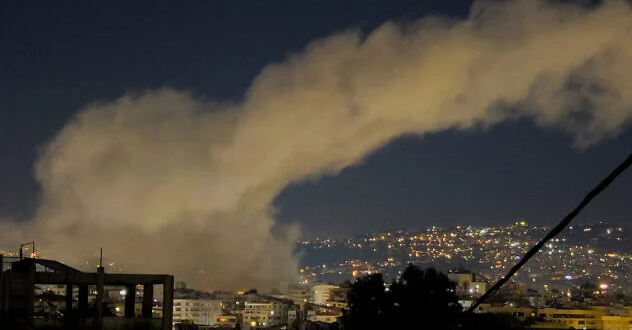
The terror group’s attacks — which it said were in retaliation for the killing of Iranian Supreme Leader Ali Khamenei in the opening minutes of the joint Israeli-US assault on Iran on Saturday — were met with an immediate response from Israel, with waves of airstrikes across Lebanon, including multiple strikes in the capital, Beirut, and the Dahiyeh suburb, a Hezbollah stronghold.
The IDF charged that Hezbollah, having initiated conflict when warned by Israel and implored by the Beirut government not to do so, was “destroying the state of Lebanon.”
Sirens were activated in the northern city of Haifa and surrounding areas shortly after 1 a.m., and the Israel Defense Forces confirmed not long after that the source of the rocket fire that set off the alarms was not Iran, but Lebanon. It then stated that Hezbollah was behind the attack, and Hezbollah acknowledged responsibility soon after.
The military said that one rocket was intercepted by air defenses, and at least two others were allowed to fall in open areas.
Alerts warning of a drone attack also sounded in the Upper Galilee shortly after, with air defenses shooting down at least two suspected drones, according to military sources.
At least three more rockets launched from Lebanon struck open areas in northern Israel at around 3 a.m., without setting off sirens, “according to protocol,” the military said.
There were no reports of injuries or damage as a result of the attacks.
Hezbollah, in a statement claiming responsibility for launching “a barrage of precision missiles and a swarm of drones,” said it attacked as “revenge for the blood of the Supreme Leader of the Muslims, Ali Khamenei.”
The terror group claimed that it had targeted a missile defense site south of Haifa.
The attack came hours after Hezbollah chief Naim Qassem vowed that his group would confront Israel and the US over their strikes on Iran, despite the Lebanese government’s plea for it to remain on the sidelines as it had done during the previous 12-day war between Israel and Iran in June 2025.
But the request fell on deaf ears as Hezbollah moved ahead with its attack, marking the first time that the Iranian proxy had fired at Israel since the US-brokered ceasefire between Israel and Lebanon came into effect in November 2024.
The attack, Hezbollah suggested, should constitute a “warning” to Israel to “withdraw from occupied Lebanese territory” — the five border posts Israel has held on to in Lebanon, citing security concerns, despite being required to withdraw under the 2024 ceasefire.
In response to the rocket fire, IDF Chief of Staff Lt. Gen. Eyal Zamir said the military launched an “offensive campaign” against Hezbollah that would likely last several days.
“We have begun an offensive campaign against Hezbollah. We are not just on the defense, now we go on the offense,” he said during an assessment following Hezbollah’s rocket and drone attacks on Israel.
“We need to prepare for several days of fighting, many. We need strong defensive readiness and continuous offensive preparedness, in waves,” he said.
The IDF confirmed that it had begun striking Hezbollah targets across Lebanon, saying that it would “not allow the organization to pose a threat to the State of Israel and harm the residents of the north.”
Alluding to the Lebanese government’s fear that Hezbollah would drag the country back into open hostilities, the IDF said the terror group was “destroying the state of Lebanon.”
“Responsibility for the escalation lies with it,” the military said.
IDF targets Hezbollah in Beirut, issues evacuation warnings in southern villages
According to the IDF, dozens of strikes in Beirut and in southern Lebanon hit Hezbollah headquarters and infrastructure, as well as a vehicle carrying two operatives from the terror group’s elite Radwan Force in the Kfar Dajjal area.
In Lebanon’s capital, the military said it had targeted “senior” members of the terror group in a strike, without immediately providing further details.
“We prepared for a multi-front scenario and for an offensive campaign against Hezbollah. Any enemy that threatens our security will pay a heavy price; we will not allow harm to the residents of the State of Israel or to the northern border,” Zamir said in remarks published by the military.
The IDF also issued evacuation warnings for Lebanese civilians in dozens of villages in southern Lebanon, where Hezbollah is believed to be present. “For your safety, you must evacuate your homes immediately and move at least 1,000 meters away from the villages to open areas,” said Lt. Col. Ella Waweya, the IDF’s Arabic-language spokeswoman.
More than a dozen explosions rocked Beirut, witnesses said, in the most intensive strikes on the southern suburbs since the war between Israel and Hezbollah in 2024. Lebanese security sources said airstrikes hit several areas of the southern suburbs of Beirut, known as Dahiyeh, a Hezbollah stronghold.
People fled on foot and by car, clogging the roads, after the series of strikes began around 2:40 a.m.
Beirut schools and shelters were reportedly being opened to accommodate a large exodus of people from Hezbollah strongholds in Lebanon’s south and east.
The Lebanese health ministry could not immediately be reached for a casualty toll.
Lebanon’s PM denounces rocket fire
As the airstrikes shook Beirut, Lebanon’s Prime Minister Nawaf Salam sharply rebuked the perpetrators of the rocket fire, but avoided directly calling out Hezbollah by name.
“Regardless of who is behind it, the rocket fire from southern Lebanon is an irresponsible and suspicious act that endangers Lebanon’s security and safety and gives Israel pretexts to continue its attacks on it,” Salam said on X.
“We won’t let the country be dragged into new adventures, and we’ll take any necessary action to prosecute those responsible and protect the Lebanese,” he said.
It was the latest effort by Lebanon’s leadership to assert its authority over Hezbollah, which it has been trying to disarm ever since the start of its ceasefire with Israel.
On Saturday, upon the start of Israel and the US’s operations in Iran and the subsequent retaliatory fire from Tehran, Salam had warned that Lebanon refused to be dragged into war.
And after Hezbollah vowed regardless on Sunday to take action against Israel and the US, Lebanon’s President Joseph Aoun reiterated that “the decision of war and peace rests solely with the Lebanese state.”
Arabic media reported that Salam has called for an emergency meeting of the Lebanese government at 8 a.m. local time in light of the rocket attack.