 Eurasia Press & News
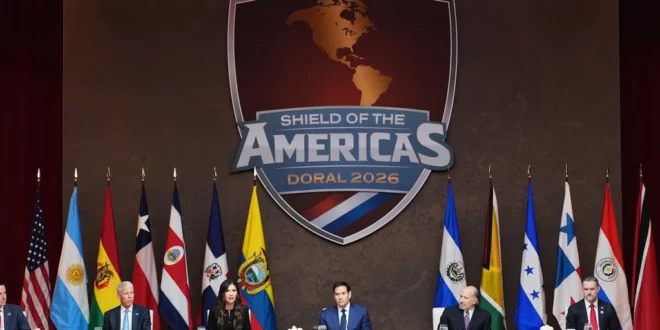
The March 7 Shield of the Americas Summit sent a message that matters: The Western Hemisphere is not a recurring crisis to “manage” and then move on.
Rather, the Americas are central to U.S. foreign policy and will increasingly continue to determine U.S. leverage globally and shape domestic stability. Kristi Noem, the new special envoy for the Shield of the Americas, followed up this week with travel to Honduras, Costa Rica, Guyana, Ecuador, and the Dominican Republic, a sign that Washington is now testing what this approach looks like in practice.
That is, after all, the hard part: building and sustaining momentum, to produce concrete outcomes.
The Florida gathering displayed the willingness of 13 countries to work together in the long-elusive goal of combatting cartels through stronger coordination. This hemispheric threat knows no borders and has only grown in complexity as governments have been outfoxed by criminal networks. But as with any new initiative, the real test comes after the initial convening. Noem’s meetings with counterparts to land more specific agreements begin to move the initiative toward implementation.
In Honduras, Noem met President Nasry Asfura and secured a commitment to deepen joint work against organized crime, including drug trafficking and technical assistance for the national police and military. Then, in Costa Rica, President Rodrigo Chaves and Noem announced a third-safe-country-type agreement, with U.S. financial support and additional assistance from the International Organization of Migration.
The good news is that the underlying logic of the Shield is not novel; the Shield brings necessary focus and a plan for implementation that can be tailored to different countries’ domestic political realities and institutional capacities.
The Shield concept closely tracks a diagnosis the Atlantic Council put on paper in 2024 in Redefining U.S. Strategy with Latin America and the Caribbean for a New Era. That strategy was built through a working group convened with former policymakers, private-sector leaders, and regional stakeholders precisely because the hemisphere’s strategic challenges are cross-border and increasingly technological. The core argument reads is that the U.S. does not get safer or more competitive by treating the hemisphere as a side project; it gets there by building a modern partnership that ties security to economic competitiveness and builds mechanisms capable of follow-through.
The Shield should lean into that connection. Secretary of State Marco Rubio framed it correctly when he called the initiative “a top priority” and linked it directly to trade, commerce, energy, and Treasury. In his words, “you can’t have economic progress without security.” The Shield has also been framed by the administration around sovereignty and cooperation, with cyber cooperation as an area where the U.S. can embed expertise and scale support.
Importantly, this agenda is also coherent with the 2025 National Security Strategy, which re-centers the Western Hemisphere with the organizing concept of “enlist and expand.” That is, enlist partners to control migration, stop drug flows, and strengthen security; expand by cultivating new partners and protecting strategic assets from hostile foreign influence.
The question now is how to adopt the kind of integrated, partner-forward implementation mechanisms for follow-through, and how to track whether objectives are being met.
There are three lines of effort that could change incentives and debilitate cartels. First, make illicit finance the center of gravity. This means stronger anti-money laundering enforcement, faster cross-border financial intelligence, and joint investigations that can keep up with shell structures and front companies.
Second, treat technology as the shared operating system. Criminal networks operate at lightning speed; governments often do not. Closing that gap requires cyber response capabilities that can be activated regionally, baseline security standards for critical infrastructure, and secure information-sharing that survives elections and changes in government. The administration’s emphasis on embedding cyber expertise with partners is the kind of practical cooperation that can scale.
Third, make the hemispheric trade system resilient. Near-shoring can be a geopolitical opportunity, but it becomes a vulnerability if ports and customs are easy to penetrate. A Shield worth defending links security cooperation to competitiveness: modern customs, container targeting, secure logistics corridors, and transparent procurement. Security and prosperity must advance together.
This is how the Shield needs to operate. The penetration of criminal networks and illicit economies goes beyond so-called “usual suspect” countries. It is also embedded in the infrastructure that makes trafficking scalable: ports, container flows, maritime corridors, free trade zones, and customs systems.
Costa Rica is a case in point. Long regarded as the most stable democracy in the hemisphere, it is now a warning that stability does not immunize a country from becoming a criminal logistics hub. In January 2026, the U.S. Treasury described Costa Rica as a “key global cocaine transshipment point,” noting that networks transport multi-ton quantities of cocaine from Colombia, store the drugs in Costa Rica and shipp them onward to the U.S. and Europe. This is precisely the kind of transit-node reality a hemispheric strategy must confront: The battle increasingly centers on ports, corruption risk and supply chain penetration.
For the Shield to be durable across Latin America and the Caribbean, it needs to be partner-designed and nimble. Success should be measurable, but not through traditional seizure counts or travel to the region. Instead, partners should demonstrate network disruptions, reduced container contamination rates at priority ports, faster cyber incident response, and, perhaps most challenging of all, real interoperability in financial investigations. Success will also depend on working closely with countries not present in Miami this month. Hemispheric momentum will require Mexico and Colombia to be part of the solution.
Old problems that have had few solutions will not be fixed in mere months. It will take consistent, hard work with setbacks expected along the way. Success needs to be tackled with new tools, shared capacity, and follow-through. If the Shield of the Americas becomes that, and remains partner-driven, with U.S. technical and financial resources to back it up, it may well prove to be a significant example of what Washington’s hemispheric foreign policy pivot can achieve.